
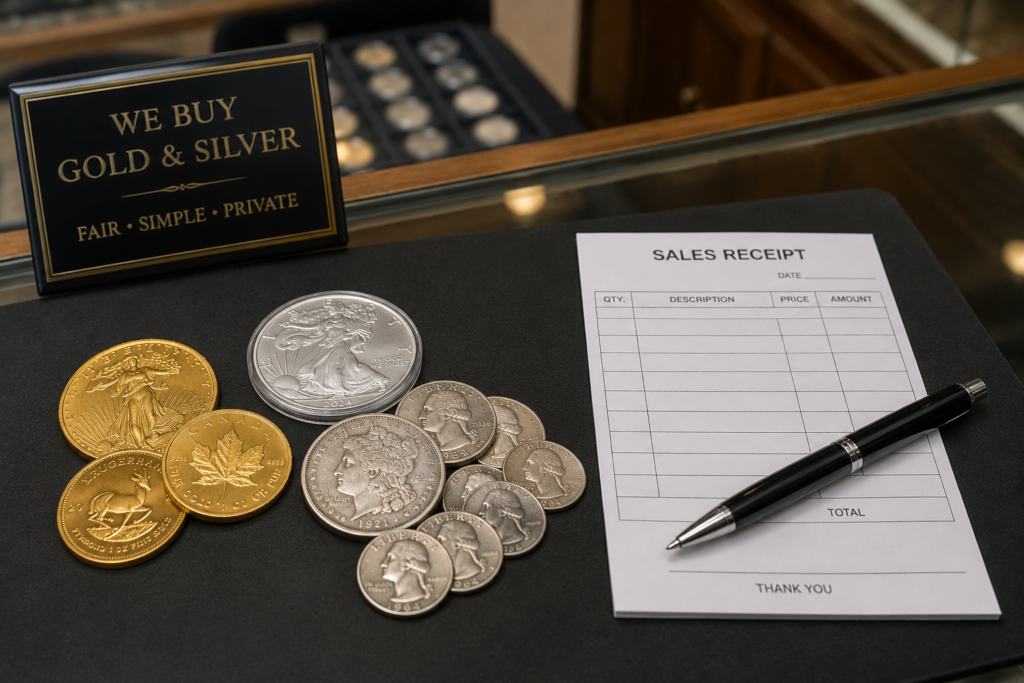
Can you sell gold anonymously? Sort of. You can often sell without a dealer filing a federal form, but “anonymous” and “tax-free” are two different claims, and only the first is ever partly true. The rest of this article keeps them apart: who else sees the sale, what actually gets reported, and what you owe no matter what.
This is general information, not tax or legal advice. The rules below cover federal treatment, and state and local rules vary, so talk to a CPA or a tax attorney before a sale of any size.
The Short Answer: Private, Sometimes; Tax-Free, Never
A sale can be private in the everyday sense. Many below-threshold cash sales to a local coin shop don’t generate any federal form, and nobody mails a copy to the IRS. If that’s what you mean by anonymous, it’s often achievable and perfectly legal.
What privacy at the counter never changes is what you owe. Every sale at a profit is reportable on your own tax return, whether or not a dealer, bank, or payment app files anything. The two ideas people run together, “no form was filed” and “no tax is owed,” aren’t related: one is about who else sees the sale, the other is about your return.
Two Different Questions People Mix Up
Most of the confusion here comes from blending two separate questions. “Is the sale reported by someone else?” and “Do I owe tax on it?” have different answers, different triggers, and different consequences. Keeping them apart is the whole game.
Transaction privacy: does a third party record or report it?
Whether a dealer, bank, or payment processor files a form or logs your identity depends on three things: the channel, how you’re paid, and how much you sell. A small cash sale at a local shop can be genuinely low-visibility, while an online-dealer sale, a bank wire, or a large quantity leaves a clear trail. This is real privacy, but it’s limited, and it’s only about who else sees the transaction. The channel table further down breaks it down.
Tax obligation: do you owe on the gain regardless?
Your tax obligation runs independently of any third-party form. Sell physical metal for more than your cost basis, the amount you paid including premium, and the difference is a capital gain reported on Form 8949 and Schedule D. Physical metal is taxed as a collectible, so long-term gains face a maximum federal rate of 28%, and short-term gains are taxed at your ordinary rate.
No 1099-B in the mail doesn’t erase this; it just means the IRS didn’t get an automatic heads-up. Our capital gains guide covers the rate math.
What’s Reportable When You Sell
Two federal forms matter most when you’re the seller. Here’s the short version, with the full detail routed out.
| Form | Who files it | What triggers it | What it means for you |
|---|---|---|---|
| Form 1099-B | The dealer, on your sale | Specific products at set minimum quantities | The dealer reports the sale to the IRS |
| Form 8300 | The dealer, on cash received | A cash payment over $10,000 | Usually hits you as a buyer, not a seller |
Currency Transaction Reports and Form 1099-K can also come into play; our full guide to IRS reporting on metals sales maps all of them.
A dealer files a Form 1099-B only when you sell specific products in specific quantities, measured against futures-contract minimums: 1,000 troy ounces of silver bars or rounds, 25 Krugerrands or Maple Leafs, or $1,000 face value of pre-1965 90% coins, the junk silver bags.
American Gold Eagles, Silver Eagles, and Gold Buffalos aren’t reportable in any quantity. Our 1099-B guide has the full product list and the rule that stops you from splitting one order across a day to duck it.
Form 8300 points the other direction. It’s a cash-handling rule, not a metals rule, and it fires when a dealer receives more than $10,000 in cash for a purchase, so it’s far likelier to touch you as a buyer than as a seller. Privacy-minded sellers still ask about it, which is why it’s here.
What Isn’t Reportable, and What “Not Reportable” Really Means
Plenty of ordinary sales don’t trigger any third-party form at all. But “not reportable” is a narrow phrase worth pinning down first.
It means no third party sends the IRS an automatic form, nothing more. It doesn’t mean the sale is invisible, that the dealer keeps no record, or that the gain is off your return. The shop still logs the transaction, your bank still sees the deposit, and you still report the profit. With that understood, these situations typically generate no automatic form:
- Exempt products: American Gold Eagles, Silver Eagles, and Gold Buffalos sold in any quantity aren’t 1099-B reportable.
- Below-threshold quantities: Sales under the futures-contract amounts, like fewer than 25 Maple Leafs or under 1,000 ounces of silver bars.
- Non-cash payment: Personal checks, bank wires, and card payments aren’t “cash” for Form 8300.
- Small marketplace volume: Online sales below the federal 1099-K threshold of $20,000 and 200 transactions, though several states set lower ones.
- A sale at a loss: No gain means no tax and usually no form, though reporting the loss can still work in your favor.
How Private Is Each Way to Sell?
Where you sell shapes how visible the sale is more than anything else does. If your goal is the best price rather than privacy, our how to sell gold and how to sell silver guides cover the payout side; the table below covers the privacy side.
One caveat cuts across every row: many states and cities require precious-metals or secondhand dealers to record seller ID and report to local police, wholly separate from federal tax rules. So “no federal form” doesn’t mean “no ID at the counter.”
| Channel | ID usually required? | Recorded or reported? | Realistic privacy |
|---|---|---|---|
| Local coin shop | Sometimes, for larger sales | Shop records; state dealer logs in some states | Highest everyday privacy on small cash sales |
| National online dealer | Yes, always | Full account and shipping trail | Low; your identity is on file |
| Peer-to-peer / marketplace | Between the parties only | Payment-app records if paid through an app | High in person, lower through a platform |
| Pawn shop | Yes, by law in most states | State-mandated logs to law enforcement | Low |
| Auction / consignment | Yes | Identity recorded by the house | Low |
“Just Split It Up” Is a Crime, Not a Loophole
The one move to avoid is breaking a sale or a deposit into chunks that each land under $10,000 to stay beneath a reporting threshold. That’s called structuring, and under the Bank Secrecy Act (31 U.S.C. §5324) it’s a federal crime on its own, chargeable even when the sale is legitimate, and you fully intend to pay the tax. The offense is the evasion itself, not the source of the money.
Banks and dealers watch for the pattern and file suspicious-activity reports when they see it. The practical takeaway is simple: if a sale crosses a threshold, the right response is to let the form be filed and report the gain, not to slice the transaction into pieces.
The Honest Privacy Move: Clean Records, Not a Secret Sale
The thing that actually protects a private seller isn’t an untraceable sale, which either isn’t fully possible or isn’t legal. It’s a clean record. When you can show what each coin and bar cost and what it sold for, a form arriving in the mail is a formality you reconcile in minutes rather than a problem. Missing records are the real exposure: with no documented cost basis, the IRS treats your basis as zero and taxes the entire sale price.
That’s the argument for keeping records as you go instead of rebuilding them under pressure. Gold Silver Ledger keeps your holdings in one place with live cost basis set against current value, so you can search, filter, and tag what you own instead of digging through a shoebox of receipts. It captures the price and premium at purchase and records the disposition at sale, so your Form 8949 figures are ready whether or not any third-party form ever shows up.
Our cost basis guide goes deeper on why that number matters, and you can start your trial on our pricing page.
This article is educational and isn’t tax or legal advice. Structuring, state and local dealer-ID rules, multi-state marketplace thresholds, and IRA-held metals all turn on specifics this guide can’t cover, and structuring in particular carries criminal exposure, so talk to a qualified tax professional, and in some cases a tax attorney, before a sale of consequence.
If your metals sit in a self-directed IRA, our Gold IRA guide explains why those rules differ.
Frequently Asked Questions
Can I sell gold anonymously?
You can often sell gold without a dealer filing a federal form, but you can’t sell it tax-free or fully off the record. Small cash sales below the reporting thresholds stay private in the everyday sense, while large sales, wires, and online-dealer transactions leave a trail, and any gain is reportable on your return either way.
Can I sell silver without the sale being reported to the IRS?
Silver sales are reported to the IRS by the dealer only for specific products at specific quantities, such as 1,000 ounces of bars or $1,000 face value of 90% coins, so most ordinary sales generate no automatic form. That doesn’t remove your own duty to report any profit on your tax return.
Do I have to show ID to sell gold or silver?
Whether you show ID depends on the buyer and your state, not just federal law. Pawn shops and many coin dealers are required by state or local ordinance to record seller ID and report to police, while a small private cash sale may require none, so expect to show ID at most established buyers.
If no 1099-B is filed, do I still owe tax on the sale?
You owe tax on any gain whether or not a 1099-B is filed, because the form is only an information report to the IRS, not the thing that creates your obligation. Sell for more than your cost basis and the profit is a reportable capital gain, taxed at up to 28% on metal held longer than a year.
Is it legal to sell gold for cash?
Selling gold for cash is entirely legal, and taking cash for a sale breaks no rule by itself. What’s illegal is deliberately splitting a sale into smaller cash amounts to stay under a reporting threshold, which is structuring, a separate federal crime even when the sale and the taxes are legitimate.
Can I avoid reporting by splitting the sale into smaller amounts?
Splitting a sale or a deposit into amounts under $10,000 to dodge a report is structuring, which is itself a federal crime under 31 U.S.C. §5324. It’s chargeable even if the underlying sale is legal and you plan to pay every dollar of tax owed, so the safe move is to let any required form be filed.
