
Gold Silver Ledger handles holdings split across self-storage, third-party depositories, and self-directed IRA accounts. Every location is tracked correctly all the way through to the tax report.
A normal person who holds physical metals usually holds them in more than one place: some at home for liquidity, some at a third-party depository, and often more inside a self-directed IRA at a custodian. Gold Silver Ledger models that distinction, so you can see what you own and what’s taxable.
Liquidity at home, scale at a depository, retirement allocation in an IRA. Each location has different access, different cost, and different tax rules. Gold Silver Ledger tracks which is which.
Sales inside a self-directed IRA aren't reported on Schedule D. Gold Silver Ledger pulls IRA disposals out of your taxable totals automatically, so the number you hand your CPA is the right one.
When fees come up at renewal, you want a clean breakdown of what's sitting at each vault: value, weight, item count, no spreadsheet export needed.
"$140,000 in gold" is one line on a balance sheet. The executor needs to know where every ounce of it is. A custody-aware ledger is the document you hand them.
Each location is named by you and tagged with one of these types. Type drives the right icon, the right grouping in reports, and for IRA, the right tax treatment.
Home safe, gun safe, hidden cache, whatever you've set up yourself. Optional free-text label so multiple spots stay distinct.
Third-party storage like Delaware, Brinks, Loomis, IDS, or A-Mark. Autocomplete suggests common depositories; type any name not on the list.
Self-directed IRA at Equity Trust, STRATA, Kingdom Trust, or any custodian. Sales from IRA-typed locations are automatically excluded from the taxable totals.
Bank-held safe deposit box. Record the bank name as the institution and the box number in the optional reference field.
Anything that doesn't fit one of the above: a trustee, a relative's safe, an offshore vault. Free-form so you can model your real arrangement.
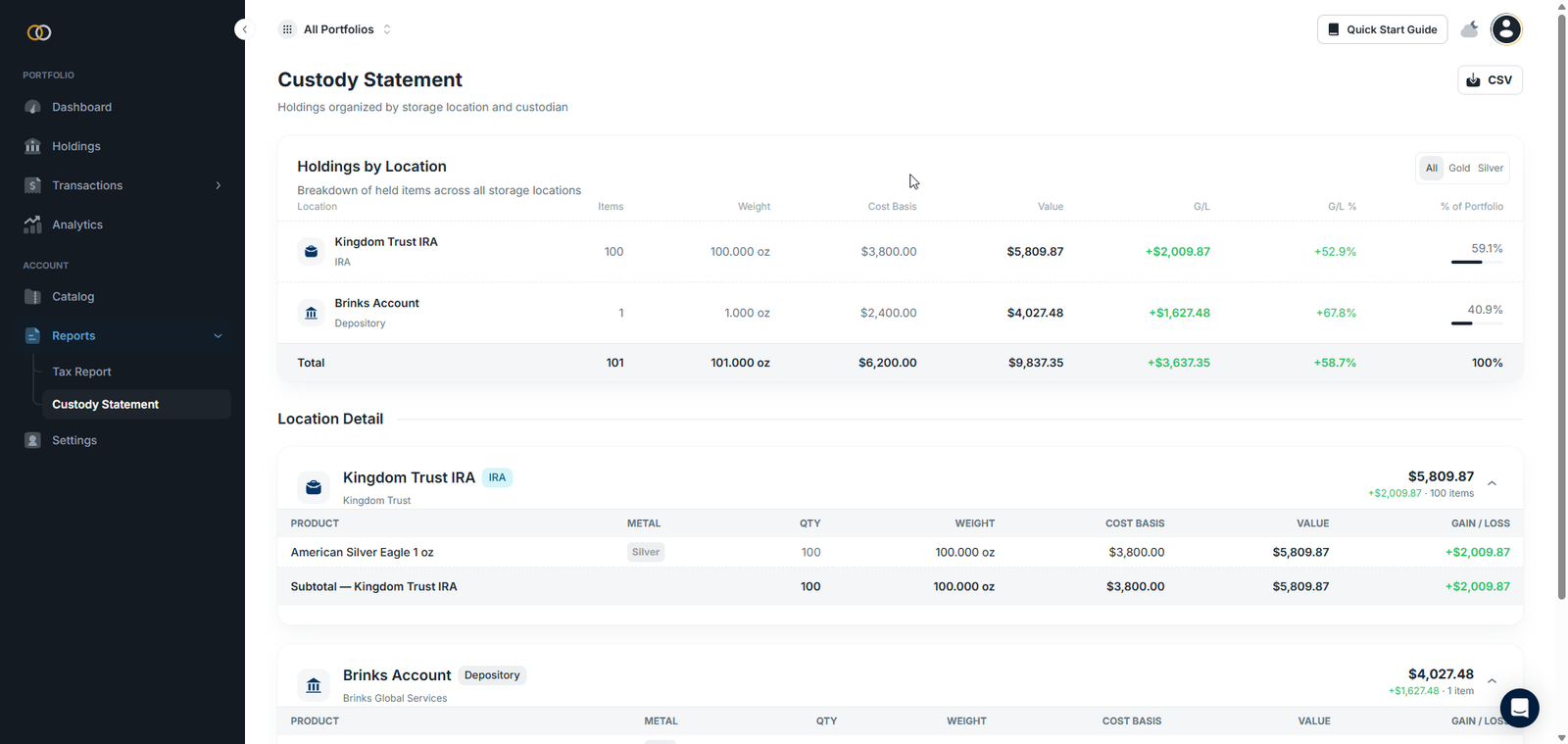
A single page that breaks out every holding by storage location, with cost basis, current value, gain/loss, and weight per location. Filter by metal, expand any location for the item-level rollup, and export to CSV. It’s the kind of document your CPA or your estate attorney can read end to end.
Two corners of US tax treatment that most owners don’t think about until April. The Gold Silver Ledger tax report handles both, so what you hand your CPA is already right.
If every item on a sale was held in a location tagged as IRA at the time of sale, the disposal is flagged and pulled out of the short- and long-term gain math. It still appears in a dedicated "IRA Activity" section so you can see how the account is performing, but it doesn't get added into the Schedule D figures your CPA is filing.
Under US tax law, physical precious metals are treated as collectibles. Long-term capital gains are taxed at a maximum 28% rate, meaningfully higher than the 15–20% rate on stocks. The tax report flags this directly on the long-term gain so you (and your CPA) plan with the right number.
Gold, silver, platinum, palladium: proceeds, cost basis, and net gain/loss broken out per metal. Useful for tax-loss harvesting decisions before year-end.
If you've sold items that never had a storage location assigned, the report flags it, so an IRA item isn't included in taxable totals just because it was unassigned at the time.
No, you don’t have to use it. If every item lives in the same place, you can leave the location field empty and the rest of the product works exactly as before. The benefit shows up the moment a second location enters the picture: a new depository, a safe deposit box, an IRA you opened. No need to redo any of your existing entries
Yes. When you add a location, the institution field autocompletes common depositories (Delaware, Brinks, Loomis, IDS, A-Mark) and IRA custodians (Equity Trust, STRATA, Kingdom Trust, GoldStar, Madison Trust). Anything not on the list you can type in as free text. The autocomplete is a convenience, not a constraint.
Open the item in your holdings, click Move, pick the destination location. That’s it. The original purchase record stays intact, with the same buy price, purchase date, and cost basis. Only the location changes. There’s no penalty in the cost basis or tax math for moving an item between locations, because nothing has been sold.
When you sell items that were all held in a location tagged as IRA at the moment of sale, the report excludes that disposal from the taxable short- and long-term totals and lists it in a dedicated IRA Activity section instead. If a single sale included a mix of IRA and non-IRA items, the report treats the line as taxable to be safe. As always, your CPA has final say.
Under IRS rules, physical precious metals are classified as collectibles. Long-term capital gains on collectibles are taxed at a maximum rate of 28%, higher than the 15–20% rate on stocks, ETFs, and most other long-term investments. The report surfaces this so the long-term gain number isn’t misread as if it were a stock gain.
Holdings is your day-to-day inventory view, with every item and every product, sortable and filterable. The Custody Statement is a report: one row per location, totals per location, designed to be printed, exported, or shared with a CPA or estate attorney. Same underlying data, different shape, different audience.

We use cookies to improve your experience on our site. By using our site, you consent to cookies.
Manage your cookie preferences below:
Essential cookies enable basic functions and are necessary for the proper function of the website.
These cookies are needed for adding comments on this website.
Statistics cookies collect information anonymously. This information helps us understand how visitors use our website.
Google Analytics is a powerful tool that tracks and analyzes website traffic for informed marketing decisions.
Service URL: policies.google.com (opens in a new window)
You can find more information in our Cookie Policy and Privacy Policy.