
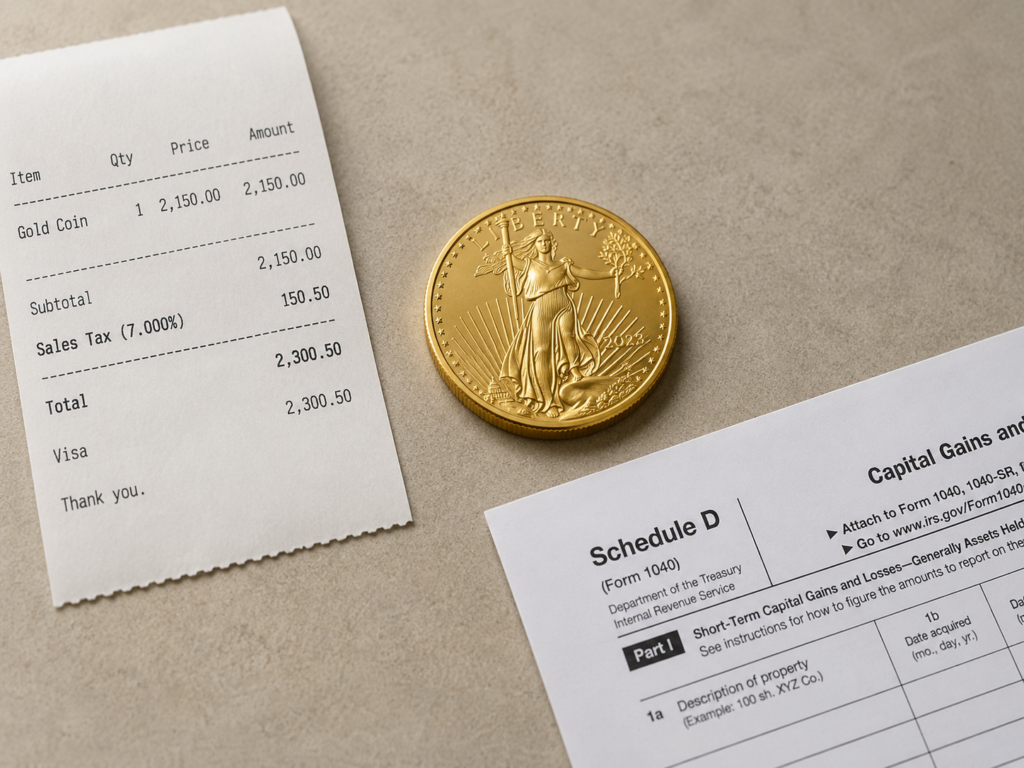
Are gold coins tax-free? Not exactly, and the question hides a trap: it depends entirely on which tax you mean.
Two different taxes touch a gold coin at two different moments. You might pay sales tax when you buy, depending on your state, and you’ll owe federal tax on any profit when you sell. A third question, whether owning coins is taxed at all, has its own answer. Here’s how all three work.
This is general information, not tax advice. Rules vary by state and change over time, so talk to a CPA about your own situation before a purchase or sale of any size.
The Short Answer: It Depends Which Tax You Mean
Gold coins run into three separate tax questions, and lumping them together is what makes “tax-free” so confusing. Sales tax may apply when you buy, though in many states it doesn’t. Federal capital gains tax applies when you sell at a profit, with no exemption for physical metal. And simply holding coins isn’t taxed in most places.
So a coin can be free of sales tax at the register and still owe federal tax on a gain years later. The two aren’t in conflict. They’re different taxes, set by different governments, triggered at different moments. The table below sorts them out.
| Tax | When it applies | Who sets it | Typical treatment |
|---|---|---|---|
| Sales tax | When you buy | Your state and locality | Often exempt for bullion; varies by state |
| Capital gains tax | When you sell at a profit | Federal, sometimes state | Up to 28% on the gain if held over a year |
| Holding | While you own it | — | No annual or property tax in most states |
Sales Tax When You Buy Gold Coins
Sales tax is the one you might see at checkout. It’s charged at the point of purchase, set by your state and sometimes your city, and whether it applies to gold coins depends on where you take delivery.
How bullion sales-tax exemptions usually work
Most states treat investment-grade bullion differently from ordinary retail goods. Bullion is metal valued for its content rather than any collectible appeal, and many states exempt it from sales tax outright, along with legal-tender coins. Some exempt purchases above a dollar threshold and tax smaller ones, and a minority tax bullion in full.
One rule catches buyers off guard: since a 2018 Supreme Court decision, an online order is taxed at your ship-to state’s rate rather than the dealer’s home state, so buying from an out-of-state website doesn’t sidestep your own state’s tax.
Bullion coins vs. collectible coins
The product itself often decides the answer more than the state does. Exemptions are usually written for bullion, valued for its metal, and for legal-tender coins, so a common one-ounce gold bullion coin is the most likely to escape sales tax.
A rare or graded numismatic coin, priced for its collectibility rather than its metal, is more often treated like any other taxable collectible. If you’re buying for the metal, the bullion products are also the ones most likely to be tax-favored at the register.
Where it varies, and where to check your state
Because the rules differ from state to state and change with new legislation, this guide won’t try to list them all. Our 50-state sales-tax overview tracks each state, with per-state pages to follow. What moves the answer is usually the same handful of factors: whether the item is bullion or a numismatic collectible, whether it’s a coin or a bar, the size of the purchase, and whether you pick it up in state or have it shipped.
Check those against your own state before a large order.
Federal Tax When You Sell Gold Coins
Sell a gold coin for more than you paid, and the profit is a capital gain the IRS wants to hear about. Physical gold is treated as a collectible, so a long-term gain on coins held more than a year faces a maximum federal rate of 28%, higher than the 15% or 20% that applies to most stocks.
A short-term gain, on coins held a year or less, is taxed at your ordinary income rate. Our capital gains guide covers the rate math and the brackets.
The part buyers miss is what’s actually taxed. You owe tax on the gain, not the full sale price: proceeds minus your cost basis, and cost basis includes the premium you paid over spot, not just the metal value. A large sale can also prompt the dealer to file a report with the IRS, which is separate from what you owe.
Our IRS reporting guide covers when that happens.
Two footnotes are worth knowing. Some states levy their own income tax on the same gain, on top of the federal rate, so your combined bill depends on where you live. And if you sell at a loss, you owe nothing on that sale, and the loss can offset other capital gains on your return.
Coins you inherited get a cost basis reset to their value on the previous owner’s date of death, which usually shrinks the taxable gain.
Is There Any Tax Just for Holding Gold Coins?
For most people, no. In the majority of states there’s no annual, wealth, or personal-property tax on privately held coins, so owning gold doesn’t generate a yearly bill the way real estate does. The taxable event is the sale, not the ownership.
A narrow set of local personal-property rules can reach tangible assets in a few places, so if that’s a concern where you live, it’s worth a quick question to a local tax professional.
The Closest Thing to Tax-Free: Gold in an IRA
If you’re after an actual tax break, a self-directed IRA is the real one. Gains on gold held inside the account grow tax-deferred in a traditional IRA or tax-free in a Roth, because the profit isn’t taxed as it builds year to year.
The trade-off is that the metal has to qualify and stay under the account’s roof: IRS-approved coins, an approved custodian, and storage at an approved depository, not coins in a home safe.
That’s the price of the shelter, and it’s why an IRA suits metal you plan to hold for the long run rather than coins you want in hand. Our Gold IRA guide walks through how that structure works and what qualifies.
The Record That Decides What You Actually Pay
Notice what every one of these answers has in common: the tax you eventually pay is figured on your gain, and the gain depends on knowing exactly what each coin cost. That number is easy to capture the day you buy and painful to reconstruct years later. Without it, the IRS treats your cost basis as zero and taxes the entire sale price rather than just the profit.
That’s the case for keeping a running record instead of a shoebox of receipts. Gold Silver Ledger keeps your holdings in one place with live cost basis set against current value, so you can search, filter, and tag what you own, and it locks in the price and premium at purchase so the figure is ready the day you sell.
Our cost basis guide goes deeper on why that number matters, and you can start your trial on our pricing page.
This article is educational and isn’t tax advice. State sales-tax rules, local property-tax questions, and IRA structures all turn on specifics, and the numbers on a real sale depend on your own basis and bracket, so talk to a qualified tax professional before a purchase or sale of consequence.
Frequently Asked Questions
Are gold coins tax-free?
Gold coins aren’t fully tax-free, because the phrase blends three separate taxes: sales tax when you buy, federal capital gains tax when you sell at a profit, and no tax for simply holding them. Many states exempt bullion coins from sales tax, but a profit on a sale is always subject to federal tax, at up to 28% on coins held longer than a year.
Do you pay sales tax on gold coins?
Whether you pay sales tax on gold coins depends on your state, since sales tax is set at the state and local level rather than federally. Many states exempt bullion coins and legal-tender coins entirely, some apply tax below a purchase threshold, and a few tax bullion in full, with online orders taxed at your ship-to state’s rate.
Which states don’t charge sales tax on gold?
A majority of US states exempt at least some gold bullion from sales tax, but the exact list shifts as states pass new legislation, so it isn’t a fixed answer. The safest move is to check your own state’s current rule before you buy, since thresholds differ and a state that exempts bullion today can change its treatment later.
Do you pay capital gains tax on gold coins?
You pay federal capital gains tax on gold coins whenever you sell them for more than you paid, with no special exemption for physical metal. Because gold is treated as a collectible, a long-term gain is taxed at a maximum federal rate of 28%, a short-term gain at your ordinary income rate, and the tax applies to the gain rather than the whole sale price.
Do I owe any tax just for owning gold coins?
In most states, you owe no tax simply for owning gold coins, because there’s no annual or personal-property tax on privately held bullion in the majority of jurisdictions. The taxable moment is the sale, not the ownership, though a few localities have personal-property rules worth checking with a local professional.
How can I buy gold coins without paying tax?
You can legally avoid sales tax on gold coins by buying in, or shipping to, a state that exempts bullion, but you can’t avoid federal tax on a future gain that way. The one structure that shelters the gain itself is a self-directed IRA, where profits grow tax-deferred or tax-free; splitting a purchase or sale to dodge reporting, by contrast, is illegal. For how a private sale is reported, see our guide on selling privately and what’s reportable.
