
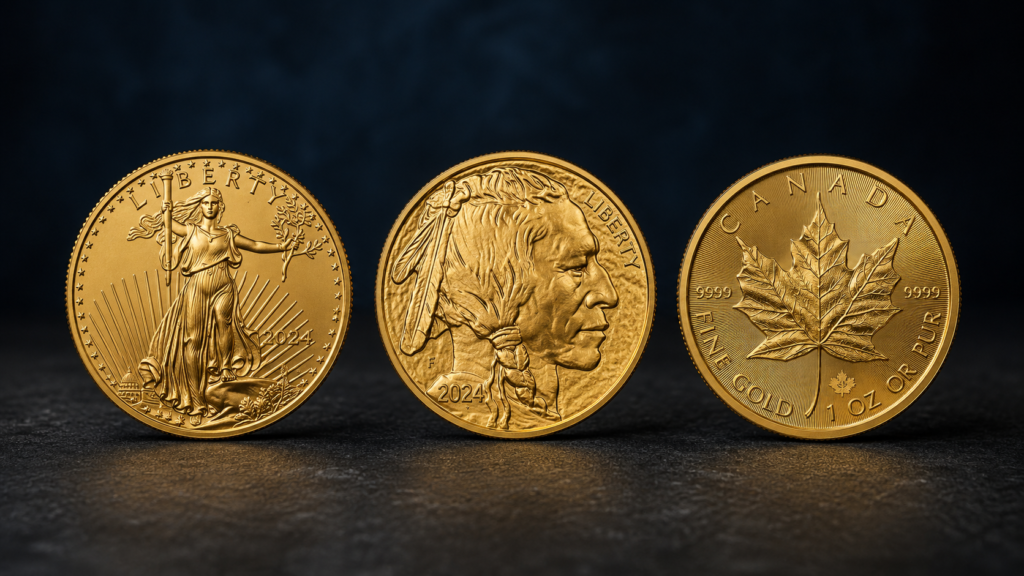
A Gold IRA is a self-directed individual retirement account that holds IRS-approved physical gold (and sometimes silver, platinum, or palladium) instead of stocks, bonds, or funds. The structure has three parties — a custodian, a dealer, and an approved depository — and a fee stack that most promoters don’t put on the front page. Here’s how it actually works.
This article is for informational and educational purposes only. It is not financial, investment, legal, or tax advice. Talk to a fee-only fiduciary advisor and a CPA before opening or rolling over any retirement account.
What Is a Gold IRA?
A Gold IRA is a self-directed individual retirement account that holds IRS-approved physical gold — and sometimes silver, platinum, or palladium — instead of paper assets. The metal is held by an approved depository, not at home, and the account follows the same federal contribution, distribution, and tax rules as any other IRA.
A few terms worth glossing. An IRA (individual retirement account) is the federal tax-advantaged retirement structure most U.S. workers know in its standard form — a brokerage IRA holding stocks, bonds, and funds. A self-directed IRA is the same legal structure with a custodian (the IRS-approved trust company that legally holds your account) that can custody non-paper assets.
For the silver-side companion, see our Silver IRA guide; for allocation sizing, our how much gold to own guide; for the direct-physical-vs-paper comparison, our physical gold vs. ETFs and mining stocks guide.
One misconception is worth flagging up front. A Gold IRA does not let you store gold at home, despite occasional marketing pitches suggesting otherwise. Taking physical possession of IRA-owned metals before retirement is a distribution — taxable income, and subject to a 10% early-withdrawal penalty if you’re under 59½. We cover the home-storage misconception in the depository section below.
This article explains what a Gold IRA is, who the parties are, the IRS eligibility rules, the rollover mechanics, and the real fee structure. It does not recommend a specific Gold IRA company. That decision belongs with you and your fiduciary advisor — the article is the input.
Self-Directed IRAs: The Wrapper That Makes This Possible
Most retail IRAs you’ve heard of — Fidelity, Schwab, Vanguard, and the IRA inside your employer’s 401(k) plan — don’t hold physical metals. The “self-directed” designation is what makes a Gold IRA legally possible.
A self-directed IRA is an IRA in which the account holder, not a brokerage’s pre-approved menu, chooses what the account holds. The federal IRS rules for IRAs — annual contribution limits, distribution rules, early-withdrawal penalties, required minimum distributions, tax treatment — still apply. What changes is the custodian. Standard brokerages won’t custody non-paper assets, so a self-directed IRA uses a specialty custodian that can. The self-directed wrapper is not a separate tax structure; it can be a Traditional, Roth, SEP, or SIMPLE IRA with a custodian who supports non-standard assets.
Self-directed IRAs are legal and widely used. Most people who get into trouble do so by violating the prohibited-transaction rules — for example, by personally using IRA-owned property — not by holding a self-directed account in the first place.
IRS Rules: Which Metals Can a Gold IRA Hold?
The IRS sets two requirements for any metal inside an IRA: minimum purity (fineness, expressed as a decimal — .999 means 99.9% pure) and approved mint source. The purity rules come from Internal Revenue Code §408(m).
IRA eligibility standards for gold, silver, platinum, and palladium.
| Metal | Minimum fineness | Example eligible coins | Example eligible bars |
|---|---|---|---|
| Gold | .995 (Eagle exception*) | American Gold Eagle*, American Gold Buffalo, Canadian Gold Maple Leaf, Austrian Philharmonic, Australian Gold Kangaroo | PAMP Suisse, Credit Suisse, Valcambi, Perth Mint, Royal Canadian Mint |
| Silver | .999 | American Silver Eagle, Canadian Silver Maple Leaf, Austrian Silver Philharmonic, Australian Silver Kookaburra | LBMA-approved refiner bars |
| Platinum | .9995 | American Platinum Eagle, Canadian Platinum Maple Leaf, Australian Platinum Koala | Approved-refiner bars (PAMP, Valcambi) |
| Palladium | .9995 | Canadian Palladium Maple Leaf, American Palladium Eagle | Approved-refiner bars |
*The American Gold Eagle is .9167 fine — below the .995 gold standard — but is explicitly permitted by statute. No other .9167-fine coin shares that exception.
Coins must come from a recognized national government mint. Bars must come from a NYMEX/COMEX-approved or LBMA-listed refiner. The mint-source rule matters as much as the fineness rule — a privately struck round that meets purity isn’t eligible if the mint isn’t on the IRS list.
What is not eligible. This is where some Gold IRA pitches get creative, so it’s worth being explicit:
- Pre-1933 numismatic U.S. gold (St. Gaudens Double Eagle, Liberty $20s, $10 Indian Heads) is not IRA-eligible despite occasional pitches that suggest otherwise.
- South African Krugerrands are not eligible. They’re .9167 fine, same as the American Gold Eagle, but they lack the statutory exception. See our Krugerrand guide.
- 90% U.S. silver coinage (junk silver) is not eligible — the purity is below the .999 silver standard. See our junk silver guide.
- Most graded, proof-only, or “certified” coins are not eligible unless they independently meet both the purity and the mint-source rules. “Graded” and “proof” status alone do not qualify a coin.
- Jewelry, regardless of fineness or country of origin, is not eligible.
A note on “exclusive” coin pitches. Some Gold IRA dealers push high-premium “collectible,” “proof,” or “exclusive” products at 30% or more over spot, often paired with claims about higher upside inside the IRA wrapper. Many of these coins are IRA-eligible by purity.
The problem is the premium: you’re paying retail collectible prices inside a structure where the gain is already tax-advantaged, and resale liquidity is far lower than for standard 1 oz bullion coins. For specifics on the most common IRA-eligible products, see our guides to the American Gold Buffalo, the Canadian Gold Maple Leaf, and the best gold coins to buy.
The Three Players: Custodian, Dealer, Depository
A Gold IRA is a three-party structure. Each party plays a different role, and each takes its own slice of fees.
The three parties in a Gold IRA structure.
| Role | What they do | Who pays them |
|---|---|---|
| Custodian | Holds the IRA account, files IRS forms, processes contributions and distributions | Account holder (annual fee) |
| Dealer | Sells the physical metal into the IRA | Account holder (via premium over spot) |
| Depository | Physically stores the metal in an IRS-approved facility | Account holder (annual storage fee) |
The custodian is the IRS-approved trust company or bank that legally holds your IRA. The custodian doesn’t custody the metal itself — they custody the account. They handle Form 5498 reporting each year, distributions, required minimum distributions, and the legal transfer of title when the IRA buys or sells. Common self-directed IRA custodians include Equity Trust, STRATA Trust, Kingdom Trust, Madison Trust, and Goldstar Trust. These are factual examples, not endorsements.
The dealer is the precious metals dealer that sells the actual coins or bars into the account. Many Gold IRA promoters are the dealer in the structure, with relationships to a small set of custodians and depositories. The dealer’s margin — the gap between wholesale spot-plus-premium and what the IRA pays — is the largest hidden cost in most Gold IRA structures. Get the dealer’s premium in writing, as a percentage over spot, before signing.
The depository is an IRS-approved storage facility that physically holds the metal. The two most commonly used are Delaware Depository in Wilmington, Delaware, and Brinks Global Services with multiple U.S. locations. Storage is either segregated (your metal is set aside as yours, identifiable by serial number) or commingled (held in a pool with other accounts’ metal of the same type). Segregated storage costs more.
Home-storage Gold IRAs. Some marketers advertise “home storage” or “checkbook” Gold IRAs that purport to let you hold the gold at home through an LLC owned by the IRA. The IRS position is conservative, and the U.S. Tax Court ruled against the structure in McNulty v. Commissioner (T.C. Memo 2021-126), treating personal possession of IRA-held metals as a prohibited distribution. Don’t assume home storage is safe even if a vendor pitches it as such.
How to Open a Gold IRA: 7 Steps
Here’s the process from decision to first storage receipt. Step 1 is the most important — and the one promoters tend to skip.
- Decide whether a Gold IRA fits your retirement plan. Talk to a fee-only fiduciary advisor before responding to any promoter. This article is educational input to that conversation, not a substitute for it.
- Choose the IRA type. Traditional, Roth, SEP, or SIMPLE. Each has different tax treatment, contribution limits, and rollover eligibility — confirm yours against current IRS rules.
- Select a self-directed IRA custodian. Look for years in business, a transparent fee schedule on the website, BBB rating, and whether they custody assets beyond precious metals. A custodian that also handles real estate or private equity IRAs is usually a real custodian, not a dealer-affiliated shell.
- Open and fund the account. Three funding options: direct contribution (subject to the annual IRS limit), rollover from a 401(k) or 403(b), or transfer from an existing IRA. Trustee-to-trustee direct movement is preferred — see the next section.
- Choose a precious metals dealer. This is where most of the cost variance lives. Ask for the dealer’s premium over spot in writing, the buyback policy and spread, and whether the “preferred” product mix runs above 8–10% premium for standard bullion. A dealer that won’t put premiums in writing is a warning sign.
- Pick eligible metals and place the order. The cleanest starting point is standard bullion — American Gold Eagle, American Gold Buffalo, Canadian Gold Maple Leaf — or recognized refiner bars at the lowest premium. The IRA wrapper gives collectible coins no structural advantage over standard bullion.
- Confirm depository storage and segregation choice. Get the depository’s storage receipt with serial numbers (bars) or item count (coins), and save it with your IRA records. The receipt is your documentation that the metal exists and is held in your name.
Three things not to do. Don’t take physical possession of the metal before retirement — that’s a distribution. Don’t use IRA-owned metal as personal property, even briefly — that’s a prohibited transaction. Don’t store IRA gold at home regardless of vendor pitches.
Rollover and Transfer Mechanics
Most Gold IRAs are funded by moving money from an existing retirement account, not by fresh contributions. The IRS recognizes three distinct movement mechanisms, and the difference matters.
A rollover moves funds with the money passing through your hands — you have 60 days to redeposit, with a once-per-12-month limit. A direct rollover (trustee-to-trustee from a 401(k) or 403(b) to an IRA) moves funds directly between trustees: no 60-day clock, no withholding, no annual limit. A transfer is an IRA-to-IRA direct movement between two IRAs — also no clock, no withholding, no limit.
Prefer trustee-to-trustee mechanics every time you can. The 60-day rollover is a common trap — miss the window and the full amount becomes a taxable distribution plus a 10% early-withdrawal penalty if you’re under 59½.
Eligibility check: Is your 401(k) eligible for an in-service rollover? Many plans only allow rollover at job separation, age 59½, or plan termination. Don’t assume — call the plan administrator before you commit to a Gold IRA structure built around the rollover.
A worked example. A 58-year-old reader with $80,000 in an old 401(k) does a trustee-to-trustee direct rollover into a self-directed IRA. The IRA buys $76,000 in American Gold Eagles at order lock; the $4,000 gap covers setup, first-year custodian, and first-year segregated storage. The metal ships to the depository under the IRA’s name. No tax event has occurred. The custodian files Form 5498 the following spring documenting the rollover.
This is not tax advice. Rollover specifics depend on your plan, age, employment status, and prior-year IRA activity. Consult a CPA before initiating. For non-IRA gold tax treatment, which is different, see our capital gains tax on gold guide.
The Real Cost of a Gold IRA: Fees You’ll Actually Pay
This is the section most promoter sites don’t put on the front page. There are several fees worth understanding before you sign.
Typical Gold IRA fee structure.
| Fee type | Typical range | Paid to | Frequency |
|---|---|---|---|
| Account setup | $50–$200 | Custodian | One-time |
| Annual custodian fee | $80–$200 | Custodian | Yearly |
| Commingled storage | $100–$300 | Depository (via custodian) | Yearly |
| Segregated storage | $150–$500 (or 0.5–1% of value) | Depository (via custodian) | Yearly |
| Dealer premium — standard bullion | 4–10% over spot | Dealer | At purchase |
| Dealer premium — proof / “exclusive” | 15–40%+ over spot | Dealer | At purchase |
| Buyback spread at sale | 3–7% below spot | Dealer | At sale |
| Wire, liquidation, or RMD distribution | $25–$50 per transaction | Custodian | Per transaction |
The dealer premium is the largest cost in most Gold IRAs. A reader buying $50,000 in metal at a 25% premium has spent $40,000 in gold and $10,000 in dealer margin — and the $10,000 of premium does not recover at sale. That gap is the single biggest variable in whether a Gold IRA is competitively priced or not.
The buyback spread is the second largest. Dealers buy back at a discount to spot (typically 3–7% below) when the metal leaves the IRA, and they sell that same metal to the next buyer at a premium. Round-trip cost — premium in plus spread out — runs 8–15% on standard bullion and significantly more on proof or “exclusive” product lines.
A worked total. A $100,000 Gold IRA at a 7% dealer premium, $150 setup, $150/year custodian, and $200/year commingled storage, held for ten years before distribution. First-year all-in cost: roughly $7,500, almost entirely dealer premium. Annual carrying cost after year one: roughly $350. Round-trip at distribution adds another 5–10% in spread. Expect to pay roughly 10–15% of asset value in friction over the full cycle for a well-priced account; a poorly priced one runs more.
For comparison, a standard brokerage IRA holding a gold ETF (such as GLD or IAU) typically costs 0.18%–0.40% per year in expense ratio with no premium over spot. The exposure is different — a paper claim on gold versus IRA-titled physical metal — but the cost gap is real. See our piece on physical gold versus ETFs and mining stocks for the broader trade-off.
Pros, Cons, and Red Flags to Watch For
The Gold IRA structure has real advantages, real disadvantages, and a marketing landscape that obscures both.
Advantages. Tax-deferred (Traditional) or qualified tax-free (Roth) treatment of any appreciation. Direct exposure to physical precious metals inside a retirement structure, which most brokerage-platform IRAs don’t accommodate. The same diversification effect as paper gold inside retirement — whether that effect matters for your portfolio is the allocation question; see our how much gold to own guide.
Disadvantages. Dealer premium is a real loss on the upside — a 7% premium means gold has to rise 7% before you break even. Round-trip cost at sale eats more. The metal pays no yield, so all return depends on price appreciation. No personal possession until retirement, and the in-kind distribution at retirement is taxable at fair market value on distribution date, not at original cost. Liquidity is slower than selling shares of a gold ETF.
Red flags in the marketing landscape. The Gold IRA search results are dense with sponsored content, and several patterns repeat:
- Free Gold IRA “kits” or silver giveaways are sales funnels, not gifts. The cost is recovered in the dealer premium.
- “Exclusive,” “proof,” or “premium” coin pitches at 25% or more over spot. The IRA wrapper does not justify the markup.
- Fear-based pitches about dollar collapse, currency reset, or hyperinflation are sales tactics, not analysis.
- Urgency framing — “act before the price moves,” “limited inventory.” Bullion is not a scarce inventory at retail.
- Celebrity endorsements. Former politicians, financial-show hosts, or any paid spokesperson. Endorsement is not due diligence.
- Home-storage Gold IRA pitches. The IRS has ruled against the structure. Walk away.
The right Gold IRA company exists. You’ll recognize it by the fee schedule on the front page, not by the call-to-action banner.
Tracking Your Gold IRA Alongside Your Other Holdings
Most Gold IRA holders also own non-IRA precious metals — coins at home, bars in a private depository. Across two or three account types, total precious-metals exposure is hard to see at a glance, and that’s the figure you need for any allocation decision.
What’s worth recording for each item: IRA designation (which account, custodian, depository, segregated or commingled), item details (coin or bar, fineness, weight, year), acquisition date and dealer, purchase price including premium, and current spot value. Records matter at distribution time, when an in-kind distribution from a Gold IRA becomes a taxable event valued at the distribution-date fair market value.
This is the reason we built Gold Silver Ledger. The ledger lets you tag each item with its account designation and renders total precious-metals exposure across all accounts on one screen.
Cross-account visibility matters most at retirement, when you’re weighing whether to take an in-kind distribution or sell inside the IRA and distribute cash. Either decision is easier when the full inventory is on one screen.
Frequently Asked Questions
Can I hold gold I already own inside a Gold IRA?
No. The IRS prohibits transferring personally owned assets into an IRA after the fact. The IRA must buy the metal directly from a dealer.
Can I store my Gold IRA metals at home?
Almost certainly not. The U.S. Tax Court has ruled against home-storage Gold IRA structures (McNulty v. Commissioner, 2021), and the IRS treats personal possession of IRA-owned metals as a distribution — taxable, and subject to the 10% early-withdrawal penalty if you’re under 59½.
Is a Gold IRA the same as a Roth IRA?
A Gold IRA can be a Roth IRA, a Traditional IRA, a SEP IRA, or a SIMPLE IRA. The “Gold” part describes what the account holds; the “Roth” or “Traditional” part describes the tax structure. All standard IRS rules for the chosen type apply.
What happens at distribution?
Two paths. In-kind: the depository ships the actual metal to you, and the fair market value at distribution date is the taxable amount (Traditional) or qualifies for tax-free treatment (Roth, if conditions are met). Cash: the dealer buys the metal back, the custodian distributes cash, and the same tax treatment applies to the cash amount.
What metals besides gold can I hold?
IRS-approved silver, platinum, and palladium. Most “Gold IRAs” are technically Precious Metals IRAs that happen to hold gold; the legal structure is identical for the other three metals. For silver specifically, see our Silver IRA guide.
Can I have a Gold IRA in addition to my regular IRA?
Yes. Annual IRA contribution limits apply across all your IRA accounts combined, not per account. You can have a Traditional IRA at a brokerage and a self-directed Gold IRA at a specialty custodian, but the combined annual contribution is capped at the IRS limit.
Are Gold IRA fees tax-deductible?
Custodian and storage fees paid from inside the IRA reduce the balance and are paid pre-tax in that sense. Fees paid out of pocket are generally not separately deductible for most filers under current tax law. Not tax advice — consult a CPA.
This article is for informational and educational purposes only. It is not financial, investment, legal, or tax advice. Consult a fee-only fiduciary advisor and a CPA about your specific situation before opening or funding any precious metals IRA.
