
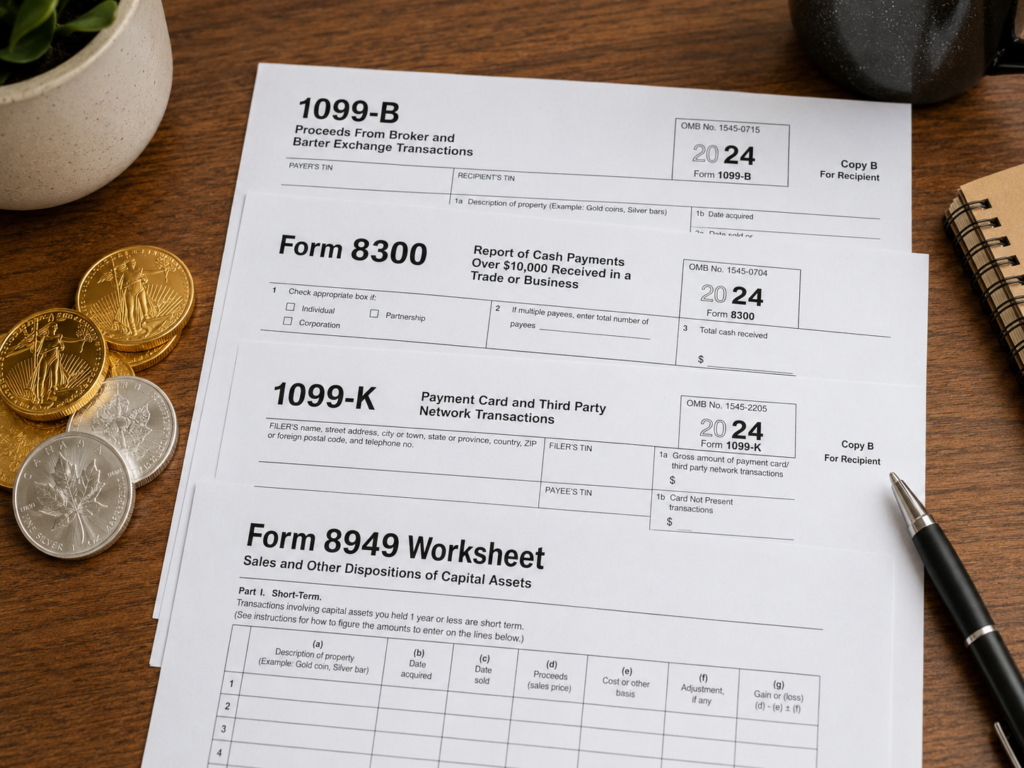
You are about to sell a stack of Eagles or a kilo bar and the question is the practical one: can the sale be private? The dealer reporting requirements gold silver buyers and sellers hear about most often — Form 1099-B — are only one of four forms that can land on a single transaction.
Each form has its own filer, its own trigger, and its own threshold. None of them remove the seller’s own obligation to report the gain. This guide is the map across all four, with the 1099-B sibling article and the 28% collectibles rate explainer carrying the deep coverage on dealer reporting and the rate side.
The seller’s obligation comes first
Every realized gain on physical bullion sold in the US is reportable on the seller’s tax return — on Form 8949, with the totals carried onto Schedule D, and with collectibles treatment that caps long-term gains at the 28% federal rate. That obligation runs on every sale that produces a gain.
It doesn’t depend on whether a dealer files a 1099-B, whether a bank files a Currency Transaction Report, or whether a payment processor files a 1099-K.
The third-party reporting forms covered in this article are visibility mechanisms — they put the IRS on notice that a transaction occurred. The seller’s reporting is the substantive filing that actually computes and pays the tax. Keep that distinction in mind as you read the rest. Several forms can land on a single sale; the seller still files once, on their own return.
The four federal reporting touchpoints
Four federal forms can trigger on a precious metals sale, each from a different party and each with a different threshold. None of them depend on the others; any can fire on its own.
Form 1099-B: dealer-side, on your sale to the dealer
Form 1099-B is filed by a dealer when the dealer buys specified precious metals from a customer at or above CFTC-approved futures contract minimums. The current list includes 1 kilo gold bars, 1,000 troy oz silver bars, 25-coin orders of Krugerrands, Maple Leafs, or Mexican Onzas (1 oz), and $1,000 face value of pre-1965 90% silver (commonly called junk silver), among others. American Gold Eagles, Silver Eagles, and Buffalos are not 1099-B reportable regardless of quantity.
The 24-hour aggregation rule combines smaller orders the dealer can see. The full mechanics — every reportable item, every exclusion, how the corrected-form process works — are covered in the dealer reporting deep-dive piece.
Form 8300: cash payments over $10,000 to the dealer
Form 8300 runs in the opposite direction. It is filed by a dealer when YOU pay them more than $10,000 in cash (or specified cash equivalents) for a purchase — a buy, not a sale. The dealer files Form 8300 with the IRS and FinCEN within 15 days of the transaction. “Cash” includes US and foreign currency, plus cashier’s checks, money orders, and traveler’s checks when used in patterns suggesting structuring.
Personal checks, bank wires, and credit card payments are NOT cash for Form 8300 purposes. Related transactions in a 24-hour period aggregate against the threshold, as do longer-range transactions the dealer knows are connected. A buyer paying $12,000 in cash for a gold-coin purchase triggers an 8300 even though the buyer is acquiring metal, not selling it.
Currency Transaction Report (CTR): bank deposits over $10,000 in cash
A Currency Transaction Report is filed by your BANK under the Bank Secrecy Act (31 USC 5313) when you deposit (or withdraw) more than $10,000 in physical cash in a single transaction. It is not a tax form — it is a FinCEN currency-tracking report.
For a metals seller, the CTR comes into play when the dealer pays in cash and the seller deposits the proceeds. The $10,000 threshold was set in 1970 and has never been adjusted for inflation. The bank files automatically; there is no seller action required, and there is no notice in advance.
Form 1099-K: payment processors over $20,000 and 200 transactions
Form 1099-K is filed by third-party payment processors — PayPal, Venmo (for goods-and-services payments), Cash App, eBay, Etsy, and similar — when total annual gross payments to a seller exceed $20,000 AND there are more than 200 transactions in the calendar year.
Both conditions must be met under current federal rules. The One Big Beautiful Bill Act, signed in July 2025, reinstated these original thresholds after several years of lower interim numbers. Friends-and-family transfers and personal Zelle payments are not reportable. Several states maintain lower state-level thresholds; the next section covers that wrinkle.
Structuring — the rule that catches “splitting it up”
Splitting a cash payment or a cash deposit into pieces individually below $10,000 specifically to avoid a CTR or Form 8300 filing is itself a federal crime under 31 USC 5324, regardless of whether the underlying funds are legitimately sourced. The crime is in the evading, not in the source. Two cash deposits of $7,500 on consecutive days at the same branch, in an account with no prior cash activity, look like exactly what the statute was written to capture.
Banks, dealers, and payment processors run automated pattern-detection that flags structuring. Banks file Suspicious Activity Reports (SARs) under 31 CFR 1020.320 when structuring is suspected — independently of whether a CTR was triggered.
The IRS Internal Revenue Manual 4.26.13 lays out the enforcement framework. Penalties under 31 USC 5324 include fines and prison time. The rule is stated here neutrally: this is what the law says. Specific situations involving cash above the threshold belong with a tax professional or tax attorney before the transaction happens, not after.
State-level reporting on top
Federal forms are one layer. Several states maintain their own reporting rules that bind state-resident sellers separately. After the federal 1099-K rollback in July 2025, several states kept lower state-level thresholds — historically including Maryland, Massachusetts, Vermont, Virginia, and Illinois, with the active list changing as states update conformity.
A seller in one of those states can receive a 1099-K from PayPal or Venmo at well below the federal $20,000 / 200-transaction line, for state income tax purposes. Sales tax on the purchase side is a separate question that this article does not cover. Verify state-specific rules with a tax professional or your state revenue department before a planned sale.
How the IRS can see undeclared sales
Even when none of the four forms trigger, the IRS has several routes into a sale on audit. The realistic visibility map runs roughly three lanes.
Bank deposit patterns: Large unexplained deposits raise the “bank deposit method,” an auditor reconstruction technique that calculates income from cash flow rather than from reported figures. A series of $9,000 deposits with no documented source is exactly the pattern the technique was designed to catch.
Dealer records: Dealers maintain transaction logs that are subpoena-accessible under audit, including on transactions that did not individually trigger a 1099-B. A dealer who has not filed any forms on your sales still has a record of every wire, every check, and every cash receipt.
Payment-processor records: PayPal, Venmo, and Cash App histories are subpoenable on audit independently of whether a 1099-K was filed. A seller running marketplace transactions under the 1099-K threshold may still see the full activity surface in an audit if one is opened.
How Gold Silver Ledger keeps the seller-side records clean
The four third-party forms come and go on their own schedule. Gold Silver Ledger does not issue, receive, or react to any of them. What it does is keep a consistent seller-side record across every sale, so reconciling whatever forms do arrive is a five-minute job rather than a weekend reconstruction.
Per-piece records that survive every form
Each coin and each bar is recorded as its own item. Spot at purchase, premium per unit in dollars, and allocated shipping are locked on the row at the moment of the buy. When a sale is recorded, the seller ticks the specific pieces sold. If a 1099-B arrives later, the per-piece record is there to reconcile.
If a 1099-K arrives from an online marketplace, the same record covers the sale. If a CTR was filed against a cash deposit, the seller’s receipts trace the proceeds back to specific pieces — no spreadsheet archaeology, no guessing.
Audit-defensible records, one row per piece
At year end, the Annual Report exports a per-row layout — Product, Buy Date, Sell Date, Days Held, Term, Proceeds, Cost Basis, and Gain or Loss — for every sale recorded in the year.
The format maps directly onto Form 8949. The IRS audit posture is that contemporaneous records support the figures filed; the report’s autofill is exactly that, captured at the moment of the buy and the moment of the sale rather than reconstructed at filing time.
The Annual Report is on the Premium plan; per-piece cost-basis capture runs on every plan from the first sale recorded.
Common misconceptions about IRS visibility
These travel through forums and dealer marketing. Each surfaces every year; each is wrong:
“No 1099-B means the IRS will never know.”
False. The agency has several other routes — bank deposits, dealer records, payment-processor histories — and the seller’s own return is required regardless.
“Cash deals are private.”
Misleading. Paying cash above $10,000 triggers Form 8300; depositing cash above $10,000 triggers a CTR. Both land on the IRS or FinCEN within days.
“Splitting the deposit into smaller pieces avoids the CTR.”
Illegal. 31 USC 5324 makes structuring itself a federal crime, even when the underlying funds are legitimate.
“PayPal does not report bullion sales under $20,000.”
Half-true. The federal threshold is $20,000 AND 200 transactions; several states maintain lower thresholds.
“If three different forms get filed on one sale, I have to report it three times.”
False. The seller reports the sale once on Form 8949; the third-party forms are visibility for the IRS, not duplicate filings for the seller.
Frequently asked questions
Does the IRS know when I sell gold or silver?
The IRS may know when you sell gold or silver through any of four federal reporting forms — Form 1099-B (filed by the dealer at specified products and quantities), Form 8300 (filed by the dealer if you paid them more than $10,000 cash on a purchase), a Currency Transaction Report (filed by your bank on a cash deposit over $10,000), or Form 1099-K (filed by a payment processor at $20,000 and 200 transactions). Whether or not any form fires, every realized gain is still reportable on your return.
Can I sell silver without the IRS finding out?
No, every realized gain on a silver sale is reportable on your US tax return regardless of whether any third-party form is filed. Small sales of common silver bullion often do not trigger a Form 1099-B (the federal dealer threshold is 1,000 troy oz of bars or $1,000 face value of pre-1965 90% silver per sale), but the seller’s own filing obligation is independent of the dealer’s. Treating the absence of a 1099-B as a tax-free pass is the most common mistake on this topic.
Does paying cash for gold trigger an IRS form?
Paying a dealer more than $10,000 in cash for a precious metals purchase triggers Form 8300, filed by the dealer with the IRS and FinCEN within 15 days. “Cash” includes US and foreign currency, plus cashier’s checks, money orders, and traveler’s checks when used in patterns suggesting structuring. Personal checks, bank wires, and credit card payments do not count as cash for Form 8300 purposes. Related transactions in a 24-hour period aggregate against the $10,000 threshold.
Will my bank report a large cash deposit from a gold sale?
Yes, your bank files a Currency Transaction Report under the Bank Secrecy Act when you deposit more than $10,000 in physical cash in a single transaction, regardless of where the cash came from. The CTR is filed with FinCEN, automatically, without any notice to you. Splitting the deposit into pieces below $10,000 to avoid the report is itself a federal crime under 31 USC 5324, even if the underlying funds are completely legitimate.
Does PayPal report gold and silver sales to the IRS?
PayPal files Form 1099-K when total annual goods-and-services payments to a seller exceed $20,000 AND there are more than 200 transactions in the calendar year, the federal threshold reinstated by the One Big Beautiful Bill Act in July 2025. Both conditions must be met. Friends-and-family transfers and personal payments are not covered. Several states maintain lower state-level thresholds, so a seller in those states may receive a 1099-K at well below the federal limit.
What happens if I do not report a precious metals sale?
Failing to report a precious metals sale that produced a gain is tax non-compliance, with penalties that scale by severity — interest, accuracy-related penalties (typically 20% of the underpayment), failure-to-file or failure-to-pay penalties, and in cases of willful evasion, fraud penalties or criminal referral. The IRS can detect undeclared sales through bank deposit patterns, dealer subpoenas, and payment-processor records on audit. A correctly filed return at the time of sale is materially less costly than a post-audit reconstruction.
Keep clean records in Gold Silver Ledger
Whichever forms land in the mail and whichever do not, the seller’s own record is what survives. Gold Silver Ledger holds that record one piece at a time — the dealer, the price, the spot at purchase, the premium, the shipping, all locked on the row from the moment the buy was made.
Each sale ticks the exact pieces that left the holding, so reconciliation against any third-party form is a row-by-row match rather than a memory exercise. The Annual Report exports the year’s sales in the per-row layout Form 8949 asks for.
This article is for informational and educational purposes only and does not constitute financial, investment, legal, or tax advice. Reporting thresholds and filing rules under federal and state law change over time; verify any specific figure against current IRS, FinCEN, and state guidance before relying on it.
Structuring violations carry criminal exposure under 31 USC 5324. Edge cases — IRA-held metals, inherited holdings sold, gifted pieces, multi-state filers, and any cash-heavy transaction — belong with a qualified tax professional, and in some cases a tax attorney.
