
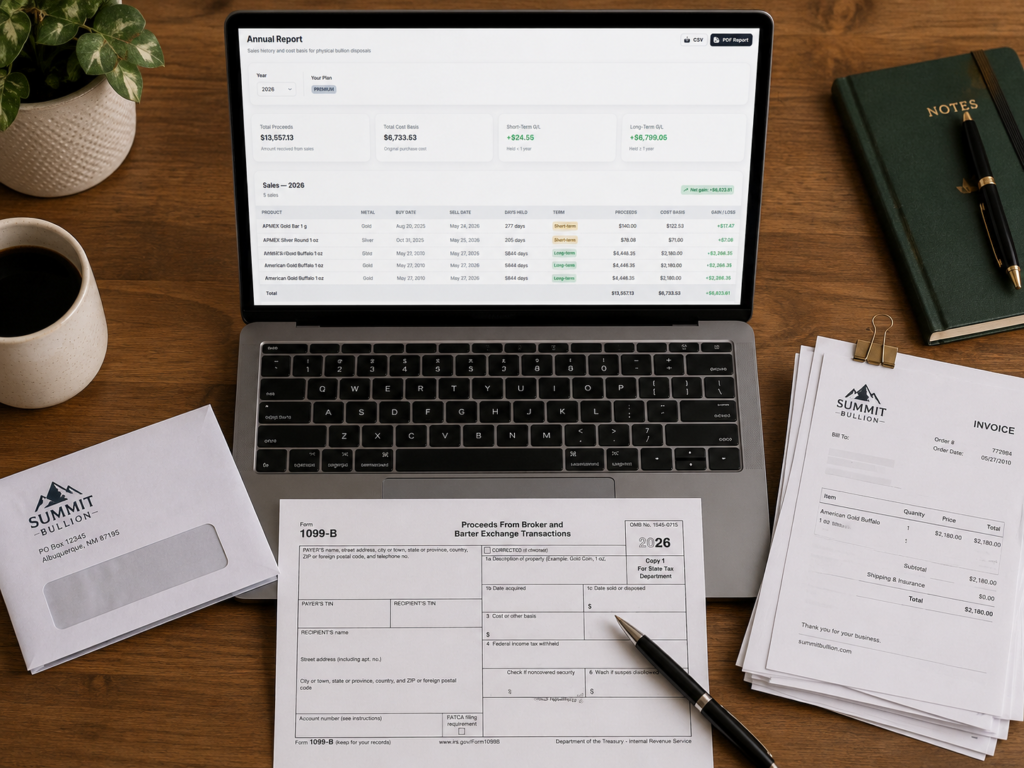
You are about to sell a stack of Krugerrands, or an envelope from the dealer arrived with the words “Form 1099-B” on the front. Either way the question is the same: when is a precious metals 1099-B actually required, and what does it mean if one is — or is not — issued?
This guide covers the rule, the practical reportable-items list, and what you owe regardless. The cost-basis side has its own piece in the full cost-basis guide.
This article is for informational and educational purposes only and is not tax advice. The full disclaimer sits at the bottom of the page.
What Form 1099-B actually is
Form 1099-B is an IRS information return that brokers and certain dealers file to report the proceeds from broker transactions, including specified sales of physical bullion. The dealer files one copy with the IRS and mails a second copy to the seller. The form reports what the seller received, not what the seller owes.
Two adjacent forms get mixed up with it. Form 1099-MISC reports a different category of income altogether. Form 8300 reports cash payments over $10,000 received in one transaction or in related transactions — a separate filing on a separate trigger.
A point that flips first-time sellers: the dealer issues the 1099-B on the dealer’s purchase of metal from you (your sale). Your purchase from a dealer never triggers a 1099-B.
When a dealer is required to file a 1099-B
The IRS-authoritative test is the CFTC-Regulated-Futures-Contract (RFC) standard. A sale of a precious metal in any form for which the Commodity Futures Trading Commission has not approved trading by RFC is not reportable. Even when the form is RFC-eligible, the sale is not reportable unless the quantity meets the minimum required to satisfy a CFTC-approved contract.
In February 2026, the IRS issued a correction to the 2025 and 2026 Instructions for Form 1099-B that removed a confusing example on page 5. The revision clarifies that small individual coin sales below CFTC minimums are not reportable — settling years of counter-side disagreement in one paragraph.
The 24-hour aggregation rule
Sales of precious metals for a single customer during a 24-hour period must be aggregated and treated as a single sale to determine whether the reporting exception applies. The exception does not apply when the dealer knows or has reason to know that a customer (alone or with a related person) is engaging in sales to avoid reporting.
Splitting one reportable-sized order into staggered transactions does not remove the obligation when the pattern is visible.
The practical reportable-items list
The National Coin & Bullion Association (NCBA, formerly the Industry Council for Tangible Assets, or ICTA) maintains the working interpretation that most US dealers follow.
The list maps each CFTC-approved contract to the minimum order size that crosses the reporting threshold. It is industry guidance built on the IRS rule, not a separate IRS list. The standard thresholds:
- Gold bars (.995+ fine): 1 kilo (32.15 troy oz) or more, in any combination.
- Silver bars (.999+ fine): 1,000 troy oz or more, in any combination.
- Platinum bars (.9995+ fine): 25 troy oz or more, in any combination.
- Palladium bars (.9995+ fine): 100 troy oz or more, in any combination.
- 1 oz Gold Krugerrand: 25 coins or more in one sale.
- 1 oz Gold Canadian Maple Leaf: 25 coins or more in one sale.
- 1 oz Gold Mexican Onza: 25 coins or more in one sale.
- Pre-1965 US 90% silver coins (dimes, quarters, half-dollars): $1,000 face value or more in one sale.
What is NOT reportable (and why this confuses people)
“Not reportable by the dealer” is the most misread phrase in the topic. It does not mean tax-free, off the books, or invisible to the IRS. The next section unpacks the distinction. The exclusions:
- American Gold Eagle (any size, any quantity): Not reportable, regardless of order size.
- American Silver Eagle (any quantity): Not reportable, regardless of order size.
- American Gold Buffalo (any quantity): Not reportable.
- Fractional gold coins (1/2 oz, 1/4 oz, 1/10 oz) of any program: Not reportable as a category.
- Most foreign and modern numismatic coins: Not deliverable under a CFTC-approved futures contract.
- Reportable items sold in quantities below the CFTC minimum: A single Maple Leaf, a half-kilo gold bar, $500 face value of junk silver.
“Not reportable” is not “tax-free”
Every realized gain on physical bullion is taxable in the US. Whether or not the dealer files a 1099-B, whether or not the seller receives one, and whether or not the IRS ever sees a paper trail, the gain belongs on the seller’s return.
Each sale lands on Form 8949 and the totals carry to Schedule D. Physical bullion is taxed as a collectible, which means long-term gains face the collectibles cap — a federal rate of up to 28%, applied as the lesser of 28% or the seller’s ordinary marginal rate. See the 28% collectibles-rate explainer for the full mechanics. Short-term gains follow ordinary-income treatment.
The absence of a 1099-B is administrative convenience for the dealer (no CFTC-minimum threshold met), not a tax exemption for the seller. See the broader piece on what triggers IRS reporting on a sale for the wider picture.
How to read a 1099-B from a precious metals dealer
The dealer fills in what they can see. Most of the cost-basis side stays blank because they were not on your end of the original purchase.
The boxes the dealer fills in
Box 1a (Description of property): A short description such as “1 kilo gold bar” or “25 Maple Leafs, 1 oz.” Box 1c (Date sold): The transaction date on the sale to the dealer. Box 1d (Proceeds): The dollar amount paid to you, gross of any separately disclosed fees. Box 4 (Federal tax withheld): Usually zero on a retail sale. Box 2 (Type of gain): Often blank, since the dealer rarely knows the acquisition date.
The boxes the dealer typically leaves blank
Box 1b (Date acquired), Box 1e (Cost or other basis), Box 1f (Accrued market discount), and Box 1g (Wash sale loss disallowed) are almost always empty on a metals 1099-B. The dealer has no visibility into when you bought, what you paid, or what premium you carried into basis. You fill those columns on Form 8949 from your own records.
Reconciling the form against your records
Match three things. The proceeds in Box 1d should equal the dealer’s payout less any separately disclosed fees. The date in Box 1c should match your sell date. The description in Box 1a should match the items you ticked as sold. If anything disagrees by more than a rounding difference, request a corrected 1099-B from the dealer before filing.
What to do if a 1099-B arrives unexpectedly
The most common cause is the 24-hour aggregation rule — several smaller orders inside one window that totaled into reportable range. Sometimes a single order crossed a threshold the seller did not realize was there. Either way: do not ignore the form. The IRS already has a copy, and a return that omits it draws an automated mismatch notice within months.
Match the form to your records and gather cost basis for the items it describes. If any field looks wrong, request a corrected 1099-B before filing. The how-to-sell-gold guide covers the dealer-side sequence for that request.
What records to keep regardless of whether a 1099-B is issued
Because dealer reporting is uneven, the seller’s own records are the only consistent source of truth at filing time. The IRS does not specify a one-size-fits-all bullion recordkeeping standard. What they expect is reasonable, contemporaneous evidence sufficient to support the figures filed. Three to six years of retention is a defensible rule of thumb. The step-by-step inventory guide covers the structural side. The minimum record set per piece:
- Dealer invoice on every purchase: Price, date, dealer, order reference.
- Dealer payout statement on every sale: Proceeds, date, items sold, dealer reference.
- Per-item purchase record: Spot price at the moment of purchase, per-unit premium, allocated shipping.
- Per-item sale record: Which specific pieces were sold — Specific Identification depends on this.
- Any 1099-B received: Archived with the return for the full retention window.
- Bank or credit card statements: Corroborating both ends of every transaction.
How Gold Silver Ledger handles dealer reporting
Gold Silver Ledger doesn’t interact with dealer reporting — reportability is the dealer’s call. What we do is keep the seller’s side clean enough that the form’s arrival (or absence) is a non-event at filing time.
Per-piece records survive the 24-hour rule
Each coin and each bar is recorded as its own item. When a sale is entered, the seller ticks the specific pieces that left the holding. If a series of sales aggregates inside a 24-hour window, the per-piece source records are already there to back out which pieces went out on which transaction. The ledger does not flag sales as reportable; that determination stays with the dealer.
Cost basis ready for Form 8949
The boxes the dealer leaves blank — Box 1b (date acquired) and Box 1e (cost or other basis) — are the boxes the seller fills on Form 8949. Because each sold item is linked to the specific buy that created it, the Annual Report autofills cost basis and buy date row by row, in the format the schedule asks for.
The Annual Report sits next to the 1099-B
At filing time, the seller hands the tax advisor two things: any 1099-B forms received and the Annual Report. The 1099-B carries the dealer’s proceeds; the Annual Report carries the per-row cost basis, holding period, and gain or loss. Both are organized around the same individual sales, so they reconcile cleanly.
The Annual Report is on the Premium plan; per-piece cost-basis capture runs on every plan from the first sale recorded.
Common 1099-B misconceptions
These travel through forums and dealer marketing:
- “No 1099-B means I owe no tax.” False. The seller’s tax obligation is separate from the dealer’s reporting threshold.
- “American Gold Eagles are tax-free.” False. They are reporting-exempt for the dealer, not tax-exempt for the seller.
- “If I split a big order, the dealer cannot report it.” Misleading. The 24-hour aggregation rule captures structured splits.
- “A 1099-B shows my gain.” False. It shows proceeds. Gain is proceeds minus cost basis, computed by the seller.
- “The dealer files 1099-B for my purchases too.” False. 1099-B applies to the dealer’s purchase from you. Cash payments over $10,000 to the dealer fall under Form 8300, a separate filing.
- “If the IRS does not get a 1099-B, they will never know.” Not a safe assumption. Bank deposits, payment-processor records, and the dealer’s own books are visible under audit.
Frequently asked questions
Does my dealer file a 1099-B when I sell gold or silver?
Your dealer files a 1099-B only when the sale meets the IRS test — a product and quantity that satisfies a CFTC-approved regulated futures contract. Small sales of common bullion (a few Eagles, a half-kilo bar, a few hundred dollars of junk silver) generally do not trigger a form. Whether one is issued or not, the gain is still taxable.
How much gold can I sell without triggering a 1099-B?
The IRS rule keys reporting to specific products and CFTC contract minimums, so the answer depends on what you sell. American Gold Eagles, Buffalos, and fractional gold coins do not trigger a 1099-B regardless of quantity. For gold bars, the threshold is 1 kilo; for 1 oz Krugerrands, Maple Leafs, or Mexican Onzas, the threshold is 25 coins or more in one sale.
Are American Gold Eagles reportable on a 1099-B?
American Gold Eagles are not reportable on a 1099-B, regardless of how many you sell. The exemption stems from the CFTC-RFC standard: Eagles are not deliverable under an approved futures contract, so the dealer has no reporting obligation. American Silver Eagles and American Gold Buffalos share the same treatment. The seller’s tax obligation on the gain is unaffected.
Do I owe tax if I do not receive a 1099-B?
Yes — every realized gain on physical bullion is taxable in the US whether or not a 1099-B is issued. Report each sale on Form 8949 with proceeds, cost basis, and holding period, then carry the totals onto Schedule D. Long-term gains face the 28% collectibles rate cap; short-term gains follow ordinary-income treatment.
What is the 24-hour aggregation rule on precious metals sales?
The 24-hour aggregation rule requires dealers to combine multiple sales by the same customer inside a 24-hour window and treat them as one sale when deciding whether reporting applies. The rule prevents a reportable order from being split into pieces that individually fall below threshold. The exception also does not apply when the dealer knows the customer is structuring sales to avoid reporting.
How do I report a precious metals sale on my tax return?
Report each sale on Form 8949 with the description, acquired date, sold date, proceeds, cost basis, and gain or loss, then carry the totals onto Schedule D. Bullion is taxed as a collectible, so long-term gains face the collectibles cap (the lesser of 28% or your ordinary marginal rate) and short-term gains follow ordinary-income treatment.
What is the difference between Form 1099-B and Form 8300 for bullion?
Form 1099-B reports your sale of metal to the dealer at the specified products and quantities; Form 8300 reports the dealer’s receipt of more than $10,000 in cash (or cash equivalents) in one transaction or related transactions. A 1099-B is triggered by what you sold; an 8300 is triggered by how the dealer was paid.
What if my 1099-B has the wrong information?
Contact the dealer that issued the form and request a corrected 1099-B before you file. The corrected form gets a “CORRECTED” check at the top and replaces the original in the IRS record. Common errors include wrong proceeds, wrong sale date, wrong description, and the form being issued under the wrong tax year.
Keep a 1099-B-ready record in Gold Silver Ledger
A 1099-B from a metals dealer is half a tax record. The proceeds side is filled in; the cost-basis and acquired-date side is yours to produce. Gold Silver Ledger holds the per-piece purchase history that fills the other half — spot at the time of purchase, premium paid in dollars, allocated shipping, locked on the row at the moment the buy was recorded.
At sale, you tick the specific pieces that left the holding; the Annual Report rolls the year’s sales into a per-row layout that maps directly onto Form 8949.
Starter and Pro both carry the per-piece cost-basis chain through every sale; Premium adds the tax-ready Annual Report and the Bulk CSV Upload for batch import of historical purchases.
This article is for informational and educational purposes only and does not constitute financial, investment, legal, or tax advice. Dealer-reporting thresholds and the underlying CFTC contract specifications change over time; verify any specific figure against the current Instructions for Form 1099-B before filing. Edge cases — inherited holdings sold, IRA distributions, multi-state filers, business sellers — belong with a qualified tax professional.
