
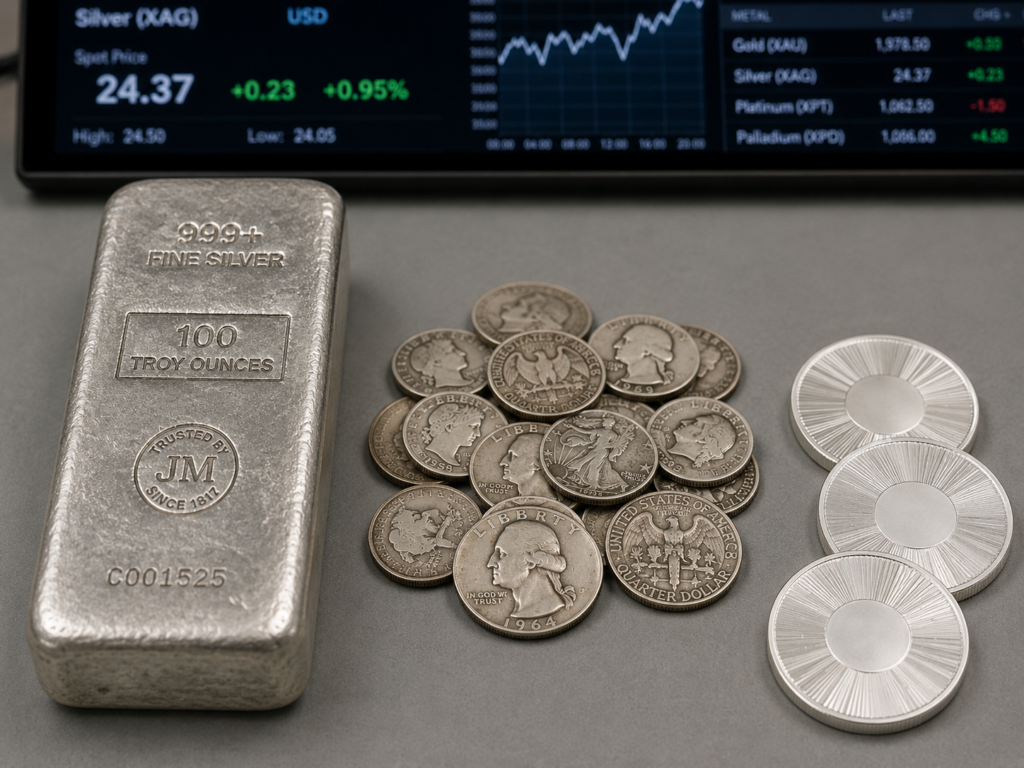
Search the spot price of silver and you get one clean number. Then you open a dealer’s cart, and every product costs more than that. The gap is the premium, and on physical silver it’s always there in some form. So can you really buy silver at spot price? Sometimes, through a genuine promotion, and consistently you can get close.
This guide covers both: the occasional at-spot deal and the repeatable near-spot playbook that keeps your markup as small as possible.
This article is general information, not investment advice. Spot prices, dealer premiums, promotions, and sales-tax rules change constantly, so verify current pricing and any promotion’s terms with the dealer before you buy.
What is the spot price, and why is silver always above it?
The spot price is the live wholesale price of one troy ounce of pure silver, set on global futures and over-the-counter markets and quoted for large, unfabricated quantities; our spot price guide explains how that number is set. Physical silver almost always costs more than spot because a retail coin or bar also has to cover fabrication, distribution, and the dealer’s margin.
That markup above the metal value is the premium over spot, and our premium over spot guide covers why it moves. On silver, the premium runs a wider percentage than on gold, because the fixed cost of striking a coin or pouring a bar is spread across a much smaller dollar value of metal. A one-ounce silver coin costs about the same to make as a one-ounce gold coin, but that cost is a far bigger slice of the silver coin’s price.
So set your expectation honestly. A zero premium basically doesn’t exist on physical metal, so the goal is the smallest premium you can get for the format you want, plus the occasional genuine at-spot promotion when one lines up with what you’re buying.
Can you actually buy silver at spot price?
You can occasionally buy silver at spot price, but only through limited promotions that established dealers run to win new customers, not as an everyday option. Dealers like APMEX, JM Bullion, SD Bullion, and Money Metals periodically advertise a single product, a one-ounce round or a specific coin, “at spot” or “at cost,” usually capped at one per customer or reserved for a first order.
These offers are loss leaders. The dealer takes little or no margin on the promo item to open an account, expecting the relationship and higher-margin purchases to follow. That’s why the at-spot product is almost always one low-cost item with a tight limit, not an open door to buy a hundred ounces at spot. Read the terms before you count on one, since minimum-order, new-customer-only, and payment-method conditions are common.
The other thing people mean by “at spot” is the bulk tier, where very large orders, monster boxes, or 100-ounce bars compress the per-ounce premium toward spot without quite reaching it. Between the rotating promos and the bulk tier, buying at spot is real but conditional. Near spot is the target you can hit again and again, and the rest of this guide is about that. If catching a promo matters to you, sign up for dealer email and deal alerts, so you see them when they run.
The lowest-premium silver, from cheapest up
Some formats structurally carry a lower premium than others. If your priority is dollars per ounce of metal rather than a specific coin, these lanes get you closest to spot on an ordinary day, listed from the lowest premium up.
- Large cast bars (100 oz and up): The lowest premium per ounce of any common format, with one pour and very little fabrication cost spread across a lot of metal. Our silver coins vs. bars guide compares the tradeoffs.
- Pre-1965 junk silver: US dimes, quarters, and half dollars struck at 90% silver, priced by face value times a multiplier times spot rather than per coin. It’s among the lowest premiums available, and our junk silver guide covers the math.
- Generic rounds and small bars: Private-mint rounds and one-to-ten-ounce bars priced on metal content with no sovereign-mint markup. This is the workhorse format for regular buying near spot.
- Secondary-market and back-year coins: Previously owned or prior-year sovereign coins that often sell below the current-year premium while holding exactly the same metal.
- Current-year sovereign coins: The American Silver Eagle, Canadian Maple Leaf, and their peers carry the highest premium of the group, because you’re paying for the mint’s authority and easy resale, not cheaper metal.
How to shave the premium on any silver purchase
Beyond choosing a low-premium lane, a few buying habits cut the gap further. Each one is small, but together they add up to a meaningfully lower cost over spot.
- Buy in volume tiers: Dealers price silver in quantity breaks, so the per-ounce premium steps down as you cross each tier.
- Pay by wire, check, or crypto: These avoid the credit-card surcharge, often around 3 to 4 percent, that quietly adds to your premium.
- Buy secondary market: Previously owned coins and bars from a dealer’s secondary inventory usually carry a lower premium than brand-new stock.
- Watch the specials pages and alerts: At-spot and reduced-premium deals get announced by email and on dealers’ deals pages, not on the main product listing.
- Favor larger units: A single ten-ounce bar carries a lower premium than ten one-ounce coins of the same metal weight.
- Compare the total cart price: Shipping, insurance, and payment method move the real number more than the advertised premium does.
The hidden costs that erase a low premium
A low sticker premium doesn’t always mean a low cost. Shipping and insurance on a heavy silver order can add a few percent on a small purchase, though they shrink as a share of a larger one. Many dealers waive shipping above an order threshold, which is one more reason volume helps.
Sales tax is the big one for silver. Because the dollar amount per coin is small, silver crosses state sales-tax thresholds more often than gold, and a taxable order can add several percent that dwarfs the premium you worked to shave.
Rules vary by state and change often, so check the tax line at the dealer’s cart before you commit; our complete guide to buying silver covers dealer routing and the sales-tax picture in more detail.
Then there’s the resale spread. Getting near spot on the way in matters less if you sell well below spot on the way out, and that buy/sell spread is where the dealer earns its margin back. The number that actually tells you how you did is your all-in cost per ounce measured against live spot, not the premium printed on any one order.
When is an “at spot” price a red flag?
An “at spot” or “below spot” price is a red flag when it comes from an unknown seller with no limits, because real metal costs money to fabricate and no honest seller moves unlimited genuine silver below the wholesale price of the metal itself. A legitimate at-spot deal comes from an established dealer, covers a specific product, and carries clear limits.
On marketplaces like eBay and Facebook, the verification burden falls entirely on you, and silver counterfeits are common. If a near-spot or below-spot price looks impossible for the format, treat the item as unverified until it passes a weight, dimension, magnet, and ping check; our guide to spotting fake gold and silver walks through each one.
Keep at-spot promotions to established dealers, and keep marketplace buys to sellers you can verify.
Track what you actually paid over spot
Whether you buy silver at spot through a promotion or work the near-spot lanes, the figure that tells you how well you bought is your premium over spot: what you paid per ounce versus what the metal was worth at spot that day. Our melt value guide covers that metal-content side of the math. Across a growing position of coins, bars, and junk silver bought at different times, that number is easy to lose in a spreadsheet.
Gold Silver Ledger records what you paid for each item and values it against live silver spot, so your premium over spot shows up per item and across the whole portfolio. Junk silver is handled as face-value items with the face-times-multiplier-times-spot math built in, and the catalog covers the generic rounds, bars, and sovereign coins you’re comparing. You can filter your holdings by format and see which lanes actually got you closest to spot.
If you want to know your real cost over spot from the first purchase forward, that visibility is worth having in place early.
Frequently asked questions
Can you buy silver at spot price?
You can buy silver at spot price only occasionally, through limited promotions that established dealers run to attract new customers, usually on a single product with a one-per-customer or first-order limit. For everyday buying, near spot is the realistic target, reached through low-premium formats rather than a spot-price checkout.
What is the cheapest way to buy silver?
The cheapest way to buy silver by metal content is large cast bars and pre-1965 junk silver, which carry the lowest premium over spot of any common format. Generic rounds and secondary-market coins come next, while current-year sovereign coins cost the most over spot.
Why is silver always more expensive than the spot price?
Silver costs more than spot because the retail price adds fabrication, distribution, dealer margin, and payment processing on top of the raw metal. That premium is a wider percentage on silver than on gold, since the fixed cost of making a coin or bar is spread across a smaller dollar value of metal.
Are APMEX and other dealer “at spot” deals real?
At-spot deals from established dealers like APMEX, JM Bullion, SD Bullion, and Money Metals are real but limited, offered as loss leaders on a single product to win new accounts. They almost always cap quantity per customer or restrict the offer to a first order, so they’re a way to save on one item, not to buy in bulk at spot.
What silver has the lowest premium over spot?
Large cast bars of 100 ounces and up have the lowest premium over spot, because their fabrication cost is spread across the most metal. Pre-1965 junk silver and generic rounds follow closely, and all three beat current-year sovereign coins on price per ounce.
Does buying more silver lower the premium?
Buying more silver lowers the per-ounce premium because dealers price it in volume tiers that step down as your quantity crosses each break. Larger units help too, since one ten-ounce bar carries a lower premium than ten one-ounce coins of the same weight.
Is silver sold below spot a scam?
Silver offered below spot in unlimited quantity by an unknown seller is almost always a counterfeit or a non-delivery scam, because genuine metal can’t be produced and sold for less than its own wholesale value. A limited at-spot promotion from an established dealer is different and legitimate; the warning sign is an unlimited below-spot offer from a seller you can’t verify.
This article is general information, not investment advice, and makes no prediction about the silver price. Premiums, promotions, and sales-tax rules change, so confirm current terms with the dealer at the time of purchase.
