
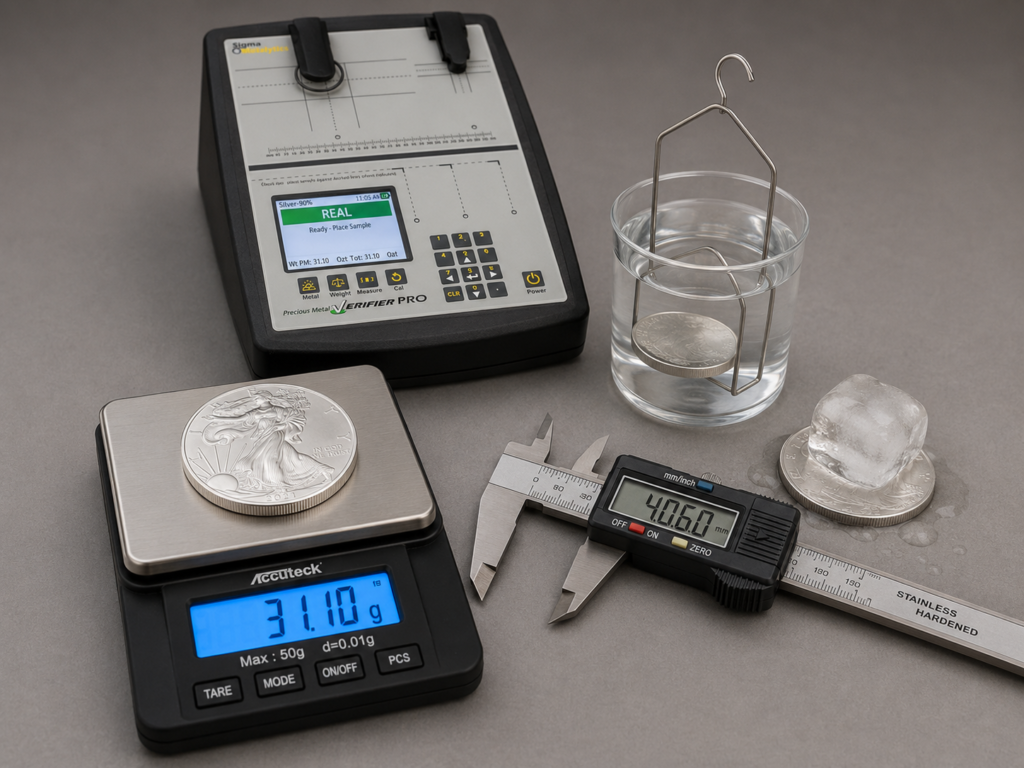
No single test catches every counterfeit. The reliable approach is a ladder of tests run in order, starting with the ones that cost nothing — visual, weight, magnet, ping — and escalating to specific gravity, ultrasonic, and, for high-value pieces, a professional assay.
Here is the full hierarchy, what each test catches, what it misses, and when to escalate.
The testing hierarchy at a glance
Most fakes fail at the first or second test. The remaining tests exist for the small share of counterfeits sophisticated enough to clear the easy checks. Run the ladder in order; stop when you have a confident answer.
The expensive escalation — Sigma, ultrasonic, XRF, professional assay — is warranted only for high-value pieces, such as 100 oz bars or rare numismatic coins, and for any piece bought outside an established dealer channel.
For a sealed PAMP bar bought from a major dealer, the first three or four steps are usually enough. For a “Suisse” bar pulled from an estate sale, run the whole ladder.
- Visual inspection: Compare the piece against the mint’s or refiner’s published design and finish.
- Weight and dimensions: Verify the published spec with a 0.01 g jeweler’s scale and digital calipers.
- Magnet test: Real gold and silver are not magnetic. Catches iron-bearing fakes only.
- Ping test: Listen for the long, clear resonance silver and gold produce when struck. Coins only.
- Ice test: Place an ice cube on a silver coin and watch it melt almost immediately. Silver only.
- Specific gravity test: Weigh dry, weigh submerged, compute the density ratio. The most reliable home test.
- Electronic test: Sigma Metalytics Verifier, ultrasonic thickness gauge, or XRF. Catches tungsten cores.
- Destructive test: Acid, file, or scratch on a touchstone. For jewelry or scrap — not for sealed bullion.
- Professional assay: XRF or fire assay at an accredited refiner. Definitive but costs $25 to $300.
Start with the seller, not the test
The single highest-leverage authentication move is choosing where the piece comes from. Established refiners on the LBMA Good Delivery List — PAMP, Valcambi, Argor-Heraeus, the Royal Canadian Mint, Perth Mint, Asahi Refining, Heraeus, and historically Engelhard and Credit Suisse — sell through dealer channels that authenticate inbound inventory before it ever reaches the buyer.
Buying a sealed bar in the original tamper-evident assay card from a reputable dealer (APMEX, JM Bullion, Money Metals, SD Bullion, Hero Bullion, BullionVault, Kitco, Provident, the U.S. Mint’s authorized purchaser network) shifts the authentication burden up the supply chain.
Our guide to gold bullion covers the umbrella context on what these dealers actually sell. The rest of this article is the toolkit for the pieces where the seller path doesn’t fully resolve the question.
Where counterfeits actually arrive
The common origin points for fakes in the retail bullion market. Bullion does not sell below melt value — a “1 oz gold coin for $50” is not gold, ever. See our melt value guide for the math on what real bullion has to be worth at any given spot price.
- eBay listings priced suspiciously low against spot.
- Facebook Marketplace and other peer-to-peer platforms.
- Garage sales and estate sales with no prior numismatic inventory.
- “Private sellers” on stacking forums and crypto-adjacent communities.
- AliExpress, Wish, and similar marketplaces for novelty plated pieces.
- Any seller whose price is materially below the live spot price.
Questions to ask before buying from a private seller
A seller who refuses a non-destructive test on a high-value piece is signaling something. A seller who provides the original dealer receipt is signaling something else. Three questions to ask before money changes hands.
- Where did you get it — dealer receipt, inheritance, or estate?
- Is it still sealed in the original assay card or capsule?
- Can I run a non-destructive test before completing the sale?
Visual inspection: what real bullion looks like
Visual inspection is the cheapest test and catches the highest share of counterfeits. The fakes that fool a casual buyer almost never fool a careful one. Spend two minutes comparing the piece in your hand to the mint’s or refiner’s official product page (not a third-party retailer’s photo), and you will catch most of what’s on the market.
Coin-specific tells
The defining visual cues for the common bullion coins, plus the most common counterfeit failure points. See our silver bullion guide for the umbrella context on the silver coins below.
- American Silver Eagle: Heraldic eagle reverse, sharp strike on the design, reeded edge, 40.6 mm diameter. Common Chinese counterfeit ASEs have softer feather detail, slightly blurred lettering, and an incorrect reeded-edge count.
- American Gold Eagle: Family-of-eagles reverse on the modern type, 22-karat gold (so the color is warmer and slightly brassier than a 24-karat coin).
- Canadian Gold Maple Leaf: Radial laser-etched lines covering the field and a micro-engraved security mark — a tiny maple leaf containing the last two digits of the year, visible only under magnification.
- South African Krugerrand: 22-karat with the characteristic copper-warm color and a lower-relief design than U.S. coins.
- Morgan and Peace silver dollars: 90% silver, distinct reeded edge, specific strike characteristics. Counterfeits often have soft devices and a faintly off color cast from the wrong alloy.
Bar-specific tells
The defining visual cues for sealed bullion bars from the established refiners. Common counterfeit tells across bars include blurred serial numbers, font mismatches versus the refiner’s published spec, soft lettering on the fineness stamp, dimensions slightly off, and assay cards with low-resolution printing or no holographic elements.
- PAMP Suisse: Veriscan technology — a microscopic surface fingerprint readable with PAMP’s free app — plus holographic Fortuna imagery on the back of the assay card and a serial number that matches across bar and card.
- Valcambi: Laser-etched serial number, the distinct Valcambi font, and a tamper-evident card.
- Credit Suisse historical bars: Precise strike, sharp corners, and exact dimensions to the published spec.
- Royal Canadian Mint bars: Maple leaf privy marks, a clear fineness stamp, and a certificate or assay card.
When real rust appears, the piece isn’t bullion
Gold, silver, platinum, and palladium do not rust. Red-brown flaking or pitting on a “gold” or “silver” piece means the base metal is iron — the piece is plated, not bullion. Our guide on whether silver, gold, or platinum can rust covers the chemistry; visible rust is one of the most reliable counterfeit tells in the catalog.
Weight and dimensions: the simplest, most reliable test
Every legitimate coin and bar has a published weight and dimension specification. A piece that’s even slightly off spec is suspect. Weight and dimensions catch the second-largest share of counterfeits after visual inspection, and the equipment is cheap, durable, and lasts a lifetime.
Reference weights for the common pieces
From the issuing mints and refiners. For coins outside this list, check the issuing mint’s product page — it always publishes weight, diameter, thickness, and fineness. Our gold bar weight guide has the complete master table of standard bar sizes from 1 g to 400 troy oz.
- American Silver Eagle: 1 troy ounce (31.103 g), 40.6 mm diameter, 2.98 mm thickness.
- American Gold Eagle (1 oz): 1.0909 troy oz total weight, 32.7 mm diameter, 2.87 mm thickness (22-karat — one troy ounce of gold plus alloy).
- Canadian Gold Maple Leaf (1 oz): 1 troy oz pure gold (.9999), 30.0 mm diameter.
- South African Krugerrand (1 oz): 1.0909 troy oz total weight, 32.77 mm diameter (22-karat).
- 1 kilo gold bar: 1,000 g (32.15 troy oz). Standard minted dimensions roughly 80 × 40 × 18 mm.
- 100 oz gold bar: 3,110.35 g (100 troy oz). Cast form, roughly 165 × 75 × 35 mm.
Equipment to run the test
A digital jeweler’s scale rated to 0.01 g, available for $15 to $30 online. Kitchen scales typically read in 1 g increments — not precise enough for bullion verification. Digital calipers rated to 0.01 mm for diameter and thickness, $10 to $25. Both are durable; one set covers a lifetime.
What this test catches — and misses
It catches any piece made of a metal with a different density than the genuine alloy. A piece will be the wrong weight for its dimensions, or the right weight at the wrong dimensions. A “gold” bar with the correct stamped weight made of brass is too large; a “silver” coin made of lead is too heavy for the stamped weight or the wrong diameter.
What it misses: tungsten-cored gold bars. Tungsten’s density (19.25 g/cm³) is close enough to gold’s (19.32 g/cm³) that a thin gold shell over a tungsten core can hit the correct weight and dimensions at the same time. Tungsten-core fakes pass weight, dimensions, magnet, ping, and specific gravity.
The only tests that catch them are ultrasonic, Sigma, XRF with a depth read, and destructive assay — covered below.
Magnet, ping, and ice: three quick at-home tests
Three fast, cheap, non-destructive tests that take less than a minute each. None is conclusive on its own, but together they rule out a large share of casual counterfeits and cost essentially nothing.
The magnet test
Real gold and silver are not magnetic. Iron and most steels are. Hold a strong neodymium magnet near the piece — if it pulls, the piece contains iron, and at retail bullion sizes that means counterfeit. What the magnet test misses: brass, copper, lead, tin, tungsten, and most other counterfeit base metals are not magnetic. A piece that passes the magnet test isn’t authenticated; it has merely ruled out iron-bearing fakes.
Keep going down the ladder.
The ping test
Real silver and gold ring at characteristic frequencies when struck. A 1 oz silver coin balanced on a fingertip and tapped gently with another coin will sustain a clear high tone for one to two seconds. Counterfeit coins made of base metals produce a dull, short, lower-pitched thud — sometimes audibly off, sometimes subtle.
Free apps (CoinTrust, Bullion Test) can record the ping and compare it against a reference spectrum, which helps if your ear isn’t calibrated yet. The ping test is fast, free, and useful, but it works on coins, not bars, and a skilled forger can match the resonance reasonably closely. Use it as a screen, not a final answer.
The ice test (silver only)
Silver has the highest thermal conductivity of any metal at room temperature. Place an ice cube directly on a silver coin: the ice begins melting visibly within seconds because the silver conducts room heat into the ice faster than any common counterfeit metal would.
The effect is dramatic, fast, free, and reliable as a screen. It does not work on gold (gold’s conductivity is lower), and it does not distinguish .999 fine silver from 90% coin silver — both pass. Dry the coin afterward to avoid water spotting.
Specific gravity: the most reliable at-home test
Specific gravity is the ratio of a substance’s density to the density of water. It’s measured by weighing the piece dry, then weighing it submerged in water, and dividing dry weight by the difference. Every metal has a characteristic specific gravity, and the values are well-published and stable. Match the reading to the published value for the alloy, and you have one of the strongest non-destructive authentications a home tester can run.
Reference values for the precious metals
The numbers to compare your reading against. The reading is in units of g/cm³ divided by the density of water (1.000 g/cm³), so the values are dimensionless.
- Pure gold (.9999 fine): 19.32.
- 22-karat gold (Krugerrand, AGE): About 17.7.
- Pure (.999 fine) silver: 10.49.
- 90% silver: About 10.34. The pre-1965 U.S. coinage covered in our junk silver guide.
- Sterling silver (.925): About 10.36.
- Platinum: 21.45.
- Palladium: 12.02.
Reference values for the common counterfeit metals
What a fake reads like when it isn’t what it claims to be.
- Tungsten: 19.25. Close enough to gold to pass a weight test, fails on bar dimensions if not core-wrapped.
- Lead: 11.34.
- Brass: About 8.5.
- Copper: 8.96.
- Steel: About 7.85.
Equipment, tolerance, and edge cases
A digital jeweler’s scale rated to 0.01 g, a container of water on a stable platform, and a thin wire or basket suspended from a frame above the scale so the piece hangs in the water without touching the bottom or sides. Pre-built specific-gravity kits with the apparatus included sell for $20 to $60; a DIY rig using a $15 scale, a glass jar, and a paperclip frame works equally well.
A reading within about 1% of the published value is acceptable — precision is limited by the scale, the suspension, and the water temperature. A reading more than 3% off is almost certainly counterfeit. Some pieces in cardboard flips and many in capsules can’t be tested without removing them from the holder.
For graded coins in tamper-evident slabs, don’t break the holder to test — the holder is part of the value. Route to ultrasonic or professional assay instead.
What the test catches: any counterfeit made of a metal with a different density than the genuine alloy, which is almost all of them. What it misses: tungsten-cored gold bars (because tungsten and gold have nearly identical densities) and any piece you can’t get water contact with.
Paired with weight and dimensions, specific gravity is the strongest authentication you can run without electronic equipment.
The three-step procedure
Once the equipment is set up, the test takes about a minute per piece.
- Weigh dry: Weigh the piece dry on the scale and record to 0.01 g. Call this Wd.
- Weigh submerged: Suspend the piece from the wire so it hangs fully submerged in the water without touching the container. Record the scale’s new weight. Call this Ws.
- Compute and compare: Specific gravity = Wd ÷ (Wd − Ws). Compare to the published value for the alloy.
Electronic tests: Sigma Verifier, ultrasonic, and XRF
Three commercially available electronic tests cover the cases where the home methods fall short. All three are non-destructive. All three pass tests on a sealed bar without breaking the assay card. The trade-off is cost — these are the escalation tiers and don’t make economic sense for everyone.
Sigma Metalytics Precious Metal Verifier
The Sigma Verifier reads the electrical resistivity of the metal beneath the surface using induced electromagnetic fields. Each alloy has a characteristic resistivity, and the verifier displays whether the reading falls inside the “real” band for the metal selected — .999 silver, .9999 gold, .9167 Krugerrand or AGE, and so on. It catches tungsten cores, plated base-metal fakes, and most sophisticated counterfeits in seconds.
Cost: roughly $700 for the standard unit, around $2,500 for the Pro with extended-thickness wands that read through 100 oz bar thicknesses
People with self-stored holdings above roughly $20,000 commonly own one; for smaller positions, many local coin shops will test for a small fee.
Ultrasonic thickness gauge
An ultrasonic gauge sends a sound pulse through the metal and times the echo. A solid gold or silver bar returns a clean single echo at the expected thickness. A tungsten-cored gold bar returns a complex echo at the boundary between the gold shell and the tungsten core — the gauge reads the wrong thickness or shows split echoes. Industrial models cost $100 to $300 and require some practice to use correctly.
A strong choice for verifying high-value bars that the specific-gravity test can’t conclusively clear.
X-ray fluorescence (XRF) analyzer
An XRF gun beams X-rays at the surface and reads the fluorescence spectrum that comes back. The spectrum identifies every element near the surface, with percentages. XRF is the gold standard for assay-card-sealed bullion because it reads through the card.
The limitation: it reads only the top fraction of a millimeter, so a tungsten-cored bar wrapped in real gold reads as pure gold at the surface. Pair XRF with ultrasonic for full-depth confidence.
Cost: $15,000-plus for a handheld unit, so this is dealer-and-refiner equipment.
Most local coin shops and refiners have one; pay $20 to $50 for a test on a high-value piece if you don’t own one.
Acid, file, and scratch: destructive tests as last resort
Acid testing kits ($15 to $30) include calibrated acid solutions for different gold karats and silver fineness. The procedure: file a small notch in an inconspicuous edge to expose fresh metal, apply a drop of the appropriate acid, and observe the reaction. Real gold of the tested karat does not react; lower-karat or plated pieces dissolve or change color visibly within seconds.
Acid testing destroys the piece’s surface in a small area and is not appropriate for sealed bullion in original assay cards, for graded numismatic coins (any alteration drops the grade), or for any piece you plan to resell at numismatic premium.
Scratch and file tests on a touchstone (a small black stone tile, around $10) are similar. Drag the piece across the touchstone and observe the streak color. Real gold leaves a yellow streak; brass and plated pieces leave a different color. The test is diagnostic, but it destroys the surface where you scrape. Use only on jewelry, scrap, or pieces you’ve already decided to refine.
For sealed bullion and graded coins, the non-destructive ladder — visual through specific gravity, ultrasonic, Sigma, and XRF — is the right toolkit. Don’t break a graded coin’s holder to acid-test it. The holder is part of the value.
When to escalate to a professional assay
At-home testing covers most practical risks for bullion in the 1 oz to 1 kilo range bought from established dealer channels. Some cases warrant a professional assay regardless of how the home tests come out, and others make assay easy and cheap relative to the value of the piece in question.
Three cases that warrant a professional assay
Each one is independently sufficient — any one of these alone is reason enough.
- High-value pieces above 100 oz: Home tests can’t guarantee no tungsten core at that thickness.
- Pieces with no provenance: Anything bought outside an established dealer channel with no receipt or paperwork.
- Pre-sale verification: Any piece destined for sale where a buyer is going to assay it anyway. A pre-sale assay protects the seller from a low-ball offer.
Where to get a professional assay
Local LBMA-accredited refiners, coin shops with XRF on premises (call ahead — not every shop has one), and mail-in services from refiners like Manhattan Gold & Silver, Asahi Refining, or Sunshine Minting. Cost is typically $25 to $100 for a non-destructive XRF read and $75 to $300 for a destructive fire assay on a small sample. For a 100 oz bar, that’s a rounding error against the bar’s value.
Calibrated confidence, not paranoia
The goal isn’t to assay every piece. For a sealed PAMP bar bought from a major dealer with the authentication chain intact, the home tests are precautionary. For a “Suisse” bar bought at an estate sale, run every step on the ladder and consider a professional assay before selling. The right amount of testing matches the value of the piece and the trust level of the seller.
Document what you own (and what you tested)
Authentication is a moment in time. The test you ran today is information that fades from memory in months. The weight reading, the specific gravity number, the dated photo of the assay card with the serial number legible — that’s a record, and the record is what protects the next sale, the inheritance handoff, or the insurance claim.
Most run the tests, get satisfied, and never write the results down. Five years later, when something moves, the testing has to happen again from scratch.
What to record at the point of authentication
Write it down once, at the moment you do the work. Our inventory guide covers the broader documentation workflow, and our cost basis guide is the recordkeeping companion that carries forward from this record forever.
- Photos: Both sides of the piece, plus the assay card or capsule if applicable, plus a close-up of the serial number.
- Source: The dealer or person you bought it from.
- Cost: The date and dollar amount of acquisition.
- Receipt: The original receipt or invoice, attached as a file.
- Weight reading: The number your scale showed, to 0.01 g.
- Specific gravity reading: Your computed SG, if you ran the test.
- Electronic test result: Sigma “real,” XRF metal percentages, ultrasonic thickness — whatever you ran.
- Condition note: A short description of the piece’s state at acquisition.
Why the record matters over time
The harder problem, in our experience, isn’t running the tests. It’s keeping the per-piece record over a multi-decade hold. A long-term position accumulates pieces from different dealers, in different conditions, with different authentication histories. A spreadsheet captures the dollars but not the per-piece state. At five or ten years it stops working.
Frequently asked questions
How can I tell if gold is real at home?
Run the testing ladder in order: visual inspection against the mint’s product page, weight on a 0.01 g jeweler’s scale, calipers for diameter and thickness, a strong magnet (real gold isn’t magnetic), and a specific gravity test against the published value (19.32 for pure gold, about 17.7 for 22-karat). For a sealed bullion bar above 1 oz, also consider ultrasonic or Sigma testing. Most casual counterfeits fail at visual or weight.
What is the specific gravity of gold?
Pure gold (24-karat, .9999 fine) has a specific gravity of 19.32 — meaning it weighs 19.32 times as much as an equal volume of water. 22-karat gold (Krugerrands and American Gold Eagles) measures about 17.7 because of the copper alloy.
What is the specific gravity of silver?
Pure (.999 fine) silver has a specific gravity of 10.49. 90% coin silver — the Mercury dimes, Washington quarters, and Walking Liberty halves dated 1964 or earlier — measures about 10.34. Sterling silver (.925) measures about 10.36.
Is tungsten heavier than gold?
Almost the same, which is exactly why tungsten is the favored core metal for the most sophisticated counterfeit gold bars. Tungsten’s density is 19.25 g/cm³ versus gold’s 19.32 g/cm³ — close enough that a thin gold shell over a tungsten core can pass weight, dimensions, magnet, ping, and specific gravity tests at the same time. Catching a tungsten-cored fake requires ultrasonic, Sigma, XRF with depth, or destructive assay.
Will a magnet stick to real silver or gold?
No — neither silver nor gold is magnetic, so a magnet should not pull either of them. A piece that’s attracted to a strong neodymium magnet contains iron or steel and is counterfeit at retail bullion sizes. The magnet test rules out iron-bearing fakes; it does not rule out brass, lead, copper, or tungsten counterfeits.
What is the ice test for silver?
The ice test exploits silver’s high thermal conductivity. Place an ice cube on a silver coin and the ice begins melting visibly within seconds because silver conducts room heat into the ice faster than any common counterfeit metal. The test is reliable as a screen for silver but does not work on gold and does not distinguish .999 fine silver from 90% coin silver — both pass.
How accurate is the Sigma Verifier?
Very. The Sigma Metalytics Precious Metal Verifier reads the metal’s bulk resistivity rather than only the surface, so it catches tungsten cores, plated base-metal fakes, and most sophisticated counterfeits. It’s the standard at-home electronic test and is widely used by coin dealers for inbound inventory. Cost is roughly $700 to $2,500, depending on the model.
Should I send a coin to PCGS or NGC if I think it might be fake?
For a piece worth more than around $500 with numismatic potential, yes — PCGS and NGC authenticate as part of their grading service, and a piece in a graded holder commands more at sale. For generic bullion (American Silver Eagles, Maples, Krugerrands traded near melt), the testing ladder in this article is sufficient; grading service fees ($20 to $75-plus per coin) don’t make sense for melt-value pieces.
This article is educational, not financial or tax advice. Consult a qualified professional before making investment or tax decisions.
