
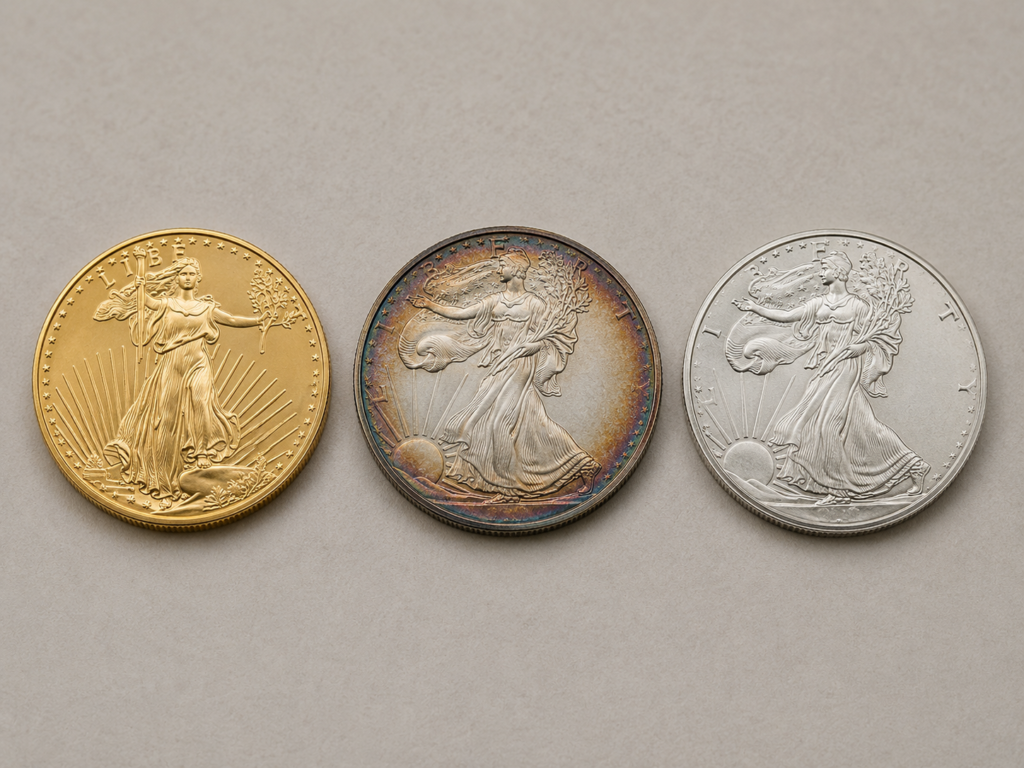
No, silver, gold, and platinum cannot rust. Rust is the oxidation of iron, and none of these metals contain iron. Gold and platinum do not tarnish in normal air either. Silver tarnishes, but the silver isn’t being lost — only its surface reacts with sulfur. Here is what each metal can and can’t do, and what the discoloration you’re looking at actually means.
Do precious metals rust? The short answer
No. Silver, gold, and platinum cannot rust, because rust is iron oxide and none of them contains iron. Gold and platinum are also resistant to tarnish and to ordinary corrosion. Silver doesn’t rust either, but it does tarnish — a surface reaction with sulfur in the air that forms silver sulfide, not iron oxide.
The reason this confuses people is that three different words get used for the same idea. Rust is the specific reaction of iron with oxygen and water. Tarnish is a thin surface film formed when a metal reacts with something in the air — for silver, almost always sulfur. Corrosion is the umbrella term that covers both of those, plus everything in between.
Most of the worry people carry about their bullion belongs in the tarnish bucket, which is cosmetic. Almost none belongs in the rust bucket, because rust on a precious-metal piece is almost always a sign that the piece isn’t what it claims to be.
The four metals an ordinary holder owns each behave a little differently. Gold is one of the most chemically inert elements known and does not react in air, water, or most acids. Platinum is similarly inert at ordinary temperatures. Silver does not rust, but it does react with the trace sulfur in normal indoor air.
Palladium sits closer to platinum than to silver — mostly inert at room temperature, with a thin oxide layer possible at industrial heat. The rest of this article expands each of those four sentences.
What rust actually is — and why precious metals can’t have it
Rust is the specific reaction of iron with oxygen and water. The product is hydrated iron oxide (Fe₂O₃·xH₂O), the flaking red-brown layer that builds up on an old tool left out in the rain. The reaction continues inward until the iron underneath is consumed. That is what makes rust structurally destructive: the oxide layer doesn’t seal the metal off, it lets the next layer rust too.
The keyword is iron. Gold, silver, platinum, and palladium are not iron. They cannot rust by definition. A coin or bar that is visibly rusting — flaking red-brown corrosion, pitting under the surface — does not contain precious metal where the rust is.
This is one of the most reliable counterfeit tells in bullion authentication. Gold-plated steel novelty bars rust through the plating because the base metal is iron. Silver-plated copper-zinc rounds can do the same. If a piece shows real rust, run authentication before doing anything else — our guide on spotting fake gold and silver walks through the full counterfeit-detection toolkit.
Corrosion is the broader category — any chemical degradation of a metal counts as corrosion. Three terms live underneath it that are useful to keep distinct:
- Rust: The specific reaction of iron with oxygen and water. Destructive. Only happens to iron-bearing metals.
- Tarnish: A thin surface film formed when a metal reacts with something in the air, usually sulfur or oxygen. Mostly cosmetic. Doesn’t reduce metal content.
- Patina: The stable, equilibrium end-state of a surface reaction — a layer that has stopped advancing and now protects the metal beneath it. Often decorative; on some coins it adds value.
Getting the vocabulary right does most of the work in this article. None of these metals rusts. Silver tarnishes. Gold and platinum do neither under normal conditions. The rest is detail.
Can gold rust or corrode?
No. Gold doesn’t rust because it contains no iron, and it doesn’t corrode in ordinary conditions because gold is one of the most chemically noble elements known. It doesn’t react with oxygen, water, or single strong acids at room temperature. Pure gold recovered from a 2,000-year-old shipwreck is typically as bright as the day it sank.
Gold sits near the bottom of the reactivity series — the standard ranking chemists use to compare how readily metals give up electrons. In a chemistry textbook, gold is the reference example of a noble metal. It does not react with oxygen at any temperature. It does not dissolve in concentrated hydrochloric acid alone, nitric acid alone, or sulfuric acid alone. It does not tarnish in air.
There are exceptions, and stating them precisely matters. Gold dissolves in aqua regia, a 3:1 mixture of concentrated hydrochloric and nitric acid whose Latin name means “royal water.” It dissolves in cyanide solutions, which is the basis of large-scale mining recovery. It reacts with chlorine gas at high temperatures and forms an amalgam with mercury on contact.
None of those conditions occurs in a home safe, a depository vault, or anywhere an ordinary holder stores bullion. A gold bar in a closet will be chemically unchanged in a century. Our guide to what counts as gold bullion covers the umbrella context.
What about discoloration on gold jewelry? The red or green spots that appear on a 10K or 14K ring are from the alloy metals, not the gold. By weight, 10K gold is 41.7% gold, 14K is 58.3%, 18K is 75%, and 24K is .999 fine. The balance is copper, silver, zinc, nickel, or palladium depending on the karat and color.
The copper in low-karat gold tarnishes; the silver in white gold tarnishes, too. The gold atoms themselves do not. .999 fine gold bullion does not discolor at all under normal conditions.
Gold’s chemical inertness is one of the oldest reasons it has been used as a store of value. The metal recovered from a Spanish wreck is still the same metal that went down, in the same weight, with the same purity. The chemistry doesn’t care about the calendar.
Can silver rust? No, but it does tarnish
No. Silver cannot rust, because rust is iron oxide and silver contains no iron. Silver does tarnish, which is a different reaction — silver atoms on the surface combine with sulfur compounds in the air, mainly hydrogen sulfide, to form a thin layer of silver sulfide (Ag₂S).
The black, brown, or rainbow film on a tarnished coin is silver sulfide. It is not rust, and the silver underneath is unchanged.
The chemistry is sulfidation, not oxidation. Silver and oxygen alone don’t react meaningfully at room temperature — silver oxide forms only under heat or chemical attack. What silver does react with is sulfur, and the trace hydrogen sulfide (H₂S) and carbonyl sulfide (OCS) in ordinary indoor air are enough to drive the reaction over time.
The rainbow phase that appears before the film turns black is a thin-film optical effect: the silver sulfide layer is still thin enough to bend light at different wavelengths. On some coins, collectors call this toning, and on a Morgan dollar with the right pattern, toning can add real numismatic value rather than subtract it.
For melt value, none of this matters. Tarnish is a surface film microns thick. The silver in a one-ounce Eagle is still one troy ounce of silver. The refinery buyer pays by weight and purity, not by color. See our melt value guide for the full framing. Numismatic graders care about toning — heavy or uneven tarnish can affect a coin’s grade — but that’s a separate consideration from whether the silver is damaged. It isn’t.
A common follow-up question: Does .999 fine silver tarnish?
Yes, often faster than 90% silver, because pure silver is more chemically available. Higher fineness does not protect the metal — what protects it is storage. Our guide on how to keep silver from tarnishing covers the six-step storage method, the products that actually work, and the locations that don’t.
What if the silver looks rusty — red-brown flaking, structural pitting? Two possibilities. Either the piece is silver-plated over a base metal that contains iron and the plating has worn through, or the piece is counterfeit. Real .999 fine silver and 90% coin silver do not produce red-brown rust. Run authentication.
Can platinum rust or tarnish?
No. Platinum doesn’t rust, because it contains no iron, and it doesn’t tarnish in ordinary air either. Under most conditions it is more chemically inert than gold — it doesn’t react with oxygen, water, or single strong acids at room temperature. A platinum coin or wedding ring stays bright with no special storage.
Platinum is a platinum-group metal (PGM), the six-element family in the middle of the periodic table that also includes palladium, rhodium, ruthenium, iridium, and osmium. PGMs share a set of properties: extreme chemical inertness, very high melting points, and catalytic activity in industrial use.
Platinum specifically is what catalytic converters and laboratory crucibles are made of, precisely because it tolerates conditions that would destroy most other metals.
There are exceptions, stated precisely. Platinum dissolves slowly in aqua regia. It reacts with fused molten alkali at high temperature and with concentrated cyanide. It can form thin oxide films above roughly 500°C (932°F), but those films decompose back to platinum metal on cooling.
None of those conditions occurs in a normal storage environment. Platinum jewelry that looks dull is almost always scratched, not corroded, and polishing restores the shine because the metal underneath is unchanged.
Practically: platinum bullion needs much less protection than silver. A Platinum American Eagle stored in a drawer for a decade will look the same as the day it left the mint. Silver in the same drawer will tarnish. Many platinum holders never bother with capsules, anti-tarnish strips, or silica gel — there’s nothing for those products to do.
What about palladium and the other platinum-group metals?
Palladium is chemically similar to platinum and, in practice, is also a non-tarnishing metal at ordinary storage temperatures. It does react with sulfur and chlorine more readily than platinum does, and at industrial temperatures above roughly 350°C (660°F) it forms a thin palladium oxide layer that re-decomposes on cooling.
At room temperature in a clean home, a Palladium Maple Leaf will not develop a meaningful film.
Rhodium — the bright reflective coating on white-gold jewelry and on the Royal Canadian Mint’s Rhodium Maple Leaf — is extraordinarily inert. It is, by most measures, more chemically stable than platinum. Ruthenium, iridium, and osmium are also non-tarnishing at retail scale, though they aren’t commonly traded as bullion.
The practical takeaway across the four metals an ordinary holder actually owns: only silver develops a visible film in normal storage. Gold, platinum, and palladium all stay bright.
The real-world reactions you’ll actually see on bullion
Chemistry is one thing; what shows up on a coin in a tube is another. Four reactions account for nearly all of the discoloration you may see on real pieces.
Silver sulfidation: the black or rainbow film
This is the default reaction to silver bullion. Sulfur comes from household combustion (natural-gas appliances, traffic exhaust), foods (eggs, onions, mayonnaise, cruciferous vegetables), wool and felt fabrics, and most rubber. Humidity doesn’t cause the reaction, but it accelerates it. The fix is storage, not cleaning.
PVC damage: the green slime
Old soft plastic coin flips, and album pages — anything made of polyvinyl chloride — outgas hydrochloric acid as the plastic ages. The acid reacts with silver and copper to form chlorides, which appear as a green, greasy film. PVC damage is the most common cause of the “green crust on silver” question, and it is the most damaging real-world reaction people see on bullion.
PVC attack etches the metal surface and is not reversible. Throw out any soft, sticky flip. Modern Mylar flips (Saflip and equivalents) are PVC-free and safe.
Copper tarnish on 90% silver
Pre-1965 U.S. coinage is 90% silver and 10% copper. The copper tarnishes on its own to brown, red, or green depending on the local chemistry, independent of the silver.
A junk silver coin showing brown or green spots is showing copper reactions, not silver decay. The silver content is unchanged. Our junk silver guide covers the composition and melt math in detail.
True rust: almost always a counterfeit tell
If a coin or bar shows actual rust — red-brown flaking, pitting under the surface, the piece contains iron. Real gold, silver, platinum, and palladium do not produce this kind of damage in normal conditions. A “gold” bar that rusts is plated steel. A “silver” round that rusts is plated base metal. Run authentication.
Does any of this affect your bullion’s value?
For bullion priced at melt — generic rounds, bars, junk silver, the bullion-grade portion of Eagles and Maples — tarnish does not change the price. The refinery buyer is paying for metal content in troy ounces, and the metal content is unchanged by a surface film. Color is invisible to the scale.
For numismatic and graded coins, the answer is more nuanced. Light, even toning can add value — some collectors specifically seek rainbow-toned Morgans. Heavy or uneven tarnish can lower a coin’s grade. PVC damage almost always lowers value.
And cleaning to remove tarnish, for any coin destined for grading, almost always destroys more value than the tarnish was costing. The grading services treat “cleaned” as a permanent mark on a holder. Our guide on whether to clean silver coins covers the full argument.
For gold and platinum specifically, the value question rarely comes up — these metals don’t develop a film under normal storage. If a gold or platinum piece is visibly corroded in a way that affects value, the most likely explanation is that the piece isn’t what it claims to be.
What to do next: storage, cleaning, and tracking what you own
For silver: the answer to tarnish is storage, not cleaning. Direct-fit capsules or PVC-free Mylar flips, anti-tarnish strips inside the storage container, silica gel to control humidity, and a climate-controlled location away from sulfur sources. The full six-step method is in the silver storage piece linked above.
For gold, platinum, and palladium: storage is mostly about physical protection and theft prevention, not chemistry. Capsules protect against handling marks; safes and depositories protect against theft and fire. No anti-tarnish products are needed. Our guides on home storage of gold and depositories versus safe deposit boxes cover the trade-offs.
The chemistry is the easy part. The harder part, in our experience, is keeping a clear record of what you actually own as the position grows. A long-term holder ends up with pieces acquired at different times — some bright, some toned, some recently bought and sealed, some inherited from a relative with no paperwork. A spreadsheet captures the dollars but not the per-piece state, and at five or ten years it stops working.
Gold Silver Ledger replaces the spreadsheet at the point where the spreadsheet gives up. The Holdings page shows every piece in the portfolio at a glance — metal, weight, original cost — with total cost basis and current portfolio value side by side, gain or loss per piece and across the whole portfolio, and search, filter, and tag controls that scale past 50 pieces.
Display unit is user-selectable: Troy ounces, grams, or kilograms. Condition tags travel with each piece, which matters more than the chemistry, because the chemistry stops worrying you once you understand it.
Frequently asked questions
Can silver rust?
No, silver does not rust, because rust is iron oxide and silver contains no iron. What silver does is tarnish: a separate reaction with sulfur in the air that forms a thin layer of silver sulfide on the surface. The silver itself isn’t damaged, and the melt value is unchanged.
Can gold rust?
No, gold does not rust and does not corrode in ordinary conditions. Gold is one of the most chemically inert elements known; it doesn’t react with oxygen, water, or single strong acids at room temperature. Pure gold artifacts recovered from ancient shipwrecks are typically as bright as the day they were made.
Does platinum tarnish?
No, platinum does not tarnish in ordinary air, water, or normal storage conditions. It is more chemically inert than gold under most conditions, which is one of the reasons it is used in catalytic converters and laboratory equipment. Platinum bullion stays bright with no special storage required.
Does palladium tarnish?
Mostly no, palladium does not tarnish meaningfully at room temperature in a clean home, though it can form a thin oxide film at industrial heat above roughly 350°C (660°F) or under heavy sulfur or chlorine exposure. For ordinary bullion storage, palladium behaves much like platinum.
What is the green crust on my old silver coin?
It is almost always PVC damage from old plastic flips, not tarnish. Polyvinyl chloride outgasses hydrochloric acid as it ages, and the acid reacts with silver and the copper in 90% silver to form chlorides that appear as a green, greasy film. Throw out any soft plastic flip and switch to PVC-free Mylar (Saflip and equivalents) or direct-fit capsules.
Does .999 fine silver tarnish?
Yes, and sometimes faster than 90% silver. Higher purity means more chemically available silver to react with sulfur. Fineness does not prevent tarnish; storage does.
Is tarnish the same as patina?
Not exactly. Tarnish is the active surface reaction — a sulfide film still forming or thickening. Patina is the stable end-state of that reaction — a layer that has stopped advancing and now protects the metal beneath it. On copper, the green patina is decorative and structural; on silver, the line between tarnish and patina is somewhat subjective and depends on the grading service’s opinion.
Does tarnish reduce a silver coin’s value?
Not for bullion sold at melt — refineries pay for metal content, and metal content is unchanged by a surface film. For numismatic and graded coins it depends on the type and severity of toning. Light even toning can add value, while heavy or uneven tarnish or PVC damage can lower it. Cleaning to remove tarnish almost always lowers the value further.
A ledger for the long-term holder
The chemistry is settled. Your gold and platinum aren’t going anywhere, and your silver tarnishes but isn’t being lost. What does change over time is the portfolio: what you bought, when, at what price, and what it’s worth today. That is the harder problem, and it’s the one we built for.
Gold Silver Ledger is the calm, unpressured way to track a precious metals position over the years and decades that holders actually hold. Every piece in one view.
Cost basis captured at purchase. Current value at today’s spot. Gain or loss per piece and across the whole portfolio. Search, filter, and tag controls that scale past 50 pieces.
No buy-now buttons, no price predictions, no noise.
