
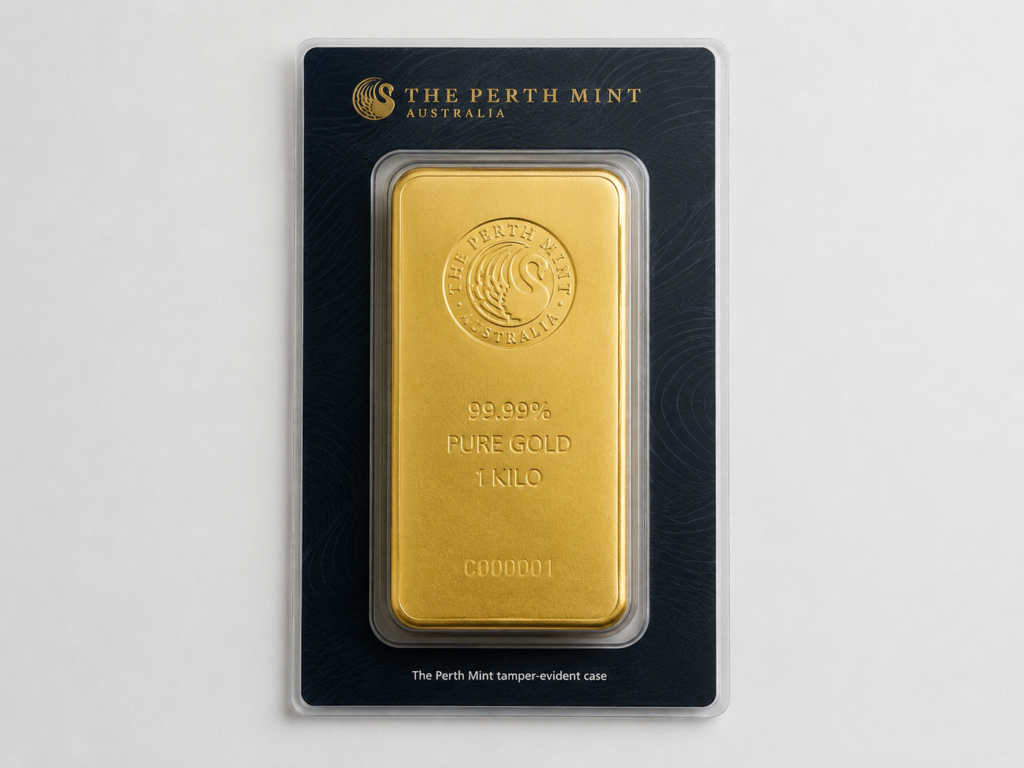
Gold bars are made in standard sizes from one gram to four hundred troy ounces. The four sizes the market actually trades in volume are the 1 oz bar (31.1 g), the 1 kilo bar (1,000 g, or 32.15 troy oz), the 100 oz COMEX delivery bar (3,110 g, or 6.86 lb), and the 400 oz London Good Delivery bar that central banks hold (about 12.4 kg, or 27.4 lb). Here is every standard size, what it weighs, and how the market uses it.
The most common gold bar weights at a glance
A standard 1 oz gold bar weighs 31.1 grams — exactly one troy ounce. A 1 kilo gold bar weighs 1,000 grams, equal to 32.15 troy ounces or 2.2 lb. The 100 oz COMEX bar weighs about 3,110 grams (6.86 lb). The 400 oz LBMA Good Delivery bar — the size kept in central-bank vaults — weighs about 12,441 grams, or 27.4 lb.
A note on units: precious metals are weighed in troy ounces, not the avoirdupois ounces on a kitchen scale. One troy ounce is 31.1034768 grams (we round to 31.1 g in body), about 1.097 regular ounces. The full conversion picture lives in our troy ounce explainer.
A note on what this article covers: gold bars only. Gold coins, gold rounds, gold jewelry, and gold-plated novelty bars are separate categories — see the gold bullion umbrella for the broader category overview, the best gold coins guide for the coin side, and the gold rounds piece for the round-shaped privately minted alternatives.
Standard gold bar sizes: the complete table
Every standard gold bar size sold by recognized refiners, smallest to largest. Sizes the market actively trades are marked in the notes column.
| Size | Grams (g) | Troy ounces (oz t) | Pounds (lb) | Notes |
|---|---|---|---|---|
| 1 g | 1.000 | 0.0322 | — | Smallest standard size; gift / micro-purchase |
| 2.5 g | 2.500 | 0.0804 | — | |
| 5 g | 5.000 | 0.1608 | 0.011 | |
| 10 g | 10.000 | 0.3215 | 0.022 | |
| 20 g | 20.000 | 0.6430 | 0.044 | |
| 1 troy oz | 31.103 | 1.0000 | 0.069 | Most-traded retail size |
| 50 g | 50.000 | 1.6075 | 0.110 | |
| 100 g | 100.000 | 3.2151 | 0.220 | |
| 10 troy oz | 311.035 | 10.0000 | 0.686 | Common size |
| 250 g | 250.000 | 8.0377 | 0.551 | Thin trading |
| 500 g | 500.000 | 16.0755 | 1.102 | Thin trading |
| 1 kilo | 1,000.000 | 32.1507 | 2.205 | COMEX-deliverable; retail workhorse |
| 100 troy oz | 3,110.347 | 100.0000 | 6.857 | COMEX delivery bar |
| 400 troy oz (nominal) | ~12,441 | ~400 | ~27.4 | LBMA Good Delivery; range 350–430 oz t |
Conversions use 1 troy oz = 31.1034768 g and 1 lb = 453.592 g. See our precious metals conversion chart for the full unit reference.
Four of these sizes do most of the work. The 1 oz bar is the standard retail starting size — small enough to gift, easy to verify, and divisible across a portfolio. The 1 kilo is the retail workhorse, where the premium per gram drops into a lower tier.
The 100 oz is the COMEX-deliverable size held by depositories and serious individual investors. The 400 oz Good Delivery bar is what central banks and the LBMA-accredited clearing system actually move.
Everything between the 1 oz and the 1 kilo exists, but the in-between sizes (50 g, 100 g, 250 g, 500 g, 10 oz) trade in lower volume — closer to the gift and smaller market than the institutional one. The form-factor decision framework in our coins versus bars piece applies to gold the same way it does to silver.
The 1-kilo gold bar: the retail workhorse
The 1-kilo bar is the most-traded retail-accessible gold bar in the world. It is a COMEX-accepted delivery size, the reference unit for serious individual buyers, and the largest size where per-gram premium reaches the lowest tier most retail buyers will see — typically 2–4% over spot from major refiners.
- Weight: 1,000 grams (32.1507 troy oz, 2.205 lb).
- Fineness: typically .9999 (four nines), occasionally .999. Both qualify for COMEX delivery and IRA eligibility.
- Typical dimensions: roughly 80 mm × 40 mm × 18 mm for a minted (struck) 1 kilo bar sealed in an assay card. Cast bars vary more in profile.
- Common producers: PAMP Suisse, Valcambi, Argor-Heraeus, the Royal Canadian Mint, Perth Mint, Asahi Refining, Heraeus.
The 1 kilo is the size where the math starts to favor bars over coins for someone building a real position. Below 1 kilo total, most people default to coins for divisibility and resale flexibility. At 1 kilo and up, the premium savings are large enough to matter.
The catch is divisibility. A 1 kilo bar sells whole. A buyer cannot split it into a half-position sale. Anyone planning partial liquidations is usually better off with two 500 g bars, five 10 oz bars, or thirty-two 1 oz pieces — accepting a slightly higher per-gram premium in exchange for the ability to sell in chunks.
The PAMP versus Credit Suisse comparison covers refiner-level resale differences at the 1 kilo size.
The 100 oz gold bar: the institutional-retail bridge
The 100 troy oz bar sits between the retail 1 kilo and the central-bank 400 oz Good Delivery. It is the deliverable size on the COMEX gold futures contract and the bar most often held by IRA custodians, private depositories, and high-net-worth individuals.
- Weight: 3,110.35 grams (100 troy oz, 6.857 lb).
- Fineness: minimum .995 under the COMEX gold contract specification; most modern bars are .999 or .9999.
- Typical dimensions: cast (poured) form, roughly 165 mm × 75 mm × 35 mm. Minted 100 oz bars exist but are uncommon — most 100 oz bars are cast.
- Common producers: Royal Canadian Mint, Johnson Matthey (historical), Engelhard (historical), Asahi Refining, Sunshine Minting.
The 100 oz is the size that private depositories and COMEX vaults actually move. Premium per gram is the lowest of any retail-accessible size — typically 1–3% over spot from major dealers, sometimes negative on private-party bulk trades. For an individual buyer, this is the largest bar most will physically handle.
A 100 oz bar is also the size where home storage starts to look impractical. The dollar value concentrated in one piece exceeds the threshold most household insurance riders will cover without an itemized rider, and the bar itself is dense and small enough to be a target. Most 100 oz buyers move to a private depository at this size — the trade-offs between depositories and safe deposit boxes are covered in our gold storage piece.
The 400 oz Good Delivery bar: what central banks trade
The London Good Delivery bar is the size held in the vaults of central banks, the Bank of England, and the LBMA-accredited refiners and depositories that clear physical gold for the global market. It is the bar visible in any photograph of Fort Knox, the Federal Reserve Bank of New York vault, or the Bank of England gold vault.
- Weight: 350–430 troy oz per bar, with a nominal target of about 400 troy oz (~12.4 kg, ~27.4 lb). The range is a feature of the casting process, not a defect — see the LBMA Good Delivery Rules for the full specification.
- Fineness: minimum .995 (995 parts per thousand pure gold).
- Dimensions: approximately 250 mm × 70 mm × 35 mm at the base, with a trapezoidal cast profile.
- Refiner: must be on the current LBMA Good Delivery List, which lists about 65 accredited refiners worldwide. Each bar carries the refiner stamp, serial number, year, and assayed fineness.
Good Delivery bars are cast, not struck. A casting that comes out 392.4 troy oz is still a Good Delivery bar; the assay tag records the exact weight to two decimal places, and that recorded weight is what trades. The 350–430 oz range is a quality specification, not a sloppy tolerance.
Who holds these: central banks, the Bank of England, the IMF, LBMA-accredited refiners, COMEX-approved depositories, and the ETFs that physically hold gold (SPDR Gold Shares, iShares Gold Trust). According to the U.S. Mint Fort Knox fact sheet, the United States Bullion Depository holds about 147.3 million troy oz of gold — primarily in Good Delivery bars, which works out to roughly 368,000 bars at the nominal 400 oz weight.
Individual retail buyers can technically buy a 400 oz bar, but rarely do — the unit price exceeds what most household budgets justify in one piece, and divisibility for partial sales is lost. The physical-versus-paper question that drives some buyers toward ETFs at this size is covered in our breakdown of physical gold versus gold ETFs versus mining stocks.
The 400 oz Good Delivery bar is what “a gold bar” means in a financial system context. The 1 oz bar in your home safe and the 400 oz bar in a central bank vault are the same metal in different packaging, scaled by a factor of four hundred.
Cast vs. minted gold bars: same weight, different look
Cast versus minted is a production-method distinction. It does not change the weight of a given size — a 100 g cast bar and a 100 g minted bar both weigh 100 g — but it changes the bar’s dimensions, appearance, and typical premium.
Cast (poured) bars
Molten gold is poured into a mold and allowed to solidify. The surface is uneven, the edges are rounded, and each bar is slightly unique. Cast bars are the production standard above 100 g and the universal standard at the 100 oz and 400 oz sizes. Lower production cost means the lowest premium per gram in any given size. Refiners using cast methods include Valcambi, the PAMP cast line, Argor-Heraeus, and the Royal Canadian Mint.
Minted (struck) bars
A blank is cut from a sheet of gold and struck between dies, like a coin. The surface is flat, the edges are crisp, and the bar is typically sealed in a tamper-evident assay card with a matching serial number. This is the standard for sizes from 1 g to 1 kilo. Higher production cost translates to 1–3% higher premium than a comparable cast bar in the same size. Refiners include PAMP Suisse Fortuna, Credit Suisse, and the Perth Mint minted line.
Weight is the same for a given size. The choice between cast and minted is premium versus presentation.
Choosing a bar size: the premium-vs-divisibility trade-off
Premium curve
Premium over spot drops sharply as bar size increases. Typical retail ranges, before shipping and tax: 1 g and 5 g bars run 8–15% over spot. 1 oz bars run 4–6%. 1 kilo bars run 2–4%. 100 oz bars run 1–3%. The gap between a 1 oz and a 1 kilo is real money at meaningful position sizes — the dynamic and how to measure it sits in our premium over spot guide.
Divisibility
A bar sells whole. A 1 kilo bar that cost (say) $80,000 to acquire returns about $80,000 at sale, minus the dealer spread; it cannot be split into a $20,000 sale and a $60,000 hold.
People planning partial liquidations across years often build the position in smaller bars (10 oz, 1 oz) instead, accepting a higher per-gram premium for divisibility. The $80,000 figure is an illustrative number, not a current quote.
Verification and storage
Larger bars concentrate more value per piece, which simplifies tracking but increases the per-piece consequence of loss or counterfeit. Smaller bars spread value across more pieces, lowering the per-piece consequence but increasing the per-piece premium and the recordkeeping load.
Most multi-bar investors end up holding a mix — a few 1 oz bars for divisibility, one or two 10 oz or 1 kilo bars for premium efficiency, and few or none of the in-between sizes unless inherited or gifted.
Verifying weight at home
Bar weight is the single most useful authentication check a buyer can perform without specialized equipment. A bar that weighs even 0.5 g light is almost certainly a problem.
- Use a jeweler’s scale, not a kitchen scale: A scale rated to 0.01 g, available for $15–$30, is the minimum equipment for any serious buyer. Kitchen scales display 1 g resolution at best — not precise enough for gold-bar verification.
- Weigh against the bar’s stamped weight, not a memorized figure: A bar stamped “100 g” should weigh 100 grams within the manufacturer’s tolerance (about ±0.05 g). A bar stamped “100 g NET” should weigh 100 g without the capsule. Read the stamp first.
- Cross-check against dimensions and density: Gold’s density is 19.32 g/cm³ — substantially higher than tungsten (19.25 g/cm³, the only common counterfeit metal close on density) and far higher than lead (11.34 g/cm³). A bar of the correct weight in the wrong dimensions is suspect.
Weight alone is not sufficient for high-confidence authentication above 1 oz — tungsten-cored counterfeits exist, though they are uncommon in legitimate dealer channels. For bars from established refiners with assay cards intact, weight verification handles most of the practical risk; the full counterfeit-detection playbook covering ping test, magnet, ultrasonic, and acid is in our fake gold and silver guide
Above the 100 oz size, professional assay is warranted at sale.
Tracking gold bars in a portfolio
Bars are easier to track than coins in some ways. Each piece comes with an assay card stating the exact weight, serial number, refiner, and fineness — facts that do not change over time and are easy to record once. They are harder in other ways. A multi-bar position mixes 1 oz, 10 oz, and 1 kilo pieces from different refiners, purchased at different spot prices across years, sometimes with different premium structures depending on the dealer and the cycle.
Calculating total cost basis, current value at today’s spot, and per-bar gain or loss in a spreadsheet works for the first few purchases and starts breaking around the fifth or sixth bar from different refiners on different dates.
The recordkeeping matters most at sale. When a bar comes apart from the position — for a home purchase, an inheritance distribution, or a portfolio rebalance — the taxable gain is computed against that specific bar’s cost basis (the original purchase price, including premium and applicable adjustments).
The IRS treats gold bullion as a collectible, taxed at up to 28% on long-term gains rather than the lower 15%/20% on most assets. Without per-bar records, the seller is forced to either over-report (and overpay tax) or scramble for receipts. This article is not tax advice; consult a qualified tax professional for your situation.
Gold Silver Ledger replaces the spreadsheet the moment the spreadsheet stops working. A Holdings page shows every bar in the portfolio — weight, refiner, purchase price, current value at today’s spot — with total cost basis and current portfolio value side by side, gain or loss per bar and across the whole portfolio, and search, filter, and tag controls that scale past 50 pieces. It is built for the multi-year holder, not for the trader moving in and out of positions weekly.
Frequently asked questions
How much does a standard gold bar weigh?
There is no single “standard” gold bar weight — standard sizes range from 1 gram to 400 troy ounces. The most-traded sizes are the 1 oz bar (31.1 g), the 1 kilo bar (1,000 g), the 100 oz COMEX bar (3,110 g), and the 400 oz LBMA Good Delivery bar (about 12,441 g).
How much does a 1-kilo gold bar weigh in pounds?
A 1-kilo gold bar weighs 2.205 pounds — 1,000 grams, which is equal to 32.1507 troy ounces. It is the most-traded retail-accessible bar size and the largest bar most individual buyers will physically handle.
How much does a 400-oz gold bar weigh?
A nominal 400 troy oz London Good Delivery bar weighs about 12,441 grams, or 27.4 pounds. The Good Delivery specification allows individual bars to weigh anywhere between 350 and 430 troy ounces; the assay tag records the exact weight of each bar to two decimal places.
How much is a gold bar worth?
A gold bar’s value is the bar’s weight in troy ounces multiplied by the current gold spot price, plus a premium that varies by size and refiner. Live spot moves continuously during market hours — for the current price and how the calculation works, see our gold spot price page.
How heavy is the gold bar in Fort Knox?
Fort Knox holdings are stored predominantly in 400 troy oz Good Delivery bars, each weighing approximately 27.4 pounds. The U.S. Mint reports the depository holds about 147.3 million troy ounces of gold, which works out to roughly 368,000 bars at the nominal 400 oz weight.
What is the largest gold bar in the world?
The largest single gold bar on record is a 250-kilogram (551 lb) bar cast by Mitsubishi Materials in 2005, on permanent display at the Toi Gold Museum in Japan. The largest gold bar that actively trades, rather than sits on display, is the 400 oz LBMA Good Delivery bar.
Can you buy a 400-oz gold bar as an individual?
Yes, technically, most major dealers will quote a 400 oz Good Delivery bar on request, and depositories accept individual ownership of them. In practice, individual retail buyers rarely do; the unit price typically exceeds what household budgets justify in a single piece, and divisibility for partial sales is lost. Buyers who want exposure at that scale without taking physical delivery typically use a gold ETF, custodied bullion, or a depository account instead.
What is the smallest gold bar?
The smallest commonly available gold bar is the 1-gram bar (0.0322 troy oz), sold sealed in a tamper-evident assay card. Even smaller half-gram and quarter-gram pieces exist as gifts and curiosities, but the 1 g size is the smallest with reliable resale liquidity. Per-gram premium is highest at this size — expect 8–15% over spot.
A ledger built for bar buyers
The case for tracking compounds with the position. One 1-kilo bar fits on an index card. Twenty bars from five refiners, bought across eight years at eight different spot prices, do not — and they are the bars whose cost basis will matter most when one of them is sold.
Gold Silver Ledger is built for the long-term holder. Every bar in the portfolio shows up on the Holdings page with weight, refiner, original cost, and current value at today’s spot, side by side. Gain or loss per bar and across the whole portfolio. Search, filter, and tag controls that scale past 50 pieces.
The spreadsheet works for the first few bars; after that, this is the tool. Start tracking for free.
This article is educational, not financial or tax advice. Talk to a qualified professional before making investment or tax decisions.
