
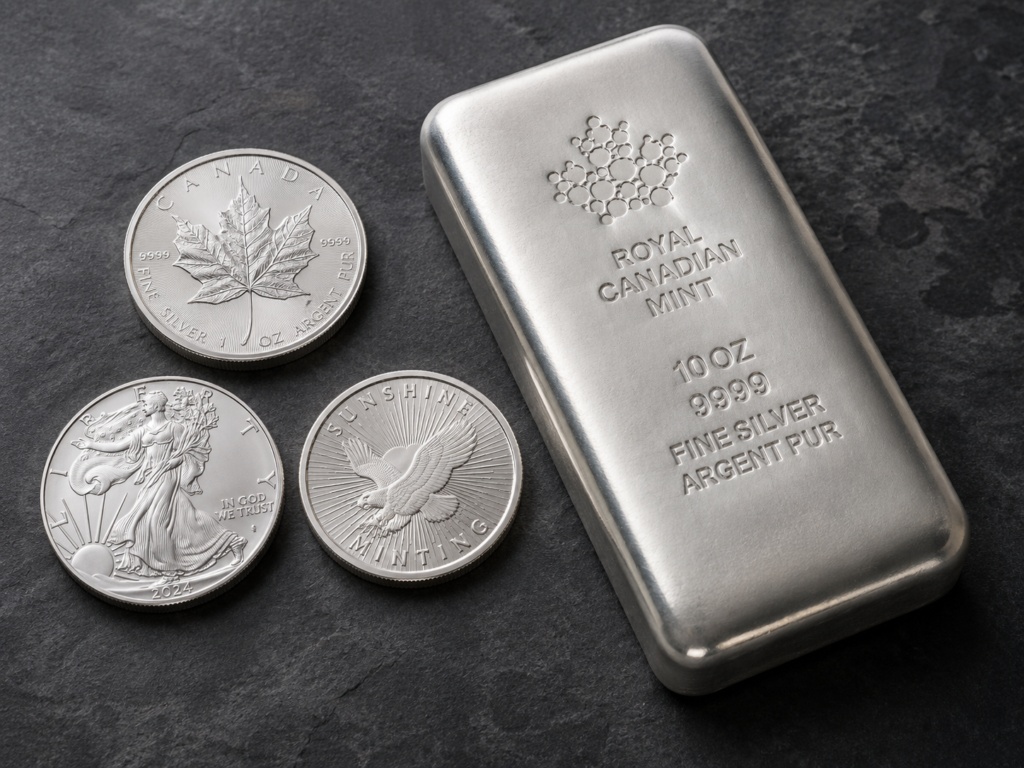
Silver coins cost more over spot but resell easily anywhere. Silver bars cost less per ounce but trade in larger chunks. For most, the right answer is both — start with a 1 oz Silver Eagle or Silver Maple for recognition, then move to 10 oz or 100 oz bars once your holdings grow. Here’s the math behind that recommendation.
The short answer
Most new investors should buy a 1 oz government coin first (American Silver Eagle or Canadian Silver Maple Leaf) for recognition and easy resale, then add 10 oz or 100 oz silver bars once they pass roughly 20–30 oz. Coins carry a higher premium (15–30% over spot for 1 oz Eagles) but resell at any dealer.
Bars carry a lower premium (5–8% over spot at 100 oz) but trade in larger pieces. A mix of both balances liquidity with premium efficiency.
That is the recommendation. The rest of this article defends it. Two terms come up throughout: spot price is the live wholesale price of one troy ounce of pure silver, and premium over spot is the markup a dealer adds for fabrication, distribution, and margin. Every retail silver price is spot plus a premium.
What are you paying for with silver coins?
Silver coins in a bullion context mean government-minted, legal-tender bullion coins. The American Silver Eagle (.999 fine, $1 face value, U.S. Mint since 1986) and the Canadian Silver Maple Leaf (.9999 fine, C$5 face value, Royal Canadian Mint since 1988) cover most U.S. retail demand. The Vienna Philharmonic, British Britannia, Mexican Libertad, and Chinese Panda fill the international roster.
Three things drive the higher premium. A national mint guarantees weight and purity. Legal-tender status makes counterfeiting a federal offense and supports broad dealer acceptance. And recognition: a 1 oz Silver Eagle or Silver Maple sells at virtually any reputable dealer in the country with no questions asked. That liquidity is real, and you pay for it.
In typical markets, 1 oz Silver Eagles run 15–30% over spot at retail and 1 oz Silver Maples run 10–20%. Premiums spike during retail demand surges — 2020 and 2022 both pushed Silver Eagle premiums above 50%. Our Silver Eagle vs Silver Maple comparison covers the coin-vs-coin choice in more detail.
One thing to know up front: 1 oz silver coins, especially Silver Eagles, are the most counterfeited silver bullion product. Built-in authentication features (reeded edges, sharp relief, micro-engraving on newer Maples) handle this at any established dealer, and buying from reputable sources eliminates the practical risk.
See our guide to how to spot fake gold and silver for the full playbook.
What are you paying for with silver bars?
Silver bars are privately or sovereign-minted rectangular ingots, .999 fine or higher, sized from 1 oz up to 100 oz. A 1-kilo bar equals 32.15 troy oz and sits between the 10 oz and 100 oz sizes. You see PAMP Suisse, the Royal Canadian Mint, Sunshine Minting, JM Bullion, Asahi, and A-Mark most often, with vintage Engelhard bars on the secondary market.
Two things drive the price. Refiner reputation — a PAMP or Royal Canadian Mint bar sells more easily and at a tighter spread than a no-name pour. And fabrication efficiency: minting a 100-oz bar takes roughly the same labor as a 1 oz coin, but the cost gets divided across 100 ounces. That math is the entire point of buying bars.
Typical retail premiums: 7–12% over spot on a 10 oz bar, 5–8% on a 100 oz, similar on a 1 kilo. On a $2,000 silver budget, the gap between a 30% Eagle premium and a 7% bar premium translates to roughly 10–15% more ounces in the same dollar amount.
Two trade-offs come with the lower premium. Divisibility: a 100 oz bar sells whole — you cannot sell 10 oz of it without liquidating the entire bar. Authentication: larger or older bars sometimes need an assay (ping test, XRF scan, weight and dimension check), especially generic pieces. Branded assay-card bars from recognized refiners like PAMP keep that friction near zero.
Side-by-side: coins vs bars at a glance
Typical retail ranges for 1 oz government coins and 10–100 oz private bars from recognized refiners. Premium percentages drift with market conditions.
| Factor | Silver Coins (1 oz government) | Silver Bars (10–100 oz) |
|---|---|---|
| Typical premium over spot | 15–30% (1 oz Eagle); 10–20% (1 oz Maple) | 7–12% (10 oz); 5–8% (100 oz) |
| Best size | 1 oz | 10 oz or 100 oz |
| Liquidity (resale) | Highest. Any dealer, anywhere. | High for branded refiners. Sell whole, not piecemeal. |
| Divisibility | 1 oz units. Sell one coin at a time. | Whole bar at minimum. Limited divisibility. |
| Recognition | Worldwide. Government-backed. | Strong for PAMP, RCM, Sunshine. Generic less so. |
| Counterfeit risk | Highest exposure (Eagles most counterfeited). Authentication features built in. | Lower for branded assay-card bars. Higher for generic pours. |
| Authentication at sale | Visual + edge check. Rarely an issue at established dealers. | May require ping test, XRF, or assay for off-brand pieces. |
| Storage footprint | 100 oz = 100 coins in tubes. More volume. | 100 oz = one bar, ~6.86 lb. Compact. |
| Best for | First buys, divisibility, gift / handoff, anywhere-resale. | Premium efficiency, larger positions, long-term hold. |
Coins win on liquidity, divisibility, and recognition. Bars win on premium efficiency. The decision is not which is “better” — it is which trade-offs match your goals. Most people want both.
Which should you buy first? A decision framework by budget
Three budget bands cover most first purchases. Find yours, and treat the suggestion as a starting pattern rather than a rule.
Under $500 (first purchase)
Lead with one or two 1 oz Silver Eagles or Silver Maples, then fill out the rest with five to ten generic 1 oz silver rounds from Sunshine, Asahi, or Scottsdale. The 1 oz coin premium is a small absolute dollar cost at this size, and the recognition payoff at first resale is worth it. A 10 oz bar is usually a bad first purchase here — it locks too much of the investment into a single illiquid piece.
$500–$2,000 (building the position)
Two to five 1 oz government coins plus one or two 10 oz bars from PAMP, the Royal Canadian Mint, or Sunshine. The 10 oz bar starts to earn its premium efficiency at this position size while still being divisible enough to liquidate without unwinding the whole inventory. Optionally add ten to twenty generic 1 oz rounds at the lowest 1 oz premium tier.
$2,000 and up (premium efficiency dominates)
Lean into 10 oz, 100 oz, and 1 kilo bars from PAMP, the Royal Canadian Mint, Sunshine, or A-Mark for the bulk of new purchases. Keep roughly 10–20% of the position in 1 oz government coins for liquidity and any gift or handoff flexibility you might need later. The percentage-point savings on bars compound at this position size.
Our guide to buying silver at or near spot and the notes on dollar-cost averaging into silver both come into play at this cadence.
Where do silver rounds fit?
Silver rounds are privately minted 1 oz pieces, .999 fine, with no face value and no government backing. Recognized mints (Sunshine, Asahi, Scottsdale) produce them in generic designs like the Buffalo or Walking Liberty. Premium runs 5–12% over spot for recognized brands — the lowest 1 oz premium tier.
Rounds sit in the middle. Against coins, they give up legal-tender status and a small amount of universal resale acceptance in exchange for a lower premium. Against bars, they keep 1 oz divisibility but lose the per-ounce efficiency of larger sizes.
Many people use generic rounds as the “working capital” layer — pieces they would liquidate first. Our complete guide to silver bullion covers all three forms together.
What mistakes do new investors make?
- Leading with fractional silver: Premium per gram on 1/10 oz and 1/4 oz pieces is brutal — sometimes 50% or more over spot. At any normal budget, 1 oz is the better unit.
- Buying numismatic or graded coins thinking they are bullion: A graded 1881-S Morgan dollar is a collector item priced for condition and rarity, not for melt. Our Morgan silver dollar value guide is the right starting point if collecting is the actual goal.
- Buying generic poured bars from unknown sources to save another dollar: Resale on unbranded pours is thinner, slower, and more likely to require an assay. The savings rarely justify the friction.
- Buying off social media ads, eBay sellers without strong feedback, or unsolicited direct messages: Counterfeit silver — especially Silver Eagles — is the most common precious-metals counterfeit. Buy from established dealers (APMEX, JM Bullion, Money Metals, SD Bullion, Hero Bullion, Kitco) or a reputable local coin shop.
- Going 100% bars on the first purchase to chase the lowest premium: A 100 oz bar locks the entire first purchase into a single piece. If the position needs to come apart, it comes apart whole.
- Not locking the price at order time: Online dealers quote a price that holds for a short window. Silver spot moves; the price you saw browsing is not the price you pay if the order sits in the cart. Our guide on when to buy silver covers the cadence question.
Tracking a mixed coin-and-bar portfolio
A mixed portfolio — say, twenty Silver Eagles, thirty generic rounds, three 10 oz bars, and a 100 oz bar — is six different product types with different premiums, different purchase dates, and different cost bases. The Eagles bought in 2024 do not have the same cost basis as the Eagles bought in 2026.
You will not remember which was which by 2028. A spreadsheet handles the first ten purchases fine; by purchase fifty, it starts breaking.
That is where a strong portfolio tracker earns its keep. Gold Silver Ledger gives you a Holdings page that shows every coin and bar, total cost basis, and current value side by side, gain or loss per piece, and across the whole portfolio, and search, filter, and tag controls that scale past fifty purchases. It replaces the spreadsheet the moment the spreadsheet stops working.
Frequently asked questions
Are silver coins or silver bars a better investment?
Silver coins and silver bars hold the same metal value per ounce, so neither is structurally a better investment — the difference is form factor, not asset quality. Coins carry a higher premium but resell more easily and divide into smaller units. Bars carry a lower premium but trade in larger pieces. For most new investors, a mix of both is the right answer.
Why do silver bars cost less than silver coins?
Silver bars cost less over spot because their fabrication cost is lower per ounce — a 100 oz bar takes roughly the same minting effort as a 1 oz coin, but that cost is divided across 100 ounces. Government coins also carry a recognition and legal-tender premium that private bars do not. Our breakdown of the premium over spot covers the fuller mechanics.
Should I buy 1 oz or 10 oz silver bars first?
A 10 oz silver bar from a recognized refiner is the better first bar purchase for most investors because it captures meaningful premium savings over 1 oz pieces while still being divisible enough to liquidate. 100 oz bars lock up too much position for a first purchase, and 1 oz bars give up most of the premium advantage that makes buying bars worthwhile.
What is the cheapest silver to buy?
The lowest-premium silver bullion is 100 oz and 1 kilo bars from recognized refiners, typically 5–8% over spot. Generic 1 oz rounds come next at 5–12%. Junk silver — pre-1965 U.S. dimes, quarters, and half dollars in 90% silver — sometimes trades 3–10% over melt at local coin shops.
Our guides on the lowest-premium silver and junk silver cover both paths.
Are silver bars harder to sell than silver coins?
Silver bars from recognized refiners (PAMP, Royal Canadian Mint, Sunshine, JM Bullion, Asahi) resell at any reputable dealer with little friction — the harder part is divisibility, not acceptance. A 100 oz bar sells whole, not piecemeal. Generic poured bars may require an assay before some dealers will buy them, which is why sticking with branded assay-card pieces matters.
Can I buy silver coins and bars from the same dealer?
Yes. Established silver dealers — APMEX, JM Bullion, Money Metals, SD Bullion, Hero Bullion, Kitco — sell both coins and bars from the same catalog, and reputable local coin shops do the same. Pricing the two side by side at one dealer is the cleanest way to compare premiums on the day of purchase.
Do silver coins or silver bars hold value better?
Both track the silver spot price at roughly equal rates over the long run because both are priced from metal content. Premiums on coins and bars compress and expand with market conditions, but neither structurally outperforms the other on metal value. Coin premiums tend to spike harder during retail demand surges, which advantages holders selling into one and disadvantages buyers entering during one.
This article is educational, not financial advice. Talk to a qualified professional before making investment decisions.
