
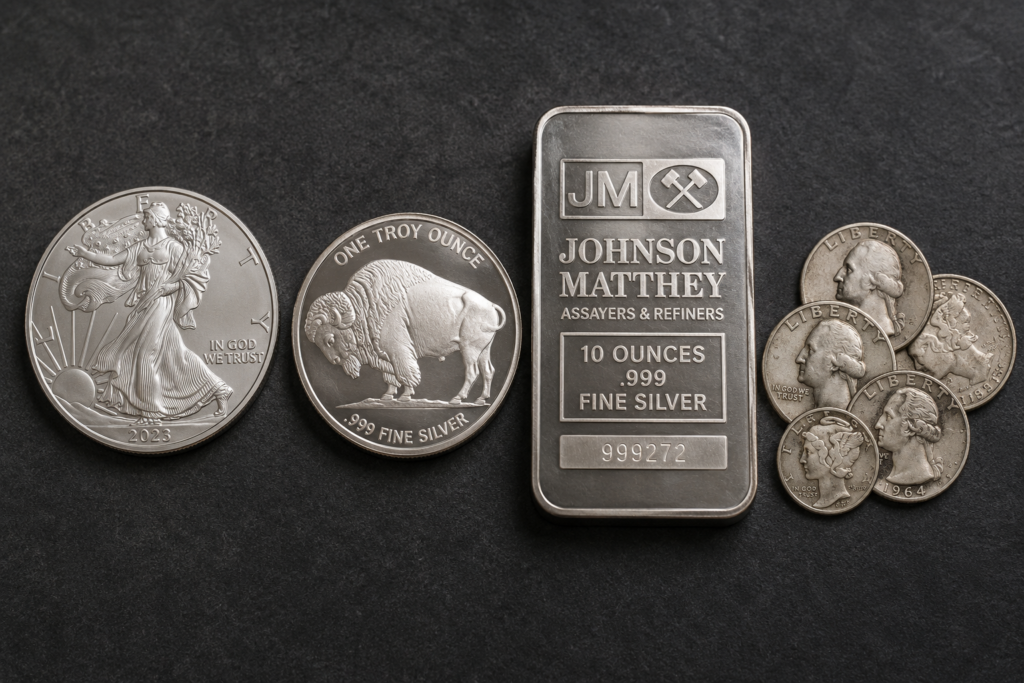
Silver bullion is investment-grade physical silver — coins, bars, or rounds — valued by the weight of metal inside, not the design on the outside. It is priced off live silver spot plus a small premium, and it is the most common entry point into precious metals because the per-ounce price is far lower than gold. Here is what counts, what does not, and how to start.
What is silver bullion?
Silver bullion is physical silver — bars, coins, or rounds — valued primarily by its metal content rather than by design, rarity, or condition. It is priced by weight at the current silver spot price plus a small dealer premium. Most modern silver bullion is .999 fine or higher; .999 is also the IRA-eligibility and the London Bullion Market Association (LBMA) Good Delivery minimum.
Three terms do most of the work there. Bullion is the category — the metal itself, sold by weight. Fineness is the share of pure metal in the piece, written as a decimal (.999 means 99.9% pure). Spot price is the live wholesale price of one troy ounce of pure silver — the number that scrolls across financial dashboards.
The defining trait of silver bullion is that the value of the piece comes from the metal, not the object. A 1 oz American Silver Eagle and a 100 oz JM Bullion bar are both silver bullion
A high-grade Morgan silver dollar is not — its value is rarity and condition, not metal content. But a heavily worn 1921 Morgan trades close to its silver melt value, which puts it back in bullion territory. This boundary case matters more in silver than in gold because of junk silver — pre-1965 U.S. coinage that trades for melt.
This article is the silver-specific guide. For the broader bullion category — gold, silver, platinum, and palladium together — see the umbrella explainer; for the gold-specific deep dive, see the gold bullion guide.
The three forms of silver bullion: coins, bars, and rounds
Silver bullion comes in three physical forms: government-minted coins, privately minted bars, and privately minted rounds. The form drives the premium you pay, how easy the piece is to resell, and how much volume you accumulate per dollar.
| Form | Issuer | Legal tender? | Typical premium over spot | Best for |
|---|---|---|---|---|
| Government-minted coins | Sovereign mints (U.S. Mint, Royal Canadian Mint, Perth Mint, etc.) | Yes (face value well below metal value) | 15%–30% on 1 oz coins; higher in demand spikes | Beginners; maximum recognition; easy resale |
| Privately minted bars | Refiners (RCM, PAMP, Sunshine, JM Bullion, Asahi, A-Mark) | No | 5%–12% on 10 oz–100 oz bars | People maximizing silver per dollar in volume |
| Privately minted rounds | Private mints (Sunshine, Asahi, Scottsdale; Buffalo and Walking Liberty designs) | No | 5%–12% on 1 oz rounds | Lower-premium alternative to government coins |
Government-minted coins lead on recognition. A 1 oz American Silver Eagle or 1 oz Canadian Silver Maple is recognized at any bullion dealer in the country, ships with legal-tender face value (the Eagle is $1; the Maple is C$5), and resells with no friction.
The trade-off is premium — government silver coins typically run 15%–30% over spot, and in retail demand surges (2020 and 2022, for example) Silver Eagle premiums climbed above 50% over spot.
Privately minted bars are where most serious investors end up over time. Premium drops sharply with size: a 10 oz bar typically sits 7%–12% over spot; a 100 oz bar typically sits 5%–8% over spot. The math is straightforward — for the same dollar budget, a buyer can acquire meaningfully more silver in bar form than in coin form.
The trade-off is divisibility (you cannot sell partial chunks of a 100 oz bar) and storage volume. The full silver coins versus silver bars comparison walks through when each form makes sense.
Privately minted rounds sit between coins and bars on the premium ladder for 1 oz pieces. They look like coins but carry no face value and no legal-tender status, which is exactly why their premium is lower — typically 5%–12% over spot for recognized mints (Sunshine, Asahi, Scottsdale). Resale is straightforward at any dealer for recognized brands; thinner for off-brand or no-name designs.
Standard silver bullion products
Within those three forms, four products cover most retail silver bullion buying. Each has its own premium pattern, recognition profile, and typical use case.
American Silver Eagle
.999 fine, 1 troy ounce of silver, legal tender at $1 face value. Produced by the U.S. Mint since 1986. The Silver Eagle is the most-traded silver bullion coin in the world by volume and the standard first-purchase coin for U.S. buyers.
Authentication features include a reeded edge and sharply defined design details — the Silver Eagle versus Silver Maple comparison covers how the two stack up side by side.
Canadian Silver Maple Leaf
.9999 fine (one nine higher than the Eagle), 1 troy ounce of silver, legal tender at C$5 face value. Produced by the Royal Canadian Mint since 1988. The Maple typically runs at a slightly lower premium than the Eagle.
Authentication features include micro-engraved radial lines on the field (introduced in 2014) and a bullion-DNA laser-marked maple leaf privy mark. Resale liquidity is as strong as the Eagle’s in U.S. markets and arguably better in Canada and globally.
Generic 1 oz silver rounds
.999 fine, 1 troy ounce of silver, no face value, no legal-tender status. Produced by private mints — Sunshine, Asahi, Scottsdale, and others — often in generic designs like the Buffalo or the Walking Liberty. Premium typically runs 5%–12% over spot, the lowest 1 oz tier.
Best for those who want maximum silver per dollar in a 1 oz package and do not need the legal-tender backing of a government coin. Resale is straightforward at any bullion dealer for recognized mint names; thinner for off-brand rounds.
10 oz, 100 oz, and kilo silver bars
.999 fine, sizes from 10 oz up to 100 oz (and 1 kilo, which equals 32.15 troy oz) from refiners like the Royal Canadian Mint, PAMP Suisse, Sunshine, JM Bullion, Asahi, and A-Mark. Premium drops sharply with size — a 10 oz bar typically sits 7%–12% over spot; a 100 oz bar typically sits 5%–8% over.
The most premium-efficient way to hold silver in volume. Trade-offs: bars are less divisible (you cannot sell 1 oz of a 100 oz bar), they take more storage volume, and some require an intact assay card for full resale liquidity.
A common starting pattern is one or two government coins (Silver Eagle or Silver Maple) for first-purchase recognition, then transitioning to 10 oz or 100 oz bars for premium efficiency once the buyer is comfortable.
Top silver coins for investment covers the international product roster — Vienna Philharmonic, Chinese Panda, Mexican Libertad, Britannia — for buyers who want diversity beyond the Eagle and Maple.
Understanding silver purity: .999, .9999, and sterling
| Fineness is the share of pure silver in a piece, expressed as a decimal. .999 means 99.9% pure (“three nines”); .9999 means 99.99% pure (“four nines”). Most modern silver bullion is .999 fine or higher; IRA eligibility and LBMA Good Delivery require .999 minimum. |
Almost all modern silver bullion is .999 or .9999 fine. Below that, two categories show up in conversations about silver but are not part of the bullion market.
| Marking | Decimal fineness | Common products |
|---|---|---|
| .9999 | 99.99% pure silver | Canadian Silver Maple Leaf; some Royal Canadian Mint bars |
| .999 | 99.9% pure silver | American Silver Eagle, Vienna Philharmonic, generic rounds, most modern silver bars |
| .925 (sterling) | 92.5% pure silver | Flatware, jewelry — NOT bullion |
| .900 (junk silver) | 90% pure silver | Pre-1965 U.S. dimes, quarters, half dollars — bullion-adjacent |
Sterling silver (.925) is the standard for silverware and silver jewelry — not bullion. A sterling tea service has real silver content and can be sold for melt, but it trades in a different market with different buyers and lower per-ounce realized value.
Sterling silver covers the composition and sale path in detail. Many beginners ask whether grandmother’s silverware is silver bullion — it is not, but it does have melt value.
Pre-1965 U.S. dimes, quarters, and half dollars were struck in 90% silver (.900 fine). They are not bullion in the production sense — they were circulating coinage — but they trade in the bullion market for melt value. A dollar of face value in pre-1965 90% silver coinage contains about 0.715 troy ounces of silver.
That is the working figure dealers use to price junk silver bags, typically at a small premium over melt.
At the same weight, a .9999 Maple Leaf and a .999 Eagle contain virtually identical pure silver — the difference is 0.09 percentage points. The market sometimes assigns a small premium to .9999 products because of mint reputation, but the metal-value difference is negligible. Choose based on the product, not the extra nine.
How silver bullion is priced: spot plus premium
Every retail silver bullion price is built the same way: the live silver spot price for one troy ounce, plus a premium that covers fabrication, distribution, and dealer margin.
Spot is the global wholesale benchmark for one troy ounce of pure silver, set continuously on the futures and over-the-counter markets that trade in London and Chicago. The full mechanics of how spot price is set are worth a read if the number on a dealer site has ever felt arbitrary.
Here is the critical thing to understand about silver premium: it runs much higher in percentage terms than gold premium, and the difference is structural — not predatory. The fabrication cost of minting a 1 oz Silver Eagle is similar in dollar terms to fabricating a 1 oz Gold Eagle (the dies, labor, packaging, and distribution costs are not metal-dependent).
But silver’s per-ounce spot price is roughly 1/80th of gold’s. When that fixed dollar fabrication cost is divided by silver’s much lower per-ounce price, the premium percentage on silver is naturally larger. First-time silver buyers who came from researching gold often interpret this gap as gouging. It is not; it is math.
Premium also varies by size, by product, and by market conditions. Premium over spot covers the broader mechanics. The summary for silver specifically:
| Product | Typical premium over spot |
|---|---|
| 1 oz American Silver Eagle | 15%–30% |
| 1 oz Canadian Silver Maple Leaf | 10%–20% |
| Generic 1 oz silver rounds (recognized mint) | 5%–12% |
| 10 oz silver bars | 7%–12% |
| 100 oz silver bars | 5%–8% |
| Junk silver (pre-1965 90% U.S. coinage) | 3%–10% over melt |
Ranges drift with market conditions. Premiums spike during retail demand surges and compress when demand cools. For the playbook on driving premium down — bigger sizes, generic refiners, junk silver, the right dealer timing — see how to buy silver at or near spot price.
Higher silver premium has a quiet implication: the math compounds across purchases. A 5%-point premium delta on 200 ounces spread over 20 monthly buys is real money at sale. Tracking each purchase’s spot lock and premium separately — not just the total paid — is what makes cost basis recoverable years later.
How to start buying silver bullion
For a first silver purchase, the path is short and the common mistakes are well-known. Six steps cover most of it:
- Decide a budget: Silver lets a first purchase start at $30–$50, where gold typically requires $300 or more. The specific number matters less than starting at a size that does not strain your finances.
- Pick a starting product: A 1 oz American Silver Eagle or Canadian Silver Maple is the conventional first-purchase coin. If budget allows and premium efficiency matters more than recognition, a 10 oz bar from a recognized refiner is the alternative.
- Pick a reputable dealer: APMEX, JM Bullion, Money Metals, Hero Bullion, SD Bullion, and Kitco are the largest online dealers; accredited local coin shops fill the same role offline. Compare prices across two or three before ordering.
- Confirm shipping is insured and signature-required: Then verify the piece on arrival — weight, dimensions, edge details, packaging. Silver is non-magnetic, so a quick magnet test rules out the most common counterfeits. How to spot counterfeit silver covers the full check.
| Do not buy silver from social media ads, eBay sellers without a long feedback history, or unsolicited DMs. Counterfeit silver — especially fake 1 oz American Silver Eagles — is the most common precious-metals counterfeit. Stick to established dealers or accredited local coin shops. |
Depth on the buying process lives in our how to buy silver guide. For the dollar-cost-averaging approach — buying a fixed dollar amount on a schedule rather than timing the market — see DCA into silver.
A few things not to lead with on a first silver purchase: numismatic or graded coins (different market), fractional silver under 1 oz (steep per-ounce premium), and novelty or colorized silver (heavy markup, weak resale).
Storing and tracking your silver bullion
Silver takes more space per dollar than gold — a $10,000 silver position is roughly 300 ounces; a $10,000 gold position is roughly 5 ounces. Storage planning matters earlier for silver buyers than for gold buyers.
Three options cover most situations. Home storage keeps the metal close but raises insurance questions that a standard homeowner’s policy may not cover; weight and volume need planning past a few hundred ounces. Bank safe deposit boxes are inexpensive but are not insured by the bank or the FDIC, and silver fills a box quickly.
Private depositories like Brink’s, Loomis, and Delaware Depository charge an annual fee but provide full insurance and are IRA-compatible. Monster boxes — sealed sets of 500 Silver Eagles or 500 Silver Maples — ship and store more efficiently per ounce than individual coins.
On the physical side, silver can tarnish from sulfur exposure (polluted air, rubber bands, certain woods). Tarnish is a surface reaction and does not reduce silver content or melt value — tarnished silver still trades at spot — but you can prevent it with proper storage to preserve resale appearance.
Tracking has its limits in most spreadsheets. A buyer adding 20 ounces a month for five years has 60 purchase events to keep straight, each with its own spot lock, premium, and dealer receipt. A spreadsheet handles the first ten fine; by purchase fifty, it is broken.
Lose those records and cost basis — what you paid, including premium — has to be reconstructed under pressure or defaulted to a worse tax outcome.
A purpose-built tracker like Gold Silver Ledger replaces the spreadsheet with a Holdings page that shows every piece, total cost basis, and current value side by side, gain or loss per piece, and across the whole portfolio, and search, filter, and tag controls that scale past purchase fifty.
Frequently asked questions
Is silver bullion a good investment?
Silver bullion has historically functioned as a portfolio diversifier and a more volatile precious-metals exposure than gold, with meaningful industrial demand on top of investment demand. It pays no yield and carries a wider buy-sell spread than gold (silver premium is higher in percentage terms).
Whether it fits a specific portfolio depends on goals, time horizon, and existing holdings. This is not investment advice; speak with a qualified advisor.
What’s the difference between silver bullion and silver coins?
Silver bullion is the category; silver coins are one of three forms silver bullion takes (the others are bars and rounds). A 1 oz American Silver Eagle is both a coin and silver bullion. Older 90% silver U.S. coins (junk silver) are circulating coinage that trades for melt—bullion—adjacent, but were not produced as bullion.
How much over spot should I pay for silver?
Typical retail premium ranges from 5%–8% on 100 oz bars to 15%–30% on 1 oz American Silver Eagles, with generic 1 oz rounds in between at 5%–12% over spot. Junk silver typically trades 3%–10% over melt. Premiums spike during retail demand surges and compress when demand cools.
Compare quotes across two or three dealers before buying.
Is silver a better buy than gold for beginners?
Silver is the more common starting point because per-ounce prices are far lower — a 1 oz Silver Eagle costs roughly 1/80th of a 1 oz Gold Eagle at typical spot ratios. The trade-off is higher premium percentage, higher storage volume per dollar, and higher price volatility. Neither metal is universally better; they serve different roles in a portfolio.
Can I buy silver at spot price?
No, dealers buy near spot at wholesale and add a premium covering fabrication, distribution, and margin. The lowest-premium silver products (100 oz bars from recognized refiners, occasional junk silver deals) sit a few percentage points above spot. Our Lowest-premium silver guide covers the playbook.
Is silver bullion taxable?
Yes, the IRS classifies silver bullion as a collectible, which means long-term capital gains are taxed at up to 28% rather than the lower 15% or 20% applied to most other long-term assets. Some states charge sales tax on silver purchases below a threshold; many states exempt silver entirely or above a threshold.
Tax treatment varies; consult a tax professional, and see our coverage of the 28% collectibles capital gains rate.
What’s the smallest silver bullion piece I can buy?
Most dealers sell down to 1 gram (about 1/31 of a troy ounce). Common small sizes: 1 g, 5 g, 1/10 oz, 1/4 oz, 1/2 oz, and 1 oz. Premium per gram is steepest at the smallest sizes — beginners on a tight budget are usually better off with a 1 oz piece than a fractional one.
Does silver bullion tarnish?
Yes, silver tarnishes from sulfur exposure — polluted air, rubber bands, certain woods, fingerprints. Tarnish is a surface reaction and does not reduce silver content or melt value; tarnished silver still trades at spot. You can prevent it with airtight tubes or capsules to preserve appearance at resale.
What is junk silver?
Junk silver is pre-1965 U.S. coinage (dimes, quarters, half dollars) struck in 90% silver. It is traded by face value × multiplier × spot for melt value, not for collector premium. A dollar of face value in junk silver contains about 0.715 troy ounces of silver. It is the most affordable way to accumulate silver in fractional sizes.
See all your holdings on one screen
Silver holdings compound faster than gold — the per-purchase ticket is smaller, the cadence is higher, and the spreadsheet that started simple eventually ends in tears.
Gold Silver Ledger replaces it with a Holdings page built for physical metals: total cost basis and current value at a glance, gain or loss per piece and across the portfolio, and a Card view that shows every coin and bar with the live numbers beside it.
Search, filter, and tag every piece — the kind of management a spreadsheet cannot do.
This article is for educational purposes only and is not financial, tax, or legal advice. Consult a qualified professional before making investment, tax, or retirement decisions.
