
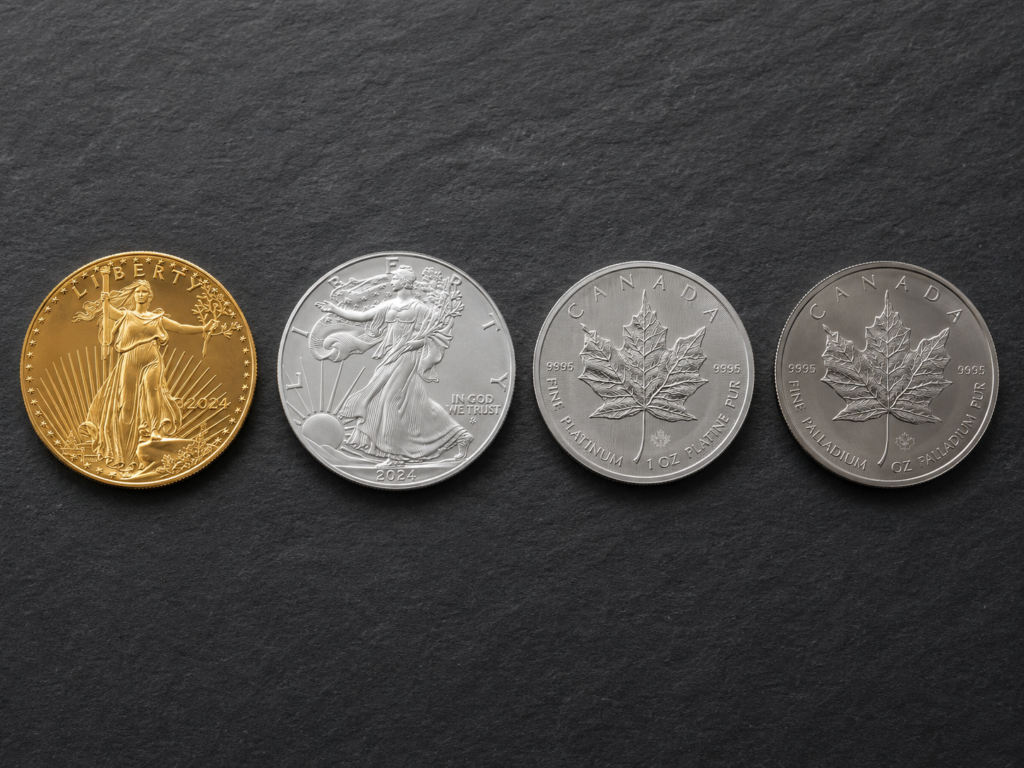
Bullion is investment-grade precious metal — gold, silver, platinum, or palladium — shaped into bars, coins, or rounds and valued by the weight of metal inside, not the artistry on the outside. It is priced off a live global number plus a small dealer markup. Here is what counts as bullion, what does not, and why people buy it.
What is bullion?
Bullion is a precious metal — gold, silver, platinum, or palladium — in bar, coin, or round form, valued primarily by its metal content rather than by design, rarity, or condition. It is priced by weight at the current spot price plus a small dealer premium. Most modern bullion is .999 fine or higher, though lower-purity government coins like the American Gold Eagle (.9167) are also bullion.
Three terms do most of the work there. Bullion is the category — the metal itself, sold by weight. Fineness is the share of pure metal in the piece, written as a decimal (.999 means 99.9% pure). Spot price is the live wholesale price of one troy ounce of pure metal — the number that scrolls across financial dashboards.
The defining trait of bullion is that the value comes from the metal, not the object. A one-ounce American Gold Eagle and a one-kilogram silver bar are both bullion. A rare 1893-S Morgan silver dollar is not — its value is rarity and condition, not metal content. The same Morgan in worn condition trades closer to its silver melt value, which puts it back in bullion territory. Most pieces sit cleanly on one side; a few sit on the boundary.
The four metals considered bullion
Four metals are commonly traded as bullion: gold, silver, platinum, and palladium. Each has its own typical fineness range, its own roster of standard products, and its own market depth. Gold and silver dominate the retail bullion market by a wide margin. Platinum and palladium exist as legitimate bullion but trade in thinner markets with wider bid-ask spreads — the gap between what a dealer will pay you and what they sell for.
| Metal | Typical fineness (IRA / LBMA minimum) | Typical use case | Liquidity |
|---|---|---|---|
| Gold | .9999 on most modern coins; .9167 on the Eagle and Krugerrand; .995 IRA/LBMA minimum | Long-horizon store of value; the most-traded bullion metal | Highest — every dealer quotes it |
| Silver | .999 on most products; .9999 on the Maple Leaf; .999 IRA/LBMA minimum | Lower entry price per ounce; popular for incremental purchases | Very high — every dealer quotes it |
| Platinum | .9995 standard; .9995 IRA/LBMA minimum | Industrial demand plus investment demand | Moderate — narrower dealer support, wider spreads |
| Palladium | .9995 standard; .9995 IRA/LBMA minimum | Industrial-demand exposure; historically volatile | Thinnest of the four — limited products, weaker resale |
Standard gold products include the American Gold Eagle, the Canadian Gold Maple Leaf, the Gold Buffalo, the Krugerrand, and one-ounce bars from refiners like PAMP Suisse, Credit Suisse, and the Perth Mint. Most modern gold bullion is .9999 fine; some legal-tender coins (the Eagle, the Krugerrand) are .9167 fine but still contain a full troy ounce of pure gold, with alloy added for durability.
On the silver side, the American Silver Eagle, Canadian Silver Maple, generic rounds, and ten- and one-hundred-ounce bars are the standard products — the Silver Eagle versus Silver Maple comparison covers the two most common starter coins side by side.
Platinum and palladium round out the category. The American Platinum Eagle, Canadian Platinum Maple, Canadian Palladium Maple, and American Palladium Eagle are the dominant retail products. Both metals carry meaningful industrial demand — platinum and palladium are used in catalytic converters and electronics — which gives them different price behavior than gold.
Bid-ask spreads run wider, and fewer dealers will quote a competitive buy-back. Most retail buyers start with gold or silver and add platinum or palladium later, if at all.
The three forms bullion comes in: bars, coins, and rounds
Within each metal, bullion comes in three physical forms: government-minted coins, privately minted bars, and privately minted rounds. The differences matter for premium, resale, and how easily a buyer outside your circle will recognize what you are selling.
| Form | Issuer | Legal tender? | Typical premium over spot | Best for |
|---|---|---|---|---|
| Government-minted coins | Sovereign mints (U.S. Mint, Royal Canadian Mint, Perth Mint, etc.) | Yes (face value well below metal value) | 3%–8% on common one-ounce coins | Beginners; widely recognized resale |
| Privately minted bars | Refiners (PAMP, Credit Suisse, Valcambi, Perth Mint, RCM) | No | 1%–4% on 10 oz+ recognized bars | People minimizing per-ounce premium |
| Privately minted rounds | Private mints (Sunshine, Asahi, Scottsdale) | No | 2%–5% on common one-ounce rounds | Lower-premium alternative to coins |
Bars are the lowest-premium option, especially at one ounce and above. Standard gold bar sizes and weights run from one gram to 400 troy ounces (the Good Delivery bar used at the wholesale level). Most retail buyers stay between one ounce and one kilogram. Recognized refiners — PAMP and Credit Suisse are the two most-cited names — resell anywhere; lesser-known refiners may require a specific dealer to take them at full price.
Coins are the easiest to resell because every dealer recognizes them on sight. They carry a face value as legal tender (a one-ounce Gold Eagle is technically worth $50; a one-ounce Silver Eagle is worth $1), though the metal value dwarfs the face value. Coins carry a higher premium than bars, but you pay for the recognition. The best gold coins to buy covers the comparison across Eagle, Maple, Buffalo, Krugerrand, and others.
Rounds are shaped like coins but issued by private mints. They have no face value and no legal tender status, which is exactly why their premium sits below government coins. Gold and silver rounds from recognized mints (Sunshine, Asahi, Scottsdale) resell at any bullion dealer; off-brand rounds may not.
For a first purchase, a one-ounce government coin is the standard starting point — recognition is highest, the premium is reasonable, and you will never have to explain what you are selling. Bars and rounds make sense once you want to drive the per-ounce premium down.
Bullion vs. numismatic coins vs. jewelry
Three things are sometimes lumped together as “physical precious metals” but trade in different markets, with different pricing logic and different buyers.
| Type | What you’re paying for | Premium over melt/spot | Resale path |
|---|---|---|---|
| Bullion | Metal content | 1%–8% on common products | Any bullion dealer, priced off live spot |
| Numismatic coins | Rarity, condition, mintage, history | 50% to several thousand percent above melt | Graded coin auction or specialist dealer |
| Jewelry | Design, brand, retail markup | Retail markup is large; resale often at or below melt | Pawn, jewelry buyer, or melt |
Bullion is the simplest case: a one-ounce Silver Eagle today is worth one ounce of silver plus the dealer’s premium. Numismatic coins are valued for what makes them rare — a low-mintage year, a key date, a high grade — and trade in a separate market. The same physical coin can sit in either market depending on condition: a worn 1921 Morgan trades close to melt; a high-grade 1893-S Morgan trades for thousands above melt. The numismatic vs. bullion coins comparison walks through where the line sits.
Jewelry is real precious metal, but it is optimized for design and retail margin, not investment economics. Most modern Western jewelry is 14-karat (.585 fine) or 18-karat (.750 fine) — below bullion purity. Retail markups are substantial, and resale outside of designer pieces typically lands at melt value or below. That does not make jewelry a bad purchase; the buyer is just buying something other than bullion.
How bullion is priced: spot plus premium
Every retail bullion price is built the same way: the live spot price for one troy ounce of the relevant metal, plus a premium that covers fabrication, distribution, and dealer margin.
Spot is the global wholesale benchmark for one troy ounce of pure metal, set continuously on the futures and over-the-counter markets that trade in London and Chicago. The full mechanics of how spot price is set are worth a read if the number on Kitco has ever felt mysterious.
Premium covers fabrication (minting a coin or pouring a bar is real labor and capital), distribution and dealer margin, and demand pressure on specific products. Premium over spot varies by product, size, metal, and market conditions. Smaller pieces carry a steeper premium per ounce — a 1/10 oz gold coin can sit 20%–30% over spot while a 10 oz gold bar sits 1%–3% over.
| Product type | Typical premium over spot |
|---|---|
| Generic gold bars, 10 oz+, recognized refiner | 1%–3% |
| Government gold coins, 1 oz (Eagle, Maple, Buffalo) | 4%–8% |
| Fractional gold coins (1/10 oz, 1/4 oz) | 10%–30% |
| Generic silver bars, 10 oz–100 oz | 5%–15% |
| Government silver coins, 1 oz (Eagle, Maple) | 15%–30% |
| Platinum coins and small bars | 8%–15% |
| Palladium products | 10%–20% |
Ranges drift with market conditions. Premiums spike during retail buying surges and compress when demand cools. Use the table as a frame for what is normal, not a quote.
Why investors buy bullion
People buy bullion for a small set of reasons, weighted differently by different buyers:
- Diversification: Bullion tends to move differently from equities and bonds over long horizons, adding a non-correlated component to a portfolio.
- No counterparty risk: A one-ounce Gold Eagle in your hand is not anyone’s promise to pay. Equities, bonds, and bank deposits all depend on someone else; physical bullion does not.
- Long historical record: Gold and silver have functioned as money or as a store of value across most cultures for thousands of years — a record, not a guarantee.
- Industrial and monetary demand split: Silver, platinum, and palladium have meaningful industrial demand alongside investment demand; gold’s demand is dominated by investment and jewelry. The mix shapes how each metal behaves through the cycle.
- IRA eligibility: Bullion meeting fineness standards is eligible for a self-directed precious metals IRA. Gold IRAs carry custodian and storage requirements, but they bring physical metal inside a tax-advantaged retirement wrapper.
- Privacy and portability: A six-figure stack fits in a shoebox — useful in some scenarios, requires care in others (storage, insurance, inheritance).
Bullion pays no yield, carries a buy-sell spread, and requires storage. It is one asset class among several, not a replacement for diversified investing. The comparison with gold ETFs and mining stocks is worth understanding before deciding how to get exposure to the metal.
How to start buying bullion
For a first purchase, the path is short and the common mistakes are well-known. Six steps cover most of it:
- Pick a metal: Gold for compactness of value; silver for a lower per-ounce entry price. Most beginners pick one and stick with it for the first few purchases before adding the other.
- Decide on a budget: Many people start at one ounce of gold or ten to twenty ounces of silver. The specific number matters less than starting at a size that does not strain your finances.
- Pick a standard starting product: A one-ounce government coin in your chosen metal — Gold Eagle, Gold Maple, Silver Eagle, Silver Maple — is the conventional first purchase. Recognition is highest, resale is easiest.
- Buy from a reputable dealer: APMEX, JM Bullion, Money Metals, Hero Bullion, SD Bullion, and Kitco are the largest online dealers; accredited local coin shops fill the same role offline. Compare prices across two or three before ordering.
- Lock the price at order time, not browsing time: Spot moves continuously, and the price you see on a product page is locked when you check out, not when you load the page.
- Verify the piece on arrival: Check weight, dimensions, edge details, and tamper-evident packaging against the dealer’s product page or the mint’s specifications. A quick read of how to spot counterfeit bullion before the package arrives will tell you what to look for.
| Do not buy bullion from social media ads, eBay individual sellers, or unsolicited DMs. Stick to established dealers or accredited local coin shops. Counterfeit-detection skills matter most when buying from anyone outside that circle. |
Depth on the buying process lives on the metal-specific guides — how to buy gold and how to buy silver. A few things not to lead with on a first purchase: numismatic coins (different market), fractional sizes when a one-ounce piece fits the budget (steeper premium per ounce), and no-name private rounds (resale friction).
Storing and tracking your bullion
Storage options run from home safes to private depositories, each with its own trade-off. Home storage keeps the metal close, but raises insurance questions that a standard homeowner’s policy may not cover. Bank safe deposit boxes are inexpensive but are not insured by the bank or the FDIC. Private depositories — Brink’s, Loomis, Delaware Depository — charge an annual fee, provide full insurance, and are IRA-compatible.
Tracking is the half most people underweight. Bullion accumulates one piece at a time across years, metals, and dealers, and by the time it sells, the original purchase prices and premiums are often scattered. That matters because cost basis — what you paid, including premium — is what the IRS deducts from your sale price to calculate the taxable gain.
A purpose-built tracker like Gold Silver Ledger replaces the spreadsheet with a Holdings page that shows total cost basis, current value, and gain or loss across the whole portfolio, with search, filter, and tags for organizing your holdings as they grow. Everything easy to capture at purchase is hard to reconstruct six years later.
Frequently asked questions
What is the difference between bullion and coins?
Bullion is the category; coins are one of three forms bullion takes (the others are bars and rounds). A one-ounce American Gold Eagle is both a coin and bullion. “Coins” in common usage sometimes also includes numismatic coins valued for rarity rather than metal — those are not bullion in the investment sense, even though they look similar.
Is bullion a good investment?
Bullion has historically functioned as a portfolio diversifier and store of value rather than a growth engine — it pays no yield and carries a buy-sell spread, but it is uncorrelated with most paper assets and has no counterparty risk. Whether it fits a specific portfolio depends on goals, time horizon, and existing holdings. This is not investment advice; speak with a qualified advisor before making allocation decisions.
What metals are considered bullion?
Four metals are commonly traded as bullion — gold, silver, platinum, and palladium — each with a range of standard products in coin, bar, and round form. Gold and silver dominate the retail market; platinum and palladium are smaller markets with wider bid-ask spreads. For IRA eligibility and LBMA Good Delivery, the minimum fineness standards are .995 for gold, .999 for silver, and .9995 for platinum and palladium.
What fineness counts as investment-grade bullion?
Investment-grade fineness — the standard for IRA eligibility and LBMA Good Delivery — is .995 for gold, .999 for silver, and .9995 for platinum and palladium. Most modern bullion exceeds these minimums (Canadian Maple Leaf coins are .9999). Lower-purity legal-tender coins like the American Gold Eagle (.9167) are still bullion and still contain a full troy ounce of pure gold, with copper and silver added for durability.
Can I buy bullion at spot price?
Typically, no, dealers buy near spot at wholesale and add a premium covering fabrication, distribution, and margin. The lowest-premium products (10 oz+ generic bars from recognized refiners) sit a few percentage points above spot; the highest-premium products (small fractional coins, specialty designs) can sit 20% to 40% over. The premium-by-product table above shows typical ranges.
Is bullion taxable?
Yes, the IRS classifies bullion as a collectible, meaning long-term capital gains are taxed at up to 28% rather than the lower 15% or 20% applied to most other long-term assets. Some states charge sales tax on bullion below a threshold; many states exempt it. Tax treatment varies; consult a tax professional, and see our coverage of the 28% collectibles capital gains rate.
What’s the smallest amount of bullion I can buy?
Most dealers sell down to one gram (about 1/31 of a troy ounce). Common small sizes: 1 g, 2.5 g, 5 g, 10 g, 1/10 oz, 1/4 oz, 1/2 oz, and 1 oz. Premium per gram is steepest at the smallest sizes — beginners on a tight budget are often better served by silver (cheaper per ounce) than fractional gold.
Does bullion lose value over time?
Physical bullion does not corrode or degrade under normal storage conditions — silver can tarnish from sulfur exposure, but tarnish is a surface reaction and does not reduce silver content. Market value moves with spot price, which fluctuates daily; over long horizons, gold and silver have generally tracked or modestly outpaced inflation.
Manage your holdings without the spreadsheet
If you buy metals — one ounce, one purchase, one metal at a time — Gold Silver Ledger gives you a Holdings page built for physical metals: total cost basis and current value at a glance, gain or loss per piece and across the portfolio, and a Card view that shows every coin and bar with the live numbers beside it. Search, filter, and tag every item — the kind of management a spreadsheet cannot do.
This article is for educational purposes only and is not financial, tax, or legal advice. Consult a qualified professional before making investment, tax, or retirement decisions.
