
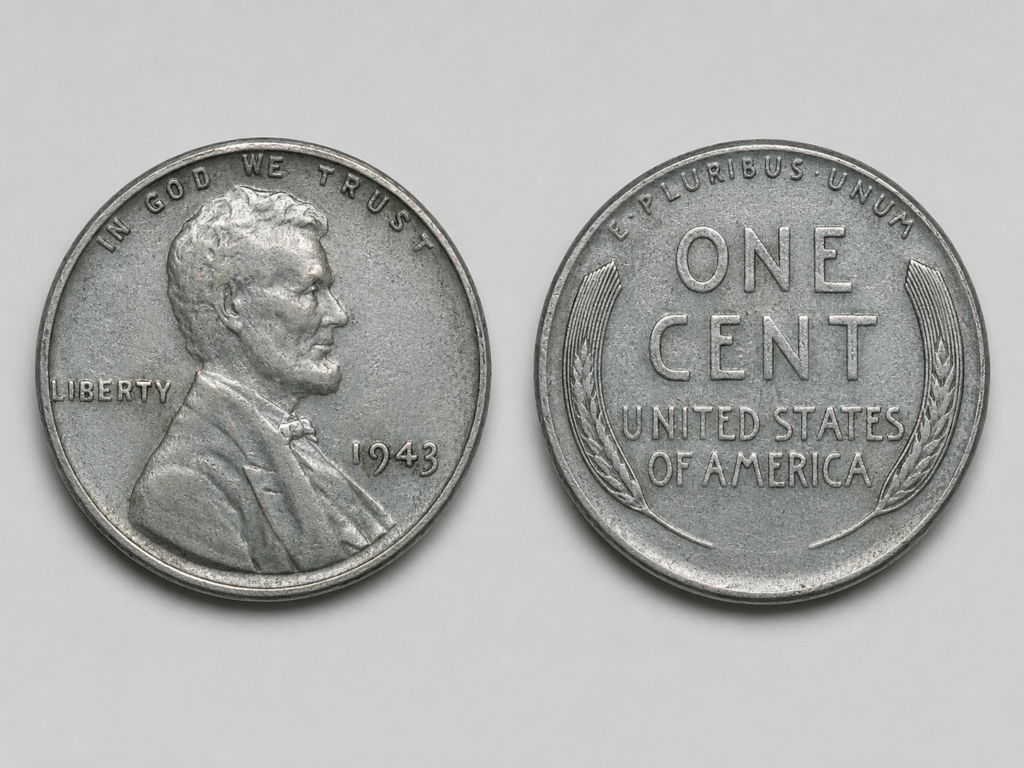
In 1943, the U.S. Mint made Lincoln cents from zinc-coated steel to save copper for World War II. About 1 billion were struck — they’re common, magnetic, and worth a quarter or so in worn condition. A tiny handful of 1943 cents were struck on leftover copper planchets by mistake and now reach six and seven figures at auction.
Here’s how to tell which you have.
Quick Answer: Is My 1943 Penny Worth Anything?
Most 1943 pennies are zinc-coated steel and worth roughly ten to fifty cents in worn condition, climbing to a few dollars in Mint State. The rare 1943 copper variety — fewer than 20 confirmed examples across all three mints — reaches six and seven figures at major auction. The fastest check is the magnet test: a steel cent sticks; a copper cent does not. Run the magnet, then the weight check, then look hard at the date.
Why 1943 Pennies Are Steel — The Wartime Composition Change
World War II created copper shortages. The metal was needed for shell casings, electrical wiring, and other war materiel, so the Mint switched the Lincoln cent composition for one year. Through 1942, cents were bronze — 95% copper, 5% tin and zinc. For 1943, the composition changed to a steel core with a thin zinc plating to prevent rust.
Weight dropped from 3.11 grams to 2.70 grams. The steel composition was used for 1943 only, across all three mints — Philadelphia (no mintmark), Denver (D), and San Francisco (S). Total 1943 production reached roughly 1.09 billion coins.
In 1944, the Mint returned to a modified bronze composition using salvaged shell-casing metal — 95% copper, 5% zinc, no tin — and that composition ran through 1946. The bronze cents from 1944 forward are not steel. For the broader 1909–1958 Lincoln Wheat series, see our wheat penny value guide. For the wartime context across U.S. coinage, see our overview of the history of U.S. coinage.
CALLOUT — There is no 1942 steel penny, no 1945 steel penny, no 1943 lead penny, and no 1943 aluminum penny. The steel composition was used for 1943 only. The 1942 and 1944+ cents are bronze.
Three Tests: Steel or Copper?
Three tests in order of speed and decisiveness. Run them in sequence; a coin that passes all three is a candidate for professional grading.
Test 1: The Magnet Test
The fastest and most reliable check. A 1943 steel cent sticks to a refrigerator magnet — the steel core is ferromagnetic. A 1943 copper cent does not stick — bronze is non-magnetic. Any kitchen-drawer magnet works. If the coin sticks, it’s a common steel cent.
If it doesn’t stick, do not celebrate yet — some counterfeits are copper-plated steel and will fail the magnet test in the opposite direction (the steel core still sticks even with the plating on top, so a magnetic “copper” cent is a counterfeit). Run the weight test next.
Test 2: The Weight Test
A 1943 steel cent weighs 2.70 grams. A 1943 copper cent weighs 3.11 grams. The acceptable ranges are 2.65–2.75 g for steel and 3.08–3.14 g for copper. Any jewelry scale that reads to 0.01 grams resolves the question; a kitchen scale at 0.1-gram resolution is borderline but workable. The 0.4-gram gap is large enough that there is no overlap between the two compositions.
A coin that weighs 2.70 grams is steel; a coin that weighs 3.11 grams is bronze, regardless of how the surface looks.
Test 3: The Date Inspection
Counterfeiters routinely alter 1948 or 1949 cents to look like 1943 by filing down the 8 or 9. The diagnostic: a genuine 1943 “3” has a long, angled lower tail that drops well below the rest of the date. An altered 8 or 9 looks rounded at the bottom, and file marks are usually visible at high magnification (10x or higher).
Counterfeits made by altering a 1944 or 1945 — reworking a 4 or 5 into a 3 — are rarer but require the same close look. The date inspection catches the altered-date counterfeits that the magnet test alone can’t.
If the coin passes all three tests, the next step is professional grading through PCGS or NGC. At that point, the value question is in the grading service’s hands.
The 1943 Steel Penny Value Chart by Mint
Three mints struck the 1943 steel cent. Mintmark sits below the date on the obverse — no mintmark for Philadelphia, a small D for Denver, a small S for San Francisco. Mintage figures don’t change; the value cells in the chart are illustrative and date faster.
| Mint (Mintage) | G-4 | VF-20 | MS-63 | MS-65 | MS-67 RD |
| 1943 (no MM) — ~684.6M | $0.10 – $0.20 | $0.30 – $0.50 | $5 – $10 | $20 – $50 | $200 – $500 |
| 1943-D — ~217.7M | $0.15 – $0.30 | $0.40 – $0.75 | $8 – $15 | $25 – $70 | $400 – $1,000 |
| 1943-S — ~191.6M | $0.20 – $0.40 | $0.50 – $1 | $10 – $20 | $30 – $80 | $500 – $1,200 |
Value ranges illustrative — last updated June 2026. Verify against PCGS CoinFacts and NGC Coin Explorer before relying on a specific figure. RD = Red, the highest color designation for Mint State Lincoln cents. Bronze (copper) error varieties from 1943 trade in five to seven figures at certified auction — see the rare 1943 copper section below for the population breakdown by mint.
A note on condition. The thin zinc plating on a 1943 steel cent is fragile. On most circulated examples the plating wore through and the steel core oxidized, leaving the dark spotting or rust the typical 1943 cent shows today. A 1943 cent with full original mint luster — brilliant uncirculated, no spotting — is uncommon.
That’s why MS-67 examples carry meaningful premiums even though the date itself is common. Re-plating is also common: a corroded coin re-zinced to look brilliant. PCGS and NGC catch re-plated coins; raw re-plated coins do not.
The Rare 1943 Copper Cent
The 1943 copper cent is a planchet error. When the steel run started, a small number of leftover 1942 bronze planchets stayed in Mint hoppers and got struck with 1943 dies. The result is a 1943 cent in the wrong composition. Total population estimates run roughly 13 to 20 confirmed examples across all three mints.
The mint breakdown matters. The 1943-P copper (no mintmark) is the largest group, with roughly 10 to 15 confirmed examples. The 1943-S copper has approximately 6 confirmed examples. The 1943-D copper is unique — a single confirmed example, the famous Denver coin that sold for $1.7 million in 2010 and remains the only known 1943-D bronze. Realized prices at major auction reflect the population: the 1943-D leads, the 1943-P examples have realized six figures consistently, and the 1943-S sits between.
Authentication is not optional. Every credible 1943 copper cent in the market is in a PCGS or NGC holder, often with provenance traced to a known collection. Any raw 1943 copper cent at any price is statistically a counterfeit until proven otherwise — the price gap between certified and raw makes counterfeiting profitable, and the market reflects it.
The 1944 Steel Cent — The Opposite Error
The 1944 steel cent is the mirror of the 1943 copper error. When the Mint returned to bronze for 1944, a few leftover 1943 steel planchets stayed in the hoppers and got struck with 1944 dies. Total population estimates run roughly 25 to 30 confirmed examples across all three mints, with the 1944-S the rarest (only 2 confirmed). 1944 steel cents are rarer than 1943 copper cents and have realized comparable five- and six-figure prices at auction.
The authentication path is the same. A 1944 cent that sticks to a magnet and weighs 2.70 grams instead of the bronze 3.11 grams is a candidate for PCGS or NGC. The counterfeit problem is the same too — most raw “1944 steel cents” offered for sale are zinc-plated bronze coins, not genuine errors. Professional grading is the answer.
Counterfeits and Altered Dates: Why Raw Coins Don’t Trade
Three counterfeit types dominate the 1943 cent market, each with a clean diagnostic.
Copper-Plated Steel Cents
A genuine 1943 steel cent with a thin copper plating applied after the Mint. Sometimes done as a novelty in the 1940s, sometimes done deliberately to deceive collectors. The diagnostic is straightforward: the magnet test fails. The steel core is still magnetic even with the plating on top, so a “copper” 1943 cent that sticks to a magnet is plated, not genuine.
Altered Dates
A 1948 or 1949 cent with the 8 or 9 filed to look like a 3. Less commonly, a 1944 or 1945 with the 4 or 5 reworked. The diagnostic: the 3 in a genuine 1943 has a long, angled tail that drops well below the rest of the date. An altered date looks rounded at the bottom, and the file marks show under magnification. The altered-date coin will pass the magnet test (it’s still bronze) and may pass the weight test (also bronze), which is why the date inspection matters.
Re-Plated Steel Cents
A corroded 1943 steel cent with the zinc plating re-applied to look brilliant uncirculated. The re-plated finish lacks the original mint-luster pattern, and PCGS and NGC catch it at submission. The coin is genuine in composition and date; it’s the grade that’s been falsified.
The calm-expert recommendation: never buy a raw 1943 copper cent or 1944 steel cent at any price. Every credible example in the market is certified. The candidate-coin path runs through PCGS or NGC, not eBay.
When and How to Sell a 1943 Penny
Three paths, depending on what the tests showed.
Common 1943 Steel Cents
Worn common-date 1943 steel cents are junk-cent material. Most coin dealers credit a few cents per coin or a bulk wholesale rate, not worth negotiating one coin at a time. Sorted rolls by mintmark sell more cleanly than a mixed handful.
High-Grade 1943 Steel Cents
Any 1943 steel cent with full original zinc luster — no spotting, no rust, mint-bright surfaces — is worth a careful look before sale. PCGS or NGC certification at MS-65 or higher captures the grade premium, and certified MS-67 examples reach meaningful realizations even on common dates. The certification fee is worth it on a clean coin; it isn’t worth it on a spotted one.
Copper or 1944 Steel Candidates
Stop and certify. The realization gap between a certified rarity and a raw coin typically costs 80% or more of value — any pre-certification sale is the wrong path. Heritage Auctions, Stack’s Bowers, and GreatCollections handle the certified rarities. For the broader sale framework, see how to sell gold.
FAQs
How much is a 1943 steel penny worth?
A 1943 steel penny is worth roughly ten to fifty cents in circulated condition, a few dollars in Mint State, and meaningful premiums at MS-67 with full original zinc luster. About 1.09 billion were struck across the three mints — the value floor is set by surface condition, not mintage.
Is my 1943 penny copper or steel?
Run the magnet test first — a steel cent sticks; a copper one does not. If it sticks, it’s the common steel variety. If it doesn’t stick, weigh it: steel is 2.70 grams, copper is 3.11 grams. A coin that fails the magnet test and weighs 3.11 grams is a copper candidate that needs PCGS or NGC grading before any sale.
How many 1943 copper pennies exist?
Roughly 13 to 20 confirmed 1943 copper cents are known across all three mints. The 1943-P has the largest population at 10 to 15 examples, the 1943-S has approximately 6, and the 1943-D is unique — the single confirmed Denver bronze sold for $1.7 million in 2010 and remains the only known example.
Is there such a thing as a 1942 steel penny?
No, the zinc-plated steel composition was used for 1943 only. 1942 cents are bronze, the standard composition through 1942. Any coin presented as a 1942 steel cent is either a 1943 with an altered date or a fabrication.
Is there a 1945 steel penny?
No, the Mint returned to bronze for 1944 and kept that composition through 1946. The genuine 1945 cent is bronze, weighs 3.11 grams, and is non-magnetic. A coin that looks like a 1945 steel cent is almost certainly a corroded cent from another year or an altered date.
What is a 1944 steel penny worth?
A genuine 1944 steel cent reaches five and six figures at certified auction — roughly 25 to 30 confirmed examples exist across the three mints, with the 1944-S the rarest at 2 confirmed. The authentication path is the same as for 1943 copper: magnetic, 2.70 grams instead of 3.11. Most raw “1944 steel cents” offered for sale are zinc-plated bronze counterfeits.
How do I know if my 1943 copper penny is real?
Run the three tests and, if the coin passes all three, submit to PCGS or NGC. The magnet test must fail, the weight must read 3.11 grams, and the date must show the long-tailed “3.” Even a coin that passes all three needs professional certification before sale — no responsible buyer will trade a six-figure coin uncertified.
Should I clean a 1943 steel penny before selling it?
Don’t clean it. Cleaning leaves microscopic scratches that PCGS and NGC catch and tag as “Cleaned” on the holder. A cleaned 1943 steel cent sells for a fraction of an uncleaned one. The corrosion on most steel cents is part of the coin and can’t be removed without damaging the surface further; live with the patina.
