
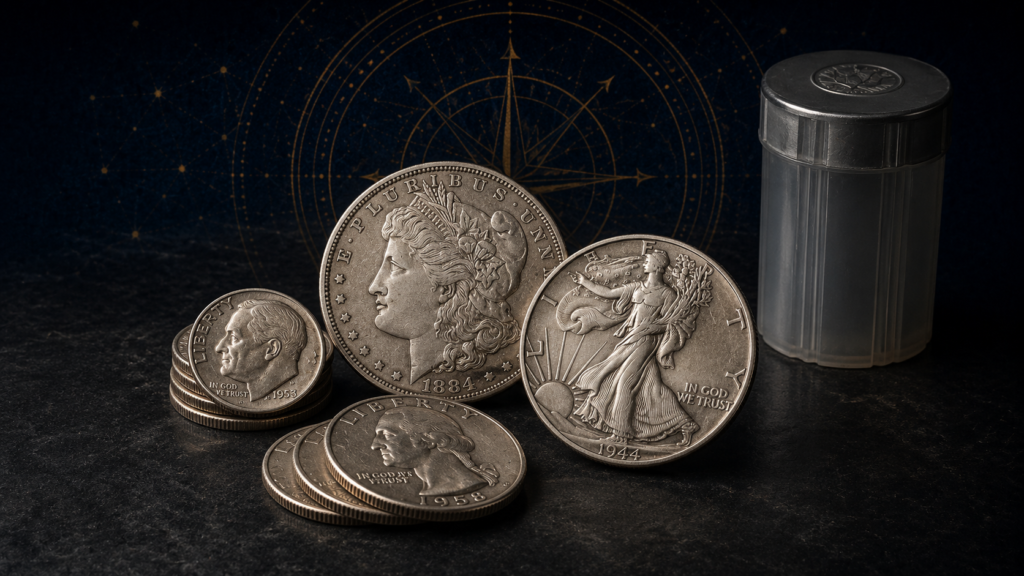
Junk silver is U.S. coinage that contains real silver — 90%, 40%, or 35% — but trades for its melt value, not its collector value. “Junk” doesn’t mean worthless. It means stripped of numismatic premium. A 1964 Roosevelt dime contains roughly 0.0723 troy oz of silver. Multiply by spot, and a single dime in your change drawer might be worth $2 or more.
What Junk Silver Actually Is
Junk silver is the bullion-trade term for U.S. coins minted before 1965 (and certain wartime variants) that contain 90%, 40%, or 35% silver by weight. The “junk” refers to numismatic value, not metal value — these coins trade for what their silver is worth, not what collectors will pay.
A coin earns numismatic value — the collector’s premium above its metal — through rarity, condition, or historical significance. Junk silver, by definition, has none of that. It’s circulated, common-date U.S. coinage, sold by the bag or roll for the silver inside.
Some dealers and collectors prefer the term constitutional silver, a synonym for the same coins. The U.S. Constitution authorizes Congress to coin money, and pre-1965 90% silver was the original constitutional coinage in metal — so the name is more dignified than “junk,” and points at exactly the same dimes, quarters, halves, and dollars.
One number runs through every section of this guide: ASW (actual silver weight) — the troy-ounce amount of pure silver in a coin, as opposed to its gross weight. A 90% silver Washington quarter weighs 6.25 grams gross but contains about 5.625 grams of pure silver, or roughly 0.1808 troy ounces. ASW is the only number that matters for melt math.
This article is the conceptual hub. If you want depth on a single denomination, follow the links inline — we cover dimes, quarters, halves, and war nickels in their own pieces, plus a calculator that does the melt math automatically.
Which U.S. Coins Are Junk Silver?
Twelve U.S. coin types qualify as junk silver. The table below covers each one — its year range, silver percentage, gross weight, and ASW per coin. This is the page’s most-referenced asset; bookmark it if you sort coins.
Every U.S. coin that qualifies as junk silver, with silver percentage and actual silver weight (ASW).
| Coin | Year range | Silver % | Gross weight | ASW (troy oz) |
|---|---|---|---|---|
| Mercury Dime | 1916–1945 | 90% | 2.50 g | 0.0723 |
| Roosevelt Dime | 1946–1964 | 90% | 2.50 g | 0.0723 |
| Standing Liberty Quarter | 1916–1930 | 90% | 6.25 g | 0.1808 |
| Washington Quarter | 1932–1964 | 90% | 6.25 g | 0.1808 |
| Walking Liberty Half | 1916–1947 | 90% | 12.50 g | 0.3617 |
| Franklin Half | 1948–1963 | 90% | 12.50 g | 0.3617 |
| Kennedy Half | 1964 | 90% | 12.50 g | 0.3617 |
| Kennedy Half | 1965–1970 | 40% | 11.50 g | 0.1479 |
| Morgan Dollar | 1878–1921 | 90% | 26.73 g | 0.7734 |
| Peace Dollar | 1921–1935 | 90% | 26.73 g | 0.7734 |
| Eisenhower Dollar (collector) | 1971–1976 | 40% | 24.59 g | 0.3162 |
| War Nickel | 1942 (mid)–1945 | 35% | 5.00 g | 0.0563 |
One important caveat in plain prose, because the table can mislead at a glance: 1965 is the cutoff for 90% silver dimes and quarters, but halves are different. The 1964 Kennedy was the last 90% half, then 1965 through 1970 Kennedys are 40% silver, then 1971 onward are clad — except for collector-only silver issues in some years. “Pre-1965” is a useful rule of thumb for dimes and quarters and a dangerous shortcut for halves.
One footnote that comes up in reader questions: the 1964-D Peace Dollar was struck but never released — the U.S. Mint melted the entire run before they entered circulation. If a 1964-D Peace ever surfaces in a junk bag, it isn’t junk; it’s a national news story.
For per-denomination depth — every year, every mintmark, the keepers — see the full guides on which quarters are silver, how to spot a silver dime, which half dollars are silver, and the 1942–1945 war nickel story.
Why Is It Called “Junk Silver”?
The label dates to the 1960s and ’70s. Coin dealers used “junk” to describe circulated 90% silver coins that had no collector value: worn, common-date Roosevelts and Washingtons that were only worth their melt. The shorthand stuck, then expanded to cover any pre-1965 U.S. silver coinage sold by metal weight rather than numismatic grade.
The name is misleading. The silver inside a worn 1964 dime is the same metal as the silver in a fresh American Silver Eagle — it doesn’t tarnish into a lower grade of element. Circulation wears the coin’s design, not its alloy. “Junk” describes the absence of a collector’s premium, not the absence of value.
A more accurate description: junk silver is common-date circulated U.S. silver coinage. That phrase tells you what’s in the bag and explains why “junk” is industry shorthand rather than a quality judgment. Some dealers use “constitutional silver” for the same reason — they don’t like selling a customer something that sounds like trash.
Why Did the U.S. Stop Putting Silver in Coins?
The short answer is that silver got too valuable to spend. By 1964, the open-market silver price had risen high enough that the metal in a Washington quarter was worth more than 25 cents. Hoarders pulled silver coins out of change drawers and registers across the country. The Treasury’s silver reserves began draining fast as the Mint kept paying silver into circulation while almost no silver flowed back.
Economists have a name for what happens when two coins of the same face value but different metal content circulate together: Gresham’s Law, which says bad money drives out good. People spend the cheaper coin and hoard the valuable one. By 1964 it was Gresham’s Law in real time, with U.S. silver disappearing from cash drawers month after month.
Congress responded with the Coinage Act of 1965, signed by President Lyndon B. Johnson on July 23, 1965. The Act removed silver from dimes and quarters entirely, replacing it with a copper-nickel clad sandwich. Halves were reduced from 90% to 40% silver. Dollar coins were paused — Eisenhower dollars wouldn’t return until 1971, and even those started as clad with 40% silver issues for collectors.
The transitions, by denomination: dimes and quarters went from 90% silver in 1964 to 0% in 1965 and after. Halves went from 90% in 1964 to 40% from 1965 to 1970 to clad from 1971 onward (with collector silver in selected later years). Silver dollars left circulation in 1935 with the last Peace Dollar; modern Eisenhower dollars in 1971–1976 included 40% silver collector versions.
The practical implication: “pre-1965” is the right rule of thumb for dimes and quarters, but the table above is more useful than the rule of thumb for halves and dollars. Sort accordingly.
How Much Silver Is in a Bag of Junk Silver?
The face-value math is the most useful single concept in junk silver. A $1,000 face value bag of pre-1965 90% U.S. silver coins contains approximately 715 troy ounces of silver. Some sources cite 723 ounces for uncirculated coins; 715 is the standard worn-coin estimate dealers use, and the difference accounts for circulation wear. Multiply face value by 0.715 and you have the silver weight.
Silver content by denomination, with the troy ounces of silver per $1 of face value.
| Denomination | Face value | ASW per coin (troy oz) | Silver per $1 face (troy oz) |
|---|---|---|---|
| Dime (90%) | $0.10 | 0.0723 | 0.7234 |
| Quarter (90%) | $0.25 | 0.1808 | 0.7234 |
| Half dollar (90%) | $0.50 | 0.3617 | 0.7234 |
| Half dollar (40%, 1965–1970) | $0.50 | 0.1479 | 0.2957 |
| Silver dollar (Morgan/Peace) | $1.00 | 0.7734 | 0.7734 |
| War nickel (35%, 1942–1945) | $0.05 | 0.0563 | 1.1260 |
Two things to notice. The 90% silver coins all carry close to 0.7234 ounces of silver per dollar of face value, so a roll of dimes, a roll of quarters, and a roll of halves all hold the same silver per dollar. Wear pushes the practical figure to 0.715 for circulated coins, which is the number dealers and refiners actually use. War nickels are the outlier: 1.126 ounces of silver per dollar of face, because nickels run at a much higher silver-to-face-value ratio than dimes and quarters.
Bag sizes follow industry conventions. A full bag is $1,000 face value (around 715 ounces of 90% silver, weighing close to 56 pounds). Half bags are $500 face. Quarter bags are $250 face. The most common retail size is the $100 face bag, which holds about 71.5 ounces. Dealers quote bags by face value with a multiplier on top of spot, not by silver weight.
For exact melt math on a specific coin or bag, use the Junk Silver Calculator — it accepts denomination, year range, and quantity, and it returns ASW and melt value at live spot.
How to Value Junk Silver: Melt, Premium, and Multipliers
Melt value is the silver content of a coin multiplied by the current spot price. As of May 2026, silver trades near $80 per troy ounce — so a 90% silver Washington quarter has a melt value of about $14.46 (0.1808 oz × $80). A worn $100 face bag of 90% holds 71.5 ounces and runs to $5,720 in melt at the same spot rate. The number moves with spot every minute the futures market is open, so any specific dollar figure in this article is a snapshot, not a forecast.
Premium over melt is the dollar amount above melt that a buyer pays the dealer (or pays at auction). For junk silver, premiums get expressed two ways. Dealers sometimes quote a flat dollar premium per ounce — “junk silver at $1.50 over melt.” More often, they quote a multiplier on face value: “junk silver at 19× face” means $1 of face value sells for $19 retail. Both shorthands describe the same markup.
Premium varies with several inputs. Smaller bags carry higher per-ounce premiums than full bags because the dealer’s per-coin handling is the same. Retail premiums run higher than wholesale. Dimes are usually cheaper per ounce than halves, because dimes are abundant and halves are popular. And the broader market matters: in a retail demand spike, junk silver premiums can hold above $2 per ounce for months at a time, then snap back when the spike fades.
Plain-text formula: Melt value = (face value × 0.715) × spot price. For a $100 face bag at $80 spot, that’s 71.5 oz × $80 = $5,720 melt. If the dealer asks $6,405, the premium is $685, or about 12% over melt. That’s a normal retail markup for a quarter bag in calm markets — well above what a wholesaler would pay.
One warning before you sell anything. Common-date junk silver gets melted by weight; key dates do not. A 1916-D Mercury Dime has substantial collector value — orders of magnitude above its 0.0723 ounces of silver — and shouldn’t go into a melt sale. Before bagging old dimes, quarters, or halves for a dealer, scan for the obvious key dates in the Mercury Dime and Morgan Silver Dollar guides. Five minutes of sorting can save you a bad mistake.
For the universal melt-value framework — coins outside the U.S. junk silver category, or rounds and bars with non-standard alloys — see the full melt value formula and methodology.
Buying Junk Silver: Pros, Cons, and Common Forms
People buy junk silver for a few specific reasons. The case for it is real, but it isn’t a fit for every buyer.
Why buyers choose junk silver:
- Divisibility: A roll of dimes is the smallest meaningful silver unit on the market. If you ever liquidate or barter, a $0.10 face dime is a natural denomination — a 100 oz bar is not.
- Recognizability: U.S. coinage is the most recognizable silver in the world among non-collectors. Less authentication friction at a coin shop, pawn dealer, or in private sale than a generic round.
- Premium efficiency at certain price points: In bag quantities, junk silver often carries a lower premium per ounce than 1 oz American Silver Eagles. The savings show up most clearly on wholesale-style purchases of $500 face or larger.
- Numismatic upside: Sorting a junk bag occasionally turns up a coin that wasn’t supposed to be there — a key-date Mercury, an early Walking Liberty, a coin worth more as a collectible than as silver.
Why some buyers skip it:
- Premium volatility: Junk silver premiums spike during retail demand surges and stay elevated for months. New buyers caught in a spike can overpay versus a generic round and then watch the premium compress later.
- Storage density: 715 ounces of 90% silver in coin form weighs about 56 pounds and takes up far more space than the same ounces in 100 oz bars. Counting and verifying a $1,000 face bag is a tedious afternoon.
- Counting friction at sale: Verifying a bag at sell time means handling thousands of coins. Buyers usually trust the seller; sellers usually want a witness.
Common purchase forms include the $1,000 face bag (full bag), $500, $250, $100, and $25 face bags, individual rolls (a $5 face roll of Mercury Dimes, for example), and individual coins. By dealer convention, “a roll of silver quarters” means 40 coins ($10 face) unless specified otherwise. Rolls and small bags carry higher per-ounce premiums than full bags.
How to Track and Store Junk Silver
Junk silver is the messiest holding in a precious metals portfolio. A $100 face bag of mixed dimes, three Kennedy halves, and a Morgan dollar are three different denominations, two different silver percentages, and a half-century of mintage years. Most spreadsheets collapse the moment you try to roll those into one “how much silver do I own” total — and that total is the only number that matters at sale.
Many track bags by face value rather than coin-by-coin. One ledger entry — “$100 face 90% silver bag” — captures everything the math needs, because face value plus silver percentage gives you ASW automatically. Per-coin tracking only earns its keep for keepers: a graded Morgan, a Walking Liberty in unusual condition, anything with numismatic upside that should be valued separately from the melt pile.
A purpose-built tracker handles both modes. Gold Silver Ledger lets you log junk silver by face value (with the silver percentage and ASW factor baked in) or per coin for graded keepers, and the portfolio total reflects actual silver weight regardless of how each item is logged. Add a $100 face 90% bag, three 1964 Kennedys, and a graded 1921-D Morgan; flip the display to grams or kilograms; the totals reconcile without you running the math in your head.
Storage is simpler than the tracking. Junk silver doesn’t need PCGS slabs — the alloy is durable and chemically stable, and circulated coins are already worn. Coin tubes, mint bags, or even zip bags work for non-keepers; humidity control matters more than packaging. Slabs and individual flips are reserved for the rare keeper that turns up in a sort.
For full inventory workflow including mint, year, and per-coin tracking, see how to inventory a coin or bullion collection.
Frequently Asked Questions
What years of U.S. coins are junk silver?
Dimes and quarters: 1964 and earlier (90% silver). Halves: 1964 and earlier (90%), plus 1965–1970 Kennedy halves (40%). Silver dollars: 1935 and earlier circulation issues, plus selected 40% silver Eisenhower collector versions from 1971–1976. War nickels: mid-1942 through 1945 (35% silver).
Is a 1964 quarter silver?
Yes. 1964 was the last year of 90% silver Washington quarters. From 1965 onward, quarters are copper-nickel clad. A 1964 Washington quarter contains about 0.1808 troy oz of silver. For year-and-mintmark detail, see the 1964 Washington quarter value guide.
How much silver is in a roll of dimes?
A standard roll of 50 pre-1965 silver dimes is $5 face value and contains about 3.575 troy oz of silver — calculated as $5 × 0.715 oz per dollar of face. At $30 spot, that’s roughly $107 in silver content per roll, before any premium.
What is a $1,000 face bag of junk silver worth?
A $1,000 face bag of 90% U.S. silver coins contains approximately 715 troy oz of silver. At spot price S, the melt value is 715 × S. Retail buy prices typically run 5–25% above melt, depending on bag size and current market conditions.
Are war nickels really junk silver?
Yes, but they’re 35% silver, not 90%. Nickels minted from mid-1942 through 1945 are the only U.S. five-cent coins with silver content. The 1942 transition happened mid-year, so 1942 nickels exist in both silver and copper-nickel forms — silver war nickels carry a large mintmark above the dome of Monticello on the reverse, where regular nickels carry no mintmark or a small one beside the building.
Should I clean junk silver coins?
No. Cleaning won’t add melt value, and on the rare key-date you didn’t notice, cleaning destroys numismatic value permanently. Sell as-is and sort as-is; let the buyer or refiner handle the rest.
Is junk silver a good investment?
Junk silver provides exposure to the silver spot price plus a small premium that varies with retail demand. Whether that fits your portfolio depends on your goals, time horizon, and how the rest of your holdings are allocated. This article is educational, not financial advice — consult a qualified professional for your situation.
