
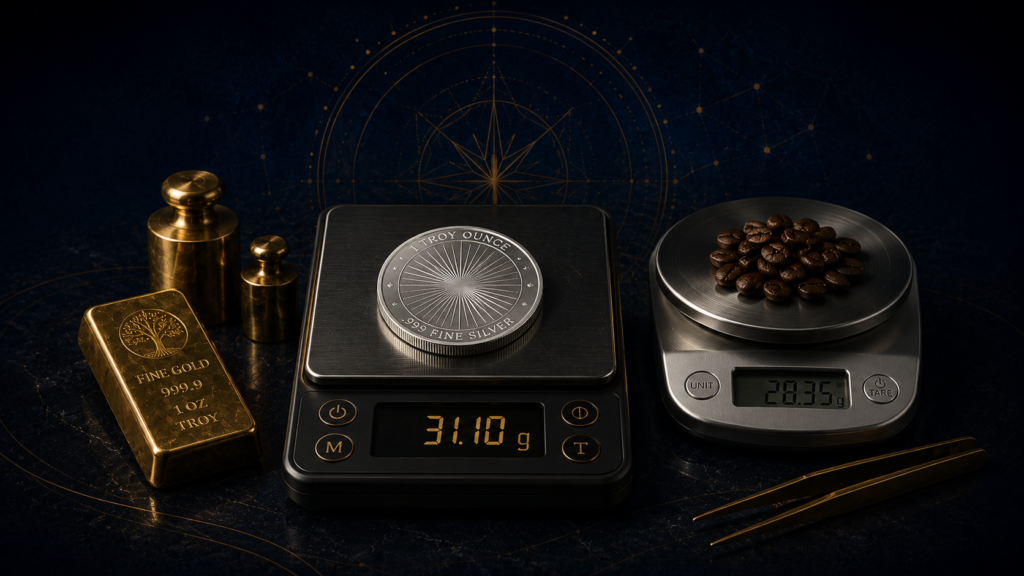
A troy ounce is the unit of weight precious metals are sold and priced in — 31.1035 grams, or about 9.7% heavier than the avoirdupois ounce on your kitchen scale. Every gold coin, silver bar, and dealer spot quote runs on troy ounces. Here is exactly what that means, where the unit came from, and when the difference matters.
Troy Ounce, Defined
A troy ounce is the standard unit of weight for precious metals — gold, silver, platinum, palladium, and rhodium. One troy ounce equals 31.1035 grams, roughly 9.7% heavier than the regular (avoirdupois) ounce used for groceries, mail, and almost everything else.
The unit shows up wherever precious metals are bought, sold, or weighed: at the U.S. Mint, on the LBMA price feed, in IRS capital-gains calculations, and across every major dealer’s spot quote. You’ll see it abbreviated several ways — oz t, ozt, t oz, or, most commonly, the bare “oz” you see on a bullion product page. On bullion, that bare “oz” always means a troy ounce. The regular ounce never enters the conversation.
The five metals weighed in troy ounces are gold, silver, platinum, palladium, and rhodium — the precious metals group. Everything outside that group, from copper to coffee, is weighed in regular ounces, pounds, or grams. There is no industrial commodity that uses troy weight outside the precious metals trade.
Troy Ounce vs. Regular (Avoirdupois) Ounce
A troy ounce is about 9.7% heavier than a regular ounce — or, said the other way, a regular ounce is about 8.9% lighter than a troy ounce. The two units have coexisted for centuries: troy stayed with bullion and gemstones, avoirdupois took over for almost everything else.
Side-by-side comparison of the troy ounce and the avoirdupois (regular) ounce.
| Unit | Grams | Relative weight | Common use |
|---|---|---|---|
| Troy ounce | 31.1035 g | 100% (baseline) | Gold, silver, platinum, palladium, rhodium |
| Avoirdupois ounce | 28.3495 g | About 91.1% of a troy oz | Food, mail, body weight, almost everything else |
The conversion factor between the two is 1.09714. To go from troy ounces to regular ounces, multiply by 1.09714; to go the other direction, multiply by 0.91146 (the inverse). For full conversion tables across grams, troy ounces, and avoirdupois ounces — including the weights you’ll actually see on a dealer page — see our complete precious metals conversion chart.
The practical takeaway is short. When a dealer quotes “$2,300 per ounce” for gold, that is per troy ounce. Treating it as a regular ounce overstates the weight of a 1 oz coin by about 10%, which works out to a meaningful pricing error on anything larger than fractional silver.
Where Troy Weight Came From
Most accounts trace troy weight to medieval Troyes, a market town in northeastern France that hosted one of Europe’s largest commodity fairs. Merchants from across the continent gathered there to trade gold, silver, gems, and other high-value goods, and a standardized weight system made cross-border deals possible. A few scholars argue earlier Anglo-Saxon roots, but Troyes is the dominant story and the one most modern references lead with.
England formalized troy weight as the official standard for gold and silver coinage in 1527, under Henry VIII. The U.S. carried the standard forward when the U.S. Mint was established in 1792, and the Coinage Act of 1828 codified troy weight into U.S. monetary law. The system has been the global bullion standard ever since.
Avoirdupois weight, meanwhile, became the everyday unit for general commerce starting in the 1300s. It eventually displaced troy for almost everything outside the precious metals trade. Why didn’t bullion switch with the rest of the economy? Troy was already entrenched in the gold and silver markets when avoirdupois arrived. Conversion costs across mints, refiners, and exchanges around the world would have been enormous, and the benefit of one global pricing standard for precious metals outweighed the cost of teaching consumers a second unit. Five hundred years later, the convention has held.
How Troy Weight Actually Works (the Full System)
Troy isn’t a single unit — it’s a complete weight system with its own pound, ounce, pennyweight, and grain. The relationships between those units differ from the avoirdupois system in ways that catch people off guard.
The troy weight system at a glance.
| Unit | Equals (in grams) | Notes |
|---|---|---|
| 1 troy pound | 373.2417 g | 12 troy ounces |
| 1 troy ounce | 31.1035 g | The unit you’ll see most often |
| 1 pennyweight (dwt) | 1.5552 g | 1/20 of a troy ounce |
| 1 grain | 0.0648 g | 1/480 of a troy ounce |
Counterintuitively, a troy pound is lighter than a regular pound. A troy pound contains 12 troy ounces and weighs 373.24 g. An avoirdupois pound contains 16 avoirdupois ounces and weighs 453.59 g. Troy ounces are heavier than regular ounces, but a troy pound has fewer ounces in it, so the pound itself comes out lighter.
Pennyweight (abbreviated dwt) is still in active use among jewelers and pawn shops, especially when buying scrap gold. One pennyweight equals 1.5552 grams, or 0.05 troy oz, and 20 pennyweights make one troy ounce. If you’re cashing out heirloom jewelry and the buyer quotes a per-dwt price, multiply that figure by 20 to compare against the troy-ounce spot rate. For a deeper walkthrough, see the full pennyweight breakdown.
Grain shows up almost exclusively in firearms ballistics and historic coin specifications — the original 1792 U.S. silver dollar, for example, was specced at 416 grains. You won’t run into it shopping for modern bullion.
Why It Matters When You Buy or Track Bullion
Three concrete situations where the troy/regular distinction trips people up:
Reading a coin spec
A 1 oz American Gold Eagle contains 1 troy oz of gold — 31.1035 g. The coin’s gross weight, however, is 33.93 g, because it is 91.67% gold alloyed with copper and silver for durability. “1 oz” on a bullion product always refers to the troy ounces of pure metal, not the coin’s total weight.
Comparing prices
Dealers quote “$X per ounce” by industry convention, and that ounce is always a troy ounce. There is no ambiguity in the bullion market itself, but plenty in the buyer’s head — especially the first time. A $2,300/oz gold quote translates to about $74 of pure gold per gram, before the dealer’s premium.
Tallying mixed holdings
A reader holding 1 oz Eagles, 100 g Valcambi bars, and a kilo brick is doing three different troy/gram conversions every time spot moves. Spreadsheet math handles it for a while; once your holdings grow past a handful of products and start touching cost basis and tax, the recordkeeping is where things break down.
For a step-by-step on doing this cleanly, see how to inventory a coin or bullion collection.
A purpose-built tracker takes the unit problem off your plate. Gold Silver Ledger displays your entire portfolio in whichever unit you pick — troy ounces, grams, or kilograms — across the holdings page, the analytics charts, and every report. Add a 1 oz Eagle and a 100 g bar; flip the display setting to grams; both line up cleanly without you running the math in your head.
For full conversions, formulas, and worked examples across every common bullion size, see our complete precious metals conversion chart.
Troy Ounce FAQ
Is a troy ounce heavier or lighter than a regular ounce?
Heavier. A troy ounce weighs 31.1035 grams; a regular (avoirdupois) ounce weighs 28.3495 grams. A troy ounce is about 9.7% heavier than a regular ounce.
Why is it called a troy ounce?
The name almost certainly comes from Troyes, a market town in medieval France that hosted one of Europe’s largest trade fairs. Merchants there used a standardized weight system for gold, silver, and gemstones, and the unit traveled with the trade.
How many regular ounces are in a troy ounce?
1.09714 avoirdupois ounces. To convert troy ounces to regular ounces, multiply by 1.09714. To go the other direction, multiply by 0.91146.
Which metals are weighed in troy ounces?
Gold, silver, platinum, palladium, and rhodium — all five of the precious metals. Every other metal, from copper to lead, is weighed in regular ounces, pounds, or grams.
Is a troy pound heavier than a regular pound?
No, it’s lighter. A troy pound weighs 373.24 g; a regular pound weighs 453.59 g. Troy ounces are heavier than regular ounces, but a troy pound has only 12 ounces in it (vs. 16 in a regular pound), so the pound itself comes out lighter.
Why don’t precious metals use grams instead?
Much of the world does. Bars from Switzerland, Germany, and most of Asia are sold by gram weight, and Indian and Pakistani markets run on the tola. But the global spot price is quoted in troy ounces, U.S. and U.K. coinage is denominated in troy ounces, and the convention has 500 years of momentum behind it. Both units coexist; the troy ounce is the one the price feeds run on.
