
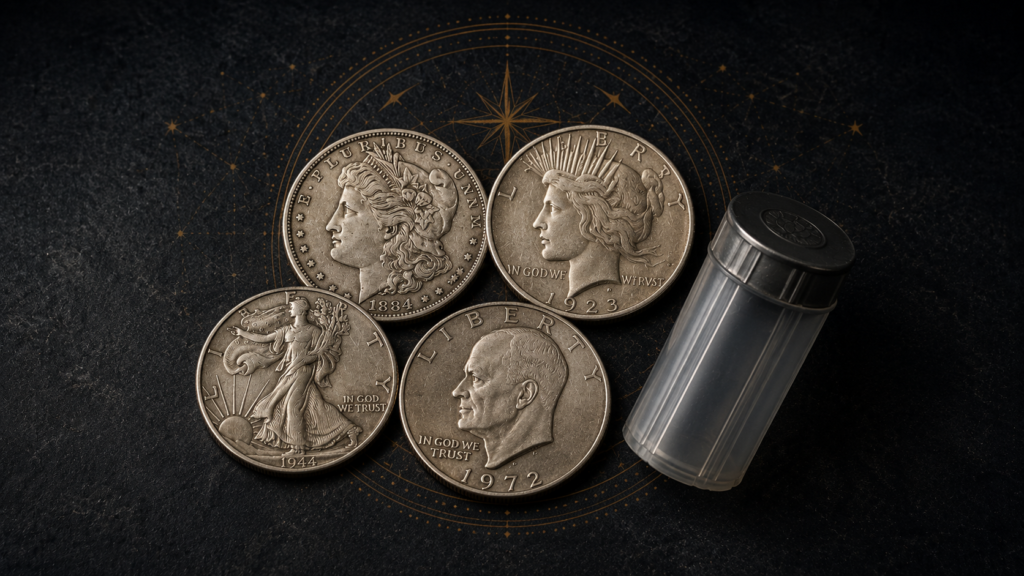
“Silver dollar” is a label that covers two centuries of U.S. coinage — and not all of it is silver. A 1921 Morgan contains roughly 0.7734 troy ounces of silver. A 1979 Susan B. Anthony contains zero. Before you can answer “what’s mine worth?” you have to answer “which silver dollar do I actually have?” This guide covers every U.S. dollar coin, what’s inside it, and how to value it.
Which “Silver Dollars” Are Actually Silver?
Most U.S. dollar coins minted from 1794 to 1935 are 90% silver. Eisenhower dollars from 1971 to 1976 included a 40% silver collector version alongside the standard copper-nickel clad. Susan B. Anthony, Sacagawea, and Presidential dollars contain no silver at all — they are copper-nickel or manganese-brass. Year and design are what determine silver content, not the word “dollar.”
The phrase silver dollar is colloquial. It refers to any U.S. dollar-denomination coin, regardless of metal — the way “silver fillings” and “silver bullets” survive in language even when the metal does not. So a 1921 Morgan is a silver dollar in both senses, and a 1979 Susan B. Anthony is a silver dollar only in name.
One number runs through every section of this guide: ASW (actual silver weight) — the troy-ounce amount of pure silver in a coin, as opposed to its gross weight. A Morgan dollar weighs 26.73 grams gross but contains only about 24.06 grams of pure silver, or 0.7734 troy ounces. ASW is the only number that matters for melt math.
This article provides an overview. If you want depth on a single type — every Morgan year and mintmark, every Peace key date, the 40% silver Eisenhower issues year by year — follow the links inline. We cover each of those in their own pieces.
Every U.S. Dollar Coin and Its Silver Content
Twelve U.S. dollar-coin types span the country’s history, from the first silver dollars of 1794 to the modern .999 fine commemoratives reissued in 2021. The table below covers each one — year range, silver percentage, gross weight, and ASW. This is the page’s most-referenced asset; bookmark it if you sort coins.
Every U.S. dollar coin, with silver percentage and actual silver weight (ASW).
| Coin | Year range | Silver % | Gross weight | ASW (troy oz) |
|---|---|---|---|---|
| Flowing Hair Dollar | 1794–1795 | 89.24% | 26.96 g | 0.7735 |
| Draped Bust Dollar | 1795–1804 | 89.24% | 26.96 g | 0.7735 |
| Seated Liberty Dollar | 1840–1873 | 90% | 26.73 g | 0.7734 |
| Trade Dollar | 1873–1885 | 90% | 27.22 g | 0.7876 |
| Morgan Dollar | 1878–1904, 1921 | 90% | 26.73 g | 0.7734 |
| Peace Dollar | 1921–1935 | 90% | 26.73 g | 0.7734 |
| Eisenhower Dollar (clad) | 1971–1978 | 0% | 22.68 g | 0 |
| Eisenhower Dollar (40% silver) | 1971–1976 | 40% | 24.59 g | 0.3162 |
| Susan B. Anthony Dollar | 1979–1981, 1999 | 0% | 8.10 g | 0 |
| Sacagawea Dollar | 2000–present | 0% | 8.10 g | 0 |
| Presidential Dollar | 2007–2016 | 0% | 8.10 g | 0 |
| Modern Morgan / Peace (.999) | 2021–present | 99.9% | 26.73 g | ~0.858 |
A few things worth flagging in plain prose, because the table can mislead at a glance.
Standard 90% silver dollars (Morgan, Peace, Seated Liberty) all share the same melt math: 26.73 grams gross, 0.7734 troy oz ASW. The Trade Dollar is an exception. It was struck heavier than the rest of the silver dollar family — 27.22 grams gross, 0.7876 troy oz ASW — because it was designed for export to Asia, where it competed against the heavier Mexican peso. It is 90% silver but carries about 1.8% more silver per coin than a Morgan.
The 1965 cutoff that defines junk silver dimes and quarters does not apply to dollars. Silver dollars left circulation in 1935 with the last Peace Dollar. The series didn’t resume until 1971 with the Eisenhower, and the Eisenhower has its own twist: most are clad, but the U.S. Mint sold collector-only 40% silver Ikes from 1971 to 1976.
The American Silver Eagle deserves a one-line note. It is technically a U.S. dollar coin — $1 face value, 1 troy ounce of .999 fine silver, struck since 1986. But it is a bullion coin sold for its metal content, not a circulation coin, and it lives in our bullion guides rather than this one.
For non-dollar pre-1965 silver — the dimes, quarters, and halves most people think of when they hear “junk silver” — see our junk silver guide.
How to Identify Your Silver Dollar in 60 Seconds
You can resolve almost any U.S. dollar coin in three checks: weight, date, and design. A kitchen scale that reads to 0.1 grams handles the first one. The other two are visual.
Step 1: Weight and diameter. A full-size silver-era dollar is 38.1 mm in diameter (about the size of a U.S. half dollar plus 8 mm). The small-dollar coins — Susan B. Anthony, Sacagawea, Presidential — are 26.5 mm, almost exactly the size of a U.S. quarter. That measurement alone separates silver-eligible coins from definite non-silver. Weight then resolves the rest:
Weight and diameter pinpoint the type before you read the date.
| If your coin weighs… | Diameter | Silver content | It is… |
|---|---|---|---|
| 26.73 g (or 26.96 g) | 38.1 mm | 89.24% – 90% | A pre-1936 silver dollar (Bust, Seated, Morgan, Peace, or Trade) |
| 27.22 g | 38.1 mm | 90% | Trade Dollar — heavier than the Morgan/Peace standard |
| 24.59 g | 38.1 mm | 40% | 1971–1976 collector Eisenhower (S mintmark) |
| 22.68 g | 38.1 mm | 0% | Standard clad Eisenhower (no silver) |
| 8.10 g | 26.5 mm | 0% | Susan B. Anthony, Sacagawea, or Presidential dollar (no silver) |
Step 2: Date. Pre-1936 dollars are silver: 89.24% for the early Bust-era issues, 90% for the Seated Liberty, Trade, Morgan, and Peace dollars. The 1936 to 1970 gap had no circulating silver dollars at all. From 1971 onward, only collector-only S-mintmark Eisenhowers from 1971 to 1976 contain silver. Standard issues from 1971 forward — including every Susan B. Anthony, Sacagawea, and Presidential — are not silver. The exception is the modern Morgan and Peace commemoratives reissued by the U.S. Mint starting in 2021, which are .999 fine silver and dated “2021” or later on the obverse.
Step 3: Design. Quick visual cues: a female bust with a tiara reading “LIBERTY” and an eagle reverse with wreath is a Morgan. A flowing-hair Liberty with a ray-burst behind her, plus an eagle clutching an olive branch on a rock reading “PEACE,” is a Peace dollar. A seated Liberty figure is Seated Liberty. A Liberty head facing left with the reverse legend “420 GRAINS, 900 FINE” is a Trade dollar. Eisenhower’s bust with an eagle landing on the moon is an Ike. A small bust of Susan B. Anthony, a Native American woman carrying a child, or a series of presidents on the obverse all signal small-dollar coins with no silver.
If you want a sortable identification reference rather than a value-focused walkthrough, see our guide on which dollar coins are silver.
Morgan and Peace Dollars (1878–1935): The Standard Silver Dollar
Morgan and Peace dollars share specifications: 26.73 grams, 90% silver, 0.7734 troy oz ASW, 38.1 mm diameter, reeded edge. For melt math, the two are interchangeable — only the design and the year give them away. If you inherited a single “silver dollar” from a grandparent, odds are very good it is one of these two.
The Morgan dollar (1878–1904, plus a final 1921 issue) was designed by U.S. Mint engraver George T. Morgan and was the workhorse silver dollar of the late 19th century. Most Morgans the average reader holds are common-date coins — 1881-S, 1882, 1884-O, 1921 — trading near melt with a small dealer premium. A handful of dates command large numismatic premiums: 1893-S, 1889-CC, 1879-CC, 1885-CC, and the proof-only 1895 (often called the “King of Morgans”). The CC mintmark, struck at the Carson City Mint in Nevada, generally adds collector value across the series.
The Peace dollar (1921–1935), designed by Anthony de Francisci, was issued to commemorate the end of World War I. The design is softer than the Morgan — a flowing-hair Liberty on the obverse, an eagle perched on a rock reading “PEACE” on the reverse — and the series is shorter and quieter than the Morgan run. Most years trade near melt. Notable dates include the 1921 high-relief first-year issue, the low-mintage 1928, and the 1934-S. The 1964-D Peace dollar is famous for what didn’t happen: the Mint struck the run, then melted every example before release. None are known to exist outside Mint-controlled chains.
Both series reward checking date and mintmark before selling. Worn common-date coins set the floor at melt; rarer dates can be worth many multiples of melt; high-grade examples (BU and above) often outpace both. For the full year-and-mintmark breakdowns, see the Morgan dollar value guide and the Peace dollar year-by-year guide.
One footnote: in 2021, the U.S. Mint resumed striking Morgan and Peace dollars as collector-issue commemoratives in .999 fine silver. These are dated 2021 onward and are not the same coin as the historical issues — different fineness, different market, different value drivers. If your “Morgan” is dated 2021 or later, it’s the modern issue.
Eisenhower Dollars (1971–1978): The 40% Silver Collector Versions
Most Eisenhower dollars in circulation are not silver. A standard 1971-D, 1972-D, or 1974-D Ike pulled from a coin shop or inherited bag is copper-nickel clad: 22.68 grams, zero silver, melt value zero. Someone holding one is usually hoping for silver and usually won’t find it.
The exception is real and worth knowing. From 1971 to 1976 the U.S. Mint sold collector-only Eisenhower dollars in 40% silver. These coins were struck at San Francisco — look for the S mintmark on the obverse, just below Eisenhower’s neck — and were sold in special blue-pack (uncirculated) or brown-box (proof) U.S. Mint packaging. They weigh 24.59 grams and contain 0.3162 troy ounces of silver per coin.
Two checks separate a 40% silver Ike from a clad one. First, the S mintmark on the obverse — only S-mint Ikes from 1971 to 1976 are silver. Second, weight: a 1.9-gram gap between the silver (24.59 g) and the clad (22.68 g) versions, which any kitchen scale will catch. Original blue-pack or brown-box packaging is the third tell, but most coins have long since left their original holders.
The 1976 Bicentennial dollar is part of the same series and follows the same rules. The dual-dated 1776–1976 Eisenhower exists in clad circulation strikes (no silver) and in 1976-S 40% silver collector issues (24.59 g, 0.3162 troy oz ASW). That keyword — “1776 to 1976 silver dollar value” — is heavily searched, and the answer hinges entirely on the mintmark and the weight.
For the year-by-year breakdown of every Eisenhower issue, see the Eisenhower dollar value guide. For a deeper dive on the 1971 silver-versus-clad distinction — the most-confused Ike year — see the 1971 silver dollar guide.
Pre-Morgan Era: Trade, Seated Liberty, and Bust Dollars (1794–1885)
If your coin predates the Morgan series, the rules change. These coins are numismatic before they are silver — the metal value is the floor, not the price. A reader holding a Bust or Trade or Seated Liberty dollar should pause before pricing it for melt or selling it quickly. A specialist appraisal almost always pays for itself.
The Flowing Hair dollar (1794–1795) was the first U.S. silver dollar. Specifications: 89.24% silver, 26.96 grams gross, 0.7735 troy oz ASW. Surviving examples are scarce, and the 1794 issue specifically is one of the most valuable U.S. coins in any condition — a single specimen sold at auction for above $10 million in recent years. Melt math does not apply here.
The Draped Bust dollar (1795–1804) shares the Flowing Hair specifications: 89.24% silver, 26.96 g, 0.7735 troy oz. The 1804 dollar is one of the most famous numismatic rarities in American coinage, struck decades after its date as a diplomatic gift, and commands seven-figure prices in original strikings.
The Seated Liberty dollar (1840–1873) moved to the modern silver dollar standard — 90% silver, 26.73 grams, 0.7734 troy oz ASW. Mintages are low compared with the later Morgan and Peace runs, and most dates carry numismatic premiums above their melt value.
The Trade dollar (1873–1885) is the heaviest U.S. silver dollar at 27.22 grams — 0.7876 troy oz ASW — because it was designed for export to Asia, specifically to compete with the Mexican peso in trade with China. Many surviving examples are chop-marked, stamped by Asian merchants who verified the silver content before accepting the coin. The Trade dollar was demonetized in 1876, briefly remonetized, and finally retired. Numismatic value varies widely, and chop-marked Trade dollars trade in their own collector market.
The operating rule for any pre-1878 U.S. dollar: get an appraisal from a numismatist or have the coin graded by PCGS or NGC before selling. Pricing one of these coins by melt leaves serious money on the table.
Susan B. Anthony, Sacagawea, and Presidential Dollars: Why They’re Not Silver
Susan B. Anthony, Sacagawea, and Presidential dollars contain zero silver. None of them. The smaller diameter (26.5 mm vs. 38.1 mm) and the lower weight (8.10 g vs. 26.73 g) are the giveaways — these coins were never designed to be silver.
The Susan B. Anthony dollar (1979–1981, with a final 1999 issue) is copper-nickel clad over a pure copper core. 8.10 grams, 0% silver. The 1979 issue is the most-searched dollar coin online, partly because of the word “dollar” in the name and partly because the metallic finish reads as silver to the eye. It is worth $1 face in circulation. A few proof and uncirculated varieties carry small numismatic premiums, but no SBA contains silver.
The Sacagawea dollar (2000–present) is manganese-brass clad. The brass alloy gives it a gold color despite containing no gold. 8.10 grams, 0% silver, 0% gold. Some low-mintage variants — the 2000-P “Cheerios” variety and selected proof issues — carry collector premiums, but the metal value is essentially nil.
The Presidential dollar series (2007–2016) shares the Sacagawea’s manganese-brass spec: 8.10 g, 0% silver. Issued four per year, honoring U.S. presidents in chronological order, with circulation strikes carrying no premium beyond face value.
If you inherited a roll of dollar coins from 1979 to 2016 expecting silver, the right move is to spend or save them at face value, or check for the few collector varieties that carry a numismatic premium. For the SBA-specific deep dive, see our Susan B. Anthony dollar value guide.
How to Value a Silver Dollar: Melt, Premium, and Numismatic Upside
Melt value is the silver content of a coin multiplied by the current spot price. For a common-date Morgan or Peace dollar, melt = 0.7734 troy oz × spot. As of May 2026, silver trades near $80 per ounce, so a worn common-date Morgan has a melt value of about $61.87. A 40% silver Eisenhower at the same spot rate is worth about $25.30 in metal. A Trade dollar, with its higher ASW, is worth about $63.01. The numbers move with spot every minute the futures market is open, so any specific dollar figure here is a snapshot, not a forecast.
Numismatic premium is the dollar amount above melt that a coin earns from rarity, condition, mintmark, or historical significance. Common-date Morgans and Peaces typically trade at modest premiums over melt at retail — a few dollars per coin in circulated grades. Key-date Morgans (1893-S, 1889-CC, 1895) trade at hundreds to thousands of times melt. The same spread applies across the silver-dollar family in different proportions: a common Eisenhower has zero or near-zero numismatic premium; a high-grade Trade dollar can be worth ten to a hundred times its silver.
The valuation flowchart for the reader of this article:
- Identify the type and year using the table above and the 60-second walkthrough.
- If the coin is a common-date Morgan, Peace, Seated Liberty, or 40% silver Eisenhower, use melt value as the floor and add a small dealer premium. The full-bag or per-coin retail markup typically runs 5–20% above melt.
- If the coin is a key-date Morgan, a Trade dollar, a Bust dollar, or anything in unusually good condition, get a numismatic appraisal. Don’t sell at melt.
Condition matters more for silver dollars than for almost any other U.S. silver coin, because the series is heavily collected. A Mint State (MS-65) common-date Morgan can sell for many multiples of a worn (Good-4) example, even though the silver content is identical. Before selling anything that looks above-average, consult a PCGS or NGC price guide and consider professional grading. For the universal melt-value framework that applies to coins outside this guide — rounds, bars, and non-standard alloys — see how to calculate melt value for any coin.
How to Track Silver Dollars in a Mixed Portfolio
Silver dollars are commonly inherited or accumulated in mixed lots: a few Morgans, a Peace dollar or two, a couple of clad Ikes that turned out not to be silver, maybe an SBA. Each item has different silver content (90%, 40%, or 0%), different physical specs, and different numismatic potential. Lump them into one “silver dollars” row in a spreadsheet, and the math collapses the moment you try to compute melt or net silver weight.
Per-coin tracking is the right default. Unlike junk silver dimes — often tracked in $100 face bags because individual coins are nearly identical — silver dollars are large enough and individually variable enough that each coin earns its own line. Track at least the type, the year, the mintmark, the grade if known, and a condition note (cleaned, raw, slabbed). The portfolio total then rolls up to actual silver weight regardless of mix.
A purpose-built tracker handles this without the spreadsheet gymnastics. Gold Silver Ledger logs each silver dollar with native fields for type, year, mintmark, and grade, and the portfolio total reflects actual silver weight (ASW) in whichever unit — ounces, grams, or kilograms — you have selected. Items keep their native designation: a Morgan stays a Morgan; the unit selector only changes how the aggregate weight columns render. Add a 1921-D Morgan, a 1923 Peace, a 1976-S 40% silver Ike, and a 1979 Susan B. Anthony, and the totals add up correctly without you running 90/40/0 conversions in your head.
Storage is simpler than tracking. Common-date raw Morgans and Peaces don’t need PCGS slabs — coin tubes, individual flips, or 2×2 holders are fine. Anything with possible numismatic upside (key-date Morgans, Trade dollars, Bust dollars, AU/MS-grade pieces) belongs in a holder that prevents handling. Fingerprints and abrasion damage value irreversibly on those coins.
For the full inventory workflow — mint, year, mintmark, and grade — see how to inventory a coin or bullion collection.
Frequently Asked Questions
How much is a 1921 silver dollar worth?
Depends on the design. The 1921 was a transition year. The 1921 Morgan was the last issue of the long Morgan run — high mintage, common date, typically worth melt plus a small premium ($65 and up at $80 spot). The 1921 Peace dollar was the first-year-issue high-relief design — lower mintage, modestly above melt in worn grades, substantially above melt in high grades. Look at the reverse: an eagle with wreath is a Morgan, an eagle on a rock reading “PEACE” is a Peace.
Is a 1979 silver dollar silver?
No. The 1979 dollar is the first-year Susan B. Anthony — copper-nickel clad, zero silver, 8.10 grams, 26.5 mm diameter. It looks silver because of the alloy color, but no SBA contains any silver. Worth $1 face in circulation, with small premiums for select proof and uncirculated varieties.
How much does a silver dollar weigh?
Most U.S. silver dollars (Morgan, Peace, Seated Liberty) weigh 26.73 grams gross at 90% silver, with 0.7734 troy oz ASW. The Trade dollar is heavier at 27.22 grams (0.7876 troy oz). The early Bust-era dollars weigh 26.96 grams at 89.24% silver. The 40% silver Eisenhower weighs 24.59 grams (0.3162 troy oz). None of the small-dollar coins (SBA, Sacagawea, Presidential) are silver — they weigh 8.10 grams.
How big is a silver dollar?
Full-size U.S. silver dollars (Morgan, Peace, Trade, Seated Liberty, Bust, Eisenhower) are 38.1 mm in diameter — 1.5 inches across. The small-dollar coins (Susan B. Anthony, Sacagawea, Presidential) are 26.5 mm, almost the size of a U.S. quarter. Diameter alone separates the silver-eligible full-size dollars from the modern small-dollar coins.
Is a 1976 Bicentennial dollar silver?
Only the collector S-mintmark issues. Standard circulation 1776–1976 Eisenhower dollars are clad and contain no silver. The 1976-S 40% silver collector versions weigh 24.59 grams and contain 0.3162 troy oz ASW. Check the mintmark below Eisenhower’s neck and the weight on a kitchen scale.
What’s the difference between a silver dollar and a Silver Eagle?
“Silver dollar” is the colloquial term for any U.S. dollar-denomination coin, silver or not. The American Silver Eagle is a specific bullion coin minted since 1986: $1 face value, 1 troy ounce of .999 fine silver, sold for its metal content. The Silver Eagle is technically a silver dollar by face value, but it is bullion, not circulation coinage, and it sits in the bullion guides cluster rather than this one.
Should I clean a silver dollar before selling?
No. Cleaning destroys numismatic value on coins where it might exist (Morgans, Peaces, Trades, Bust, Seated Liberty) and adds nothing for melt-only coins. Sell as-is and let the buyer or refiner handle the rest.
Is buying silver dollars a good investment?
Silver dollars give exposure to the silver spot price plus a numismatic premium that varies by date and condition. Whether they fit your portfolio depends on your goals, time horizon, and how the rest of your holdings are allocated. This article is educational, not financial advice — consult a qualified professional for your situation.
