
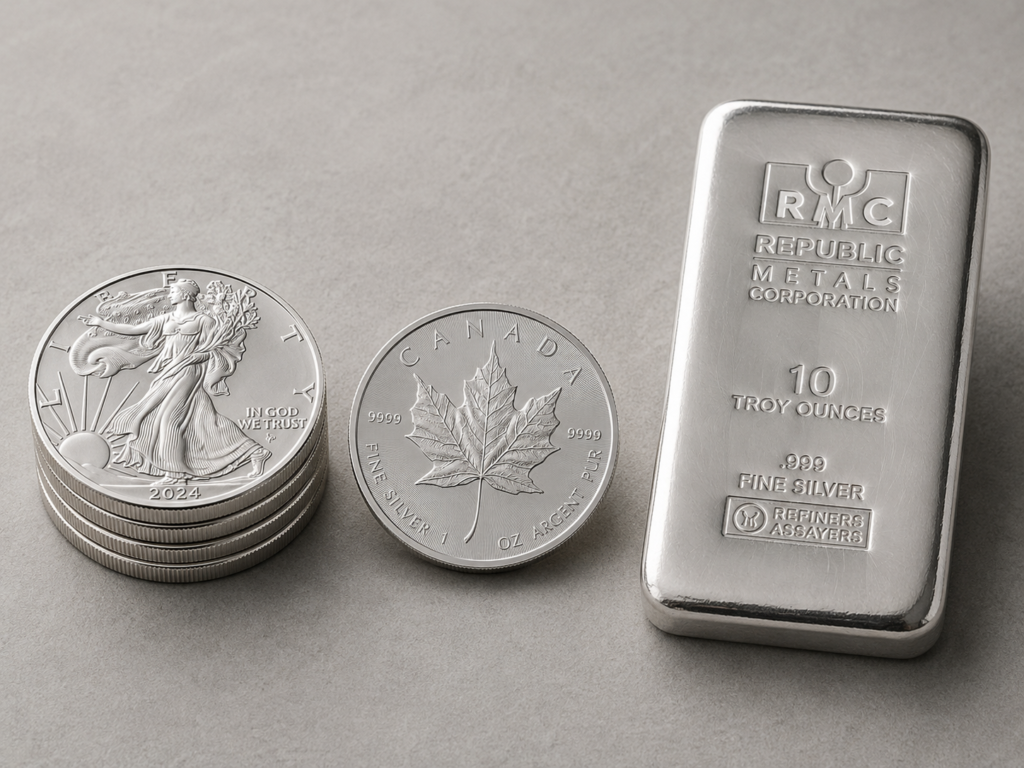
A Silver IRA is a self-directed individual retirement account that holds IRS-approved physical silver — at least .999 fine — instead of paper assets. It uses the same three-party structure as a Gold IRA (custodian, dealer, depository) and the same federal IRS rules, with one practical wrinkle: silver’s storage cost per dollar is the highest of any IRA-eligible metal. Here’s how it actually works.
This article is for informational and educational purposes only. It is not financial, investment, legal, or tax advice. Talk to a fee-only fiduciary advisor and a CPA before opening or rolling over any retirement account.
What Is a Silver IRA?
A Silver IRA is a self-directed individual retirement account that holds IRS-approved physical silver — at least .999 fine — instead of stocks, bonds, or funds. The silver is held by an approved depository, not at home, and the account follows standard IRA contribution, distribution, and tax rules. Structurally, it is identical to a Gold IRA, with silver as the underlying metal.
A few terms worth glossing. An IRA (individual retirement account) is the federal tax-advantaged retirement structure most U.S. workers know in its standard form. A self-directed IRA is one in which the account holder, not a brokerage menu, chooses the assets.
Fineness is purity, expressed as a decimal — .999 means 99.9% pure silver. A depository is an IRS-approved storage facility that physically holds the metal on behalf of the account.
One structural point matters up front. There is no separate IRS category called a “Silver IRA.” It is a self-directed Precious Metals IRA that happens to hold silver. The label is a marketing convention. The same custodian and depository handle gold, silver, platinum, and palladium under one account, so a reader who already runs a self-directed IRA for gold does not need to open a second account to add silver.
A misconception worth flagging. Taking physical possession of silver inside the IRA before retirement is a taxable distribution and subject to the 10% early-withdrawal penalty if you’re under 59½. Home storage is not permitted regardless of how a vendor frames it.
This article explains the silver-specific eligibility rules, the cost economics that make silver different from gold inside the wrapper, the rollover mechanics, and the fee structure. It does not recommend a specific Silver IRA company.
Silver IRA vs. Gold IRA: What’s Actually Different
Structurally, a Silver IRA is a Gold IRA with silver as the underlying metal. Same self-directed wrapper, same custodian model, same depository requirement, same IRS rules on contributions, rollovers, distributions, and prohibited transactions. The differences are practical, not legal.
For the full deep-dive on the self-directed IRA wrapper — what the custodian does, how the three parties interact, and how rollovers from a 401(k) actually flow — see our Gold IRA guide. The four sections below cover what is silver-specific.
Higher purity floor
Silver must be at least .999 fine to be IRA-eligible. Gold is .995, with the American Gold Eagle as a statutory exception at .9167. The silver standard is cleaner: no statutory exceptions, and most modern bullion silver coins and bars meet it. Sterling silver (.925) does not qualify.
Storage cost per dollar is higher
This is the single most important silver-specific factor. At silver’s lower price per ounce, $50,000 of silver weighs roughly 50–60 times more than $50,000 of gold. Depositories charge storage in one of two ways: as a percentage of asset value (in which case silver and gold cost about the same per dollar) or as a flat fee with a weight or volume surcharge (in which case silver costs materially more).
Ask the depository which model they use before you sign — it’s the single biggest cost question on the silver side.
Dealer premium drag is proportionally higher
Dealer premiums on silver bullion coins are typically a larger share of the underlying spot price than gold premiums. A 1 oz American Silver Eagle commonly trades at 12–25% over spot, compared with 4–10% for a 1 oz American Gold Eagle.
Proof and “exclusive” silver coins pushed by some Silver IRA dealers can carry 40%+ premiums. Premium drag matters more per dollar on silver than on gold.
Liquidity and round-trip spread
Silver markets are deep in total dollar terms but thinner per dealer transaction than gold. The buy-sell spread on smaller silver positions is wider than the equivalent gold position. That matters most at distribution time, when IRA silver is sold back to the dealer or distributed in-kind.
IRS Rules: Which Silver Can a Silver IRA Hold?
The IRS sets two requirements for any silver inside an IRA: minimum purity of .999 fine, and an approved source. Coins must come from a recognized national government mint. Bars and rounds must come from a NYMEX/COMEX-approved or LBMA-listed refiner.
The mint or refiner standard matters as much as the fineness — a privately struck round that meets the purity rule but lacks an approved refiner stamp does not qualify.
IRA-eligible silver products by category.
| Product type | Examples | Fineness | Notes |
| Government bullion coin (U.S.) | American Silver Eagle (1 oz) | .999 | Statutorily authorized for the bullion program; the most common choice |
| Government bullion coin (Canada) | Canadian Silver Maple Leaf (1 oz) | .9999 | Highest standard purity among major government coins |
| Government bullion coin (Austria) | Austrian Silver Philharmonic (1 oz) | .999 | Long-running bullion program |
| Government bullion coin (Australia) | Silver Kangaroo (1 oz), Silver Kookaburra (1 oz) | .9999 / .999 | Perth Mint products |
| Government bullion coin (UK) | Silver Britannia (1 oz) | .999 (pre-2013) / .9999 (2013+) | Royal Mint product |
| Approved-refiner bar | PAMP, Asahi, Sunshine Mint, Royal Canadian Mint (10 oz, 100 oz typical) | .999+ | Lowest premium per ounce of pure silver |
| Approved-refiner round | Generic 1 oz rounds from LBMA-listed refiners | .999+ | Lower premium than government coins; less brand recognition at resale |
| NOT eligible | Junk silver (90% U.S. coinage), Morgan & Peace dollars (.900), sterling silver (.925), graded/proof-only collectibles, jewelry | Below .999 or wrong source | Often pitched as IRA-eligible; they are not |
For a deeper look at the two coins most commonly chosen inside a Silver IRA, see our American Silver Eagle vs. Canadian Silver Maple Leaf comparison. For a broader survey of silver beyond the two flagships, see our top silver coins for investment guide.
A note on “exclusive” coin pitches. Some Silver IRA promoters push high-premium proof Silver Eagles or graded silver coins at 30–50%+ over spot, claiming IRA eligibility plus collectible upside. Many of these coins are IRA-eligible by purity — the issue is the premium, not the eligibility.
The IRA wrapper does not confer any collectible-coin tax advantage, so paying a 40% premium for a coin that resells at spot is a 40% loss to friction.
What is not eligible. This is where some Silver IRA pitches get creative, so it’s worth being explicit:
- Junk silver — 90% U.S. silver coinage (pre-1965 dimes, quarters, half dollars) and 40% Kennedy halves — is not IRA-eligible. The purity sits below the .999 silver standard. See our junk silver guide for the broader treatment.
- Morgan and Peace silver dollars (.900 fine) are not eligible, regardless of grade or strike year.
- Sterling silver (.925) and silver jewelry are not eligible at any weight.
- Pre-1933 numismatic silver and most graded, proof-only, or “certified” collector coins are not eligible unless they independently meet both the .999 purity rule and the approved-source rule.
- Foreign silver coins that don’t come from a recognized national government mint are not eligible.
The Three Players, and Where the Silver Differences Live
A Silver IRA uses the same three parties as a Gold IRA: a custodian holds the account, a dealer sells the metal into it, and an IRS-approved depository physically stores the silver. The role definitions, the fee accounting between them, and the home-storage prohibition all behave the same way. The question worth its own treatment on the silver side is the depository question.
Depository storage models and how each one bites for silver.
| Storage model | How it’s priced | Silver vs. gold cost impact |
| Percentage-of-value | 0.5%–1% of asset value per year, charged identically to gold and silver | About the same per dollar of metal as gold; cleanest for smaller silver positions |
| Flat fee plus weight or volume surcharge | $100–$300 base per year plus a per-pound or per-bar surcharge | Silver costs materially more than the equivalent dollar of gold; common at Delaware Depository and IDS |
| Tiered flat fee | Flat $X per year for a balance up to $Y in either metal | Favors silver at higher balances; can be expensive at small balances |
Segregated versus commingled storage applies the same way as for gold. Segregated storage means your silver is set aside as yours, often labeled in your name on the bin. Commingled storage means your silver sits in a pooled inventory of the same product type, with your account credited for the count and product. Segregated costs more — typically 25–50% more on silver — and the trade-off matters more on the silver side because the absolute footprint is larger.
The most commonly used depositories for silver are Delaware Depository in Wilmington, Brinks with multiple U.S. locations, IDS of Texas in Dallas, and HSBC. Custodian-to-depository relationships vary, so confirm at account opening which depository your custodian uses and what their silver fee schedule looks like before signing anything.
Taking physical possession of your Silver IRA metal before retirement is a distribution. It is taxable and subject to the 10% early-withdrawal penalty if you’re under 59½. Home-storage Silver IRA pitches exist in the same shape as home-storage Gold IRA pitches and carry the same legal risk — the U.S. Tax Court ruled against the structure in McNulty v. Commissioner (2021).
How to Open a Silver IRA: 7 Steps
Here’s the process from decision to first storage receipt. The most important step is the first one, and it’s the one promoters most often skip.
Decide whether silver inside an IRA fits your retirement plan
Talk to a fee-only fiduciary advisor before responding to any promoter. This article is the educational input to that conversation, not a substitute for it.
Decide whether you need a separate Silver IRA
In almost every case the answer is no — one self-directed Precious Metals IRA can hold gold, silver, platinum, and palladium simultaneously. “Silver IRA” as a separate product is a marketing label, not a separate account type.
Choose the IRA tax type — Traditional, Roth, SEP, or SIMPLE — and confirm your contribution and rollover eligibility against current IRS rules.
Select a self-directed IRA custodian
Look for years in business, a transparent fee schedule published on the website, BBB rating, and whether the custodian holds assets beyond precious metals. A custodian that also handles real estate or private equity is a real trust company, not a dealer-affiliated shell.
Open and fund the account
Funding options are direct contribution (subject to the annual IRS limit), rollover from a 401(k) or 403(b), or trustee-to-trustee transfer from an existing IRA. A $20,000 contribution buys far more coins on the silver side than on the gold side, which compounds the storage question.
Choose a precious metals dealer
This is where most of the cost variance lives on silver. Ask for the premium over spot in writing for standard bullion (1 oz American Silver Eagle, 1 oz Canadian Silver Maple Leaf, 10 oz and 100 oz approved-refiner bars), the buyback policy and spread, and whether a “preferred” mix runs above 20–25% over spot.
Pick eligible silver and place the order
Default to standard bullion at the lowest available premium. The IRA wrapper gives proof or graded silver no tax advantage. Confirm the depository, segregation choice, and get a storage receipt with bar serial numbers or coin count and product.
Rollover and Transfer Mechanics for Silver Specifically
Most Silver IRAs are funded by moving money from an existing retirement account, not by fresh annual contributions. The IRS recognizes three movement mechanisms: a 60-day rollover (you take possession of the funds and have 60 days to redeposit, with a once-per-12-month limit); a direct rollover from a 401(k) or 403(b) to an IRA (trustee-to-trustee, no 60-day clock, no withholding); and a trustee-to-trustee IRA transfer (not a rollover at all, no clock, no limit).
Prefer trustee-to-trustee mechanics every time you can — the 60-day rollover is a common trap, and missing the window converts the full amount to a taxable distribution plus the 10% penalty if you’re under 59½.
Two wrinkles are silver-specific. First, most 401(k) plans don’t hold silver in any form, so a rollover into a Silver IRA often represents a reader’s first physical-metal exposure inside a tax-deferred wrapper.
Second, order timing matters more on silver. Spot price moves are a larger percentage of position value at silver’s price point, so ask the dealer about their price-lock policy at order placement.
A worked example. A 52-year-old reader with $40,000 in an old 401(k) does a trustee-to-trustee direct rollover into a self-directed IRA. The IRA buys $36,500 in a mix of 1 oz American Silver Eagles and 100 oz silver bars; the $3,500 gap covers setup, year-one custodian fee, dealer premium, and one storage payment.
The silver ships to a depository for commingled storage. No tax event occurred, and the custodian issues Form 5498 documenting the rollover the following spring.
This is not tax advice. Rollover specifics depend on your plan, age, employment status, and prior-year IRA activity — talk to a CPA before initiating. For the difference between IRA tax treatment and the 28% collectibles rate that applies to non-IRA silver sales, see our capital gains tax on silver guide.
For how cost basis works on the metal you hold outside the wrapper (IRA gains are taxed at distribution, not at sale, so the basis math is different), see our cost basis treatment of precious metals guide.
The Real Cost of a Silver IRA: Fees You’ll Actually Pay
This is the section most promoter sites don’t put on the front page. There are several fees worth understanding before you sign — and the numbers run higher per dollar than the equivalent gold position.
Typical Silver IRA fee structure.
| Fee type | Typical range | Paid to | Frequency |
| Account setup | $50–$200 | Custodian | One-time |
| Annual custodian fee | $80–$200 | Custodian | Yearly |
| Storage — percentage-of-value | 0.5%–1% of asset value | Depository (via custodian) | Yearly |
| Storage — flat plus weight surcharge | $100–$300 base + $50–$200 silver surcharge | Depository (via custodian) | Yearly |
| Segregated storage premium | +25–50% over commingled | Depository (via custodian) | Yearly |
| Dealer premium — standard silver bullion | 12–25% over spot (coins), 4–10% (10 oz / 100 oz bars) | Dealer | At purchase |
| Dealer premium — proof / exclusive coins | 30–50%+ over spot | Dealer | At purchase |
| Dealer buyback spread | 3–7% below spot at sale + next-buyer premium | Dealer (at sale) | At sale |
| Wire / liquidation / RMD distribution | $25–$50 per transaction | Custodian | Per transaction |
The dealer premium and the storage-fee model are the two biggest cost variables in a Silver IRA. Ask for both in writing — premium as a percentage over spot, storage as dollars per year per dollar of position — before you sign anything.
A worked total. A $50,000 Silver IRA at a 15% dealer premium, $150 setup, $150 per year custodian, and $250 per year storage (flat plus a modest weight surcharge), held for ten years before distribution. First-year all-in cost runs roughly $8,000, the bulk of it dealer premium; annual carrying cost after that is about $400.
The round-trip at distribution adds another 10–15% spread. Expect to pay 18–25% of asset value in friction over the full cycle for a well-priced silver account — meaningfully higher per dollar than the equivalent gold position.
For comparison, a standard brokerage IRA holding a silver ETF (such as SLV or SIVR) typically costs 0.30%–0.50% per year in expense ratio with no premium over spot. The exposure is different — a paper claim on silver versus IRS-titled physical silver inside a wrapper — but the cost gap is real, and wider on silver than the equivalent gap on gold.
For the full vehicle comparison, see our physical silver versus silver ETFs guide.
Pros, Cons, and Red Flags to Watch For
The Silver IRA structure has real advantages, real disadvantages, and a marketing landscape that obscures both.
Advantages
- Tax-deferred (Traditional) or qualified tax-free (Roth) treatment of any appreciation.
- Direct exposure to physical silver inside a retirement structure.
- Adding silver to an existing self-directed Precious Metals IRA is operationally simple.
Disadvantages
- Storage drag and premium drag are proportionally larger per dollar than gold.
- No yield.
- No personal possession until retirement.
- Liquidity gap at sale.
- Round-trip spread is wider on silver than on gold.
Red flags in the marketing landscape
The Silver IRA results page is denser with promoter content than most retirement-product searches, and several patterns repeat:
- Free Silver IRA “kits” or starter giveaways are sales funnels, not gifts — the cost is recovered in the dealer premium.
- “Exclusive,” “proof,” or “limited mintage” silver coin pitches at 30%+ over spot. The IRA wrapper does not justify the markup.
- “Silver IRA bonuses” where the dealer offers a percentage of free silver on top of your contribution.
- Fear-based pitches around silver shortage, industrial demand spikes, or gold-silver ratio inversion.
- Home-storage Silver IRA pitches. The IRS has ruled against the structure repeatedly. Walk away.
Tracking Your Silver IRA Alongside Your Whole Portfolio
Most Silver IRA holders already own silver outside the wrapper — Eagles and Maples accumulated over years, generic rounds, junk silver bags, maybe a few 100 oz bars in a private depository. Once an IRA position is added, total silver exposure splits across two or more account contexts and becomes hard to see at a glance — and that total is exactly the number you need for any allocation decision.
What’s worth recording for each item: account it belongs to (IRA or personal, and which portfolio if you use multiple), item details (coin or bar, fineness, weight in troy ounces, year), acquisition date and dealer, purchase price including premium, and the resulting cost basis.
The records matter most at distribution time, when an in-kind distribution becomes a taxable event valued at fair market value on the distribution date.
Frequently Asked Questions
Can I hold silver I already own inside a Silver IRA?
No, the IRS prohibits transferring personally owned assets into an IRA after the fact — the IRA itself must buy the silver directly from a dealer. Silver Eagles already in your safe stay in your safe; Silver Eagles inside the IRA are a separate purchase made by the IRA at the dealer’s premium.
Can I store my Silver IRA metals at home?
Almost certainly not — the U.S. Tax Court has ruled against home-storage Precious Metals IRA structures (McNulty v. Commissioner, 2021) and the IRS treats personal possession of IRA-owned metals as a taxable distribution. That triggers the 10% early-withdrawal penalty if you’re under 59½ on top of the income tax.
Is junk silver IRA-eligible?
No, 90% U.S. silver coinage (pre-1965 dimes, quarters, half dollars) and 40% Kennedy halves are not IRA-eligible because they sit below the .999 silver purity standard. The IRS treats them as collectibles, and reputable custodians and depositories won’t accept them into an IRA. Junk silver is fine to hold personally — it cannot go inside the wrapper.
Do I need a separate Silver IRA if I already have a Gold IRA?
Almost certainly not — a self-directed Precious Metals IRA can hold gold, silver, platinum, and palladium simultaneously under one account. “Silver IRA” as a separate product is a marketing label, not a separate IRS account type. Adding silver to your existing self-directed IRA is a single dealer transaction, not a new account opening.
What’s the minimum to open a Silver IRA?
There is no IRS minimum, but most custodians set a practical floor in the $5,000–$10,000 range to make their flat fees reasonable for the account holder. Below that floor the annual custodian and storage fees consume too much of the position to make the wrapper worthwhile.
What happens at distribution?
Two paths apply, identical to gold. In-kind: the depository ships the silver to you, and the fair market value at the distribution date is the taxable amount (Traditional) or qualifies for tax-free treatment (Roth, if conditions are met). Cash: the dealer buys the silver back and the custodian distributes cash, with the same tax treatment on the cash amount.
Why does silver cost more to store inside an IRA than gold?
Per dollar of metal, silver occupies roughly 50–60 times the depository space of gold at typical spot ratios. Depositories that charge by weight or volume pass that cost through; depositories that charge by percentage of value typically don’t.
Track Your Silver, All of It, In One Place
If silver inside an IRA fits your plan, those ounces are still part of your portfolio. Gold Silver Ledger logs IRA and personal silver on one screen, with the IRA designation as a tag you can add on each item. Search and filter to slice by metal or account, and live cost basis versus current value from current spot — so your total silver position is one number, in oz, grams, or kilograms.
This article is for informational and educational purposes only. It is not financial, investment, legal, or tax advice. Consult a fee-only fiduciary advisor and a CPA about your specific situation before opening, rolling over, or funding any retirement account.
