
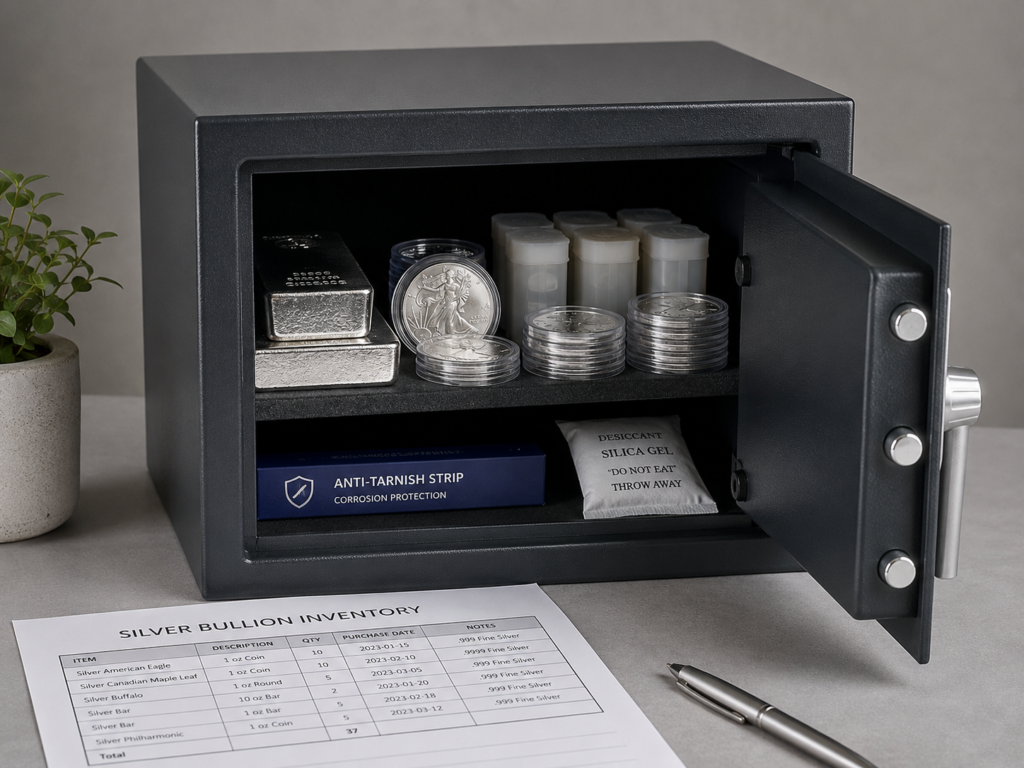
Silver has a problem gold doesn’t: it’s heavy, and it takes up room. A position worth a few thousand dollars can weigh more than a bowling ball and fill a dresser drawer, which quietly rules out half the clever hiding ideas you read about online.
Storing silver safely at home comes down to two jobs: keeping it from being stolen or destroyed, and keeping it from slowly degrading in a damp drawer.
This article is general information on storing physical silver, not security, insurance, legal, or tax advice. Your situation, local risks, and policy terms differ, so confirm coverage and any legal questions with the right professional before you rely on them.
Safe storage means managing two risks
Store silver at home by defending against two risks. Guard against loss with a concealed, weight-anchored, fire-rated safe, and guard against degradation by keeping each piece in an airtight capsule or tube in a cool, dry spot. Keep a written inventory somewhere off-site, and insure anything you can’t afford to lose.
Every decision that follows bends around one fact: silver is bulky and heavy for its value. Because you need real volume to hold meaningful value in silver bullion — physical metal valued for its content rather than any collectible premium — you can’t tuck a serious position into a small nook the way you could with a few gold coins.
And a safe that isn’t heavy or bolted down just gets carried off with your silver inside. Weight isn’t a detail here; it’s the constraint that shapes where you store, what you store it in, and when home storage stops making sense.
If you also keep gold at home, the calculation is different because gold packs far more value into far less space; our guide to storing gold at home covers that side. For silver, plan for the volume first.
Where to store silver at home: concealment and weight
The instinct is to hide silver, and concealment does help — a burglar can’t take what they don’t find in a short, nervous visit. But silver’s weight caps how well hiding works. You can conceal a few ounces almost anywhere; you can’t discreetly tuck fifty pounds of it behind a picture frame without the storage becoming obvious and awkward to reach. The realistic goal is a spot that’s both hard to find and hard to move fast, which usually means low, heavy, and off the normal path through your home.
Skip the first places anyone looks: the master bedroom, the office desk, the freestanding safe sitting in plain view. A ground-floor interior spot beats an upper floor both for concealment and for the load a heavy safe puts on a structure. Splitting a position between two locations means a single discovery doesn’t cost you everything. Here, silver’s bulk is quietly on your side, because a full-position grab is slow and heavy, which is exactly the friction you want.
The most reliable security measure costs nothing: don’t advertise. Silver ownership mentioned at the bar, on social media, or to a wide circle is the most common way a home gets targeted. Tell only the one or two people who’d genuinely need to find it if something happened to you, and keep deliveries discreet — a box obviously from a bullion dealer left on a porch is a billboard. Quiet ownership protects silver better than any single lock.
Safes and containers that actually hold up
A safe does two different jobs, and cheap ones do neither well. Fire protection and burglary protection are rated separately, so a fireproof document safe is often trivial to pry open or carry off, while a heavy burglary safe may offer little against heat. For silver, add a third factor most guides skip: the safe has to be heavy enough, or anchored well enough, that a thief can’t simply wheel it out with your metal still inside. Match the container to what you actually own:
- Fire rating: Look for a stated fire rating (a UL or ETL classification for a set temperature and time) if fire is a real risk where you live.
- Burglary rating: A residential security container (RSC) rating or higher signals real pry resistance; an unrated “security cabinet” is a deterrent, not a barrier.
- Weight and anchoring: Bolt a lighter safe to the floor or a wall stud, or choose one heavy enough that two people can’t carry it off.
- Size for silver, not gold: Silver eats interior volume fast, so size up and leave room to grow — a position you keep adding to outgrows a small safe quickly.
- Individual containers: Inside the safe, keep pieces in airtight capsules, mint tubes, or a lidded case so they don’t rub, scratch, or rattle.
Keeping silver from tarnishing in storage
Silver’s second risk is chemical. Silver reacts with sulfur compounds in ordinary air and tarnishes over time — gold largely doesn’t — and because silver has so much more surface area per dollar than gold, storage humidity and air quality matter far more for a silver position. Tarnish rarely destroys value on bullion, but it looks bad, can make pieces harder to sell at a strong price, and is much easier to prevent than to reverse.
The prevention that fits into a storage plan is simple: keep silver dry, keep air off it, and keep the temperature stable. Airtight capsules and sealed tubes limit air exposure, a desiccant pack in the safe controls humidity, and anti-tarnish strips absorb the sulfur that drives the reaction.
Avoid PVC-based flips and soft plastics, which can chemically damage silver over years, and don’t store metal against cardboard, felt, or rubber bands, which off-gas sulfur.
That’s the storage-level summary. The full method — which materials work, how to handle pieces without leaving fingerprints, and what to do about silver that has already tarnished — is its own subject, and our guide to preventing silver from tarnishing covers it in depth.
Carry one rule into the rest of this article: whatever you store silver in has to be dry and airtight, because the container is doing double duty as both a security and a preservation tool.
Write down what you own before you need to
The storage step people skip is the one that matters most after something goes wrong. If silver is stolen, damaged in a flood, or left to an heir who doesn’t know what it is, a current record is the difference between a recoverable loss and a total one. Insurers, police, and estates all work from documentation, so build the record while everything is still in the safe:
- What each piece is: Product, metal, weight, and quantity, so a claim or an heir isn’t guessing what a tube of unmarked rounds holds.
- What you paid: Purchase date, price, and dealer, which sets your cost basis and helps prove value in a claim or a future sale.
- Identifying details: Serial numbers on bars and any distinguishing marks, recorded somewhere other than on the item itself.
- Photographs: Clear photos of the pieces and any serials, updated whenever the position changes.
- A copy stored off-site: Keep one copy away from the silver, so a fire or theft doesn’t take your metal and its only record at once.
Insurance, and when silver should leave the house
Home storage has a coverage blind spot most owners find too late. A standard homeowners or renters policy typically caps precious metals at a low sublimit — often a few hundred to a couple thousand dollars — far below what a real silver position is worth.
Covering the rest usually means scheduling the silver on a rider or buying a specialty policy, and insurers will ask for exactly the documented record described above. Our guide to insuring gold and silver covers what coverage to buy and what insurers require.
Silver’s bulk is also what eventually pushes it out of the house. A position that has grown to hundreds of pounds is hard to hide, hard to insure affordably at home, and a genuine target. At some point the safest and cheapest option is professional storage, where the metal is insured, secured, and easy to sell. A bank safe deposit box handles a mid-size position; an allocated depository account suits a large one, and our guide to depositories and safe deposit boxes compares the two.
There’s no single right answer, only a threshold that shifts with how much you hold. A modest position is well served by a good home safe, quiet ownership, and a scheduled insurance rider. A large one is usually better off at least partly off-site. Many owners split the difference, keeping a portion at home for access and moving the bulk of the weight into insured storage, which is why knowing exactly what sits where becomes its own small task.
Knowing what you own, and where it sits
Storing silver well ends up being two habits: protecting the metal, and knowing exactly what you have and where it is. The record you built for insurance and recovery is the same record that tells you, at a glance, how much sits in the home safe versus the bank box versus a depository once a position starts to spread across locations.
Gold Silver Ledger is built to hold that record without a spreadsheet. You assign each holding to a storage location — self storage, a safe deposit box, a depository, and so on — so the custody picture stays current, and each item carries its cost basis locked at purchase and its current value against live silver spot. The three per-item labels (Year, Nickname, and Reference) give you a place for a bar’s serial number or a box reference, and the Custody Statement pulls it all into a holdings-by-location summary, which is the exact documentation an insurer or an heir would ask for.
If you want that record in place before you need it, you can start with the free Starter tier and keep track of what you own and where it lives from your first coin forward. Start your trial on our pricing page.
Frequently asked questions
How should I store silver at home?
Store silver at home in a concealed, fire-rated safe that’s either heavy or bolted down, with each piece in an airtight capsule or tube to hold off tarnish. Keep the safe in a cool, dry spot away from the obvious first places a thief looks, stay quiet about owning it, and keep a written inventory somewhere else in case of loss.
Does silver need to be stored in airtight containers?
Silver should be kept in airtight containers because it reacts with sulfur in ordinary air and tarnishes over time, and sealed capsules or tubes slow that reaction. Airtight storage won’t stop tarnish forever, but paired with a desiccant and anti-tarnish strips it keeps bullion looking clean for years.
Is it safe to keep silver at home?
Keeping silver at home is safe for a modest position if you conceal it, secure it in a weight-anchored safe, stay quiet about it, and insure it. The main risks are theft and under-insurance, both of which you can manage; once a position grows into hundreds of pounds, off-site storage usually becomes the safer choice.
What kind of safe do I need for silver?
For silver you want a safe with a burglary rating (such as a residential security container rating) and, if fire is a real risk, a separate fire rating, since the two are certified independently. Just as important, it has to be heavy enough or bolted down so a thief can’t carry it off with your silver inside.
How much silver can you legally keep at home?
There’s no federal limit or reporting requirement on privately owning physical silver, so you can legally keep as much as you want at home. The practical limits are storage space, security, and insurance, not the law. This is general information, not legal advice.
Should I tell anyone where my silver is stored?
Tell only the one or two people who would genuinely need to find your silver if something happened to you, and no one else. Casual mentions of silver ownership are the most common way a home gets targeted, so quiet ownership protects your metal better than any single lock.
How do I keep stored silver from tarnishing?
Keep stored silver from tarnishing by sealing it in airtight capsules or tubes, adding a desiccant to control humidity and anti-tarnish strips to absorb sulfur, and storing it somewhere cool and dry. Avoid PVC flips, cardboard, felt, and rubber bands, which off-gas the compounds that cause tarnish.
When should I move my silver to a bank or depository instead?
Move silver off-site once your position outgrows what you can hide, insure affordably, and secure at home, which for most owners lands somewhere in the hundreds of pounds. A bank safe deposit box suits a mid-size holding and an allocated depository account suits a large one, each with its own trade-offs in access and cost.
This article is for informational and educational purposes only. It isn’t security, insurance, legal, or tax advice. Confirm your coverage with your insurer and any legal questions with a qualified professional before acting.
