
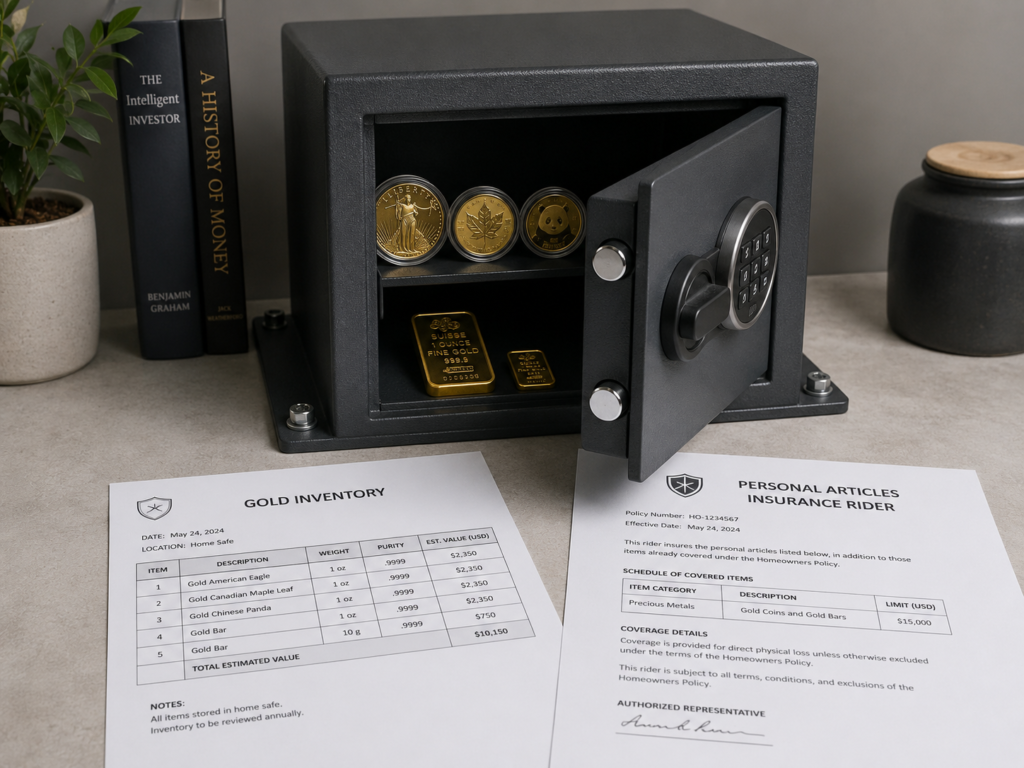
Gold’s superpower is also its risk: a serious amount of it fits in your hand. That’s what makes it easy to tuck away, and it’s exactly why a thief who finds it can carry your whole position out in a pocket. Storing gold at home well means doing three things at once: locking it in a safe worth the name, hiding that safe intelligently, and documenting everything so an insurer will actually pay if the worst happens.
This guide walks through all three, built around the one trait that defines gold — how much value hides in how little space.
This article is general information on storing physical gold, not security, insurance, legal, or tax advice. Your situation, local risks, and policy terms differ, so confirm coverage and any legal questions with the right professional before you rely on them.
Gold’s size is both the appeal and the risk
Store gold at home by doing three things together: lock it in a fire- and burglary-rated safe that’s bolted down, conceal that safe so a burglar never finds it, and keep a documented inventory so your homeowners policy or a rider will cover a loss. Gold’s small size makes hiding realistic, but no hiding spot replaces a safe and insurance.
Everything about storing gold flows from one fact: it packs enormous value into almost no space. A meaningful position in gold bullion — physical metal valued for its content — can fit in a container smaller than a paperback, the opposite of silver’s bulk problem.
That density is the appeal, because gold is genuinely concealable and a small safe can protect a large value. It’s also the danger, since that much value in one tiny place is a magnet for theft and a challenge to insure. Hold that trait in mind through every decision below.
If you also keep silver, the calculation flips: silver’s constraint is weight and volume, not concealment, and our guide to storing silver at home covers that side. For gold, the whole game is protecting a lot of value in a very small package.
Choosing a safe that resists a real attack
A safe does two separate jobs — resisting fire and resisting a burglar — and they’re rated independently, so a cheap “fireproof” box may pop open with a pry bar, and a heavy burglary safe may not protect against heat.
With gold, size isn’t the point; a small safe can hold a fortune, so what matters is how well it resists a determined attack and whether it can simply be carried off. Match the rating to what’s inside:
- Burglary rating: Look for at least a residential security container (RSC) rating; for higher value, a UL tool-resistant rating like TL-15 or TL-30 buys real attack resistance and often better insurance terms.
- Fire rating: A stated UL or ETL fire rating for a set temperature and time protects both the metal and the paperwork stored with it.
- Anchoring: Bolt the safe to the floor or a structural wall so it can’t be carried off whole — a small unbolted safe is portable, and gold makes it worth carrying.
- Concealed, not showcased: A safe hidden inside the home beats a freestanding one in plain view, which just tells a burglar where to focus.
- Quality lock and records: A reliable lock matters, and so does keeping a note of the safe’s rating elsewhere, since some insurers ask for it when you schedule coverage.
Hidden spots and decoys: what concealment really buys you
Concealment earns its keep with gold in a way it can’t with silver. Because a large value fits in a tiny space, gold can be genuinely hidden, and a burglar can’t take what they don’t find in a short, nervous visit. The goal isn’t a clever puzzle; it’s simply not keeping gold in the obvious places — the master bedroom, the office desk, a jewelry box, a freestanding safe on display — where a thief looks first and spends most of their limited time.
Treat hiding as one layer, not the whole plan. A concealed, bolted safe combines two layers at once: hard to find and hard to open. Splitting a position between two locations means a single discovery doesn’t cost you everything.
A modest decoy — a little cash or a few low-value items in an easy-to-find spot — can satisfy a burglar who wants to leave quickly. What no hiding spot does is replace a safe or insurance, so concealment supplements them rather than standing in for them.
The cheapest security measure is silence. Gold ownership mentioned casually — at work, on social media, to a wide circle — is the most common way a home becomes a target, and no hiding spot survives someone knowing it’s there.
Tell only the one or two people who’d truly need to find it if something happened to you, and keep deliveries discreet. Quiet ownership protects gold better than any single hiding place.
What insurers want before they’ll cover it
Here’s the gap most owners find only at claim time: a standard homeowners or renters policy covers almost no gold. These policies carry a very low special sublimit on money and bullion — often just a couple hundred dollars — so a real position is effectively uninsured under the base policy.
Closing that gap means adding coverage, and insurers attach conditions before they will. Our guide to insuring gold and silver covers the coverage options in depth; here’s what insurers typically ask for:
- A documented inventory: An itemized list of what you own — product, weight, quantity, and value — usually with photos and purchase records.
- Proof of value: Receipts or an appraisal establishing what the gold is worth, since coverage is written to a stated amount.
- A qualifying safe: For meaningful coverage, a safe of a specified rating, sometimes bolted, is a condition of the policy or a factor in the premium.
- A scheduled rider or specialty policy: Gold is covered by scheduling it on a valuable-items rider or a separate collectibles policy, not by the base homeowners limit.
- A record kept current: The schedule and values updated as the position grows, so you’re neither under-insured nor paying for coverage you no longer need.
When gold should live off-site instead
Home storage has a ceiling. Past a certain value, keeping gold at home means either carrying real theft risk or paying rising premiums to insure a single vulnerable spot, and at some point professional storage is both safer and cheaper. There’s no universal number; the threshold is simply the point where the value at home outgrows your comfort, your safe, and your coverage.
Two off-site options dominate, and they differ in a way that surprises people. A bank safe deposit box is private and convenient, but the bank or the FDIC doesn’t insure its contents — you have to insure them yourself, and some banks restrict storing bullion.
An allocated depository account stores your gold as your own property, professionally secured and insured, and is built for bullion. Our guide to depositories and safe deposit boxes compares the two in detail.
Most owners don’t pick one or the other so much as split by purpose. A portion stays home in a good safe for access and peace of mind, and the bulk of the value moves to insured off-site storage as the position grows. That split is sensible, but it introduces a new small task: knowing exactly how much gold sits in each place, and being able to prove it.
Keeping the record insurers and heirs rely on
Storing gold well keeps coming back to one document: a current record of what you own, what it’s worth, and where it sits. It’s what an insurer wants before they’ll cover you, what the police need if it’s stolen, and what an heir needs if it passes to them. Building that record is the last job of home storage, and the one people skip until it’s too late to reconstruct.
Gold Silver Ledger is built to keep that record without a spreadsheet. You assign each holding to a storage location — self storage, a safe deposit box, a depository, and so on — so you always know how much gold is where, and each item carries its cost basis locked at purchase and its current value against live gold spot.
The three per-item labels (Year, Nickname, and Reference) hold a bar’s serial number or a box reference, and the Custody Statement pulls it into a holdings-by-location summary, which is the documented inventory an insurer or an heir would ask for.
Start your free trial on our pricing page.
This article is for informational and educational purposes only. It isn’t security, insurance, legal, or tax advice. Confirm your coverage with your insurer and any legal questions with a qualified professional before acting.
Frequently asked questions
How do you store gold at home?
Store gold at home by locking it in a fire- and burglary-rated safe that’s bolted down, concealing that safe away from the obvious rooms a thief checks first, and keeping a documented inventory so a homeowner’s rider or specialty policy will cover a loss. Gold’s small size makes hiding realistic, but the safe and the insurance are what actually protect you.
What is the best safe for storing gold at home?
The best safe for gold has both a burglary rating (a residential security container rating at minimum, or a UL tool-resistant TL rating for higher value) and a separate fire rating, and it’s bolted to the structure so it can’t be carried off. Because gold packs a large value into a small space, the safe’s rating matters far more than its size.
Where is the best place to hide gold at home?
The best place to keep gold is a concealed, bolted safe rather than any single clever hiding spot, ideally away from the master bedroom and office where burglars look first. Splitting a position between two locations and keeping a modest decoy elsewhere both help, but concealment supplements a rated safe and insurance rather than replacing them.
Does homeowners insurance cover gold stored at home?
A standard homeowners or renters policy covers almost no gold, because it caps money and bullion at a very low special sublimit — often just a couple hundred dollars. To cover a real position you schedule the gold on a valuable-items rider or buy a separate specialty policy, and the insurer will want a documented inventory.
Do I have to declare or register gold I keep at home?
There’s no federal requirement to declare or register physical gold you own and keep at home. Ownership is private, and the practical concerns are security and insurance, not registration. This is general information, not legal advice.
Is it better to store gold at home or in a safe deposit box?
Home storage gives you instant access and no rental fee but puts the security and insurance on you, while a bank safe deposit box adds a layer of physical security off your property. Neither is automatically insured, and many owners split the difference — some gold at home for access, the rest in insured off-site storage.
Are bank safe deposit boxes insured for gold?
Bank safe deposit box contents aren’t insured by the bank or the FDIC, so gold kept in one is only covered if you arrange your own insurance for it. Some banks also restrict or discourage storing bullion in their boxes, so confirm the rules before you rely on one.
How much gold can I legally keep at home?
There’s no federal limit on how much physical gold you can legally keep at home, so the real limits are your security, your insurance, and your comfort with the risk. Once the value outgrows those, off-site storage usually makes more sense. This is general information, not legal advice.
