
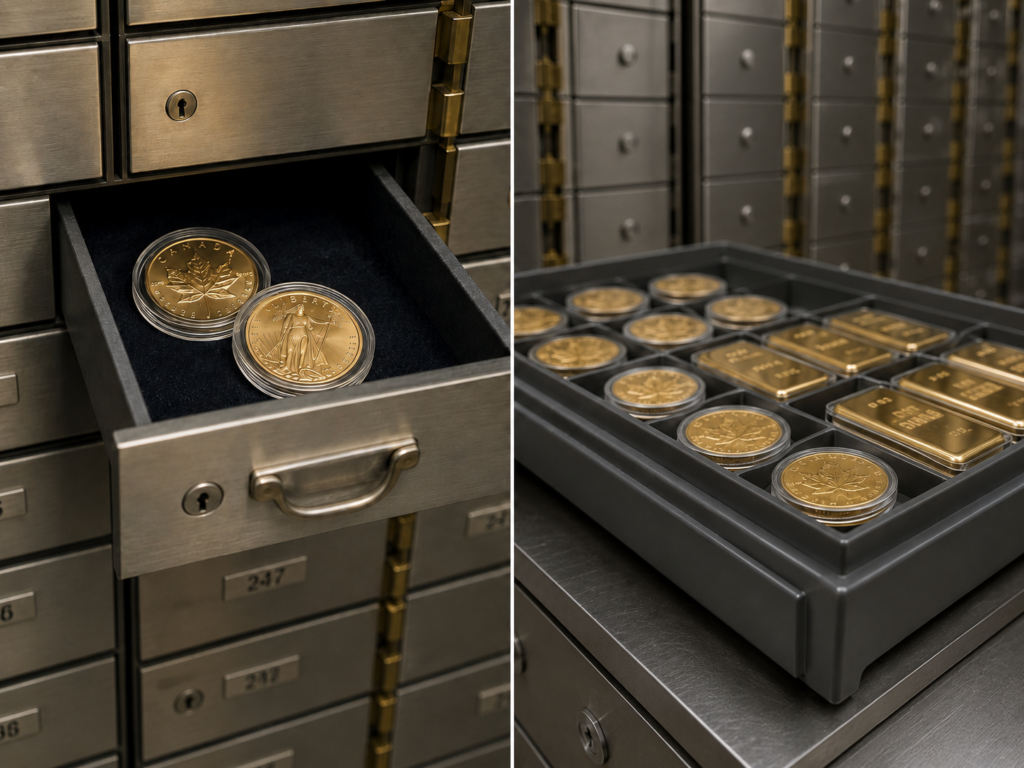
Once you own more gold than you’re comfortable keeping at home, the question becomes where it should live instead — and the two usual answers, a bank safe deposit box and a precious metals depository, are far less alike than they look. One is a locked drawer the bank rents you and insures nothing inside.
The other is a purpose-built vault that can hold your gold as your titled property, fully insured. This guide compares them on the things that actually decide it: insurance, ownership, cost, access, and privacy — so you store bullion where a loss is genuinely recoverable.
This article is general information on storing physical gold, not security, insurance, legal, or tax advice. Storage terms, insurance coverage, and IRA rules vary and change, so confirm the specifics with the provider and the right professional before you rely on them.
Where gold should live when it leaves your home
Store gold bullion in one of three places: a rated safe at home, a bank safe deposit box, or a precious metals depository. The choice comes down to two things — whether the metal is insured and whether you hold direct title to it. A depository typically covers both. A bank box covers neither unless you arrange insurance yourself.
This guide sets the two off-site options against each other, because that’s the real decision most owners face once home storage runs out of room. A bank safe deposit box is the familiar default, and it has genuine strengths. A precious metals depository is purpose-built for gold bullion — physical metal valued for its content — and closes the gaps the bank box leaves open. The rest of this guide compares them where it counts, then helps you decide which fits, or whether the answer is some of each.
The bank safe deposit box: private, convenient, and uninsured
A bank safe deposit box is a locked drawer inside the bank’s vault that you rent by the year, and its strengths are real: it’s inexpensive, it’s private, and it keeps gold out of your home and off a burglar’s list. For a modest position, it’s a reasonable step up from a bedroom safe, and the annual rent is usually far less than depository fees. If simplicity and low cost are what you’re after, the box delivers.
Here’s what the bank never volunteers: the contents of a safe deposit box aren’t insured by the bank or the FDIC. FDIC insurance covers deposit accounts, not the gold in a box, and most banks explicitly disclaim liability for box contents in the rental agreement.
If the box is flooded, burgled, or the metal simply goes missing, the bank generally owes you nothing beyond a token capped amount. To protect gold in a box you have to insure it yourself, and our guide to insuring gold and silver covers how that coverage works.
Two more limits matter. Access is tied to branch hours, so your gold isn’t reachable nights, weekends, or holidays — and if the branch closes or the bank fails, retrieving the contents can get complicated. Some banks also restrict or discourage storing bullion in their boxes at all, so the box that works today may not be an option everywhere. None of this makes the box a bad choice; it makes it a choice you take on with eyes open.
The precious metals depository: built for bullion
A precious metals depository is a high-security vault built specifically to store bullion for investors, not a bank branch with a spare drawer. Facilities such as Delaware Depository, Brink’s, International Depository Services, and the Texas Bullion Depository hold gold under continuous professional security, and — unlike a bank box — the metal is insured while it’s in their care, typically through the all-risk coverage the depository carries. That insurance is the single biggest difference from a safe deposit box.
A depository also settles the ownership question cleanly. Your gold is recorded as yours and stored either allocated, meaning your specific identified metal, or unallocated, meaning a pooled claim — a distinction the next section unpacks.
You don’t drop by a depository the way you visit a bank box; instead, you get audited statements, and you can usually request delivery or sell back through the dealer or custodian. It trades hands-on access for stronger security, insurance, and record-keeping.
There’s one situation where a depository isn’t optional. Gold held in a self-directed IRA must be stored by an approved trustee or depository — the IRS treats storing IRA metal at home as a taxable distribution, so a “home storage IRA” simply isn’t allowed
If your gold sits inside a retirement account, a depository is the only compliant home for it, and our gold IRA guide covers how that setup works.
Safe deposit box vs. depository at a glance
Laid side by side on the criteria that decide it, the two options separate cleanly. The box wins on cost and casual access; the depository wins on insurance, ownership clarity, and IRA eligibility. Use this to match the option to what you actually need:
Table: How a bank safe deposit box and a precious metals depository compare.
| Criterion | Bank safe deposit box | Precious metals depository |
| Insurance | Contents not insured by the bank or FDIC; you insure them yourself. | Metal insured under the depository’s all-risk coverage while in storage. |
| Ownership | You keep possession, but contents aren’t titled or audited. | Held as your property; allocated (specific pieces) or unallocated (pooled). |
| Cost | Low flat annual rent, often modest. | Ongoing fee, commonly a small percentage of value or a minimum charge. |
| Access | In person, during branch hours only. | No walk-in browsing; statements plus delivery or sell-back on request. |
| Privacy | Private; the bank doesn’t inventory contents. | Documented and audited; identity known to the depository and custodian. |
| IRA eligibility | Not permitted for IRA metal. | Required for IRA metal; must be an approved trustee or depository. |
| Best for | A modest position you want cheap, private, and out of the house. | A larger position, IRA metal, or anyone who wants it insured and titled. |
Allocated vs. unallocated storage: what you actually own
Inside a depository, how your gold is stored decides what you legally own. Allocated storage means specific, identified bars or coins are set aside as yours — the exact pieces you deposited, held apart and recorded under your name.
Segregated storage is allocated storage kept in its own space rather than mixed with other clients’ identical metal. Unallocated, or commingled, storage pools your gold with everyone else’s of the same type and fineness, so you own a proportional share rather than particular pieces.
The difference is about more than tidiness; it’s about what happens if the operator fails. With allocated metal, you hold title to specific bars, so they aren’t part of the operator’s bankruptcy estate, and creditors can’t claim them.
With unallocated metal, you’re effectively a creditor with a claim on a pooled quantity, which is cheaper to store but weaker if the institution goes under. The trade-off is simple:
- Allocated (or segregated): You own specific metal with direct title and bankruptcy protection; storage costs more.
- Unallocated (commingled): You own a proportional share of a pool; storage costs less but your claim is weaker if the operator fails.
Choosing between them, or using both
There’s no single right answer, only a right answer for your position. A bank box makes sense for a modest amount you want cheap, private, and out of the house, as long as you insure it.
A depository makes sense once the value is large enough that all-risk insurance and clean title matter more than saving a few dollars a year, and it’s mandatory for IRA metal. Size, insurance, and whether it’s retirement money decide it more than anything else.
Most owners past a certain point don’t pick one — they split by purpose. A small amount stays home in a good safe for access and peace of mind, and our guide to home storage of gold covers doing that well.
A private tranche may sit in a bank box, and the bulk moves to an insured depository as the position grows. Splitting spreads risk, so no single failure, theft, or access problem touches everything at once.
The moment gold lives in more than one place, a new problem appears: knowing exactly how much is where, and being able to prove it. Which coins are in the box, which bars are allocated at the depository, what each cost, and what it’s worth now — that’s the record every off-site decision quietly depends on, and it’s the one thing no vault keeps for you across locations.
Keeping one record across every location
Whichever way you store gold, the comparison keeps returning to one thing: a single record of what you own, where it sits, what it cost, and what it’s worth. Spread across a home safe, a bank box, and a depository account, that record is easy to lose track of and painful to reconstruct — and it’s exactly what an insurer, an heir, or you at tax time will need.
Gold Silver Ledger is built to hold that record in one place. You assign each holding to a storage location — self-storage, a safe deposit box, a depository, an IRA, or other — so you always know how much gold is in each, and every item carries its cost basis locked at purchase and its current value against live gold spot.
This article is for informational and educational purposes only. It isn’t security, insurance, legal, or tax advice. Confirm coverage with your insurer and any legal or tax questions with a qualified professional before acting.
Frequently asked questions
Is gold in a bank safe deposit box insured?
Gold in a bank safe deposit box isn’t insured by the bank or the FDIC — FDIC coverage applies to deposit accounts, not the contents of a box — so it’s protected only if you buy your own insurance for it. Most banks also disclaim liability for box contents in the rental agreement, capping any payout at a token amount.
What is a precious metals depository?
A precious metals depository is a high-security vault built specifically to store bullion for investors, holding your gold under professional security and insuring it under all-risk coverage while it’s in storage. Unlike a bank box, it records the metal as your property and provides audited statements, with delivery or sell-back available on request.
Is it safer to store gold in a depository or a safe deposit box?
A depository is generally the more secure option because the metal is professionally guarded, insured, and formally titled to you, while a safe deposit box offers physical security but no insurance and no audit of contents. The box’s advantages are lower cost and privacy, not stronger protection against loss.
What does it cost to store gold in a depository?
Depository storage typically costs an ongoing fee — commonly a small percentage of the metal’s value or a flat minimum annual charge — with allocated storage costing more than pooled, unallocated storage. A bank safe deposit box usually costs less as a flat annual rent, but that lower price buys no insurance. Confirm current fees directly with the provider.
What is the difference between allocated and unallocated storage?
Allocated storage means you own specific, identified bars or coins held apart under your name, with direct title that keeps them out of the operator’s bankruptcy estate. Unallocated, or commingled, storage pools your metal with others’ of the same type and fineness, so you own a proportional share and hold a weaker, creditor-style claim if the operator fails.
Can I store my IRA gold in a bank safe deposit box?
You can’t store IRA gold in a personal bank safe deposit box — the IRS requires IRA metal to be held by an approved trustee or depository, and taking personal possession is treated as a taxable distribution. A depository is the only compliant storage for gold inside a self-directed IRA. This is general information, not tax advice.
Can banks refuse to let me store gold in a safe deposit box?
Yes, banks can refuse or restrict storing bullion in a safe deposit box, because the rental agreement governs what’s allowed and some banks discourage or prohibit valuables like gold. Confirm a bank’s policy before you rent a box for that purpose, since rules vary from one institution to another.
Should I keep all my gold in one place?
Keeping all your gold in one place concentrates every risk — theft, a single access problem, or one institution’s failure — into a single point, which is why many owners split a position by purpose. A portion at home for access, some in a bank box, and the bulk in an insured depository spreads that risk without much added effort.
