
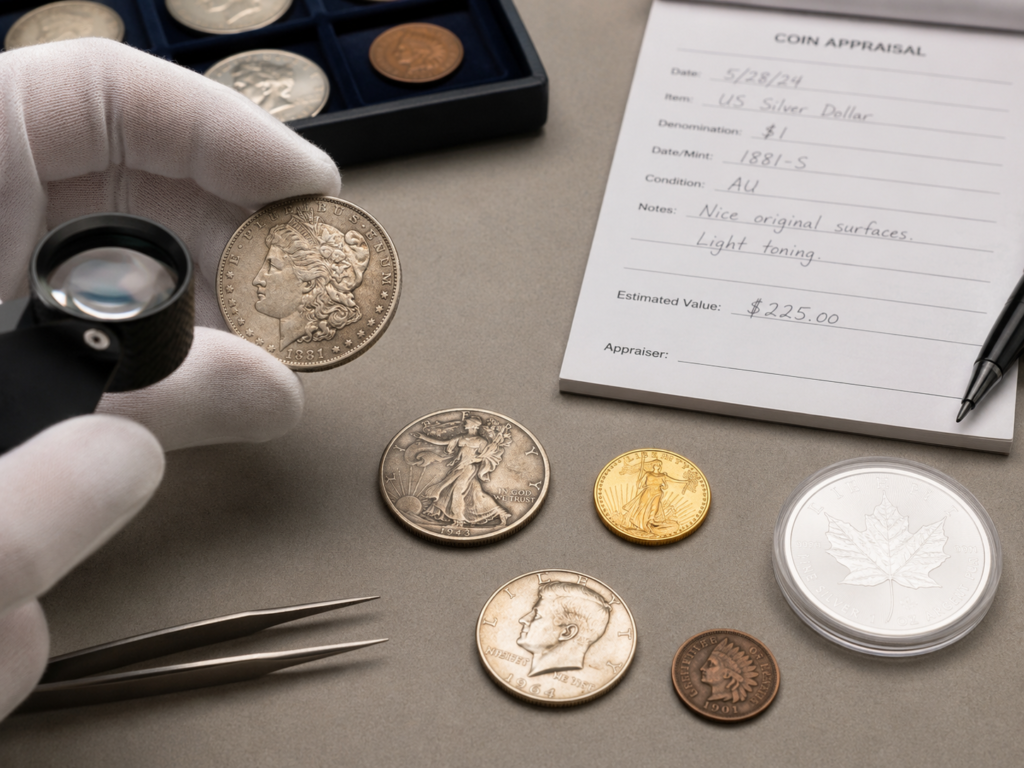
If you’ve got coins and no idea what they’re worth, you need an appraisal — but where you take them, and whether you should pay for one at all, depends on what you’re holding. A roll of common silver Eagles is worth close to its metal content, and you can value it yourself.
A rare or graded coin is a different matter, and getting an honest number means knowing who to trust. This guide covers what a coin appraisal is, when you actually need one, where to get coins appraised online and in person, what it costs, and how to avoid being lowballed.
This article is general information on coin appraisals, not financial, tax, legal, or professional appraisal advice. Values depend on condition, market, and the individual coin, and appraisal requirements for insurance, estate, or tax purposes vary, so confirm the specifics with a qualified appraiser or the right professional.
What a coin appraisal actually is
A coin appraisal is a professional estimate of what a coin is worth, based on its condition, rarity, metal content, and current market demand. Unlike grading, which only rates a coin’s physical condition on a numbered scale, an appraisal assigns an actual dollar value — the figure you’d use for insurance, an estate, or a sale.
The first question is whether you even need one. A common bullion coin — an American Silver Eagle, a Gold Maple Leaf, a bag of junk silver — is worth close to its melt value plus a standard premium over spot, and you can estimate that yourself in minutes without paying an appraiser.
Appraisals earn their cost on the other kind of coin: rare dates, high grades, and numismatic pieces where scarcity and condition, not metal content, set the price. Knowing which you’re holding tells you whether you need a quick value check or a real appraisal.
Appraisal vs. grading: two different things
People use “appraisal” and “grading” interchangeably, but they’re separate steps. Grading is a third-party assessment of a coin’s physical condition, expressed as a number on a 70-point scale by a service like PCGS, NGC, or ANACS, which also authenticates the coin.
Grading doesn’t tell you what the coin is worth — the graders assign a grade, and the market decides the value. An appraisal is that second step: turning the coin’s grade, rarity, and demand into a dollar figure.
The two often go together for valuable coins, because a certified grade makes an appraisal more precise and the coin easier to sell. But you don’t always need both. A quick verbal value check needs neither a slab nor a formal appraisal; an insurance policy needs a written appraisal but not necessarily grading; a rare coin you plan to sell usually benefits from both.
Our guide comparing PCGS, NGC, and ANACS covers how grading works and what it costs, so this guide stays focused on the appraisal itself.
When do you actually need an appraisal?
You need a formal appraisal when a specific decision or requirement depends on a documented value, and the reason shapes what kind of value the appraiser reports. The same coin can carry three different numbers depending on why you’re asking. Get an appraisal when you’re:
- Insuring a collection: Insurers want a written appraisal at replacement value, which can run higher than what the coin would sell for, and our guide to insuring gold and silver covers how that coverage works.
- Settling an estate: Inherited coins usually need a fair-market-value appraisal dated to the owner’s death for tax and division purposes.
- Selling valuable coins: A fair-market or wholesale-value appraisal tells you what to expect before you take an offer, so you can spot a lowball.
- Dividing or donating: Splitting a collection among heirs or donating coins to charity both need a documented value, and larger charitable donations require a qualified appraisal for the IRS.
Where to get coins appraised in person
In-person appraisal still gives the most accurate read on a coin, because condition is hard to judge from a photo. Your options range from a quick free look at a local shop to a formal written appraisal from a credentialed, independent numismatist. Each fits a different need:
Table: In-person coin appraisal options at a glance.
| Where | Best for | Typical cost | Watch for |
| Local coin shop or dealer | A quick value check or common coins | Often free (verbal) | A conflict of interest if they also want to buy |
| Coin show | Comparing several dealers in one place | Usually free (verbal) | Still buy-oriented; get more than one opinion |
| Auction house | Rare or high-value coins you may consign | Often a free evaluation | Geared to winning your consignment, not neutral advice |
| Independent certified appraiser | Insurance, estate, or a neutral written value | Paid, typically hourly | Confirm credentials (ANA, PNG, or a qualified appraiser) |
Online coin appraisals: how they work and what to watch for
Online coin appraisal has grown fast, and for good reason: you photograph the coin — both sides, plus any mintmark or date — submit the images through a website or app, and get an estimated value back, often within a day or two.
Major auction houses, many dealers, and a handful of apps all offer some version of this, frequently free. For getting a rough sense of whether a coin is common or special, it’s convenient and quick.
The trade-off is accuracy. Condition drives a coin’s value, and grade is genuinely hard to judge from a photo — lighting hides the hairlines, cleaning, and wear that a coin in hand reveals at once. An online estimate is a starting point, not a final number, and it’s no substitute for an in-person look or a written appraisal when real money or an insurance policy is involved.
Be clear-eyed about why most online appraisals are free. The site giving you a number usually wants to buy the coin or take it to auction, so the “appraisal” doubles as a sales lead. That doesn’t make the estimate useless, but it does mean the incentive runs toward a number that gets you to sell or consign. Treat a free online figure as one data point, and never mail coins to an unvetted buyer on the strength of it.
What a coin appraisal costs
The cost depends on what you need. A verbal opinion at a coin shop, a show, or through an online form is usually free — with the conflict of interest already noted. A formal written appraisal, the kind an insurer or an estate requires, is a paid professional service, typically billed by the hour and often more for estate or tax work because of the documentation involved. As a rule, the more the appraisal has to hold up to scrutiny, the more it costs.
Whether to pay comes down to the coins and the reason. Paying for a written appraisal on a handful of common bullion coins rarely makes sense, because you can value them yourself against melt and premium.
Paying for one on a rare or inherited collection, or when an insurer or court requires it, is money well spent — a credible independent number can be worth far more than its fee. Grading is a separate cost with its own fees, which is worth factoring in when a coin needs both.
How to avoid a lowball or a scam
The biggest risk in getting coins appraised isn’t a bad grade; it’s an honest-looking number designed to get you to sell cheap. A few habits protect you:
- Separate the appraisal from the sale: The most neutral value comes from someone who isn’t trying to buy your coins, and a paid independent appraiser has no stake in the number.
- Get more than one opinion: For anything valuable, a second or third read exposes a lowball fast, and it’s completely normal to ask several dealers.
- Check credentials: Look for ANA membership, the PNG directory, or a qualified personal-property appraiser, and confirm it rather than taking it on faith.
- Never surrender the coins to get a number: Keep your coins in your possession during an in-person appraisal, and don’t mail them to an unvetted online buyer on the strength of a free estimate.
Keeping your appraisals and coins on record
An appraisal is only as useful as your ability to find it later. The value you paid for, the grade on the slab, the certificate number, what you originally paid for the coin — that record is what an insurer asks for, what an estate needs, and what keeps you from paying for the same appraisal twice. Most people get the number and then lose track of it.
Gold Silver Ledger gives that record a home. You log each coin as a holding — using the custom-item option for numismatic pieces — with its cost basis locked at purchase, the grade and certificate ID in the Reference label, and the mint year noted on the item.
This article is for informational and educational purposes only. It isn’t financial, tax, legal, or professional appraisal advice. Confirm a coin’s value with a qualified appraiser and any tax or legal questions with the right professional before acting.
Frequently asked questions
How much does a coin appraisal cost?
A verbal coin appraisal is usually free, while a formal written appraisal for insurance or an estate is a paid service typically billed by the hour, with estate and tax work costing more because of the documentation involved. Whether it’s worth paying depends on the coins: common bullion pieces you can value yourself, but rare or inherited collections often justify a professional fee.
Where can I get my coins appraised?
You can get coins appraised at a local coin shop, a coin show, an auction house, or through an independent certified appraiser, and many offer a free verbal opinion. For insurance or estate purposes you’ll want a written appraisal from a credentialed, independent appraiser rather than a dealer who also wants to buy the coins.
Are coin appraisals free?
Many coin appraisals are free, but the free ones almost always come from someone who wants to buy or consign your coins, which is a built-in conflict of interest. A neutral written appraisal — the kind an insurer or estate requires — is a paid service from an independent appraiser who has no stake in the sale.
What is the difference between a coin appraisal and coin grading?
A coin appraisal estimates a coin’s dollar value, while coin grading rates only its physical condition on a numbered scale and assigns no value at all. Grading services like PCGS, NGC, and ANACS authenticate and grade the coin; the market and an appraiser translate that grade into what it’s worth.
How do online coin appraisals work?
Online coin appraisals work by having you photograph both sides of the coin and submit the images through a website or app, with an estimated value returned in a day or two. They’re convenient for a rough read, but photos hide the condition details that drive value, so treat an online figure as a starting point rather than a final number.
Do I need an appraisal to insure my coin collection?
Yes, insurers typically require a written appraisal at replacement value to schedule a coin collection for coverage, not just a grade. The appraisal documents what the coins are worth so the policy pays out correctly after a loss, which is why insurance appraisals are usually paid and independent.
How do I get inherited coins appraised?
Get inherited coins appraised by a qualified independent appraiser who can provide a fair-market-value appraisal dated to the previous owner’s death, which is what estates and the IRS generally require. Avoid selling to the first dealer who offers a free look, since a neutral written value protects you and any co-heirs from a lowball. This is general information, not tax or legal advice.
Can I appraise my own coins?
You can reliably value common bullion coins yourself, because they trade close to their melt value plus a standard premium that’s easy to look up. For rare, older, or high-grade coins, condition and scarcity drive the price in ways that take an expert eye, so a professional appraisal is worth it there.
