
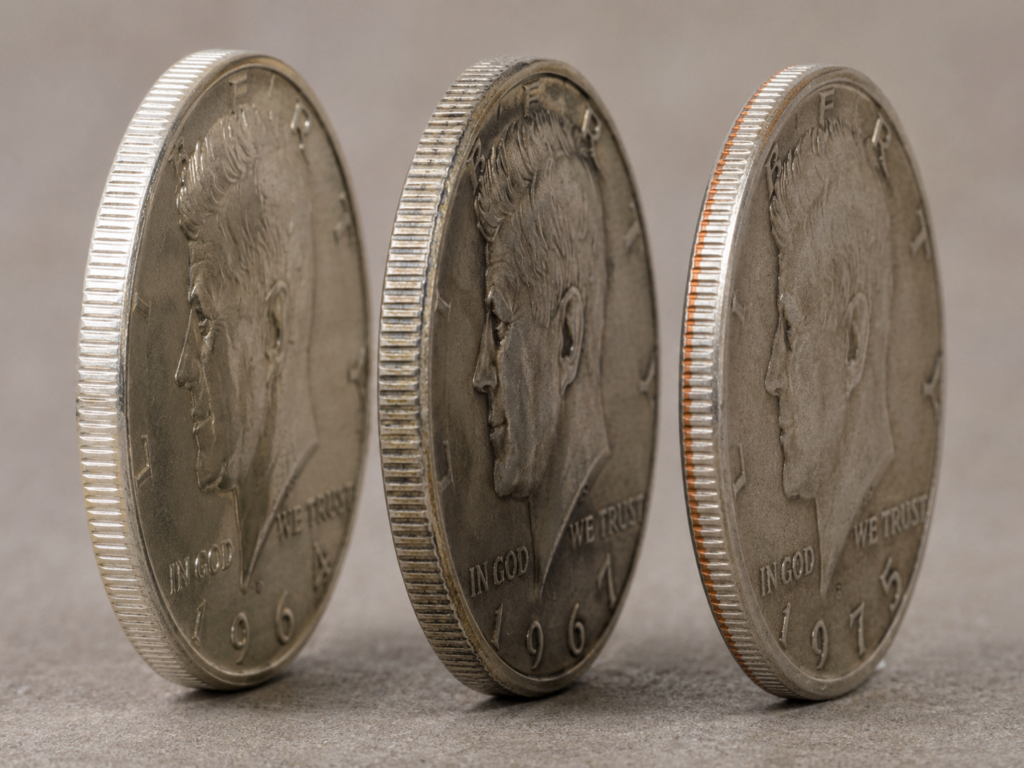
Which half dollars are silver? Short answer: U.S. half dollars dated 1964 or earlier are 90% silver. Kennedy halves dated 1965 through 1970 are still silver — but only 40%, in a unique layered composition that no other U.S. denomination ever used. From 1971 onward, half dollars are copper-nickel clad and contain no silver.
This guide gives you the year-by-year chart for every U.S. silver half, three physical tests for worn or dateless coins, and the truth about the 1965–1970 Kennedys that most readers don’t know exist.
Quick rule: 1964 = 90% silver. 1965–1970 = 40% silver (Kennedy only). 1971 and after = clad.
The Quick Answer: Which Half Dollars Are Silver
U.S. half dollars dated 1964 or earlier are 90% silver. Kennedy halves dated 1965 through 1970 are 40% silver — the only U.S. circulating denomination ever struck at 40%. From 1971 onward, half dollars are copper-nickel clad. The 1976-S 40% silver Bicentennial collector half is the one post-1970 silver exception.
A silver half dollar is a U.S. fifty-cent coin minted with silver — 90% silver for circulation through 1964, 40% silver in Kennedy halves only from 1965 to 1970, and silver in 1992-and-later collector proof issues (90% through 2018, .999 fine from 2019).
A 40% silver clad half is a layered composition unique to the 1965–1970 Kennedy: outer layers of 80% silver bonded to an inner core of 21% silver, with the whole coin averaging to 40% silver. A clad half dollar — 1971 onward — is the copper-nickel sandwich used for dimes and quarters since 1965, with no silver in the coin.
The rest of this article is the identification reference — the year chart, the physical tests for confirming silver content, and the edge cases worth knowing. For dollar values: Walking Liberty halves route to our Walking Liberty half dollar value guide, Kennedy halves (every era, 1964 through today) route to our Kennedy half dollar value guide, and the 1976 Bicentennial routes to our Bicentennial Quarters & Half Dollars guide.
For broader melt-value math, see our melt value explainer or our junk silver guide.
The Silver Half Dollar Year & Mintmark Chart
The chart below covers every U.S. half dollar series since 1794. Find the date on your coin, read across, and you’ll know whether it’s silver, what kind of silver, and how much pure silver it contains.
Silver content of U.S. half dollars by series, 1794–present.
| Series | Year range | Mintmarks | Composition | Gross weight | Silver content (ASW) | Notes |
| Flowing Hair Half Dollar | 1794–1795 | P only | 89.24% silver | 13.48 g | ~0.3870 troy oz | Pre-1837 silver standard. Extremely rare — almost entirely numismatic. |
| Draped Bust Half Dollar | 1796–1807 | P only | 89.24% silver | 13.48 g | ~0.3870 troy oz | Pre-1837 silver standard. |
| Capped Bust Half Dollar | 1807–1839 | P only | 89.24% → 90% silver | 13.48 → 13.36 g | ~0.3870 troy oz | Composition revised mid-series; pre-1837 issues use the older 89.24% standard. |
| Seated Liberty Half Dollar | 1839–1891 | P, O, S, CC | 90% silver | 12.44–13.36 g (12.50 g from 1873) | 0.36169 troy oz | Weight standardized to 12.50 g in 1873. Carson City (CC) issues 1870–1878 carry steep premiums. |
| Barber Half Dollar | 1892–1915 | P, O, S, D | 90% silver | 12.50 g | 0.36169 troy oz | 1892-O “Micro O” is the famous variety. Denver (D) issues from 1906. |
| Walking Liberty Half Dollar | 1916–1947 | P, D, S | 90% silver | 12.50 g | 0.36169 troy oz | Adolph Weinman design. Mintmark on OBVERSE 1916 and early 1917, REVERSE mid-1917 onward. Key dates: 1916-S, 1921, 1921-D, 1921-S, 1938-D. No issues 1922, 1924–1926, 1930–1932. |
| Franklin Half Dollar | 1948–1963 | P, D, S | 90% silver | 12.50 g | 0.36169 troy oz | John Sinnock obverse; Liberty Bell reverse. “Full Bell Lines” (FBL) is a grading designation, not a composition variant. |
| Kennedy Half Dollar — 90% era | 1964 only | P, D | 90% silver | 12.50 g | 0.36169 troy oz | Memorial issue struck after JFK’s November 1963 assassination. Hoarded immediately — rarely found in circulation today. |
| Kennedy Half Dollar — 40% era | 1965–1970 | P, D, S | 40% silver (clad layered) | 11.50 g | 0.1479 troy oz | Outer layers of 80% silver bonded to a 21% silver core, averaging 40%. No mintmark on 1965–1967 issues — suspended during transition. |
| 1976 Bicentennial — collector silver | 1776–1976-S | S only | 40% silver (clad layered) | 11.50 g | 0.1479 troy oz | Sold only in special U.S. Mint sets — blue-pack uncirculated and brown-box proof. Never circulated. |
| 1976 Bicentennial — circulation | 1776–1976 | P, D | Clad | 11.34 g | 0 | Independence Hall reverse. Clad despite the special date. |
| Kennedy Half Dollar — clad era | 1971–present | P, D, S, W | Clad (copper-nickel) | 11.34 g | 0 | Fully clad. From 2002 onward, Kennedy halves are not released into general circulation — produced only for collector sets. |
| Silver proof halves — 90% era | 1992–2018 | S only | 90% silver | 12.50 g | 0.36169 troy oz | Collector silver proof sets only. Never circulated. |
| Silver proof halves — .999 era | 2019–present | S only | .999 fine silver | 12.50 g | ~0.4019 troy oz | U.S. Mint switched to .999 fine silver for proofs in 2019. |
Production gaps in the Walking Liberty series: no halves were minted in 1922, 1924–1926, or 1930–1932. The Depression-era demand for half dollars collapsed; the Mint paused production and resumed regular minting in 1933. If you’re searching for a “1925 silver half dollar” or “1931 silver half dollar,” none was struck.
Rule of thumb (90% silver halves): about 2.8 pre-1965 halves contain 1 troy ounce of silver. By face value, $1.40 in pre-1965 halves ≈ 1 troy oz — the same junk-silver shortcut that works for dimes and quarters. Rule of thumb (40% silver Kennedys 1965–1970): about 6.8 coins contain 1 troy ounce of silver, or $3.40 face value ≈ 1 troy oz.
For a full silver-content reference across all U.S. denominations — dimes, quarters, halves, and dollars — see our broader silver coin identification reference.
How to Tell If a Half Dollar Is Silver Without the Date
Sometimes the date is the easy answer. Other times — a worn coin slick from decades of handling — the date is the problem. Three quick tests can confirm silver content without a date. You only need to pass one. The twist for half dollars is that three composition tiers exist (90% silver, 40% silver, clad), so each test has to read three answers, not two.
Test 1: Edge color (no tools)
Hold the half on edge and look at the reeded rim. A 90% silver half shows a uniform silver-gray edge. A clad half (1971 onward) shows a clear copper-colored stripe running through the middle of the edge — the copper core peeking out between the two cupronickel outer layers.
A 40% silver Kennedy (1965–1970) is the middle case: the layered structure has silver-rich outer layers but a high-copper core, so the edge shows a faint or partial copper tinge — not a full bright stripe like the clad coin, but not the uniform silver-gray of the 90% issue either. Edge color tells you 90%-or-not at a glance; the 40%-vs-clad call needs close inspection or one of the other tests.
Test 2: Weight (most accurate)
A 90% silver half weighs 12.50 g. A 40% silver Kennedy (1965–1970) weighs 11.50 g. A clad half (1971+) weighs 11.34 g. The 90%-vs-clad gap is 1.16 g — the largest of any U.S. denomination and decisive on any kitchen scale. The 90%-vs-40% gap (1.00 g) is also kitchen-scale-decisive. The 40%-vs-clad gap (0.16 g) is the tight one: borderline for a 0.1 g kitchen scale, easy for a 0.01 g jeweler’s scale. Diameter (30.6 mm) is identical across all three composition tiers, so don’t bother measuring it.
Test 3: The ring test
Drop the half from a few inches onto a hard, flat, non-padded surface like a glass tabletop or stone counter. A 90% silver half rings loudly — halves resonate more clearly than any other U.S. denomination because the larger mass produces a stronger tone. A 40% silver Kennedy rings, but less brightly — the layered structure damps the resonance somewhat. A clad half gives a flat, dull “clack.” The ring test is useful as a confirmation after the weight test, not as a standalone diagnostic. Don’t bounce graded or visibly high-grade coins — impact damage destroys numismatic value.
What about the magnet test?
Don’t use a magnet to test for silver. Neither 90% silver, nor the 40% layered composition, nor cupronickel clad is magnetic — all three pass a magnet test. The magnet test is useful for screening out steel-core counterfeits, not for distinguishing silver content. If you’re seeing magnet-test advice online for silver ID, it’s been pulled out of context.
If your half passes the edge or weight test, it’s silver — 90% if the edge is uniformly silver-gray, 40% if you see a faint copper tinge. For Walking Liberty values, see our Walking Liberty half dollar value guide. For Kennedy values across every era — 90%, 40%, and clad — see our Kennedy half dollar value guide.
Two Cutoffs: The Coinage Act of 1965 and 1971
Half dollars have two silver cutoffs, not one. Through the early 1960s, the U.S. Mint produced 90% silver dimes, quarters, and half dollars. Rising silver prices pushed the metal value of these coins toward — and eventually above — their face value, which incentivized hoarding. By 1964, coins were disappearing from circulation faster than the Mint could strike replacements.
The Coinage Act of 1965 (signed by President Lyndon B. Johnson on July 23, 1965) handled the half dollar differently than the dime and quarter. Dimes and quarters lost silver entirely in 1965 — clad copper-nickel from then on. Half dollars kept silver at reduced fineness: 40% silver in a layered structure, with outer layers of 80% silver bonded to an inner core of 21% silver, averaging to 40% silver across the whole coin.
The compromise was partly political (the Kennedy memorial issue had cultural weight) and partly practical (halves were already being hoarded, and a partially-silver coin was meant to keep the denomination functional).
The 40% silver era ran from 1965 through 1970. Federal legislation in late 1970 authorized the move to fully clad halves starting in 1971. From 1971 onward, circulating Kennedy halves are copper-nickel clad — same composition as post-1965 dimes and quarters. Zero silver.
One quirk worth knowing: 1965, 1966, and 1967 Kennedy halves carry no mintmark at all. The same Coinage Act provision that hit the dime and quarter applied to halves too — mintmarks were suspended during the transition to discourage hoarding. Mintmarks returned in 1968, this time on the obverse below the bust truncation. If you check a 1965, 1966, or 1967 Kennedy expecting to find a mintmark, you won’t find one — but the coin is still 40% silver regardless.
A circulation footnote that confuses readers: from 2002 onward, the U.S. Mint stopped releasing Kennedy halves into general circulation. They’re still produced annually in Philadelphia and Denver, but only for collector sets, rolls, and bags sold directly to the public.
So a Kennedy dated 2002 or later in someone’s possession came from a collector source, not pocket change. Composition is still clad — zero silver — so this is a where-did-it-come-from footnote, not a what-metal-is-it one.
For the parallel cutoff story on silver dimes and quarters, see our silver quarter identification guide and our silver dime identification guide.
Edge Cases: Bicentennial, the Silver Eagle Confusion, Modern Proofs, and War-Era Walkers
Half dollars carry more identification traps than any other U.S. denomination. Here are the four you’re most likely to encounter and ask about.
1976 Bicentennial Kennedy halves
Three versions exist. The standard 1776–1976 circulation strikes from Philadelphia (no mintmark) and Denver (D) are clad — 11.34 g, zero silver, Independence Hall reverse. The U.S. Mint also produced a 40% silver collector version with an S mintmark, weighing 11.50 g and containing 0.1479 troy oz of silver, sold only in special blue-pack uncirculated and brown-box proof sets.
Bicentennial halves are everywhere in family stashes — they were the most-saved circulation coin of the modern era. The vast majority of pulled-from-circulation Bicentennials are the clad version. The 40% silver collector version has the S mintmark and weighs marginally more. For deeper valuation detail, see our Bicentennial Quarters & Half Dollars guide.
The American Silver Eagle isn’t a half dollar
This one trips people up. The American Silver Eagle bullion coin (1986–present) uses Adolph Weinman’s Walking Liberty design on its obverse — the same design that appeared on the 1916–1947 half dollar. Some readers see a Walking Liberty figure on a coin and assume it’s a half. It isn’t.
The American Silver Eagle is a $1 face value bullion coin, weighs 31.10 g (1 troy oz of pure .999 fine silver), and measures 40.6 mm in diameter — substantially bigger than the 12.50 g, 30.6 mm Walking Liberty half dollar. If the coin says “1 OZ. FINE SILVER ONE DOLLAR” and is noticeably larger than a quarter, it’s a Silver Eagle, not a circulating half dollar. The Silver Eagle is worth more — but it’s a different coin.
Modern silver proof Kennedy halves (1992–present)
Since 1992, the U.S. Mint has produced annual silver proof sets that include silver Kennedy halves — 90% silver from 1992 through 2018, and .999 fine silver from 2019 onward. All carry the S mintmark and ship in U.S. Mint hard-shell proof packaging. None entered circulation. A 1992-or-later Kennedy in a hard plastic capsule with an S mintmark may be from a silver proof set; a Kennedy loose in a coin jar is clad.
War-era Walking Liberty halves (1942–1945)
Yes, silver — 90%, the same as every other Walking Liberty half dollar from 1916 to 1947. There’s no “war half” composition variant. The wartime metal change applied to nickels only: the 1942–1945 Jefferson “war nickels” used 35% silver because nickel metal was diverted to the war effort. A 1942 or 1945 Walker is a standard 90% silver half. Wartime-dated Walkers carry mintmark and grade premiums that are valuation questions, not composition questions — see our Walking Liberty half dollar value guide.
Found a Silver Half Dollar? What to Do Next
So you’ve confirmed a silver half. Maybe one Kennedy from a family stash, maybe a roll of Franklins your grandfather kept, maybe a single Walking Liberty in an old paper flip. Now what.
The first step is to set it aside from regular change. A 90% silver half — Walking Liberty, Franklin, or 1964 Kennedy — contains 0.36169 troy oz of silver, the highest per-coin silver content of any U.S. circulating denomination. Even a worn common-date example is typically worth substantial dollars at melt value at recent spot prices. A 40% silver Kennedy (1965–1970) still contains 0.1479 troy oz of silver — not as much as the 90% issues, but well above face value. Don’t spend either.
The second step is to assess what you have. Walking Liberty key dates (1916-S, 1921, 1921-D, 1921-S, 1938-D), high-grade Franklin halves with Full Bell Lines, and the 1964 Kennedy in high grade can carry numismatic premiums well above melt — don’t sell at melt without a price-guide check.
Don’t clean any silver half dollar — cleaning destroys numismatic value permanently. For the why, see our notes on how to store silver coins without tarnish.
The third step is to decide whether you’re accumulating (junk-silver mindset) or collecting (numismatic mindset). The two paths have different storage implications. Common-date Walkers, Franklins, and 1964 Kennedys are fine in 2×2 flips or coin tubes. Anything with collector upside — Walking Liberty key dates, high-grade Franklin halves with FBL, Seated Liberty, Barber, or notable Kennedy varieties — belongs in an individual flip or graded holder where it can’t be handled or scratched.
If you’ve pulled multiple halves from a family stash, the inventory question is more involved than it is for dimes or quarters. Halves come in three composition tiers: pre-1964 (90% silver), 1965–1970 (40% silver), and 1971-plus (clad). The three tiers contain different silver amounts — 0.36169 troy oz, 0.1479 troy oz, and zero — and have to be tracked separately if you’re cataloging by silver weight. This is the bookkeeping problem unique to half dollars.
Whether you’re holding a single Walker, a 1964 Kennedy, a roll of 1965–1970 forties, or a family stash spanning all three tiers, the tracking question is how to handle the mixed composition without juggling three categories in a spreadsheet.
Frequently Asked Questions
Are 1964 half dollars silver?
Yes. 1964 was the only year the Kennedy half dollar was struck at 90% silver. A 1964 Kennedy contains 0.36169 troy oz of silver and weighs 12.50 g. 1964 was also the last year for 90% silver in any circulating U.S. half dollar.
Are 1965 half dollars silver?
Yes — but only 40% silver. The Coinage Act of 1965 kept Kennedy halves silver at reduced fineness while removing silver from dimes and quarters entirely. A 1965 Kennedy is 40% silver in a layered structure (80% silver outer layers bonded to a 21% silver core), weighs 11.50 g, and contains 0.1479 troy oz of silver. 1965, 1966, and 1967 issues carry no mintmark — that part of the Act applied to halves too.
Are 1968 or 1969 half dollars silver?
Yes — 40% silver. All Kennedy halves dated 1965 through 1970 are 40% silver. Each contains 0.1479 troy oz of silver. The mintmark moved to the obverse (below the bust) starting in 1968.
Are 1971 half dollars silver?
No. 1971 was the first year of fully clad copper-nickel Kennedy halves — zero silver. A 1971 Kennedy weighs 11.34 g (silver halves weigh 12.50 g for 90% or 11.50 g for 40%). From 1971 onward, all circulating Kennedy halves are clad.
What year did half dollars stop being silver?
Two answers, depending on what you mean. 1964 was the last year for 90% silver. 1970 was the last year for any silver in circulating half dollars — Kennedy halves were 40% silver from 1965 through 1970. 1971 onward is fully clad.
What years are silver half dollars?
1794 through 1970, excluding years halves weren’t minted. The series in order: Flowing Hair (1794–1795), Draped Bust (1796–1807), Capped Bust (1807–1839), Seated Liberty (1839–1891), Barber (1892–1915), Walking Liberty (1916–1947, with no issues in 1922, 1924–1926, and 1930–1932), Franklin (1948–1963), Kennedy 90% (1964 only), and Kennedy 40% (1965–1970). Silver proof Kennedy halves from 1992 to the present also exist but were sold only in collector sets and never released into circulation.
How can I tell if a half dollar is silver?
Three quick tests: check the edge color (90% silver shows a uniform silver edge; 40% silver shows a faint copper tinge; clad shows a clear copper stripe), check the weight (90% = 12.50 g, 40% = 11.50 g, clad = 11.34 g — any kitchen scale catches the 90%-vs-clad and 90%-vs-40% gaps; a jeweler’s scale is needed for 40%-vs-clad), or drop it on a hard surface (90% silver rings loudly; 40% rings less brightly; clad gives a duller clack).
Weight is the most decisive test on halves — the gaps are larger than on dimes or quarters.
How much does a silver half dollar weigh?
12.50 g for 90% silver halves (1964 and earlier, including Walking Liberty, Franklin, and the 1964 Kennedy). 11.50 g for 40% silver Kennedys (1965–1970). 11.34 g for clad halves (1971 and later). The diameter is 30.6 mm for all of them — silver, 40%, and clad.
How much silver is in a half dollar?
A 90% silver half dollar contains 0.36169 troy oz of silver (11.25 g of pure silver inside a 12.50 g coin). A 40% silver Kennedy half (1965–1970) contains 0.1479 troy oz of silver (4.6 g of pure silver inside an 11.50 g coin). The 2019-and-later .999 fine silver proof halves contain approximately 0.4019 troy oz.
How many silver half dollars make an ounce of silver?
Two rules of thumb, depending on which silver era. For 90% silver halves: about 2.8 coins, or $1.40 face value — same junk-silver shortcut as dimes and quarters. For 40% silver Kennedys (1965–1970): about 6.8 coins, or $3.40 face value. The 40% rule matters when you’re cataloging 1965–1970 Kennedys, which are their own junk-silver tier.
Are 1976 Bicentennial half dollars silver?
Usually no. The standard 1776–1976 circulation halves from Philadelphia and Denver are clad — zero silver, Independence Hall reverse. The U.S. Mint made a separate 40% silver collector version with an S mintmark, weighing 11.50 g and containing 0.1479 troy oz of silver, sold only in special Mint sets.
If your Bicentennial half came from change or a family stash, it’s almost certainly the clad version. For more detail see our Bicentennial Quarters & Half Dollars guide.
Are war-era (1942–1945) Walking Liberty halves made of special silver?
No. Wartime-dated Walking Liberty halves are 90% silver, the same as every other Walker from 1916 to 1947. The wartime composition change applied to nickels only — the 1942–1945 Jefferson “war nickels” used 35% silver. There’s no “war half” variant. Wartime Walkers do carry mintmark and grade premiums (especially 1942-S, 1944-S, and 1945-S in high grade), but those are valuation questions, not composition questions.
Is a Walking Liberty silver dollar the same as a Walking Liberty half?
No, those are different coins. The American Silver Eagle bullion coin (1986–present) is a $1 face value coin containing 1 troy oz of pure .999 fine silver and measuring 40.6 mm in diameter. It uses Adolph Weinman’s Walking Liberty design on its obverse — the same design that appeared on the 1916–1947 half dollar.
The two coins look similar but are different sizes and different metals. The original Walking Liberty halves are 90% silver, weigh 12.50 g, measure 30.6 mm, and contain 0.36169 troy oz of silver.
