
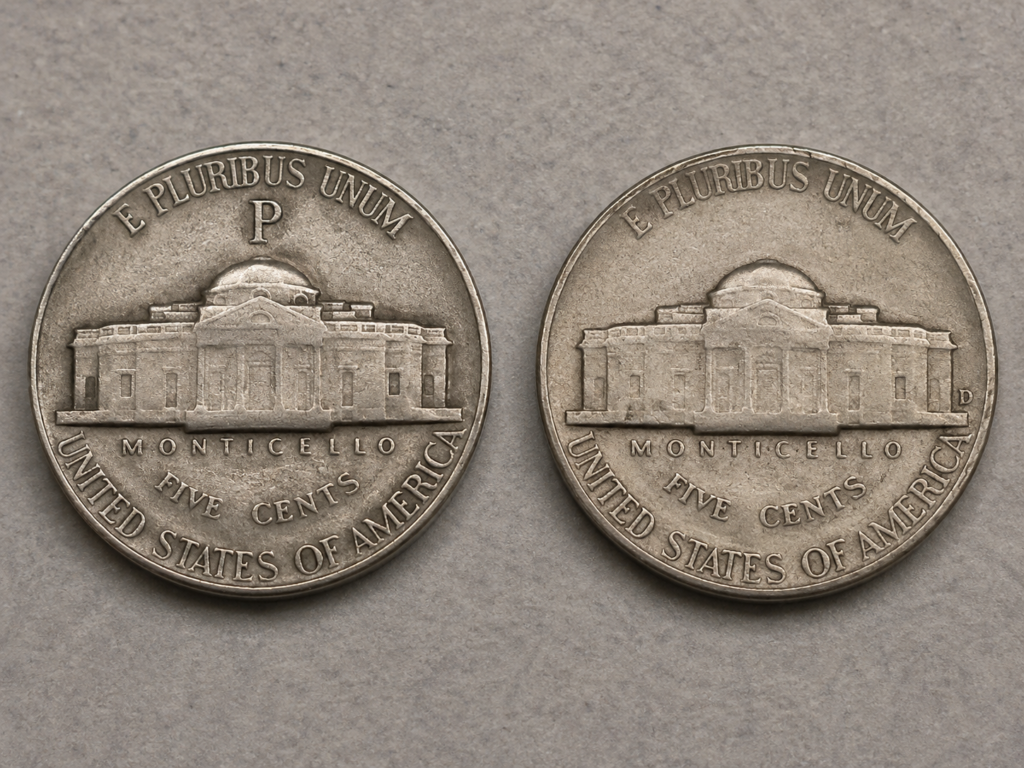
Most U.S. nickels have never contained silver. The Buffalo nickel isn’t silver. The 1964 Jefferson isn’t silver. Only one narrow window in the history of the five-cent piece used a silver alloy: the 1942–1945 “war nickels,” struck at 35% silver to free up nickel metal for the war effort. This guide gives you the year-by-year chart, the one-glance mintmark test, and the three misconceptions to clear up.
Quick rule: Only Jefferson nickels struck from October 1942 through 1945 are silver. Look for a large P, D, or S above the dome of Monticello on the reverse.
The Quick Answer: Are Any Nickels Silver?
Yes, but only a narrow window. Jefferson “war nickels” struck from October 1942 through 1945 are 35% silver, 56% copper, and 9% manganese — the only U.S. nickels ever made with silver. The give-away is a large P, D, or S mintmark above the dome of Monticello on the reverse. Every other U.S. nickel — Shield, Liberty Head, Buffalo, and standard Jefferson — contains no silver.
A silver nickel is a U.S. five-cent coin minted with silver, specifically the wartime Jefferson nickels of October 1942 through 1945. No other U.S. nickel series — Shield (1866–1883), Liberty Head / V-nickel (1883–1913), Buffalo (1913–1938), or standard Jefferson (1938–1942 early and 1946–present) — contains silver. The standard alloy outside that window is 75% copper and 25% nickel, sometimes called cupronickel.
The rest of this article is the identification reference — the year and mintmark chart, the single visual test that works, why the alloy changed during the war, and the misconceptions worth correcting. For a broader cross-denomination silver coin reference, see our complete silver coin identification guide.
The War Nickel Year & Mintmark Chart
The chart below covers every Jefferson nickel from 1942 through 1945, plus the 1946 return to the standard alloy. Find the date and mintmark on your coin and read across.
| Year & mintmark | Mintmark location | Composition | Gross weight | Silver content (ASW) | Silver? | Notes |
| 1942 (no mintmark) | None (Philadelphia) | 75% Cu / 25% Ni | 5.00 g | 0 troy oz | No | Standard composition. Struck before the October 1942 alloy change. |
| 1942-P | Large P above Monticello dome (reverse) | 35% Ag / 56% Cu / 9% Mn | 5.00 g | 0.05626 troy oz | Yes | First U.S. coin to carry a P mintmark. Struck October 1942 onward. |
| 1942-D | Small D right of Monticello (reverse) | 75% Cu / 25% Ni | 5.00 g | 0 troy oz | No | Denver did not strike war nickels in 1942. |
| 1942-S | Large S above Monticello dome (reverse) | 35% Ag / 56% Cu / 9% Mn | 5.00 g | 0.05626 troy oz | Yes | All 1942-S nickels are silver. |
| 1943-P / 1943-D / 1943-S | Large letter above Monticello dome (reverse) | 35% Ag / 56% Cu / 9% Mn | 5.00 g | 0.05626 troy oz | Yes | All 1943 nickels from all three mints are silver. 1943/2-P overdate is a known variety. |
| 1944-P / 1944-D / 1944-S | Large letter above Monticello dome (reverse) | 35% Ag / 56% Cu / 9% Mn | 5.00 g | 0.05626 troy oz | Yes | All 1944 nickels are silver. Many show a brassy or dark patina from manganese — the color is normal. |
| 1945-P / 1945-D / 1945-S | Large letter above Monticello dome (reverse) | 35% Ag / 56% Cu / 9% Mn | 5.00 g | 0.05626 troy oz | Yes | Last year of the wartime alloy. 1945-P doubled-die reverse is a known variety. |
| 1946 onward | Small letter right of Monticello (reverse) | 75% Cu / 25% Ni | 5.00 g | 0 troy oz | No | Standard composition resumed January 1, 1946 and has continued ever since. |
Silver content of U.S. Jefferson nickels, 1942–1946. All war nickels weigh and measure the same as a standard nickel.
Rule of thumb: about 17.8 war nickels contain 1 troy ounce of silver. By face value, $0.89 in war nickels ≈ 1 troy oz. A standard 40-coin bank roll contains about 2.25 troy oz, and a $50 face-value bag (1,000 coins) holds about 56.3 troy oz. War nickels trade as a recognized junk silver bag category — see our junk silver guide for the broader framework.
How to Tell a War Nickel at a Glance: The Mintmark Test
Nickels are not a multi-test problem. The mintmark above Monticello is so dominant — and the alternatives so useless — that one quick check answers the question. We’ll cover the one test that works, and then explain why the usual silver tests don’t.
Test 1: The mintmark above Monticello (decisive)
Flip the nickel to the reverse, the side showing Monticello. A war nickel has a large letter — P, D, or S — directly above the dome. A non-war nickel either shows no mintmark there or shows a small mintmark to the right of Monticello (Denver and San Francisco issues, 1942 cupronickel and 1946 onward; Philadelphia carried no mintmark on nickels until 1980).
The large-letter-above-the-dome placement was used only on war nickels — nowhere else in U.S. coinage. It is the most reliable single-feature silver test of any U.S. denomination.
Test 2: Weight test (doesn’t work for nickels)
A war nickel weighs the same 5.00 grams as a standard Jefferson. The wartime alloy was calibrated to match the cupronickel weight and diameter (21.21 mm) so vending machines and coin counters kept working through the change. Skip the weight test for nickels — it can’t distinguish silver from cupronickel.
Test 3: Edge test (also doesn’t work)
Standard nickels are a homogeneous cupronickel alloy, not a clad sandwich. They have no copper stripe through the edge to contrast against silver. War nickels and standard nickels look essentially identical on edge.
Test 4: Color and patina (supporting clue)
Many war nickels develop a yellowish, brassy, or dark gray tone over time as the manganese in the alloy reacts with sulfur in the air or in coin album pages. A standard cupronickel Jefferson stays a more uniform silver-gray. A grimy, dark, mottled Jefferson is statistically more likely to be a war nickel — but always check the mintmark to confirm. Don’t try to clean it; cleaning destroys numismatic value.
One quick caveat on the magnet test: neither silver, cupronickel, nor the war-nickel alloy is magnetic. The magnet test is for counterfeit detection (steel cores), not silver identification.
Why War Nickels Exist: Nickel as a Strategic Metal
The silver nickel didn’t come out of monetary policy — it came out of wartime industrial demand. Metallic nickel was a strategic material in World War II, needed for armor plate, aircraft engine parts, and the high-strength alloys used in artillery and naval armor. By 1942, the War Production Board had restricted civilian nickel use, and the U.S. Mint was running its five-cent coin on a metal the military wanted back.
Congress passed Public Law 77-732 on October 8, 1942, authorizing the Mint to substitute a silver-bearing alloy in the five-cent coin for the duration of the war. The Mint chose 35% silver, 56% copper, and 9% manganese — silver for value, copper for color and durability, manganese to preserve the coin’s electrical conductivity so vending machines and coin counters kept reading it correctly. Weight (5.00 g) and diameter (21.21 mm) stayed the same.
To make wartime nickels easy to recall for melt after the war, the Mint moved the mintmark to a large, prominent position above the dome of Monticello and added a P mintmark for Philadelphia issues — the first time Philadelphia’s mintmark had ever appeared on a U.S. coin. (P mintmarks didn’t return to other denominations until the late 1970s.) The recall never happened. The Mint simply restored the old alloy in 1946 and left the silver issues in circulation.
The 1942 transition is the tricky year. Early 1942 nickels — struck before the alloy change — used standard cupronickel. Late 1942 nickels used the silver alloy. The mintmark placement is what tells them apart. Philadelphia produced both versions in 1942, a no-mintmark cupronickel and a large-P silver. San Francisco produced only the silver version. Denver produced only the cupronickel version. From 1943 through 1945, all three mints produced only silver war nickels.
The wartime alloy was a single uninterrupted window from October 1942 through December 1945 — no other U.S. nickel before or since contains silver. For the broader composition-change history across U.S. coinage, see our history of U.S. coinage.
Misconceptions: Buffalo Nickels, 1964 Nickels & the “40% Silver” Myth
Three misconceptions show up more often for nickels than for any other denomination. Each one is wrong for a slightly different reason, and each one is worth correcting plainly.
Buffalo nickels are not silver
Buffalo nickels are not silver. The Indian Head / Buffalo nickel (1913–1938, designed by James Earle Fraser) is one of the most iconic U.S. coin designs and is often assumed to be silver because of its age and its prominent place in coin collections. The composition is 75% copper and 25% nickel — the same cupronickel alloy used for every non-war Jefferson. Zero silver.
The confusion comes from the design’s classic look, not the metal. Buffalo nickels do carry collector premiums — sometimes substantial — for key dates (1913-S Type 2, 1937-D “three-legged,” 1918/7-D overdate, 1916 doubled-die obverse) and high grades. For Buffalo nickel values, see our Buffalo nickel value guide.
1964 nickels are not silver
1964 nickels are not silver. The 1964 silver cutoff applies to dimes, quarters, and half dollars — the denominations that contained 90% silver through 1964 and lost it (or kept partial silver, in the case of half dollars) starting in 1965.
Nickels weren’t 90% silver going in, so the Coinage Act of 1965 didn’t touch the five-cent denomination at all. A 1964 Jefferson is 75% copper and 25% nickel — same as a 1963 Jefferson and same as a 2025 Jefferson. Zero silver in any of them.
There is no “40% silver nickel”
The 40% silver composition was used only for Kennedy half dollars from 1965 through 1970 (and the 1976 Bicentennial collector half). It was never used for nickels. War nickels are 35% silver — a different alloy, used for a different reason, in a different denomination. If a source claims “40% silver nickels,” it’s confused with the Kennedy half story. See our Kennedy half dollar identification guide for the 40% details.
Shield and V-nickels aren’t silver either
Shield nickels (1866–1883) and Liberty Head or V-nickels (1883–1913) are also cupronickel — 75% copper, 25% nickel. They carry numismatic value, especially the 1877, 1878, and the famous 1913 Liberty Head (only five known), but no silver content.
The name “nickel” comes from the high nickel content of the five-cent piece — which is why the denomination has never been silver outside the wartime exception.
Found a War Nickel? What It’s Worth and What to Do Next
A common-date war nickel in average circulated grade contains 0.05626 troy oz of silver. At recent silver prices, melt value runs in the low-single-dollar range per coin — not life-changing, but dozens of times face value. Set it aside; don’t spend it.
From there, check whether you have a key date or variety. The 1943/2-P overdate, the 1945-P doubled-die reverse, and the 1944-D over horizontal D are the better-known war-nickel varieties; full-step grades on any war nickel can also carry premiums. Common dates trade at or near melt. For the math at current spot prices, see our guide to calculating melt value.
On storage: common-date war nickels are fine in coin tubes or 2×2 flips. Anything graded or with a known variety belongs in an individual flip or graded holder. The brassy or dark patina many war nickels develop is from manganese oxidation, not damage — leave it alone. Cleaning destroys numismatic value. Our guide to preventing silver tarnish covers the general storage practice.
Frequently Asked Questions
What years are silver nickels?
Only Jefferson nickels struck from October 1942 through December 1945 are silver, and only those carrying the large P, D, or S mintmark above the dome of Monticello on the reverse. That covers all 1943, 1944, and 1945 issues from Philadelphia, Denver, and San Francisco, plus the 1942-P and 1942-S silver issues. The early-1942 no-mintmark Philadelphia nickels and all 1942-D nickels are standard cupronickel with no silver.
Are 1942 nickels silver?
Some 1942 nickels are silver and some are not — the mintmark placement tells you which. The 1942-P (large P above Monticello) and 1942-S (large S above Monticello) are silver war nickels containing 0.05626 troy oz each. The 1942 no-mintmark Philadelphia issue and the 1942-D (small D to the right of Monticello) are standard cupronickel with zero silver.
Are 1943, 1944, and 1945 nickels silver?
Yes — every Jefferson nickel struck in 1943, 1944, and 1945 from any mint is a 35% silver war nickel. Each contains 0.05626 troy oz of silver. The large P, D, or S mintmark above Monticello confirms the silver alloy on every one.
Are 1946 nickels silver?
No — standard cupronickel composition (75% copper, 25% nickel) resumed January 1, 1946, and has continued without interruption ever since. Every Jefferson nickel from 1946 through today contains zero silver.
How can I tell if a nickel is silver?
Flip it to the reverse and look above the dome of Monticello: a large P, D, or S there means a 35% silver war nickel from 1942–1945, while a small mintmark to the right (or no mintmark at all) means a standard cupronickel nickel with no silver. The mintmark test is decisive — weight and edge tests don’t work on nickels because the wartime alloy was designed to match the weight and diameter of standard cupronickel exactly.
How much does a silver war nickel weigh?
A silver war nickel weighs 5.00 grams — the same as a standard Jefferson nickel. The wartime 35% silver, 56% copper, 9% manganese alloy was deliberately calibrated to match the cupronickel weight and the 21.21 mm diameter so vending machines kept working through the change. Don’t try to identify war nickels by weight; use the mintmark above Monticello.
How much silver is in a war nickel?
Each war nickel contains 0.05626 troy oz of pure silver — about 1.75 grams of silver inside a 5.00-gram coin. The full alloy is 35% silver, 56% copper, and 9% manganese.
How many war nickels make a troy ounce of silver?
About 17.8 war nickels contain 1 troy oz of silver. By face value, $0.89 in war nickels ≈ 1 troy oz. A standard 40-coin bank roll holds about 2.25 troy oz, and a $50 face-value bag of 1,000 coins holds about 56.3 troy oz.
Are Buffalo nickels silver?
No, Buffalo nickels (1913–1938) are 75% copper and 25% nickel, the same cupronickel alloy used for every non-war Jefferson nickel. They can carry significant collector value for key dates (1913-S Type 2, 1937-D “three-legged,” the 1918/7-D overdate, the 1916 doubled-die obverse) and high grades, but the value comes from rarity and design — not silver content. See our Buffalo nickel value guide for the details.
Are 1964 nickels silver?
No, the 1964 silver cutoff applies to dimes, quarters, and half dollars only; nickels were never covered by it. A 1964 Jefferson is 75% copper and 25% nickel, the same as a 1963 Jefferson and the same as a current-year Jefferson. Zero silver in any of them.
Is there a 40% silver nickel?
No, the 40% silver composition was used only for Kennedy half dollars from 1965 through 1970 (plus the 1976 Bicentennial collector half) and was never used for nickels. War nickels are 35% silver, a different alloy and a different historical episode. See our silver half dollar identification guide for the 40% Kennedy story.
Why does my 1944-P nickel look brassy or dark?
The brassy or dark patina is normal for war nickels and comes from the 9% manganese in the wartime alloy oxidizing slowly when exposed to air or to sulfur compounds in coin album pages. The unusual color is itself a soft tell that the coin is a war nickel — but always confirm with the large mintmark above Monticello. Don’t clean it; cleaning destroys numismatic value.
Keep track of every silver coin you find
If you’ve started picking silver coins out of pocket change or family stashes, Gold Silver Ledger keeps track of what each one is actually worth — by year, custom tags, and live silver spot — so you don’t have to recalculate every time the price moves. Log a 1944-P war nickel today and it carries the right 0.05626 troy oz weighting forever.
Start your ledger.
