
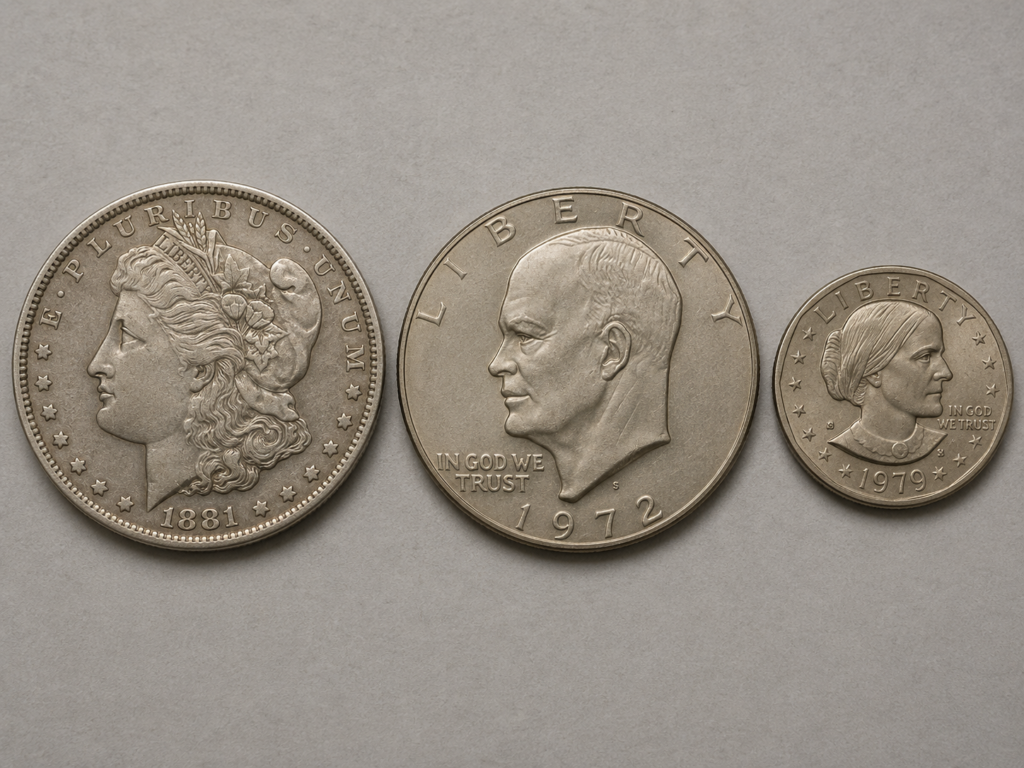
Every U.S. dollar coin minted before 1936 is silver. Most dollar coins minted from 1971 to 1978 are not — they’re copper-nickel clad — but a few specific S-mint Eisenhowers are 40% silver. Every dollar coin minted from 1979 onward is clad or manganese-brass, with zero silver, despite the silver color of the Susan B. Anthony.
This guide gives you the year-by-year chart, three physical tests, and the truth about the 1976 Bicentennial Ike.
Quick rule: 1935 or earlier = 90% silver. 1971–1976 = mostly clad, with S-mint Eisenhowers from 1971–1974 and 1976 the only 40% silver exceptions. 1979 onward = no silver in any circulating dollar coin.
The Quick Answer: Which Dollar Coins Are Silver?
U.S. dollar coins dated 1935 or earlier are silver — 90% silver for Seated Liberty, Trade, Morgan, and Peace dollars, with slightly different fineness for the earlier Flowing Hair, Draped Bust, and Gobrecht series. The U.S. did not strike a circulating dollar coin from 1936 through 1970. Eisenhower dollars (1971–1978) are mostly copper-nickel clad, but S-mint collector issues are 40% silver. Susan B. Anthony, Sacagawea, and Presidential dollars contain no silver.
A silver dollar is a U.S. one-dollar coin minted with silver — 90% silver for circulation from 1840 through 1935, 89.24% for pre-1837 issues, 40% silver for specific Eisenhower collector versions, and silver again in modern commemorative dollars and American Silver Eagle bullion coins.
A golden dollar is the colloquial name for the Sacagawea (2000+) and Presidential (2007–2016) coins, struck in a manganese-brass clad composition that gives a gold-toned appearance — the color is the only thing about them that’s gold-adjacent. A clad dollar is the copper-nickel sandwich used for Eisenhower circulating issues and for Susan B. Anthony dollars. Zero silver in either modern category.
The rest of this article is the identification reference — the year and mintmark chart, the three physical tests that confirm silver content, and the edge cases that trip up the most readers (Eisenhower clad vs. 40% silver, the 1976 Bicentennial three-version split, Susan B. Anthony and Sacagawea misconceptions, and the American Silver Eagle bullion coin).
The Silver Dollar Year & Mintmark Chart
The chart below covers every U.S. dollar coin series since 1794 — circulating and collector — plus the American Silver Eagle bullion coin. Find the date and series on your coin and read across.
| Series | Year range | Mintmarks | Composition | Gross weight | Silver content (ASW) | Notes |
| Flowing Hair Dollar | 1794–1795 | P only | 89.24% silver | 26.96 g | ~0.7737 troy oz | First U.S. dollar coin. Extremely rare — almost entirely numismatic. |
| Draped Bust Dollar | 1795–1804 | P only | 89.24% silver | 26.96 g | ~0.7737 troy oz | 1804 “King of American Coins” is one of the most famous U.S. rarities. |
| Gobrecht Dollar | 1836–1839 | P only | 89.24%–90% silver | 26.73 g | ~0.7734 troy oz | Transitional series; small mintage; mostly held by museums and major collections. |
| Seated Liberty Dollar | 1840–1873 | P / O / S / CC | 90% silver | 26.73 g | 0.77344 troy oz | Carson City (CC) issues from 1870–1873 carry steep premiums. |
| Trade Dollar | 1873–1885 | P / CC / S | 90% silver | 27.22 g | 0.7874 troy oz | Authorized for Asian trade and slightly heavier than other 90% dollars (420 grains vs. 412.5). 1879–1885 issues are proofs only and extremely rare. |
| Morgan Dollar | 1878–1904, 1921 | P / O / S / CC / D | 90% silver | 26.73 g | 0.77344 troy oz | Designer George T. Morgan. 1893-S and 1895-P (proof only) are the famous keys. CC issues from 1878–1893 carry premiums. 1921 Morgans were struck after the Pittman Act melt. |
| Peace Dollar | 1921–1928, 1934–1935 | P / D / S | 90% silver | 26.73 g | 0.77344 troy oz | Designer Anthony de Francisci. 1921 high-relief is the key. Last circulating 90% silver U.S. dollar. |
| Eisenhower Dollar — clad | 1971–1978 | P / D | Cupronickel clad | 22.68 g | 0 troy oz | Standard circulation strike. Same 38.1 mm diameter as Morgan/Peace but lighter (22.68 g vs. 26.73 g) and contains zero silver. |
| Eisenhower Dollar — 40% silver collector | 1971–1974, 1976 | S only | 40% silver clad (layered) | 24.59 g | 0.3161 troy oz | Sold only in special Mint sets — Blue Pack (uncirculated) and Brown Pack (proof). Heavier than the clad Ike and shows a uniform grayish-silver edge with no copper band. |
| 1976 Bicentennial Eisenhower — circulation | 1776–1976 | P / D | Cupronickel clad | 22.68 g | 0 troy oz | Liberty Bell over Moon reverse. Most Bicentennial Ikes in family stashes are this version. |
| 1976 Bicentennial Eisenhower — 40% silver collector | 1776–1976-S | S only | 40% silver clad (layered) | 24.59 g | 0.3161 troy oz | Sold only in special Mint sets. Identified by S mintmark plus heavier weight plus uniform silver edge. |
| Susan B. Anthony Dollar | 1979–1981, 1999 | P / D / S | Cupronickel clad | 8.1 g | 0 troy oz | Diameter 26.5 mm — much smaller than the historical silver dollar. Zero silver. Often miscalled a “silver dollar” because of the silver color. |
| Sacagawea Dollar | 2000–present | P / D / S | Manganese-brass clad | 8.1 g | 0 troy oz | Golden color from the manganese-brass alloy. No gold, no silver. |
| Presidential Dollar | 2007–2016 | P / D / S | Manganese-brass clad | 8.1 g | 0 troy oz | Four different presidential designs per year. Date and mintmark are on the edge, not the obverse. Circulating production ended in 2012; collector-only after that. |
| American Silver Eagle (bullion) | 1986–present | None / W / S | .999 fine silver | 31.10 g | 1.000 troy oz | $1 face value but is bullion, not a circulating coin. Diameter 40.6 mm — larger than Morgan/Peace. .9999 fine for 2021+ Type 2 issues. |
| Modern commemorative silver dollars | 1983–present | P / D / S / W | 90% silver pre-2019, .999 fine 2019+ | 26.73 g | 0.77344 ozt pre-2019, ~0.85937 ozt 2019+ | U.S. Mint collector issues for specific commemorative programs. Sold only in Mint packaging; never released into circulation. |
Silver content of U.S. dollar coins by series, 1794–present.
Rules of thumb. For 90% silver Morgan or Peace dollars: about 1.293 coins, or $1.29 in face value, equals 1 troy oz of silver — a standard 20-coin roll holds about 15.47 troy oz, and a $1,000 face-value bag contains approximately 770 troy oz. For 40% silver Eisenhowers: about 3.17 coins, or $3.17 face value, equals 1 troy oz.
The Trade Dollar carries 0.7874 troy oz per coin because the Mint struck it slightly heavier (420 grains vs. 412.5) to match the Mexican silver coins favored in Asian trade. Morgan and Peace dollars trade as a recognized junk silver bag denomination — see our junk silver guide for the broader framework.
For a full silver-content reference across all U.S. denominations — dimes, quarters, halves, and dollars — see our complete silver coin identification guide. For Morgan-specific valuation, see the Morgan silver dollar value guide.
How to Tell If a Dollar Coin Is Silver Without the Date
The dollar denomination has the largest physical difference between silver and non-silver versions of any U.S. coin. The weight gap, the edge gap, and the diameter gap are all decisive — easier to confirm than dimes, quarters, halves, or nickels. Three tests, any one of which gives you a clear answer.
Test 1: Edge color (no tools)
Hold the dollar on edge and look at the reeded rim. A 90% silver dollar — Morgan, Peace, Seated Liberty, Trade, or pre-1837 — shows a uniform silver-gray edge. A copper-nickel clad Eisenhower (any 1971–1978 P or D issue, plus the 1776–1976 P and D Bicentennials) shows a clear copper-colored stripe through the middle of the edge — the same look as a clad half dollar.
A 40% silver Eisenhower (1971-S through 1974-S and 1976-S) shows a uniform grayish-silver edge with no copper band; the layered structure has silver-rich outer layers and the edge reads as silver. The Susan B. Anthony shows a copper stripe (cupronickel clad). Sacagawea and Presidential dollars are uniformly golden on the edge (manganese-brass).
Test 2: Weight (most decisive)
Weights tell the whole story for dollar coins. A 90% silver Morgan, Peace, or Seated Liberty weighs 26.73 g; a Trade Dollar weighs 27.22 g (the slightly heavier Asian-trade specification); pre-1837 silver dollars weigh approximately 26.96 g. A 40% silver Eisenhower weighs 24.59 g; a clad Eisenhower weighs 22.68 g.
A Susan B. Anthony, Sacagawea, or Presidential weighs 8.1 g. The 90%-vs-clad-Ike gap (4.05 g) is the largest weight gap in U.S. coinage — any kitchen scale handles it. The 40%-vs-clad-Ike gap (1.91 g) is also kitchen-scale-decisive. The SBA-vs-Morgan gap (18.63 g) is so large it’s visible without weighing — the SBA literally feels different in the hand.
Test 3: Diameter (instant rule-out for modern dollars)
All historical silver dollars and Eisenhower dollars — clad or 40% silver — measure 38.1 mm across. Susan B. Anthony, Sacagawea, and Presidential dollars measure 26.5 mm, the same diameter as a Washington quarter. If a “dollar coin” in your hand is roughly quarter-sized, it’s one of those three modern denominations and contains no silver. If it’s noticeably larger than a half dollar, it’s either a historical silver dollar, a clad or 40% silver Eisenhower, or an American Silver Eagle (40.6 mm — slightly larger still).
What about the magnet test?
Don’t use a magnet to test for silver in a dollar coin. None of the silver, clad, layered 40% silver, or manganese-brass compositions are magnetic — all five pass a magnet test, so the test can’t distinguish them. Magnets are useful for spotting counterfeit silver with a steel core, not for genuine U.S. coinage.
A dollar coin that passes the edge or weight test is silver — 90% if the edge is uniformly silver-gray and the coin weighs about 26.73 g, 40% if it’s a 24.59 g Eisenhower with the S mintmark. For Morgan dollar values year by year, see the Morgan silver dollar value guide. For melt math at current spot prices, see our melt value framework. For Peace dollar, Trade Dollar, and Eisenhower valuation, we currently route to PCGS and NGC until our dedicated guides are published.
The Big Cutoffs: The Pittman Act, the End of Circulating Silver Dollars, and the Eisenhower Era
Unlike the dime, quarter, and half dollar — which each have one or two clean silver cutoffs — the silver dollar has multiple inflection points spread across a century. Worth knowing if you’re trying to make sense of why a particular dollar coin exists in the form it does.
The Coinage Act of 1873 ended the standard silver dollar (Seated Liberty) as a circulating denomination and authorized the Trade Dollar specifically for Asian commerce. The Trade Dollar was heavier than the standard silver dollar (27.22 g vs. 26.73 g) and was intended to compete with the Mexican silver coins favored by merchants in China and the broader Asian trade. From 1873 to 1878, the U.S. produced no standard circulating silver dollar — only the Trade Dollar. Production of Trade Dollars for circulation ended in 1878, and Congress demonetized the Trade Dollar in 1876 — an unusual status for a U.S. coin that remained in production but was no longer legal tender.
The Bland-Allison Act of 1878 reauthorized the standard silver dollar and required the Treasury to buy between $2 million and $4 million of silver bullion per month to mint into dollar coins. That’s the political context for the Morgan dollar — designed by George T. Morgan, struck from 1878 through 1904, and again in 1921 after a gap. The Sherman Silver Purchase Act of 1890 expanded the silver-purchase mandate, and millions of Morgans were struck and stored in Treasury vaults rather than circulated. That stockpile is the source of many uncirculated Morgan dollars that survive today.
The Pittman Act of 1918 is the most consequential single piece of legislation in U.S. silver dollar history. It authorized the U.S. Treasury to melt up to 350 million silver dollars from its vaults — about 270 million Morgan dollars were actually melted — to provide silver bullion to Great Britain for use in British India during World War I. The Act also required Treasury to replace the melted dollars with newly struck silver dollars. That’s why the Morgan series resumed in 1921 after a 17-year production gap and why the Peace dollar was designed and rushed into production late that same year. The Pittman melt also explains why certain pre-1921 Morgan dates are relatively scarce — many of the Treasury vault holdings for those years were melted.
The end of the circulating silver dollar came in 1935. The Peace series ran 1921–1928 and 1934–1935. After 1935, the U.S. did not strike a circulating dollar coin of any composition until 1971 — a 36-year gap, the longest in U.S. circulating-coinage history. Silver prices and the political demonetization of silver had made the silver dollar unviable as circulating money. Modern commemorative silver dollars from the U.S. Mint (1983 onward) are collector products, not circulation strikes.
The Coinage Act of 1971 authorized the Eisenhower dollar as a circulating coin — copper-nickel clad, matching the post-1965 dimes, quarters, and halves — and also authorized the Mint to strike a 40% silver collector version. From 1971 through 1974, S-mint 40% silver Ikes were sold in Blue Pack (uncirculated) and Brown Pack (proof) packaging directly to collectors. The 1976 Bicentennial issue followed the same pattern: standard P and D circulation strikes are clad, the S-mint version is 40% silver. The Eisenhower series ended in 1978.
The modern dollar coin era began in 1979. The Susan B. Anthony dollar (1979–1981, with a one-year revival in 1999) replaced the Eisenhower at a much smaller diameter (26.5 mm) and much lighter weight (8.1 g) in copper-nickel clad — no silver. The Sacagawea dollar (2000–present) and Presidential dollar (2007–2016) followed at the same size in manganese-brass clad — golden color, no silver, no gold. Circulating Presidential dollar production ended in 2012; most modern golden-dollar production is collector-only. For the broader composition-change story across U.S. coinage, see our history of U.S. coinage.
Edge Cases: Eisenhower 40% Silver, Bicentennial Ikes, Susan B. Anthony, Sacagawea, and the American Silver Eagle
Dollar coins carry more identification traps than any other U.S. denomination — five worth knowing.
Eisenhower 40% silver collector versions
The Mint struck 40% silver Eisenhower dollars only at San Francisco (S mintmark) and only for these years: 1971-S, 1972-S, 1973-S, 1974-S, and 1976-S. Each contains 0.3161 troy oz of silver and weighs 24.59 g. The Mint sold them directly to collectors in two distinct packagings: Blue Pack (uncirculated, in a blue envelope) and Brown Pack (proof, in a brown box).
Every P and D Eisenhower, every S-mint copper-nickel proof from 1977 and 1978, and any S-mint clad proof from 1971–1976 is standard copper-nickel clad with zero silver. If an Eisenhower has no S mintmark, it’s clad. If it has an S mintmark, the weight test decides: 24.59 g is 40% silver, 22.68 g is clad.
1976 Bicentennial Eisenhower dollars
Three physical versions exist, parallel to the Bicentennial half dollar structure covered in our silver half dollar identification guide. The standard 1776–1976 circulation strikes from Philadelphia (no mintmark) and Denver (D) are copper-nickel clad — 22.68 g, zero silver, Liberty Bell over Moon reverse. The 40% silver collector strike from San Francisco (1776–1976-S) weighs 24.59 g and contains 0.3161 troy oz of silver, sold only in Blue Pack and Brown Pack Mint sets.
A clad S-mint proof also exists from the regular 1976 Proof Set — same S mintmark, but still clad. Most Bicentennial Ikes in family stashes are the clad P or D version. The weight test is decisive for any S-mint Bicentennial: 24.59 g is silver, 22.68 g is clad.
The Susan B. Anthony misconception
Susan B. Anthony dollars (1979–1981 and 1999) are not silver — every single one is copper-nickel clad, the same composition as a post-1965 clad quarter. The SBA weighs 8.1 g, measures 26.5 mm in diameter, and contains zero silver. The silver color comes from the cupronickel alloy, not from any silver content. The “1979 silver dollar” search phrase is the largest single misconception in the silver-dollar topic area — and there’s no such thing.
Per-coin value: face only, with rare exceptions for specific high-grade die varieties like the 1979-P Wide Rim. The SBA was so commonly confused with a quarter (same diameter) that the public widely rejected it, and the Mint withdrew it from active circulation in 1981.
Sacagawea and Presidential “golden” dollars
Sacagawea (2000–present) and Presidential (2007–2016) dollar coins are neither gold nor silver. The golden color comes from a manganese-brass clad composition (88.5% copper, 6% zinc, 3.5% manganese, 2% nickel). They share the SBA’s 8.1 g weight and 26.5 mm diameter — only the alloy and color differ. Neither carries any silver or gold content. Common-date Sacagawea and Presidential dollars trade at face value, with rare exceptions for specific die varieties (the 2000-P Cheerios variety on the Sacagawea is the best-known).
The American Silver Eagle isn’t a circulating dollar
This one trips people up. The American Silver Eagle (1986–present) carries a $1 face value, which is why it shows up in dollar-coin searches, but it’s a one-ounce silver bullion coin — .999 fine silver (.9999 fine for 2021+ Type 2 issues), 31.10 g, 40.6 mm in diameter. The obverse uses Adolph Weinman’s Walking Liberty design — the same design that appeared on the 1916–1947 half dollar — which is the most common source of confusion with historical silver dollars.
Size and edge composition rule it out instantly: the Silver Eagle is larger than a Morgan, has a uniform silver edge, and ships in U.S. Mint or bullion-dealer packaging. Worth far more than $1 face — current melt tracks the silver spot price closely.
Modern commemorative silver dollars (1983–present)
The U.S. Mint produces an annual program of commemorative silver dollar coins for specific events — Olympic Games, statehood anniversaries, presidential commemorations, museum and monument programs. Through 2018 these were struck at 90% silver and weighed 26.73 g (same specs as the historical Morgan and Peace dollars).
From 2019 onward the U.S. Mint switched to .999 fine silver for commemorative dollars, typically containing about 0.85937 troy oz at the same 26.73 g gross weight. All modern commemorative silver dollars were sold only in U.S. Mint packaging and were never released into circulation. A silver-colored dollar coin from 1983 or later in a hard plastic capsule with original Mint documentation is almost always a commemorative silver dollar.
Found a Silver Dollar? What to Do Next
Maybe one Morgan from a grandparent’s drawer. Maybe a roll of Peace dollars your father kept as a wedding gift. Maybe a Bicentennial Ike that turns out to be the S-mint silver version. Silver dollars carry the highest per-coin silver content in U.S. circulating coinage — 0.77344 troy oz for a Morgan or Peace, more than twice a Walking Liberty half — and a single common-date Morgan is worth substantial dollars at melt before any numismatic premium is applied. The moment of identification is meaningful here in a way it isn’t for a war nickel.
First step: set the coin aside. Even a worn, common-date Morgan, Peace, Seated Liberty, or Trade Dollar carries enough silver to be worth $15–$25 at recent spot prices. A 40% silver Eisenhower carries 0.3161 troy oz — significantly less, but still well above face value. Don’t spend any of them.
Second step: assess what you have. Key dates and varieties carry numismatic premiums many times melt — Morgan dates 1893-S, 1895-P (proof only), 1889-CC, 1879-CC, and most pre-1879 Carson City strikes; Peace dates 1921 high-relief and 1928; Trade Dollar 1884 and 1885 (proof only); Seated Liberty CC issues; and the 1804 Draped Bust dollar are the headliners. For Morgan-specific values, see the Morgan silver dollar value guide. For Peace, Trade, and pre-1840 silver dollar values, we currently route to PCGS and NGC until our own guides are ready.
Third step: decide whether you’re accumulating (junk-silver mindset) or collecting (numismatic mindset). The two paths have different storage and handling implications. Don’t clean any of them — cleaning destroys numismatic value permanently. See our guide to preventing silver tarnish for storage practice.
If you’ve inherited a mixed dollar-coin stash, you likely have three composition tiers in the same tube: 90% silver Morgans and Peaces (0.77344 troy oz each), 40% silver Eisenhower S-mint collector versions (0.3161 troy oz each), and standard clad Eisenhowers, SBAs, Sacagaweas, and Presidential dollars (zero silver). The three tiers carry dramatically different per-coin silver weights and should be tracked separately. A bag labeled “silver dollars” from a family stash is often actually a mix, and the silver math fails badly if treated as a homogeneous group.
Frequently Asked Questions
Are 1921 silver dollars silver?
Yes, every 1921 dollar coin is 90% silver, regardless of design. 1921 is the only year both Morgan and Peace dollars were struck. The 1921 Morgan is the largest-mintage Morgan year (over 86 million coins across Philadelphia, Denver, and San Francisco) and is the most common Morgan by a wide margin. The 1921 Peace dollar is the high-relief inaugural issue and is a key date. Both contain 0.77344 troy oz of silver and weigh 26.73 g.
Are 1922 silver dollars silver?
Yes, 1922 Peace dollars are 90% silver, weigh 26.73 g, and each contains 0.77344 troy oz. The 1922 Peace dollar is the most common Peace dollar, struck in high mintage from all three mints. The “1922 misprint” or “misspelled” queries refer to minor die varieties (the TRVST vs. TRUST distinction is one), but every 1922 Peace dollar is silver regardless of variety.
Are 1971 silver dollars silver?
Most 1971 Eisenhowers are not silver, but the 1971-S collector issue is. The 1971 (no mintmark) and 1971-D Eisenhowers are copper-nickel clad with zero silver, weigh 22.68 g, and were struck for general circulation. The 1971-S Eisenhower is a 40% silver collector version — sold only in Blue Pack (uncirculated) or Brown Pack (proof) Mint packaging — weighs 24.59 g, and contains 0.3161 troy oz of silver. The mintmark and packaging tell you which version you have.
Are 1976 Bicentennial dollar coins silver?
Most 1776–1976 Bicentennial Eisenhowers are not silver. The standard P and D circulation strikes are copper-nickel clad with zero silver — these are the version most readers have. The 40% silver collector version (1776–1976-S) was sold only in special Blue Pack and Brown Pack Mint sets and contains 0.3161 troy oz of silver. There’s also a clad S-mint proof from the regular 1976 Proof Set — same S mintmark, but still clad. The weight test is decisive: 24.59 g is 40% silver, 22.68 g is clad.
Are 1979 silver dollars silver?
No, the 1979 Susan B. Anthony dollar is copper-nickel clad with zero silver. It’s the same composition as a post-1965 clad quarter, weighs 8.1 g, and measures 26.5 mm across — much smaller and lighter than a historical silver dollar. The silver color comes from the cupronickel alloy, not from silver content. The “1979 silver dollar” search phrase is the largest single misconception in the silver-dollar topic area; there is no such thing.
What year did dollar coins stop being silver?
Two answers, depending on what you mean by “dollar coin.” The last circulating 90% silver dollar was the 1935 Peace dollar — no circulating silver dollar was struck again until 1971. The last U.S. dollar with any silver content offered as a circulation-era product was the 1976-S 40% silver Bicentennial Eisenhower. From 1979 onward, no circulating U.S. dollar coin contains silver. Modern commemorative silver dollars (1983 onward) are sold by the U.S. Mint to collectors and were never released into circulation.
How much does a silver dollar weigh?
A 90% silver Morgan, Peace, or Seated Liberty dollar weighs 26.73 grams. A Trade Dollar weighs 27.22 grams (slightly heavier — it was designed for Asian trade and matched Mexican silver coin weight). Pre-1837 silver dollars (Flowing Hair, Draped Bust, Gobrecht) weigh approximately 26.96 grams.
A 40% silver Eisenhower weighs 24.59 grams; a clad Eisenhower weighs 22.68 grams. A Susan B. Anthony, Sacagawea, or Presidential dollar weighs 8.1 grams. All historical silver dollars and the Eisenhower (clad or silver) measure 38.1 mm in diameter.
How much silver is in a silver dollar?
A Morgan or Peace silver dollar contains 0.77344 troy oz of silver — about 24.057 grams of pure silver inside a 26.73-gram coin. A Trade Dollar contains 0.7874 troy oz (about 24.49 g of pure silver). A 40% silver Eisenhower contains 0.3161 troy oz. American Silver Eagles (1986–present) contain one full troy ounce of .999 fine silver each.
How many silver dollars make an ounce of silver?
Two rules of thumb, depending on which silver era. For 90% silver Morgan or Peace dollars: about 1.293 coins, or $1.29 in face value, equals 1 troy oz of silver. A 20-coin Morgan/Peace roll holds about 15.47 troy oz, and a $1,000 face-value bag holds approximately 770 troy oz. For 40% silver Eisenhowers: about 3.17 coins, or $3.17 face value, equals 1 troy oz.
Are Eisenhower dollars silver?
Most Eisenhower dollars are not silver. The standard Eisenhower (1971–1978, P and D mints) is copper-nickel clad with zero silver. The exception is the 40% silver collector version (S mintmark, 1971-S through 1974-S and 1976-S), sold only in Blue Pack and Brown Pack Mint sets. Each 40% silver Ike contains 0.3161 troy oz of silver and weighs 24.59 g — heavier than the 22.68 g clad version. If your Ike came from circulation or a coin jar, it’s almost certainly the clad version.
Are Susan B. Anthony dollars silver?
No, every Susan B. Anthony dollar (1979–1981 and 1999) is copper-nickel clad, the same composition as a post-1965 clad quarter, with zero silver. The silver color is from the cupronickel alloy, not from any silver content. Common-date SBAs trade at face value with rare exceptions for specific high-grade die varieties like the 1979-P Wide Rim.
Are Sacagawea dollar coins silver or gold?
Neither, Sacagawea dollar coins (2000–present) are struck in a manganese-brass clad composition that’s 88.5% copper, 6% zinc, 3.5% manganese, and 2% nickel. The golden color comes from the manganese-brass alloy, not from any gold content. No silver either. Same 8.1 g weight and 26.5 mm diameter as the Susan B. Anthony. Common-date Sacagawea dollars trade at face value.
Are Presidential dollar coins silver or gold?
Neither, Presidential dollar coins (2007–2016) use the same manganese-brass clad composition as the Sacagawea dollar, giving them a golden color but no gold and no silver content. Four different presidential designs were struck per year. Date and mintmark appear on the edge of the coin, not the obverse — a distinctive feature of the Presidential series. Circulating production ended in 2012; coins from 2013–2016 were collector-only. Common-date Presidential dollars trade at face value.
Is a Morgan silver dollar worth more than melt?
Almost every Morgan dollar is worth more than melt, but the premium varies dramatically by date and mintmark. Common-date Morgans (most 1880s and 1890s Philadelphia issues, the 1921 issues) trade at modest premiums over melt. Better-date and lower-mintage Morgans — most Carson City issues, 1893-S, 1903-O before the Treasury hoard release, the 1895-P proof-only — carry premiums many times melt.
Is the American Silver Eagle the same as a Morgan silver dollar?
No, they’re different coins. The American Silver Eagle (1986–present) is a one-troy-ounce silver bullion coin with a $1 face value, struck in .999 fine silver (.9999 fine for 2021+ Type 2 issues), weighing 31.10 g and measuring 40.6 mm. It uses Adolph Weinman’s Walking Liberty design — the same design from the 1916–1947 half dollar — but it’s a bullion product, not a circulating coin. The Morgan silver dollar is a circulating 90% silver dollar from 1878–1904 and 1921, weighing 26.73 g and containing 0.77344 troy oz of silver. Both are silver coins; only the Morgan was ever a circulating dollar.
