
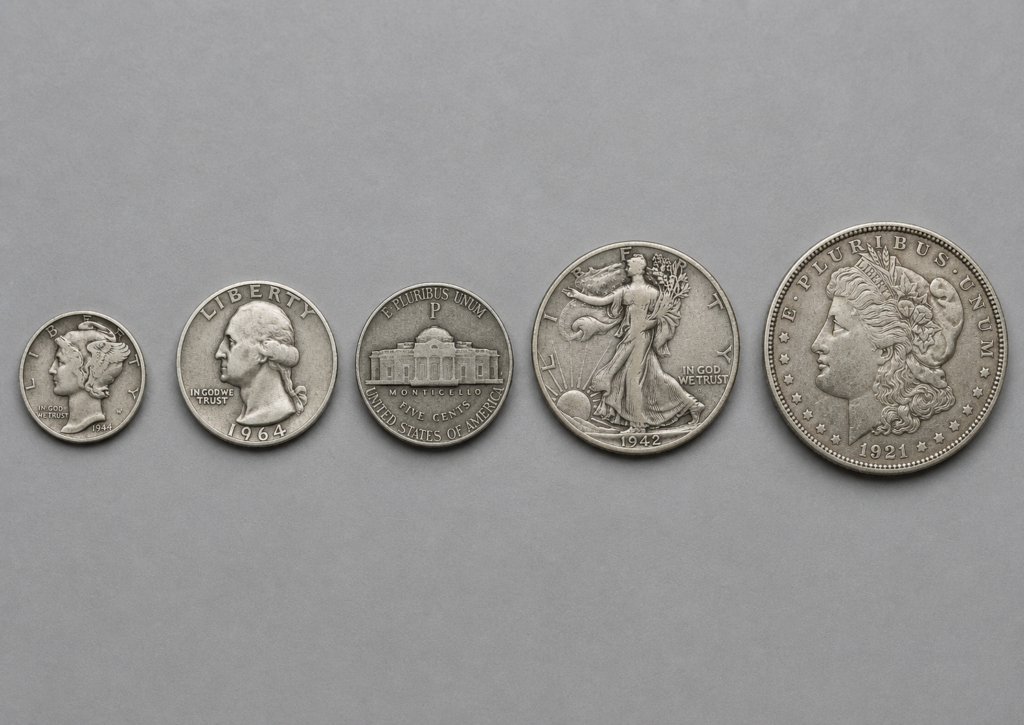
Most U.S. dimes, quarters, and half dollars minted through 1964 are 90% silver. Half dollars stayed 40% silver through 1970. The only silver nickels are the 1942–1945 “war nickels” at 35%. After 1965, silver was removed from circulating coins entirely — but collector-only 40% and 90% silver versions continued.
Here is the complete year-by-year reference.
Quick rule: Date is the fastest test. If a U.S. dime, quarter, or half dollar is dated 1964 or earlier, it’s 90% silver. If a half dollar is dated 1965 through 1970, it’s 40% silver. If a nickel is dated 1942 through 1945 and has a large mintmark above Monticello, it’s a 35% silver war nickel. Everything else circulating is clad.
The Quick Answer: Which U.S. Coins Are Silver?
U.S. dimes, quarters, and half dollars dated 1964 or earlier are 90% silver. Half dollars dated 1965 through 1970 are 40% silver. Nickels dated 1942 through 1945 with a large mintmark above Monticello are 35% silver war nickels. After 1970, no circulating U.S. coin contains silver — but collector-only 40% Bicentennial sets (1976-S) and 90% Silver Proof Sets (1992 onward) continue to be struck.
Pennies have never contained silver. Modern golden dollars (Susan B. Anthony, Sacagawea, Presidential) are also not silver despite the misconception. The rest of this article is the identification reference — the master year-by-year chart, the three composition eras that explain it, the four physical tests that confirm silver content, the common misconceptions that catch people out, and the per-coin silver weights you need to value what you find.
The Master Chart: Silver U.S. Coins by Denomination and Year
The chart below covers every U.S. circulating denomination from the half cent to the silver dollar — with the year ranges, silver percentages, per-coin silver weight, and a one-line identification note for each entry. “ASW” means actual silver weight, the troy ounces of pure silver in a single coin. Find the date and denomination on your coin and read across.
Silver content of U.S. circulating coinage, 1793–present.
| Denomination | Years | Composition | ASW (troy oz) | Identification note |
| Half cent | 1793–1857 | Copper | 0 | Never silver |
| Cent (penny) | 1793–present | Copper, bronze, zinc; 1943 steel | 0 | Never silver (1943 steel is magnetic) |
| Three-cent silver | 1851–1853 | 75% silver | 0.0181 | Smallest U.S. silver coin |
| Three-cent silver | 1854–1873 | 90% silver | 0.0217 | Smallest U.S. silver coin |
| Half dime | 1794–1837 | 89.24% silver | 0.0386 | Predecessor to the nickel |
| Half dime | 1837–1873 | 90% silver | 0.0362 | Predecessor to the nickel |
| Nickel | 1866–1942 | Copper-nickel | 0 | Standard composition |
| Nickel (war nickel) | 1942–1945 | 35% silver | 0.0563 | Large mintmark above Monticello |
| Nickel | 1946–present | Copper-nickel | 0 | Standard composition |
| Dime | 1796–1837 | 89.24% silver | 0.0386 | Pre-standardization issues |
| Dime | 1837–1964 | 90% silver | 0.0723 | Solid silver-gray edge |
| Dime | 1965–present | Copper-nickel clad | 0 | Copper stripe on edge |
| Dime (S proof) | 1992–present | 90% silver | 0.0723 | S mintmark; proof set only |
| Twenty-cent | 1875–1878 | 90% silver | 0.1446 | Short-lived denomination |
| Quarter | 1796–1837 | 89.24% silver | 0.1937 | Pre-standardization issues |
| Quarter | 1837–1964 | 90% silver | 0.1808 | Solid silver-gray edge |
| Quarter | 1965–present | Copper-nickel clad | 0 | Copper stripe on edge |
| Quarter (S silver) | 1976-S Bicentennial | 40% silver | 0.0739 | S mintmark; collector set only |
| Quarter (S proof) | 1992–present | 90% silver | 0.1808 | S mintmark; proof set only |
| Half dollar | 1794–1964 | 90% silver | 0.3617 | Solid silver-gray edge |
| Half dollar | 1965–1970 | 40% silver | 0.1479 | Silver-colored edge, no copper stripe |
| Half dollar | 1971–present | Copper-nickel clad | 0 | Copper stripe on edge |
| Half dollar (S silver) | 1976-S Bicentennial | 40% silver | 0.1479 | S mintmark; collector set only |
| Half dollar (S proof) | 1992–present | 90% silver | 0.3617 | S mintmark; proof set only |
| Silver dollar (early) | 1794–1839 | 89.24% silver | 0.7732 | Flowing Hair, Draped Bust, Gobrecht |
| Silver dollar (Seated, Morgan, Peace) | 1840–1935 | 90% silver | 0.7734 | Solid silver-gray edge, 38.1 mm |
| Trade Dollar | 1873–1885 | 90% silver | 0.7874 | Heavier than standard silver dollar |
| Eisenhower (circulation) | 1971–1978 | Copper-nickel clad | 0 | Copper stripe on edge |
| Eisenhower (S silver) | 1971-S–1974-S, 1976-S | 40% silver | 0.3161 | S mintmark; collector only |
| Susan B. Anthony | 1979–1981, 1999 | Copper-nickel clad | 0 | Quarter-sized; not silver |
| Sacagawea / Presidential | 2000–present | Manganese-brass | 0 | Golden color; not gold or silver |
| Silver dollar (S proof) | 1992–present | 90% silver | 0.7734 | S mintmark; proof set only |
Four cutoff dates anchor the chart. Pre-1965 dimes, quarters, and half dollars are 90% silver. Half dollars stayed 40% silver from 1965 through 1970. The 1942–1945 war nickels are 35% silver — the only silver nickels ever struck for U.S. circulation. And the 1976-S Bicentennial sets, plus the 1992-onward Silver Proof Sets, are the only post-1970 U.S. coins with silver in them, both collector-only.
For the bag-math version of this chart — “how many troy ounces does $1,000 face value hold” — see our junk silver guide.
The Three Composition Eras: Pre-1965, 1965–1970, 1971–Present
The chart’s pattern makes more sense once you see the three eras behind it. U.S. circulating silver coinage moves through one long stable period, one short transition, and a long modern era where silver shows up only in collector sets. Knowing which era a coin belongs to tells you most of what you need to know before you even check the date.
Era 1: The 90% silver standard (1837–1964)
The Coinage Act of 1837 standardized the silver content of U.S. circulating coins at 90% silver, 10% copper — a ratio that held for dimes, quarters, half dollars, and silver dollars through 1964. Every Mercury dime, Standing Liberty quarter, Walking Liberty half, Morgan dollar, and Peace dollar belongs to this era.
The 1942–1945 war nickel is the only exception inside Era 1: nickel was reserved for the war effort, so the Mint replaced the standard copper-nickel five-cent piece with a 35% silver alloy for those four years. Look for the large mintmark above Monticello on the reverse — the only U.S. coin design where the mintmark sits over the building.
Era 2: The 1965–1970 transition
The Coinage Act of 1965 removed silver from circulating dimes and quarters entirely — every dime and quarter dated 1965 or later is copper-nickel clad with zero silver. The half dollar was a political compromise: Congress reduced its silver content from 90% to 40% but kept it silver, in deference to the recently-assassinated Kennedy.
That 40% half dollar ran from 1965 through 1970, then ended. From 1971 forward, the circulating Kennedy half is also copper-nickel clad. For the history behind the 1965 transition, see our history of U.S. coinage.
Era 3: The collector-only era (1971–present)
Every U.S. circulating coin struck from 1971 forward is non-silver — copper-nickel clad for dimes, quarters, halves, and Eisenhower dollars; manganese-brass for the modern golden dollars.
Silver still appears in three specific places: the 40% silver S-mint Eisenhower collector versions (1971–S through 1974–S); the 1976-S Bicentennial sets, which include a 40% silver quarter, half dollar, and Eisenhower dollar; and the U.S. Mint’s Silver Proof Sets, which have been struck since 1992 with 90% silver dimes, quarters, and half dollars (the standard was upgraded to 99.9% silver in 2019).
None of these are pulled from circulation — they’re sold directly by the Mint to collectors.
How to Identify a Silver Coin at a Glance
Four physical tests confirm silver content with no scale, no acid kit, and no specialist knowledge. Run them in this order. The first two settle most coins in seconds; the third and fourth are for ambiguous edge cases. Throughout, “clad” means a sandwich construction — a copper core with thin copper-nickel outer layers — used in every circulating U.S. dime, quarter, and half dollar minted after the silver cutoff.
Test 1: The date check
The date and denomination together answer the question for almost every U.S. circulating coin. A dime or quarter dated 1964 or earlier is 90% silver. A half dollar dated 1964 or earlier is 90% silver; a half dated 1965 through 1970 is 40% silver.
A nickel dated 1942 through 1945 with a large mintmark above Monticello is a 35% silver war nickel. Anything else circulating is clad. The date test fails only for collector-only S-mint pieces, which is why the next three tests matter.
Test 2: The edge check
Hold the coin on edge and look at the rim. A 90% silver dime, quarter, or half dollar shows a solid silver-gray edge with no color change. A copper-nickel clad coin shows a clear copper-colored stripe running down the middle of the edge — the copper core visible between the two outer layers.
A 40% silver Kennedy half (1965–1970) is the trickiest edge case: it’s a silver-clad sandwich, but the outer layers are 80% silver and 20% copper and the core is 21% silver and 79% copper, so the edge is silver-colored without the obvious copper stripe of a fully clad coin.
Test 3: The audio check
Drop the coin from a few inches onto a hard surface. A silver coin rings clearly — a sustained, bell-like note. A clad coin thuds. The difference is unmistakable once you’ve heard a known silver coin and a known clad coin back to back. The audio test is useful in edge cases where the edge stripe is ambiguous, and it’s the test coin dealers use most informally because it requires nothing but a hard surface.
Test 4: The weight check
When in doubt, weigh it. Silver and copper-nickel clad have different densities, so silver coins are noticeably heavier than their clad equivalents. The table below shows the as-minted weight and the threshold below which wear has reduced the coin enough that the weight test becomes unreliable.
| Denomination | Silver weight | Clad weight |
| Dime (Roosevelt, Mercury, Liberty) | 2.50 g | 2.27 g |
| Quarter (Washington, Liberty) | 6.25 g | 5.67 g |
| Half dollar (Walking, Franklin, Kennedy) | 12.50 g | 11.34 g |
| Kennedy half (40% silver) | 11.50 g | — |
| Silver dollar (Morgan, Peace) | 26.73 g | — (clad Ike: 22.68 g) |
| Eisenhower (40% silver) | 24.59 g | — |
| Nickel (war nickel) | 5.00 g | 5.00 g (same weight, different alloy) |
The nickel is the one denomination where the weight test fails: the war nickel and the standard nickel both weigh 5.00 grams, by design. Use the date and the mintmark location instead. For nickels and every other denomination, a magnet test is not useful: no U.S. circulating coin from any era is magnetic, with the single exception of the 1943 steel cent. A magnet that sticks to a U.S. coin is almost always a sign of a counterfeit, not a silver indicator.
The 1965 cutoff doesn’t apply uniformly. Dimes and quarters lost silver in 1965. Half dollars stayed 40% silver through 1970. War nickels (1942–1945) are the only silver nickels ever struck. Check the date and the denomination together.
Common Misconceptions: Coins People Think Are Silver But Aren’t
Five recurring misconceptions show up in almost every drawer or jar a reader brings to this article. Each one is worth correcting cleanly because the corrections often decide whether a coin is worth setting aside.
Susan B. Anthony dollars are not silver
The Susan B. Anthony dollar (1979–1981, with a one-year revival in 1999) is copper-nickel clad — the same composition as a post-1965 quarter. The SBA was a small-diameter dollar coin (26.5 mm, the same size as a quarter), and the visual similarity to the silver-colored Morgan and Peace dollars led many people to assume it must be silver. It never has been. No SBA dollar of any date or mintmark contains silver.
Most Eisenhower dollars are not silver
The Eisenhower dollar (1971–1978) is the biggest source of confusion in the entire denomination set. The standard circulating Ike — P-mint and D-mint, every year 1971 through 1978 — is copper-nickel clad with zero silver, despite being the same diameter as a Morgan dollar (38.1 mm).
Only the S-mint collector versions are silver: the 1971-S through 1974-S Blue Pack (uncirculated) and Brown Pack (proof) issues are 40% silver, and the 1976-S Bicentennial silver Ike is 40% silver. The 1976 Bicentennial Ike has three physical versions — a clad P, a clad D, and a 40% silver S — so the S mintmark is the only reliable indicator.
The 1943 “silver penny” is steel
The 1943 cent looks silver-colored and is often called a silver penny, but it’s zinc-coated steel — produced for one year only because copper was needed for the war effort. The 1943 steel cent is magnetic, which is the simplest way to confirm it. No U.S. cent of any date contains silver. The famous 1943 bronze cent (a wartime error worth six figures) is copper alloy, not silver — a different rarity story entirely.
Modern “golden dollars” are not gold or silver
The Sacagawea dollar (2000–present) and Presidential dollar coins (2007–2016) are manganese-brass — a copper-zinc-manganese alloy with a golden color that fades to a darker patina over time. They are not gold, not gold-plated, and not silver in any form. The Native American dollar series (2009–present) and the American Innovation dollar series (2018–present) use the same manganese-brass composition.
Silver-colored doesn’t mean silver
Post-1965 dimes, quarters, and half dollars look identical to silver versions at a glance because the copper-nickel outer layers of a clad coin mimic the appearance of silver. The date and the edge are the only reliable visual differentiators — a 1965 quarter and a 1964 quarter look indistinguishable from the obverse and reverse alone. The date test remains the fastest answer for every circulating U.S. coin.
Bullion Silver Coins vs. Circulating Silver Coinage
The word “silver coin” covers two very different categories, and conflating them is the most common confusion this article handles. Circulating silver coinage — the article’s scope — means U.S. dimes, quarters, halves, dollars, and war nickels struck for general circulation in 90%, 40%, or 35% silver. These coins have a face value, traded at face value when minted, and are now collected for their silver content (junk silver) or numismatic value.
Bullion silver coins are a separate category. The American Silver Eagle (1986–present), the Canadian Silver Maple Leaf, the Britannia, the Australian Kangaroo, and similar modern world bullion coins are 99.9% or 99.99% fine silver, struck for investment rather than circulation.
They carry a nominal face value (the Silver Eagle is denominated $1) but trade at the silver spot price plus a premium, not at face value. The U.S. Mint’s America the Beautiful 5 oz silver coins also belong to this bullion category. None of these are within the scope of this identification reference — they’re a different category with a different premium structure, and they sit on a future bullion-coins guide.
Per-Coin Silver Weights and Junk Silver Math
If you’ve identified a silver coin, the next question is how much silver it actually contains — the troy ounces of pure silver per coin, called the actual silver weight or ASW. Troy ounces are slightly heavier than the everyday avoirdupois ounce; a troy ounce is 31.103 grams versus 28.35 grams. The ASW figures below are per single coin and assume no wear.
| Coin | Composition | ASW (troy oz) | ASW (grams) |
| Roosevelt / Mercury / Liberty dime | 90% silver | 0.0723 | 2.25 |
| Washington / Standing Liberty quarter | 90% silver | 0.1808 | 5.62 |
| Walking Liberty / Franklin / Kennedy half (pre-1965) | 90% silver | 0.3617 | 11.25 |
| Kennedy half (1965–1970) | 40% silver | 0.1479 | 4.60 |
| Morgan / Peace / Seated dollar | 90% silver | 0.7734 | 24.06 |
| Trade Dollar | 90% silver | 0.7874 | 24.49 |
| Eisenhower (1971-S–1974-S, 1976-S) | 40% silver | 0.3161 | 9.83 |
| War nickel (1942–1945) | 35% silver | 0.0563 | 1.75 |
Two shortcuts make the math easy. For 90% silver dimes, quarters, and halves, every $1.00 of face value contains 0.715 troy oz of silver. That means a roll of forty silver quarters ($10 face) holds 7.15 troy oz; a $1,000 face-value bag of mixed 90% silver dimes, quarters, and halves holds approximately 715 troy oz.
For 40% silver Kennedy halves, $1.00 face value contains 0.295 troy oz of silver, so $1,000 face-value holds roughly 295 troy oz. War nickels work out to about $1.00 face containing 0.563 troy oz, or 56.3 troy oz per $100 face.
To turn ASW into a dollar value, multiply by the silver spot price — the live wholesale price of a troy ounce — then add any numismatic premium for key dates and high grades. Our melt value framework walks through that calculation step by step for any coin.
For glossary definitions of ASW, junk silver, bullion, clad, and the other terms in this article, see our coin glossary.
Found Silver Coins? What to Do Next
Most readers who arrive at this article don’t have one coin — they have a jar, a drawer, an inherited binder, or a roll of mixed dates. That’s a different problem than checking a single coin: you’re working through multiple denominations, multiple composition tiers, and dozens of years. The five steps below are the practical order to work through any mixed pile.
Sort by composition tier first
Separate the pile into four groups: 90% silver (pre-1965 dimes, quarters, halves, dollars), 40% silver (1965–1970 Kennedy halves, S-mint Bicentennial and Eisenhower silvers), 35% silver (1942–1945 war nickels), and everything else. Use the date test for the first pass.
Date-check to confirm
Run through each silver pile a second time and verify every coin’s date against the chart above. The slow second pass catches mis-sorted coins (a 1965 quarter that snuck into the 90% pile, a 1971 Kennedy half mistaken for a 1970).
Weigh a sample
If the sample matches the table above within tolerance, the pile is what the date check says it is. If the sample is light, you have worn coins (still silver, still valuable) or a clad coin in the wrong pile.
Decide intent
Hold for the silver, sell to a dealer, set key dates aside for numismatic value, or some combination. Mixed piles often deserve mixed strategies — common Roosevelt dimes go in the junk silver pile, key-date Mercury dimes deserve individual evaluation.
Log it before you forget
The hardest part of owning physical silver isn’t buying it or storing it — it’s knowing what you have, what you paid, and what it’s worth today.
Our step-by-step guide to inventorying a coin or bullion collection covers the mechanics; the principle is to capture each coin’s date, mintmark, composition, and cost basis before the receipt fades and the memory blurs.
Storage matters once you’ve sorted
Silver tarnishes in the presence of sulfur in air, so the tubes, flips, or albums you store coins in should be sulfur-free and the storage area should be dry.
Our guide on how to store silver coins without tarnish covers the specifics.
Frequently Asked Questions
What year did the U.S. stop making silver coins?
The U.S. stopped making 90% silver dimes and quarters for circulation in 1964 — every 1965 and later dime and quarter is copper-nickel clad. The half dollar transitioned in two steps: 90% silver through 1964, then 40% silver from 1965 through 1970, then fully clad from 1971 onward.
The Coinage Act of 1965 was the legislative driver. Collector-only silver continues: 1976-S Bicentennial 40% silver quarters, halves, and dollars; and 1992-onward 90% silver dimes, quarters, and halves in U.S. Mint Silver Proof Sets.
What is the cutoff year for silver dimes and quarters?
Silver dimes and silver quarters both end at 1964 — every Roosevelt dime, Mercury dime, Washington quarter, and Standing Liberty quarter dated 1964 or earlier is 90% silver. Every dime and quarter dated 1965 or later is copper-nickel clad with zero silver, the only exception being S-mint proof set issues from 1992 onward.
Are any pennies silver?
No U.S. cent of any year, mint, or composition contains silver. The 1943 cent is often called a silver penny because it’s silver-colored, but it’s actually zinc-coated steel produced for one year only during World War II. Stick a magnet to a 1943 penny and it will jump — confirmation that it’s steel, not silver.
Are any nickels silver?
Yes, but only the 1942–1945 “war nickels,” which are 35% silver, 56% copper, and 9% manganese. Mid-World War II, the Mint replaced the standard copper-nickel five-cent alloy to free up nickel for armor plating.
Identify a war nickel by the large P, D, or S mintmark above the dome of Monticello on the reverse — the only U.S. coin design where the mintmark sits over the building. No other U.S. nickel from 1866 to today contains silver.
What’s the difference between 90% silver coins and 40% silver coins?
90% silver coins (90% silver, 10% copper) include the entire pre-1965 series of circulating U.S. dimes, quarters, half dollars, and silver dollars, plus 1992-onward S-mint Silver Proof Sets. 40% silver coins are limited to four specific issues: Kennedy half dollars dated 1965–1970; S-mint Eisenhower collector versions dated 1971-S through 1974-S; and the 1976-S Bicentennial quarter, half dollar, and Eisenhower dollar.
A 40% silver coin holds noticeably less silver than the same-denomination 90% version — a 40% Kennedy half contains 0.1479 troy oz of silver versus 0.3617 for a 90% version.
How do I know if my coin is silver without a scale?
The date is the fastest test for any U.S. circulating coin. If a dime, quarter, or half dollar is dated 1964 or earlier, it’s 90% silver; if a half is dated 1965 through 1970, it’s 40% silver; if a nickel is dated 1942 through 1945 and has the large mintmark above Monticello, it’s a 35% silver war nickel.
As a second check with no tools, hold the coin on edge — a solid silver-gray rim is silver; a clear copper stripe down the middle of the edge is clad. As a third, drop the coin on a hard surface: silver rings; clad thuds.
