
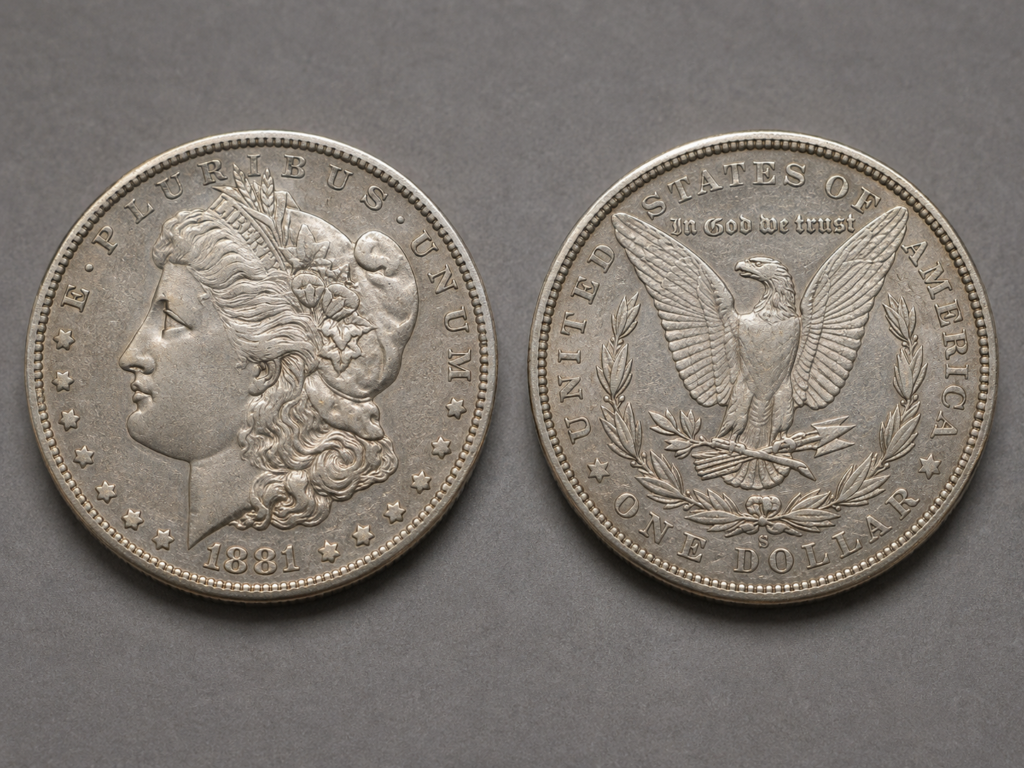
A Morgan silver dollar contains 0.7734 troy oz of silver — multiply by the live silver spot price for the melt-value floor. Common-date Morgans in worn condition trade just above that floor; Mint State examples trade higher. Key dates like the 1893-S, 1889-CC, and 1895 proof reach five and six figures. The chart, the grade tiers, and the identification steps are below.
Quick rule: Year and mintmark drive value first; grade multiplies it. A common-date Philadelphia Morgan in worn condition trades near melt plus a small premium. A Carson City (CC) Morgan from any year is worth a meaningful premium over its Philadelphia counterpart. A key-date suspect — 1889-CC, 1893-S, 1895 proof, 1879-CC, 1885-CC — deserves professional authentication before any sale.
The Quick Answer: What Is a Morgan Silver Dollar Worth?
A common-date Morgan silver dollar (1878–1904 or 1921) in worn circulated condition trades at retail just above its silver melt floor — the value of 0.7734 troy oz of silver at the current spot price, before any numismatic premium. Common dates in Mint State carry a stronger numismatic premium.
Semi-key dates trade well above common-date pricing. Key dates — the 1893-S, 1889-CC, 1895 proof, and a handful of others — reach five and six figures. Year, mintmark, and grade together set the value; no two of the three are enough.
Most Morgan dollars in circulation today are common dates worth a modest premium over silver content. That’s the honest framing, and it matters: an inherited Morgan is far more likely to be a 1921-P at $35 than a 1893-S at $35,000. The rest of this article is the identification reference — the chart, the per-mint paragraph, the key dates section, and how grade interacts with the value tiers.
Is It a Morgan? Identification Before Valuation
Several U.S. silver dollar types look alike at a glance, so the first valuation step is confirming you have a Morgan and not one of the other 38.1 mm silver dollars from overlapping eras.
Morgan dollar (1878–1904, 1921)
Designed by George T. Morgan, then U.S. Mint Assistant Engraver. Obverse: Liberty’s left-facing portrait wearing a Phrygian cap with a wreath of cotton bolls and wheat ears, surrounded by 13 stars and the date. Reverse: a heraldic eagle with outstretched wings holding arrows and an olive branch, with the motto IN GOD WE TRUST above and UNITED STATES OF AMERICA / ONE DOLLAR around the rim.
The mintmark sits below the eagle’s tail feathers, above the DO of DOLLAR. 90% silver, 26.73 grams, 0.7734 troy oz of silver per coin.
Peace dollar (1921–1928, 1934–1935)
Designed by Anthony de Francisci. Obverse: Liberty’s right-facing portrait with radiate crown. Reverse: a bald eagle perched on a rock holding an olive branch, with PEACE inscribed at the rock. Same diameter, weight, and silver content as a Morgan, but a completely different design.
Mintmark location also differs — Peace dollar mintmarks sit on the reverse near the eagle’s wing, not below the tail. If your coin shows Liberty with a radiate crown rather than a Phrygian cap, it’s a Peace dollar, not a Morgan.
Trade dollar (1873–1885)
Heavier than a Morgan (27.22 grams) and dated 1873–1885 with a Seated Liberty obverse and a different eagle reverse. Trade dollars were struck for the Asian export trade and are unmistakable once you’ve seen one. If the reverse says TRADE DOLLAR below the eagle, it’s a Trade dollar.
Eisenhower dollar (1971–1978)
Same diameter as a Morgan but with Eisenhower’s profile on the obverse and an eagle landing on the moon on the reverse — circulating copper-nickel clad with zero silver in standard issues, and only a 40% silver collector version from the S mint. If it’s an Ike, it’s not a Morgan. See our silver dollar identification guide for the full Ike vs. Morgan distinction.
If you’ve confirmed your coin is a Morgan, continue. If it’s a Peace, Trade, or Eisenhower, the broader silver dollar value guide is the right starting point for those series.
For the cross-denomination question — which U.S. coins of any denomination contain silver — see our cross-denomination silver coin identification reference.
How to Read the Date and Mintmark on a Morgan Dollar
Date and mintmark together identify the Morgan with enough precision to value it. A mintmark is a small letter struck into the coin indicating which U.S. Mint facility produced it.
The date sits on the obverse, just below the truncation of Liberty’s neck. Every Morgan is dated 1878 through 1904 or 1921 — there are no Morgans dated 1905 through 1920 because the series went dormant for 17 years after the Bland-Allison silver-purchase mandate expired. The 1921 Morgan is the one-year revival, struck before the Peace dollar replaced the series later that same year.
The mintmark sits on the reverse, below the eagle’s tail feathers and directly above the letters DO of the word DOLLAR. There are five possible mintmarks across the Morgan series. No mintmark means Philadelphia (P). CC means Carson City, Nevada — operated 1870–1885 and 1889–1893, the most valuable mint for nearly every Morgan year.
O means New Orleans, in operation as a branch mint for Morgans from 1879 through 1904. S means San Francisco, operating across the entire series. D means Denver, used only for the 1921 issue.
Looking under the eagle for the mintmark is the single most-common identification step readers miss. The Peace dollar’s mintmark sits in a different location on the reverse, and conflating the two locations is the most-common identification mistake in the entire series.
The Morgan Silver Dollar Value Chart by Year and Mintmark
The chart below shows representative retail values for every Morgan year and mintmark. Each cell shows two values separated by a slash: worn circulated condition on the left, low Mint State (MS-63) on the right. Where the worn cell reads “near silver,” the coin trades at its silver melt floor plus a small premium (typically $5–15 over the value of 0.7734 troy oz of silver at the current spot price) — those cells move with silver.
Where a worn cell shows a dollar figure, the coin carries a numismatic premium even in worn condition. MS-63 figures are largely numismatic-driven and more stable. Higher Mint State grades (MS-64, MS-65 and above) can multiply the MS-63 figure by 2x to 50x on key dates.
All dollar figures are illustrative and pulled from PCGS and NGC price guides at the time of writing; verify live pricing on PCGS or NGC for any specific coin before buying or selling.
Representative Morgan dollar retail values. Cell format: worn condition / MS-63 Mint State. “Near silver” means worn coins trade at silver content plus a small numismatic floor (typically $5–15 over melt). Dollar figures only appear where the value carries a numismatic premium independent of silver price. MS-63 figures are illustrative — verify live pricing for any specific coin.
| Year | Philadelphia (P) | Carson City (CC) | New Orleans (O) | San Francisco (S) | Denver (D) |
| 1878 | near silver / $120 | $200 / $700 | — | near silver / $200 | — |
| 1879 | near silver / $80 | Key: $250 / $5,000 | near silver / $80 | near silver / $200 | — |
| 1880 | near silver / $80 | $300 / $700 | near silver / $80 | near silver / $80 | — |
| 1881 | near silver / $80 | $400 / $700 | near silver / $80 | near silver / $80 | — |
| 1882 | near silver / $80 | $150 / $250 | near silver / $80 | near silver / $200 | — |
| 1883 | near silver / $80 | $150 / $250 | near silver / $80 | near silver / $1,000 | — |
| 1884 | near silver / $80 | $150 / $250 | near silver / $80 | near silver / $8,000 | — |
| 1885 | near silver / $80 | Key: $700 / $1,000 | near silver / $80 | near silver / $300 | — |
| 1886 | near silver / $80 | — | near silver / $300 | near silver / $300 | — |
| 1887 | near silver / $80 | — | near silver / $80 | near silver / $300 | — |
| 1888 | near silver / $80 | — | near silver / $80 | near silver / $400 | — |
| 1889 | near silver / $80 | Key: $1,200 / $35,000 | near silver / $300 | near silver / $300 | — |
| 1890 | near silver / $80 | $80 / $400 | near silver / $80 | near silver / $300 | — |
| 1891 | near silver / $80 | $80 / $400 | near silver / $200 | near silver / $300 | — |
| 1892 | near silver / $200 | $200 / $1,400 | near silver / $200 | $50 / $200,000 | — |
| 1893 | near silver / $700 | $300 / $2,000 | near silver / $4,000 | Key: $5,000 / $250,000 | — |
| 1894 | Key: $1,500 / $4,500 | — | near silver / $1,500 | $80 / $2,500 | — |
| 1895 | Proof only: $50,000+ | — | Key: $400 / $25,000+ | $700 / $5,500 | — |
| 1896 | near silver / $80 | — | near silver / $300 | $80 / $2,500 | — |
| 1897 | near silver / $80 | — | near silver / $1,000 | near silver / $200 | — |
| 1898 | near silver / $80 | — | near silver / $80 | near silver / $100 | — |
| 1899 | near silver / $200 | — | near silver / $80 | near silver / $300 | — |
| 1900 | near silver / $80 | — | near silver / $80 | near silver / $300 | — |
| 1901 | near silver / $4,500 | — | near silver / $80 | near silver / $500 | — |
| 1902 | near silver / $200 | — | near silver / $80 | $80 / $500 | — |
| 1903 | near silver / $200 | — | $400 / $700 | $250 / $5,500 | — |
| 1904 | near silver / $200 | — | near silver / $80 | $80 / $1,500 | — |
| 1921 | near silver / $50 | — | — | near silver / $60 | near silver / $60 |
Each mint has a structural reason for the premium pattern it shows in the chart.
Philadelphia (P, no mintmark)
Largest mintages most years, lowest premiums most years. The bulk of common-date Morgans available in dealer inventory today are Philadelphia issues — they’re the floor of the series. Exceptions: 1894-P is a key date with low mintage; 1895-P exists only as proofs (no business strikes are known to survive); 1901-P is rare in high Mint State.
Carson City (CC)
The Carson City mint operated for short stretches (1870–1885, 1889–1893) and struck modest mintages, so every CC Morgan carries a premium at every grade tier. Common CCs from 1882, 1883, and 1884 — all heavily represented in the 1972–1980 General Services Administration (GSA) Treasury hoard release — trade at $150–$250 in worn condition. Carson City’s status as a Western-frontier mint adds a collecting premium beyond mintage alone.
New Orleans (O)
Branch mint operating across most of the Morgan series. Common-date New Orleans Morgans (most years 1880–1904) trade at common-date prices, but specific O-mint dates and varieties — 1893-O, 1895-O, the 1900-O/CC overmintmark — carry meaningful premiums. New Orleans Morgans are often softly struck, which compresses the value differential between low Mint State and high Mint State.
San Francisco (S)
Operated across the entire series. S-mint Morgans show the widest value range of any mint because the series includes both common-date pieces (1881-S, 1898-S, 1902-S in low grades) and the king of Morgan circulation strikes — the 1893-S — plus several semi-keys (1884-S, 1892-S, 1893-S, 1895-S, 1903-S, 1904-S). Strike quality is generally strong on S-mint Morgans, so high Mint State examples command meaningful premiums over low Mint State.
Denver (D)
Only one Morgan year was struck at Denver: 1921. The 1921-D is the only Morgan dollar Denver ever made, and it trades at common-date prices because its mintage was high. The mintmark is a curiosity rather than a value driver.
For the bag-math version of common-date Morgans — how many troy ounces a $1,000 face-value bag of mixed common-date Morgans holds — see our junk silver guide. To turn the chart’s silver-floor value into a dollar amount at the current spot price, see our melt value framework.
Key Dates and Semi-Keys: The Morgans Worth a Closer Look
A handful of Morgan dates diverge sharply from common-date values. The list below is not comprehensive — there are dozens of varieties and minor keys collectors pay attention to — but it covers the dates that most often appear in inherited collections and the dates most likely to be misidentified or counterfeited. Any coin you suspect is one of these should be professionally authenticated by PCGS or NGC before any sale. Counterfeits and altered-mintmark coins are common in this part of the market.
1893-S: The king of Morgan circulation strikes
Mintage 100,000, the lowest of any business-strike Morgan dollar. Even worn examples (G-4 to VF-20) trade in the $5,000–$15,000 range. Mint State examples reach the high five figures, and MS-66 to MS-67 examples have crossed $1 million at auction. The 1893-S is the most-counterfeited Morgan, often with altered mintmarks on common-date Philadelphia 1893 hosts — never buy a raw 1893-S; PCGS or NGC slab is the only safe purchase.
1889-CC: The rarest Carson City Morgan
Mintage 350,000. Worn examples trade for $1,200–$3,000; Mint State examples reach $35,000 and above. Like the 1893-S, the 1889-CC is heavily counterfeited — and altered 1889-P or 1889-O coins with added CC mintmarks appear regularly. Professional grading is essential.
1895: The King of Morgans (proof only)
Officially, 12,880 business strikes were minted at Philadelphia in 1895, but no authenticated business strike has surfaced — the entire mintage was likely melted under the Pittman Act of 1918. What remains are 880 proofs, all of which command $50,000 and rise into six figures at top grades. The 1895-O (450,000 minted) and 1895-S (400,000 minted) exist as business strikes and are keys in their own right.
1879-CC, 1881-CC, 1885-CC: The Carson City keys
Three CC Morgans below 300,000 mintage. The 1885-CC has the lowest CC mintage at 228,000 and trades for $700+ even in worn condition. 1879-CC has the famous “Capped Die” (clear CC) and “Capped CC” varieties, both keys. 1881-CC trades for $400+ in worn condition.
1894-P: The rarest business-strike Philadelphia Morgan
Mintage 110,000 — third-lowest of any Morgan after the 1893-S and 1895-P. Worn examples trade at $1,500+; Mint State examples cross $4,500 and climb sharply from there. Often overlooked because Philadelphia (no mintmark) Morgans get less collecting attention than mintmarked issues.
1903-O: The GSA-release story
Through 1962, the 1903-O was considered the rarest Morgan in Mint State and traded accordingly. In November 1962, the U.S. Treasury released bags of uncirculated 1903-O Morgans from its vaults into the collector market, collapsing the rarity premium overnight. Today the 1903-O trades at $400+ in worn condition and $700+ in Mint State — still a date worth setting aside, but no longer the rarity it was. The 1903-O is the canonical example of how Treasury vault discoveries can reshape Morgan rarity.
1878 7TF and 8TF: First-year-of-issue tailfeather varieties
The first Morgan dies depicted the eagle with eight tail feathers (8TF). Midway through 1878, the design was changed to seven tail feathers (7TF) to match the standard heraldic eagle. Both varieties exist for 1878 Philadelphia, plus a transitional 7-over-8 (7/8TF) variety. The 8TF and 7/8TF varieties carry premiums; the 7TF reverse with the parallel tailfeathers is the common 1878-P. See VAMworld (the canonical Morgan variety attribution reference) for the full breakdown.
1900-O/CC: The overmintmark variety
A 1900 New Orleans Morgan struck from a die punched with a CC mintmark, then overpunched with an O. The CC remnants are visible under magnification. Carries a $50–$300 premium over common 1900-O depending on grade. One of the most collected Morgan varieties.
Several other Morgans (1884-S, 1892-S, 1895-S, 1903-S, 1904-S) are semi-keys with strong premiums in Mint State but trade close to common-date values in worn condition. The chart above shows their ranges.
If you suspect you have any of the dates in this section, the only responsible recommendation is professional authentication before sale — see our professional numismatist guide for how to engage one.
How Grade Drives Value: Reading the Numbers
The Sheldon grading scale runs from 1 (barely identifiable) to 70 (perfect Mint State or proof). Coins are graded by professional services — PCGS and NGC are the two dominant U.S. graders — and the grade is encoded as a letter prefix and a number. Three broad tiers matter for Morgan valuation: circulated, Mint State, and proof.
Circulated grades (G-4 to AU-58)
Show varying degrees of wear. G-4 (Good) coins are heavily worn — Liberty’s portrait is visible but most fine detail is gone, and the eagle’s breast feathers are smooth. VF-20 (Very Fine) coins show moderate wear on the high points but retain most of the design detail. AU-58 (About Uncirculated) coins have only a trace of wear on the highest points, visible under magnification.
Mint State grades (MS-60 to MS-70)
Coins with no wear at all — they were never circulated. The grade within Mint State is determined by three factors: luster, the original mint frost or cartwheel sheen on the surfaces; strike, how completely the design transferred from the die to the planchet; and bag marks, the small scratches and contact marks Morgan dollars picked up bouncing against each other in U.S. Treasury bags.
MS-63 (Choice Mint State) is the typical low Mint State grade. MS-65 (Gem) is the threshold above which prices rise sharply on many dates.
Proof grades (PR-60 to PR-70)
Special-strike collector coins produced with polished dies and planchets. Proof Morgans were struck in small annual quantities (typically 700–1,200 per year) at the Philadelphia mint. They’re distinguishable from Mint State business strikes by their mirror-like fields and frosted devices. Proofs are graded on the same numeric scale as Mint State but with a PR prefix.
Grade is a value multiplier. On a common-date 1881-S, worn coins (G-4 through VF-20) trade at silver content plus a small premium — value moves with the spot price. Low Mint State (MS-63) trades around $80–$120 — largely numismatic premium, mostly independent of spot. Gem Mint State (MS-65) trades around $300 — pure numismatic premium.
A 10x or wider spread from worst to best, with the worst end tracking silver and the best end stable. On a key-date 1893-S, the spread stretches across four orders of magnitude and is numismatic at every grade: worn examples trade above $5,000, MS-63 above $250,000, MS-66 above $1 million.
The takeaway: if a coin looks Mint State to the naked eye, professional grading is worth the cost ($30–$60 at PCGS or NGC at standard service tiers) on anything that might break into MS-65 or higher.
Carson City (CC) Morgans command a premium at every grade tier. A worn 1882-CC trades at $150+ in G-4 — independent of silver price. A worn 1882-P from Philadelphia trades at silver content plus a few dollars, and that floor moves with spot. The mintmark is the second-most-important value driver after grade.
When (and How) to Sell a Morgan Silver Dollar
Three sale paths work for Morgan dollars, with different speed-vs-price tradeoffs. Pick the path that matches the coin and your timeline. For any coin you believe is a key date, professional grading by PCGS or NGC before sale is the difference between fair price discovery and a transaction the buyer wins.
Sell to a local coin dealer
Fastest and lowest gross. Dealers typically pay 60–80% of retail for common-date Morgans and 70–90% for key dates in graded slabs. Best for: common-date pieces where the price spread isn’t worth a longer process, and for any coin you want converted to cash same-day. Get two or three dealer quotes before accepting; quotes vary more than non-collectors expect.
Sell on an online auction site (eBay, Heritage Live, GreatCollections)
Higher gross than dealer sales, lower than auction-house consignment. Authentication friction is real — buyers expect PCGS or NGC slabs for anything above common-date value. Fees and shipping reduce the net. Best for: graded Mint State Morgans below the major-auction-house threshold (roughly under $2,000–$3,000 per coin) where online auction price discovery matters.
Consign to a major auction house
Best price discovery, slowest process, lowest seller’s premium on high-value pieces. Appropriate for key dates in any Mint State grade, semi-keys in high Mint State, and any Morgan above $2,000 in market value. Auction houses handle photography, cataloging, and bidder reach; expect 60–90 days from consignment to settlement.
For the broader framework — when to sell precious metals generally, how to think about tax consequences, what dealer markups look like — see our how to sell gold or silver guide.
Frequently Asked Questions
What is a Morgan silver dollar worth today?
A common-date Morgan silver dollar in worn circulated condition (G-4 to VF-20) typically trades at a modest premium to its silver melt floor (0.7734 troy oz of silver, valued at the current spot price). Common dates in Mint State carry a stronger numismatic premium; semi-key dates and key dates carry substantially more.
Year, mintmark, and grade together set the value. For live per-coin pricing, check PCGS Price Guide or NGC Price Guide; the year × mintmark chart earlier in this article gives a representative range.
Is a 1921 Morgan silver dollar valuable?
A 1921 Morgan silver dollar is the most common date in the entire series and trades for $30–$50 in worn condition and $50–$60 in low Mint State, regardless of whether it carries the P, D, or S mintmark. Mintages exceeded 86 million across the three mints, making 1921 Morgans more available than any earlier date.
Higher Mint State grades (MS-64 and above) carry stronger premiums, but no 1921 Morgan in any normal condition rises to key-date territory.
What is the rarest Morgan silver dollar?
The 1895 proof Morgan is the rarest collectible Morgan, with 880 minted at Philadelphia and no business strikes known to survive — making it the “King of Morgans” for collectors. For business-strike rarity, the 1893-S (mintage 100,000) is the rarest circulating Morgan; the 1889-CC (mintage 350,000) is the rarest Carson City Morgan.
All three trade in five and six figures even in worn condition, and all three are heavily counterfeited — professional authentication by PCGS or NGC is essential before any sale.
How can I tell what mintmark my Morgan dollar has?
The mintmark on a Morgan dollar sits on the reverse, just below the eagle’s tail feathers and directly above the letters DO of the word DOLLAR. Five possibilities: no mintmark (Philadelphia), CC (Carson City), O (New Orleans), S (San Francisco), or D (Denver, used only for the 1921 issue).
A magnifying glass or strong reading glasses helps — Morgan mintmarks are small, and worn coins can show faint or partially worn mintmarks.
How much silver is in a Morgan silver dollar?
A Morgan silver dollar contains 0.7734 troy oz of pure silver, with a total coin weight of 26.73 grams (90% silver, 10% copper). Multiplying 0.7734 by the current silver spot price gives the coin’s melt-value floor — the absolute minimum a common-date Morgan trades at in worn condition, before any numismatic premium. Live spot prices are widely available on financial dashboards and dealer sites.
Are Morgan silver dollars a good investment?
Morgan silver dollars combine a silver melt floor (0.7734 troy oz of silver per coin at the current spot price) with a modest-to-substantial numismatic premium, which means common-date Morgans behave somewhat like silver bullion with a small floor, and key dates behave like rare coins with substantial collecting premiums.
Whether either profile fits a given investor depends on goals, risk tolerance, and time horizon. Morgan silver dollars are not a guaranteed return — they’re a collectible asset with both metal exposure and market cycles. This article is not financial advice; consult a qualified professional before making investment decisions.
Should I clean a Morgan silver dollar before selling it?
No — cleaning a Morgan silver dollar reduces its value, often substantially. Professional graders penalize coins that show evidence of cleaning, and cleaned Morgans typically grade no higher than “AU Details — Cleaned” or “Mint State Details — Cleaned,” which trade at significant discounts to comparable problem-free coins. Natural patina (the toning Morgans develop over decades) is valued by collectors. If a Morgan looks dirty or grimy, leave it alone.
What is a GSA Morgan silver dollar?
A GSA Morgan is a silver dollar originally struck by the U.S. Mint and held in U.S. Treasury vaults, then released to collectors by the General Services Administration in a series of sales from 1972 to 1980. Most GSA Morgans are Carson City issues (1878-CC through 1885-CC, with concentrations in 1882, 1883, and 1884), still housed in their original hard plastic GSA holders with a black slip case and certificate of authenticity. Intact GSA Morgans command a premium over loose Carson City Morgans of the same date and grade.
