
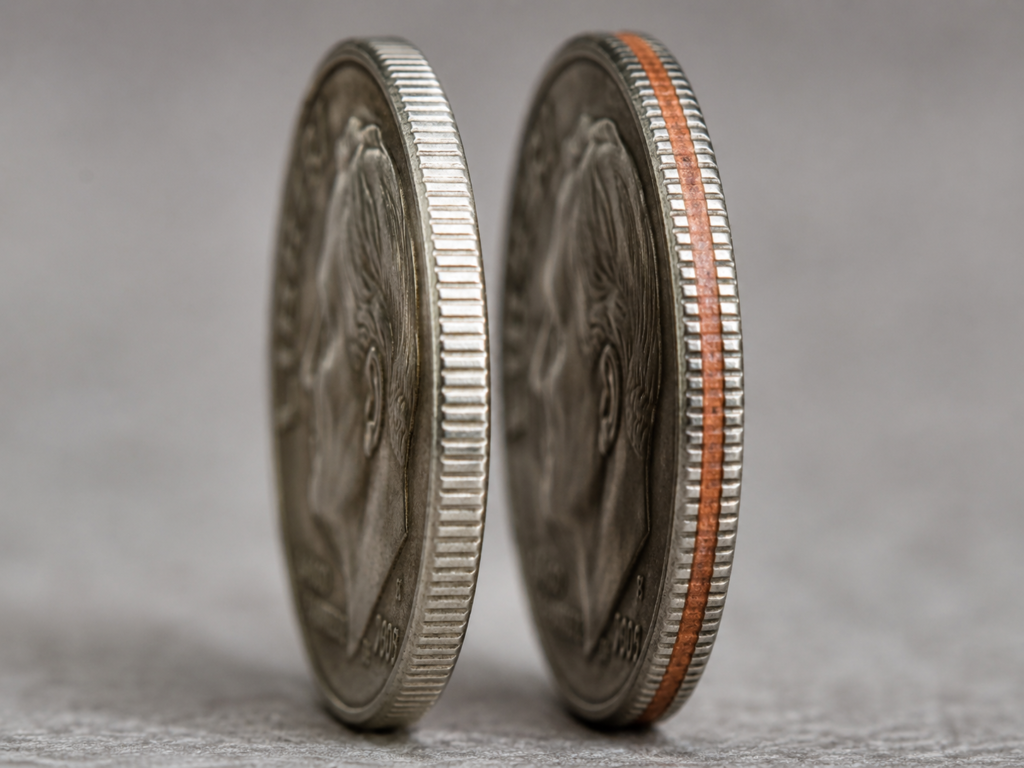
Which dimes are silver? Short answer: U.S. dimes dated 1964 or earlier are 90% silver; from 1965 onward, the dimes in your pocket are copper-nickel clad and contain no silver. The diameter never changed — only the metal did.
This guide gives you the year-by-year chart for every U.S. silver dime, three physical tests for worn or dateless coins, and the 14-dimes-per-ounce rule of thumb that turns a handful of pre-1965 dimes into a quick silver-weight estimate.
Quick rule: 1964 = silver. 1965 = clad. The diameter didn’t change; only the metal did.
The Quick Answer: Which Dimes Are Silver
U.S. dimes minted from 1796 through 1964 are silver — 90% silver from 1837 onward, and slightly higher (89.24%) for the earliest Bust dimes. Four series dominate the silver era: Seated Liberty (1837–1891), Barber (1892–1916), Mercury or Winged Liberty Head (1916–1945), and Roosevelt (1946–1964). From 1965 onward, circulating dimes are copper-nickel clad — zero silver.
A silver dime is a U.S. ten-cent coin minted with silver in its composition — historically 90% silver for circulation, with 1992-and-later silver proof issues (90% through 2018, .999 fine from 2019) that never entered circulation. A clad dime is the copper-nickel sandwich introduced under the Coinage Act of 1965: a pure copper core wrapped in cupronickel outer layers, with no precious metal anywhere in the coin.
The rest of this article is the identification reference — the year chart, the physical tests for confirming silver content, and the edge cases worth knowing. For dollar values on a specific Mercury dime, see our Mercury dime value guide. For broader melt-value math across any silver coin, see our melt value explainer or our junk silver guide.
The Silver Dime Year & Mintmark Chart
The chart below covers every U.S. dime series since 1796. Find the date on your coin, read across, and you’ll know whether it’s silver, what it weighs, and how much pure silver it contains.
Silver content of U.S. dimes by series, 1796–present.
| Series | Year range | Mintmarks | Composition | Gross weight | Silver content (ASW) | Notes |
| Bust Dime (Draped & Capped) | 1796–1837 | P only | 89.24% silver | 2.70 g | ~0.0775 troy oz | Pre-1837 silver standard. Tiny mintages — almost entirely numismatic, rare in circulation. |
| Seated Liberty Dime | 1837–1891 | P, O, S, CC | 90% silver | 2.49–2.50 g | 0.07234 troy oz | Weight standardized to 2.50 g in 1873. Carson City (CC) issues 1871–1878 carry steep collector premiums. |
| Barber Dime | 1892–1916 | P, O, S, D | 90% silver | 2.50 g | 0.07234 troy oz | 1894-S is the legendary key date (only 24 struck). Denver (D) issues from 1906. |
| Mercury Dime (Winged Liberty Head) | 1916–1945 | P, D, S | 90% silver | 2.50 g | 0.07234 troy oz | Officially Winged Liberty Head. 1916-D is the key date. No 1922, 1932, or 1933 issues. |
| Roosevelt Dime — silver era | 1946–1964 | P, D, S | 90% silver | 2.50 g | 0.07234 troy oz | Introduced months after FDR’s death. No key dates in the silver era — common-date silver Roosevelts trade at melt. |
| Roosevelt Dime — clad era | 1965–present | P, D, S, W | Clad (copper-nickel) | 2.268 g | 0 | Coinage Act of 1965 eliminated silver. No mintmark on 1965–1967 issues. W appears only on the 1996-W — still clad. |
| Silver proof dimes — 90% era | 1992–2018 | S only | 90% silver | 2.50 g | 0.07234 troy oz | Collector silver proof sets. Never circulated. |
| Silver proof dimes — .999 era | 2019–present | S only | .999 fine silver | 2.50 g | ~0.0803 troy oz | U.S. Mint switched to .999 fine silver for proofs in 2019. |
Years with no Mercury dimes minted: 1922 (silver dollar reactivation diverted production), 1932, and 1933 (Depression-era production gaps). The Mercury series jumps from 1931 to 1934 for that reason. If you’re searching for a “1922 silver dime” or “1933 silver dime,” none was struck.
Rule of thumb: 14 pre-1965 silver dimes contain roughly 1 troy ounce of silver. By face value, $1.40 in pre-1965 dimes ≈ 1 troy oz. (For quarters, the equivalent is about 4 quarters or $1 face. For halves, about 2 halves or $1 face.)
For a full silver-content reference across all U.S. denominations — dimes, quarters, halves, and dollars — see our broader silver coin identification reference.
How to Tell If a Dime Is Silver Without the Date
Sometimes the date is the easy answer. Other times — a worn coin slick from decades in change — the date is the problem. Three quick tests can confirm silver content without a date. You only need to pass one.
Test 1: Edge color (no tools)
Hold the dime on edge and look at the reeded rim. A 90% silver dime shows a uniform silver-gray edge. A clad dime shows a clear copper-colored stripe running through the middle of the edge — that’s the copper core peeking out between the two cupronickel outer layers.
This is the fastest test, requires no equipment, and works on virtually every circulated coin. The diagnostic is even more striking on a dime than on a quarter because the small diameter (17.91 mm) puts the copper stripe right in your eye.
Test 2: Weight (most accurate)
A 90% silver dime weighs 2.50 g. A clad dime weighs 2.268 g — often rounded to 2.27 g. The 0.232 g gap is real but small. A 0.01 g jeweler’s scale catches it cleanly; a 0.1 g kitchen scale catches it but only marginally — you want a reading that lands at 2.50 g or 2.27 g, not in between.
For mixed bags or roll-search verification, a jeweler’s scale is the right tool. The diameter (17.91 mm) is identical across the silver-to-clad transition, so don’t bother measuring it.
Test 3: The ring test
Drop the dime from a few inches onto a hard, flat, non-padded surface like a glass tabletop or stone counter. A 90% silver dime rings — a clear, sustained higher-pitched tone. A clad dime gives a duller, shorter “clack.” The ring is less pronounced on a dime than on a quarter because the coin is smaller and the resonant tone is shorter, but the silver-vs-clad difference is still audible to a careful ear. Don’t bounce graded or visibly high-grade coins — impact damage destroys numismatic value.
What about the magnet test?
Don’t use a magnet to test for silver versus clad. Neither composition is magnetic — both pass a magnet test. The magnet test is useful for screening out steel-core counterfeits, not for distinguishing silver content. If you’re seeing magnet-test advice online for silver ID, it’s been pulled out of context.
If your dime passes the edge or weight test, it’s silver. For dollar values on a confirmed Mercury dime, see our Mercury dime value guide. For common-date Roosevelt silver dimes and bulk junk-silver math, see our melt value explainer.
Why 1964 Was the Last Year (The Coinage Act of 1965)
Through the early 1960s, the U.S. Mint produced 90% silver dimes, quarters, and half dollars. Rising silver prices pushed the metal value of these coins toward — and eventually above — their face value, which incentivized hoarding. By 1964, coins were disappearing from circulation faster than the Mint could strike replacements.
The Coinage Act of 1965 (signed by President Lyndon B. Johnson on July 23, 1965) ended silver in circulating dimes and quarters and reduced the half dollar from 90% to 40% silver. Dimes from 1965 onward use the copper-nickel clad composition still in use today — a pure copper core, cupronickel outer layers, 2.268 g total weight, zero silver. The cutoff is identical to the quarter’s: same Act, same year. That’s why “1964 = silver, 1965 = clad” works as a universal rule across dimes, quarters, and (for the 90% threshold) half dollars.
Some 1964-dated dimes were actually struck in 1965 and 1966. The Mint kept using the 1964 dies to discourage hoarders from cherry-picking the last “real” silver year. Every dime dated 1964 is 90% silver regardless of when it was physically struck — the date controls composition for you, not the actual production date.
One quirk worth knowing: 1965, 1966, and 1967 dimes carry no mintmark at all. The Mint suspended mintmarks during the silver-to-clad transition to further discourage hoarding. Mintmarks returned in 1968, this time moved from the reverse to the obverse, above the date. If you check a 1965–1967 dime expecting to find a mintmark, you won’t find one, and that’s by design.
For the parallel story on silver quarters and half dollars, see our silver quarter identification guide and silver half dollar identification guide.
Edge Cases: Mercury vs. Roosevelt, the 1996-W, Bicentennial, and Modern Proofs
A handful of dimes confuse even experienced collectors. Here are the five you’re most likely to encounter and ask about.
Mercury vs. silver Roosevelt — same metal, different design
A Mercury dime (1916–1945) and a silver-era Roosevelt dime (1946–1964) are identical in composition: 90% silver, 2.50 g, 0.07234 troy oz of silver each. From a silver-weight standpoint they count equally in a junk-silver bag. The designs differ — Mercury shows a winged Liberty head on the obverse and a fasces with olive branch on the reverse; the silver Roosevelt shows FDR on the obverse and a torch flanked by olive and oak branches on the reverse. Mercury dimes do carry numismatic premiums for certain dates — 1916-D, 1921, 1921-D, and the 1942/1 overdate — that common-date silver Roosevelts don’t. For Mercury-specific valuation, see our Mercury dime value guide.
The 1996-W Roosevelt dime
This one trips people up. The 1996-W is a special issue struck at West Point for the 50th-anniversary set commemorating the Roosevelt dime’s 1946 introduction. The W mintmark is unusual and looks special, but the coin is still clad copper-nickel composition — zero silver. It carries a collector premium because of its limited mintage and set-only distribution, not its metal. Don’t confuse the W mintmark with the silver-proof S mintmark.
There is no Bicentennial dime
The 1975–1976 Bicentennial coinage program included the quarter, half dollar, and dollar — not the dime. Dimes minted in 1975 and 1976 are standard Roosevelt clad designs with normal dates. No dual 1776–1976 date, no special reverse, no silver collector version. If you’ve heard of a “Bicentennial dime,” it doesn’t exist.
Modern silver proof dimes (1992–present)
Since 1992, the U.S. Mint has produced annual silver proof sets that include silver dimes — 90% silver from 1992 through 2018, and .999 fine silver from 2019 onward. All carry the S mintmark and ship in U.S. Mint hard-shell proof packaging. None entered circulation. If you have a 1992-or-later dime in a hard plastic capsule with an S mintmark, check whether it came from a silver proof set. If it’s loose in a coin jar, it’s clad.
War-era Mercury dimes (1942–1945)
Yes, silver — 90%, the same as every other Mercury dime from 1916 through 1945. There’s no “war dime” composition. The wartime metal change applied to nickels only: the 1942–1945 Jefferson “war nickels” used 35% silver because nickel metal was diverted to the war effort. A 1942 or 1945 Mercury is a standard 90% silver dime. The famous 1942/1 overdate is an error variety — one date stamped over another — not a wartime composition change. For Mercury error and key-date premiums, see our Mercury dime value guide.
Found a Silver Dime? What to Do Next
So you’ve confirmed a silver dime. Maybe one, maybe a handful from a roll, maybe a whole jar. Now what.
The first step is to set it aside from regular change. Even a worn common-date silver Roosevelt or Mercury contains 0.07234 troy oz of silver — typically several dollars at melt value at recent spot prices, not 10 cents. Don’t spend it.
The second step is to assess what you have. If it looks like a key date — 1916-D Mercury, 1921 or 1921-D Mercury, the 1942/1 overdate, any Barber dime in decent condition, any Seated Liberty, or anything in visibly high grade — don’t clean it and don’t sell it at melt value without a price-guide check. Cleaning destroys numismatic value permanently. For the why, see our notes on how to store silver dimes without tarnish.
The third step is to decide whether you’re accumulating (junk-silver mindset) or collecting (numismatic mindset). The two paths have different storage and tracking implications. Common-date silver Roosevelts and run-of-the-mill Mercury dimes are fine in tubes, rolls, or 2×2 flips. Anything with collector upside — a key-date Mercury, any Barber, any Seated Liberty — belongs in an individual flip or graded holder where it can’t be handled or scratched.
If you’ve sorted a roll or bag and ended up with 20, 50, or 200 silver dimes, the workflow shifts from “log each coin” to “log the bag.” Junk-silver bags are conventionally tracked by face value. A $10 face-value bag of pre-1965 dimes contains approximately 7.15 troy oz of silver; a $100 face bag contains roughly 71.5 troy oz. The 14-dimes-per-ounce rule gives you a quick estimate at any quantity.
Whether you’re holding a single Mercury, a roll of common dates, or a face-value bag, the question becomes how to keep track of what you actually own.
This is where a portfolio tracker earns its keep. Logging a single dime — type, year, mintmark, condition — takes a few seconds. For the full workflow, see our step-by-step guide to inventorying a coin or bullion collection.
For Mercury dime dollar values, see our Mercury dime value guide. For melt-value math across any silver coin, see our melt value explainer.
Frequently Asked Questions
Are 1965 dimes silver?
No. 1965 was the first year of copper-nickel clad dimes under the Coinage Act of 1965. A 1965 dime contains zero silver and weighs 2.268 g — silver dimes weigh 2.50 g. The diameter (17.91 mm) didn’t change from 1964 to 1965; only the composition and weight did. 1965, 1966, and 1967 dimes also carry no mintmark — mintmarks were suspended during the transition and returned in 1968.
Are 1964 dimes silver?
Yes. 1964 was the last year of 90% silver Roosevelt dimes for circulation. A 1964 dime contains 0.07234 troy oz of silver. Some 1964-dated dimes were actually struck into 1965 and 1966 using the old dies, but every dime dated 1964 is 90% silver regardless of strike year.
What year did dimes stop being silver?
1964 was the last year for 90% silver in circulating dimes. 1965 and later are clad. There is no silver collector exception for circulating dimes after 1964 — unlike the 1976-S 40% silver Bicentennial quarter, the dime had no Bicentennial program at all.
What years are silver dimes?
1796 through 1964 for circulation, in five main groupings: Bust (1796–1837, pre-1837 silver standard at 89.24%), Seated Liberty (1837–1891), Barber (1892–1916), Mercury or Winged Liberty Head (1916–1945), and the Roosevelt silver era (1946–1964). No Mercury dimes were minted in 1922, 1932, or 1933. Silver proof sets from 1992 to the present include silver dimes that were never released into circulation.
How can I tell if a dime is silver?
Three quick tests: check the edge color (silver dimes show a uniform silver-gray edge; clad shows a copper stripe down the middle), check the weight (silver = 2.50 g, clad = 2.268 g, on a jeweler’s scale for the cleanest reading), or drop it on a hard surface (silver rings with a higher tone; clad gives a duller clack). Edge color is the fastest.
How much does a silver dime weigh?
A 90% silver dime weighs 2.50 g. A clad (1965+) dime weighs 2.268 g — often rounded to 2.27 g. The diameter is 17.91 mm for all of them: silver, clad, Mercury, Roosevelt.
How much silver is in a dime?
A 90% silver U.S. dime (Barber, Mercury, or pre-1965 Roosevelt) contains 0.07234 troy oz of silver — 2.25 g of pure silver inside a 2.50 g coin. The 2019-and-later .999 fine silver proof dimes contain approximately 0.0803 troy oz.
How many silver dimes make an ounce of silver?
About 14. Fourteen pre-1965 silver dimes contain roughly 1 troy ounce of silver (14 × 0.07234 = 1.0128 oz). Equivalent face value: $1.40 in pre-1965 dimes ≈ 1 troy oz. This is the dime version of the junk-silver rule of thumb.
Are war-era (1942–1945) Mercury dimes made of special silver?
No. Wartime-dated Mercury dimes are 90% silver, the same as every other Mercury dime from 1916 to 1945. The wartime composition change applied to nickels only — the 1942–1945 Jefferson “war nickels” used 35% silver. There’s no “war dime” variant. The 1942/1 overdate is a famous error variety, not a wartime composition change.
Is the 1996-W Roosevelt dime silver?
No. The 1996-W is a special anniversary issue struck at West Point and included only in the 1996 Uncirculated Mint Set. It carries an unusual W mintmark and a collector premium, but it is clad copper-nickel composition — zero silver. The W mintmark on a Roosevelt does not indicate silver; the silver-proof mintmark is S.
Is there a Bicentennial dime?
No. The 1975–1976 Bicentennial coinage program included only the quarter, half dollar, and dollar. Dimes from 1975 and 1976 are standard Roosevelt clad designs with normal dates — no dual 1776–1976 date, no special reverse, no silver collector version.
What is a Mercury dime, really?
The “Mercury” dime (1916–1945) is officially called the Winged Liberty Head dime. The obverse shows Liberty wearing a winged Phrygian cap — symbolizing freedom of thought — that the public mistook for the Roman god Mercury’s winged helmet. The nickname stuck. Composition: 90% silver, 2.50 g, 0.07234 troy oz ASW — identical to the silver-era Roosevelt dime that succeeded it in 1946.
Track every silver dime
You’ve identified a silver dime. The next step is keeping track of it — whether you hold a single found Roosevelt, a roll of common-date Mercurys, a face-value junk-silver bag, or a key-date Barber in a flip. Gold Silver Ledger logs each coin or bag in seconds. Start your free trial today.
