
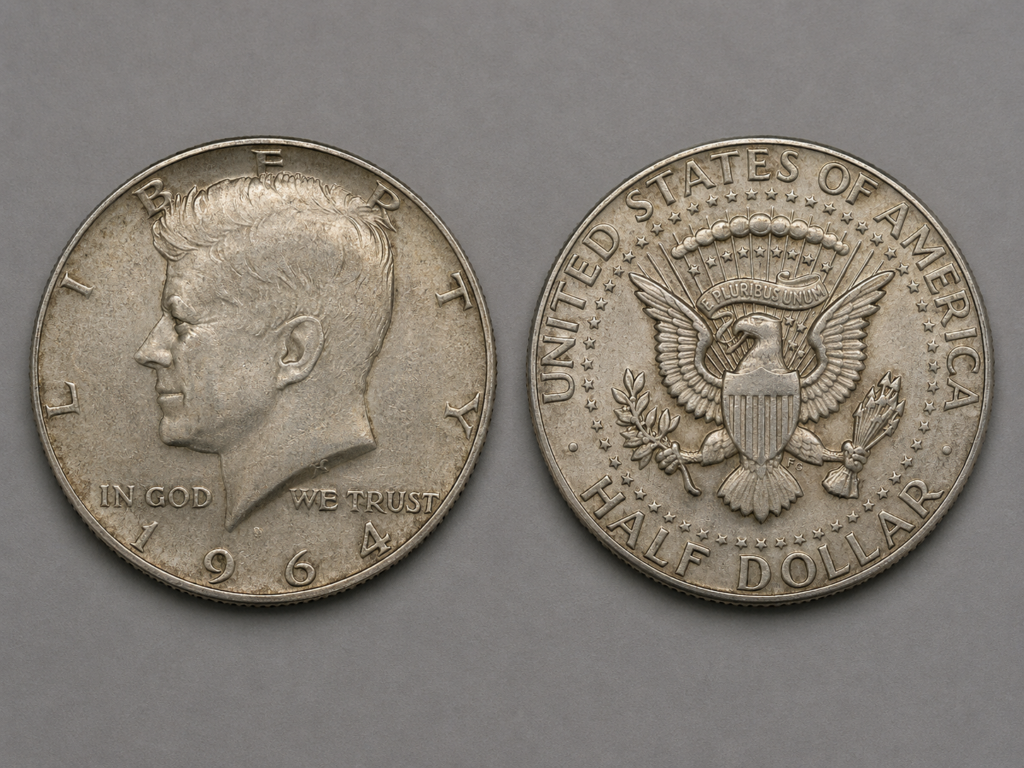
The Kennedy half dollar has run from 1964 to today across three composition eras: 90% silver in 1964, 40% silver from 1965 through 1970, and copper-nickel clad from 1971 onward. Most clad Kennedys are worth fifty cents. The silver and 40% silver coins carry melt-equivalent premiums.
A handful of varieties — the 1970-D, the 1964 Accented Hair Proof, the 1998-S Matte — reach four and five figures. The chart, the varieties, and the year-by-year reality are below.
Quick Answer: What Is a Kennedy Half Dollar Worth?
A 1964 Kennedy half dollar is 90% silver and trades at roughly eight to ten times face value at melt-equivalent. A 1965–1970 Kennedy is 40% silver and trades at three to four times face value. A 1971-or-later circulating Kennedy is copper-nickel clad and worth fifty cents.
Premium varieties — the 1970-D, the 1964 Accented Hair Proof, the 1998-S Matte Proof, the 1976-S 40% silver Bicentennial, and the 2014-W gold — sit on top of the era baseline.
Is It a Kennedy Half Dollar? Identification Before Valuation
Before the chart, confirm what you have. The Kennedy half dollar entered circulation in 1964 as a memorial after President John F. Kennedy’s November 1963 assassination. The obverse shows Kennedy’s left-facing portrait, designed by Gilroy Roberts from the Kennedy inaugural medal.
The reverse shows the Presidential Coat of Arms — a heraldic eagle holding an olive branch and arrows — designed by Frank Gasparro. One exception: the 1976 Bicentennial reverse shows Independence Hall, designed by Seth Huntington.
The most common identification error is confusing a Kennedy half with the Bicentennial Eisenhower dollar. Both carry the 1776–1976 date stamp and turn up frequently in family stashes. The Kennedy half measures 30.6 mm across; the Eisenhower dollar measures 38.1 mm. If the coin is roughly the size of a half-dollar coin slot, it’s a Kennedy.
For the full composition story across all U.S. half dollar designs — Walking Liberty, Franklin, and Kennedy — see our guide to which half dollars are silver.
The Three Composition Eras: Why Year Matters Most
The Kennedy half dollar is the only U.S. circulating denomination with three composition eras in one series. Each era has its own weight, its own silver content, and its own value baseline. Get the era right and the rest of the article follows.
1964: 90% Silver
The 1964 Kennedy weighs 12.50 grams and contains 0.36169 troy ounces of silver. Composition: 90% silver, 10% copper — the same standard used for Walking Liberty and Franklin halves before it. The Mint struck more than 430 million across Philadelphia and Denver, anticipating demand for a Kennedy memorial coin.
Most were hoarded immediately and rarely entered circulation, which is why so many survive in higher grades than a typical 60-year-old circulating coin.
1965 through 1970: 40% Silver Clad
The Coinage Act of 1965 removed silver from dimes and quarters but kept the half dollar partly silver at a reduced fineness. The 1965–1970 Kennedy weighs 11.50 grams and contains 0.1479 troy ounces of silver.
The composition is layered: outer layers of 80% silver / 20% copper bonded to a core of 21% silver / 79% copper, averaging 40% silver across the whole coin.
Coins dated 1965, 1966, or 1967 carry no mintmark. The same Act suspended mintmarks during the transition to discourage hoarding. The mintmark returned on the obverse below the bust starting in 1968. A 1965 or 1966 Kennedy without a mintmark hasn’t lost it — it was never struck with one.
1971 to Today: Copper-Nickel Clad
The Bank Holding Company Act amendments of 1970 ended the 40% silver run. From 1971 onward, circulating Kennedy halves are copper-nickel clad — pure copper core, cupronickel outer layers — the same composition as 1965-and-later dimes and quarters. Weight: 11.34 grams. Silver content: zero.
The U.S. Mint stopped releasing Kennedy halves into general circulation in 2002. Philadelphia and Denver still strike them every year, but only for collector rolls, bags, and Mint sets sold directly. A 2002-or-later Kennedy in someone’s possession came from a Mint source, not pocket change.
Silver Proof Kennedys (1992 to Today)
A side tier worth knowing. Since 1992 the Mint has produced silver proof sets that include silver Kennedys with an S mintmark — 90% silver from 1992 through 2018, .999 fine from 2019 onward. None entered circulation. A loose Kennedy in a coin jar is the clad version, even one dated 1992 or later.
The Kennedy Half Dollar Value Chart by Year and Mintmark
The chart is the centerpiece of this article. Rows are years from 1964 forward. Columns are mintmarks (P for Philadelphia, D for Denver, S for San Francisco, W for West Point) plus the composition era flag and illustrative value ranges at four grade tiers — G-4, VF-20, MS-63 / PR-63, and MS-65 / PR-65.
| Year / Variety | Composition | Worn (G-4 → AU) | MS-65 / PR-65 | High-Grade Premium |
| 1964 (P, D) — business strike | 90% silver | Silver melt | $25 – $40 | MS-67 $200 – $500 |
| 1965–1970 (P, D, S*) | 40% silver | 40%-silver melt | $10 – $25 | MS-67 $100 – $500 |
| 1971–2001 (P, D) — circulating | Cupronickel clad | Face value | $1 – $5 | MS-67 $20 – $200 |
| 2002–present (P, D) — Mint sets only | Cupronickel clad | Face value | $1 – $5 | MS-67 $20 – $100 |
| 1992–2018 Silver Proof (S) | 90% silver | — | PR-65 $20 – $30 | PR-69 DCAM $30 – $50 |
| 2019–present Silver Proof (S) | .999 fine silver | — | PR-65 $30 – $40 | PR-69 DCAM $80 – $150 |
| 1964 Proof (regular) | 90% silver | — | PR-65 $15 – $25 | PR-69 DCAM $300 – $800 |
| 1964 Accented Hair Proof | 90% silver | — | PR-65 $30 – $60 | PR-69 DCAM $15,000+ |
| 1964 SMS | 90% silver | — | — | MS-68 $100,000 – $150,000+ |
| 1966 SMS | 40% silver | — | SP-67 $25 – $50 | SP-68 CAM $100 – $200 |
| 1970-D (Mint set only) | Cupronickel clad | $25 – $50 | $40 – $100 | MS-67 $150 – $500 |
| 1976 Bicentennial (P, D) | Cupronickel clad | Face value | $2 – $5 | MS-67 $50 – $200 |
| 1976-S 40% Silver Bicentennial | 40% silver | — | $10 – $15 | PR-69 DCAM $30 – $50 |
| 1979-S Type 2 Proof | Cupronickel clad | — | PR-65 $5 – $10 | PR-70 DCAM $100 – $200 |
| 1981-S Type 2 Proof | Cupronickel clad | — | PR-65 $10 – $15 | PR-70 DCAM $200 – $400 |
| 1998-S Matte Proof | Cupronickel clad | — | SP-68 $150 – $250 | SP-70 $400 – $700 |
| 2014-W Gold High Relief | 24-karat gold | — | Gold spot + ~10% | PR-70 DCAM gold spot + ~20%+ |
Value ranges illustrative — last updated June 2026. Verify against PCGS CoinFacts and NGC Coin Explorer before relying on a specific figure. * 1965–1967 carry no mintmark regardless of mint.
How the Mintmarks Read
Philadelphia and Denver struck Kennedy halves every year of the series. Philadelphia coins carry no mintmark from 1964 through 1979; the P first appeared on the Kennedy in 1980. The D sits on the reverse for 1964 (between the olive branch and arrows) and moved to the obverse below the bust starting in 1968. San Francisco struck circulation Kennedy halves only in 1965, 1966, and 1967 — years that carry no mintmark regardless of mint.
From 1968 forward, San Francisco’s Kennedy production has been proof and silver proof only, so an S mintmark on a 1968-or-later Kennedy means proof. West Point has struck one Kennedy half dollar: the 2014-W 50th Anniversary Gold High Relief.
Key Dates and Varieties: The Kennedy Halves Worth a Closer Look
A short list. Most Kennedy halves are common in any grade. The varieties below are the exceptions — the coins where the date, the mintmark, the surface finish, or a die marker pushes value materially above the era baseline.
1970-D
Mintage 2.150 million. The 1970-D was released only inside the 1970 Mint set; no coins entered general circulation. Mint-set distribution means most survivors are in Mint State, but the population is small enough that the coin commands a premium in every grade.
The headline circulating-grade key date of the series and the variety an estate-cleanout reader is most likely to actually find.
1964 Accented Hair Proof
A 1964 Proof variety identified by the hair detail above Kennedy’s ear: heavier, more pronounced strands forming a distinctive wishbone shape, set apart from the smoother hair on the standard 1964 Proof. Jacqueline Kennedy reportedly disliked the initial rendering, and the dies were reworked, making the Accented Hair an early-strike variety estimated at 1–3% of the total 1964 Proof mintage.
Standard grades carry a modest premium; high-grade Deep Cameo examples have realized five-figure prices at major auction.
1964 SMS
The rarest single Kennedy half. Special Mint Set coins were produced in limited quantities — current estimates suggest 20 to 50 examples are known. Identified by surface finish (a distinctive matte-like sheen distinct from both circulation strikes and proofs), not by die markers.
Confirmed specimens have realized five- and six-figure prices at Heritage Auctions. Any 1964 Kennedy suspected of being SMS belongs at PCGS or NGC for professional attribution before sale.
1966 SMS
A more accessible Special Mint Set issue. Mintage approximately 2.2 million inside the 1966 Special Mint Sets — large enough to be available but distinctive in surface finish. A modest premium over the standard 1966 in equivalent grades; Ultra Cameo examples carry meaningful premiums.
1998-S Matte Proof Kennedy
Mintage 62,000 — the lowest-mintage Kennedy proof variety in the series. Issued only inside a special collector set alongside the Robert F. Kennedy commemorative silver dollar. The matte (sandblast) finish is distinct from both standard proofs and uncirculated coins. A genuine premium in PR-68 and PR-69 grades; PR-70 examples have realized four-figure prices.
1976-S 40% Silver Bicentennial
The 1776–1976 Bicentennial Kennedy was struck in two compositions. The clad version (P and D mintmarks) circulated in the hundreds of millions and is worth face value in worn grades. The 40% silver version (S mintmark) was struck only for special U.S. Mint blue-pack uncirculated and brown-box proof sets, weighs 11.50 grams, and contains 0.1479 troy ounces of silver.
Both versions feature the Independence Hall reverse. Most Bicentennials pulled from change or family stashes are the clad version.
1979-S and 1981-S Type 2 Proofs
On both the 1979-S and 1981-S Proof Kennedys, the Mint changed dies mid-year. Type 1 coins show a filled, blob-like S mintmark; Type 2 coins show a clearer, sharper S. Type 2 is scarcer and commands a premium across all proof grades.
2014-W Gold High Relief
Struck at West Point for the Kennedy series’ 50th anniversary. Composition: three-fourths of a troy ounce of 24-karat (.9999 fine) gold. The first gold half dollar in U.S. Mint history. Original issue price tracked gold spot at the time, and resale value still tracks gold spot today plus a modest numismatic premium for the high-relief design and the 50th-anniversary attribution.
A note on authentication: counterfeits and altered coins exist for the 1970-D, the 1964 Accented Hair, the 1964 SMS, and the 1998-S Matte. For any coin suspected of being one of these varieties, professional grading through PCGS or NGC is the answer before sale or major purchase.
How Condition and Variety Drive Value
Even on a common-date Kennedy, grade can move value. The Kennedy obverse has a famously deep field around the portrait that picks up bag marks and contact marks easily, so Mint State Kennedys are common but Gem (MS-65) and Premium Gem (MS-66 and up) examples are noticeably scarcer.
The Sheldon scale runs from Poor-1 to MS-70. For circulation-strike Kennedys, the meaningful tiers are roughly: circulated (G-4 to AU-58), Mint State (MS-60 to MS-64), Gem (MS-65 to MS-66), and Premium (MS-67 and up). For proofs: PR-60 through PR-70, with most of the price movement between PR-69 and PR-70.
Two finish designations matter for Kennedy proofs. Cameo (CAM) indicates light contrast between the mirrored field and the frosted devices; Deep Cameo (DCAM) or Ultra Cameo means strong, consistent contrast. Early Kennedy proofs — 1964 especially — show wide variation. A 1964 Proof in Deep Cameo carries a multiple of the value of an identical grade in standard finish.
Even a common clad date follows this pattern: the floor is face value, and the ceiling is set by the population at the top grades. A 1985-P Kennedy is common in any grade through MS-66 and worth face value in circulated condition, but the certified population at MS-67 drops sharply enough that a sealed MS-67 example can realize ten to fifty times face value at auction.
Track Every Kennedy Half Dollar by Year, Era, and Variety
A Kennedy collection often spans all three composition eras. A typical estate stash holds a 1964 or two (silver), a handful of 1965–1970 coins (40% silver), a pile of clad Kennedys from the 1970s through the 1990s, one or two Bicentennials, and maybe a sealed Mint roll or proof set. Cataloging the three eras separately matters because the silver content per coin differs by roughly 2.4× between the 1964 and the 1965–1970 group, and goes to zero from 1971 onward.
Five practical steps:
- Sort by composition era. 1964 (90% silver) goes in one collection. 1965–1970 (40% silver) goes in a second. 1971 onward (clad) goes in a third. Within the clad collection, separate 1971–2001 (circulation) from 2002 onward (Mint-source only).
- For each coin, record year, mintmark (or note its absence for 1965–1967), and any variety flag — Accented Hair, SMS, Matte Proof, Type 2 Proof, doubled die.
- Flag suspected premium varieties separately and consider professional grading through PCGS or NGC before sale.
- For the silver and 40% silver coins, the value question is largely junk-silver math — silver content times spot price, with a numismatic premium added only on key dates and high grades. For clad coins, the value is face plus any condition or variety premium.
- Cross-reference value ranges against PCGS or NGC, log each coin worth tracking, and refresh values when spot moves meaningfully — or once a quarter, whichever comes first.
The three-era problem is an inventory question we built Gold Silver Ledger to handle. A 1964 Kennedy logs as a junk silver entry at the 90% multiplier; a 1968 Kennedy logs at the 40% multiplier; a 1985 Kennedy logs as a clad face-value item.
Portfolio value rolls up automatically from the per-coin records, and the variety flag — Accented Hair, 1970-D, 1998-S Matte, Bicentennial silver — lives in the per-item label, so a quick filter surfaces every premium coin.
When and How to Sell a Kennedy Half Dollar
Four paths, depending on what you have.
Common-Date Clad to a Dealer
For 1971-and-later Kennedys with no variety flag, most coin dealers will credit face value or close to it. A bag of common clad Kennedys is a deposit, not a transaction worth negotiating. If a 1970-D is hiding, set it aside before the bag goes anywhere.
1964 and 1965–1970 Silver as Junk Silver
The right path for worn common-date silver Kennedys is junk silver — sold by weight at a percentage of spot, the same as pre-1965 quarters and dimes. Local coin dealers and junk silver buyers handle this routinely. For the broader buyer framework, see our guide to junk silver.
Individual Key Dates and High-Grade Coins
For the 1970-D, the 1964 Accented Hair, the 1998-S Matte, the SMS issues, and any common-date coin certified MS-67 or higher, the realistic sale paths are a coin dealer (typically 60–80% of price-guide retail for raw, 70–90% for certified) or an auction marketplace like eBay (higher gross but with fees and authentication friction). Certification through PCGS or NGC before sale is worth the cost on these coins.
Headline Rarities to a Major Auction House
For a top-population 1964 Accented Hair Deep Cameo, a confirmed 1964 SMS, or a top-grade 1970-D, a consignment to Heritage Auctions, Stack’s Bowers, or GreatCollections produces the strongest realizations. The 2014-W Gold High Relief routes through bullion-and-numismatic dealers because its value sits on gold spot more than collector premium.
For the broader sale framework covering both bullion and numismatic paths, see how to sell gold.
FAQs
Are Kennedy half dollars silver?
Some are, some aren’t — silver content depends on the year. The 1964 Kennedy half dollar is 90% silver, coins dated 1965 through 1970 are 40% silver in a layered clad structure, and from 1971 onward circulating Kennedy halves are copper-nickel clad with no silver. Silver proof Kennedys with an S mintmark (1992 to today) are also silver but never entered circulation.
How much is a 1964 Kennedy half dollar worth?
A worn 1964 Kennedy half dollar trades at roughly its silver melt-equivalent — eight to ten times face value depending on the silver spot price at the moment of sale. Higher-grade examples (Mint State 65 and up) carry a numismatic premium above melt, and the 1964 Accented Hair Proof variety can reach four and five figures in top grades.
Mintmark doesn’t matter for value on the standard 1964; Philadelphia and Denver coins trade at the same range.
How much is a 1971 Kennedy half dollar worth?
A 1971 Kennedy half dollar in any circulated condition is worth its face value — fifty cents. It contains no silver; 1971 was the first year of copper-nickel clad Kennedys. Only the highest-grade Mint State examples (MS-67 and up) carry a modest collector premium, and even then the dollar figures stay small.
What is the rarest Kennedy half dollar?
The 1964 Special Mint Set (SMS) Kennedy is the rarest, with current estimates of 20 to 50 confirmed examples known and realized prices in the five and six figures at Heritage Auctions. The 1970-D is the rarest variety actually present in collector hands at scale — released only in 1970 Mint sets, never into general circulation, with a mintage of 2.15 million.
Is a Bicentennial Kennedy half dollar silver?
Usually no — most 1776–1976 Bicentennial Kennedys are copper-nickel clad and worth fifty cents. The U.S. Mint also struck a 40% silver Bicentennial Kennedy with an S mintmark, sold only inside special blue-pack uncirculated and brown-box proof sets. The silver version weighs 11.50 grams (versus 11.34 for the clad) and contains 0.1479 troy ounces of silver. Most Bicentennials pulled from change or family stashes are the clad version.
Why don’t I find Kennedy half dollars in my change anymore?
Kennedy half dollars haven’t been released into general circulation since 2002. The U.S. Mint still produces them every year in Philadelphia and Denver, but only for collector rolls, bags, and Mint sets sold to the public. Banks don’t stock half dollars unless a customer requests a roll, and most customers don’t, so the coins effectively vanished from everyday transactions.
What is the 1964 Accented Hair Proof Kennedy?
The 1964 Accented Hair Proof is an early-strike Kennedy Proof variety identified by heavier, more defined hair strands above Kennedy’s ear, forming a distinctive wishbone shape. Jacqueline Kennedy reportedly objected to the rendering and the dies were reworked, making Accented Hair coins an estimated 1–3% of total 1964 Proof mintage. Standard grades carry a modest premium; Deep Cameo examples in top grades have realized five-figure prices.
Should I clean a Kennedy half dollar before selling it?
Don’t clean it. Cleaning a coin — even gently with a cloth or soap — leaves microscopic scratches that PCGS and NGC will catch and tag as “Cleaned” on the holder. A cleaned coin sells for a fraction of an uncleaned equivalent. The buyer wants original surfaces and natural tone; the brown patina on an old silver coin is part of what gives it value.
Track Your Kennedy Half Dollar Value the Honest Way
Cataloging Kennedy half dollar value across three composition eras is the inventory question most spreadsheets get wrong. Gold Silver Ledger handles it cleanly: a 1964 logs at the 90% silver multiplier, a 1968 at the 40% multiplier, a 1985 as a clad face-value item. Portfolio value rolls up automatically, and key dates like the 1970-D surface at a glance in the holdings view.
