
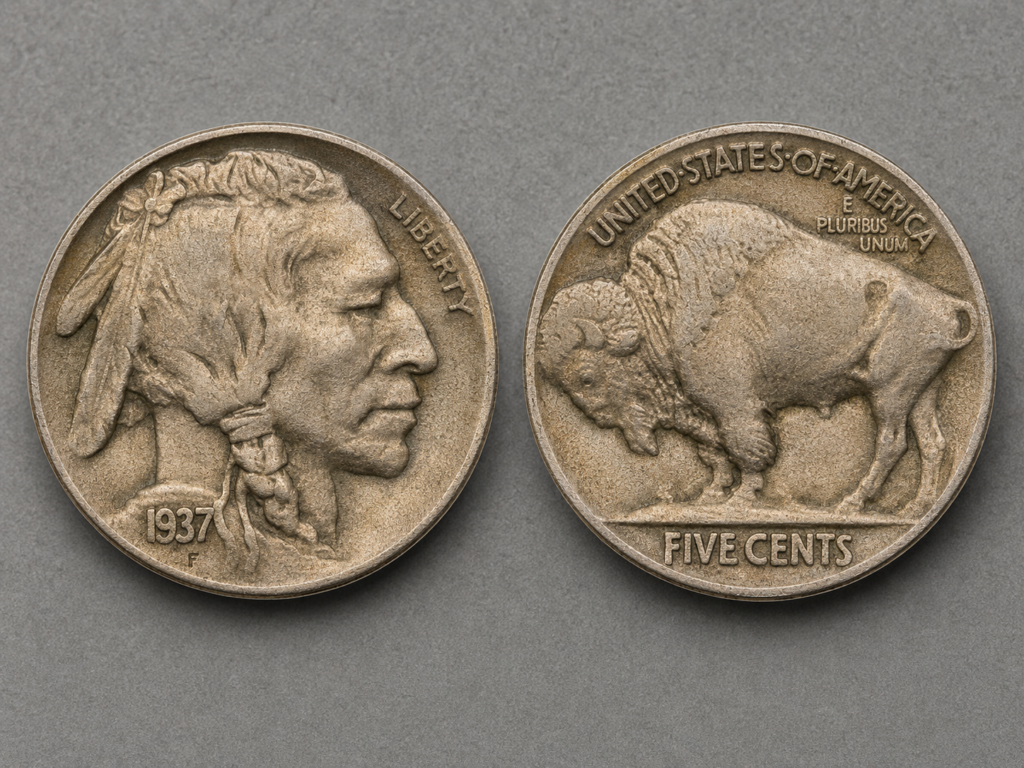
The Buffalo nickel — also called the Indian Head nickel — ran from 1913 to 1938. Most circulated buffalos are worth 50 cents to $5; dateless coins, which are common, trade for 25 to 50 cents. Key dates such as the 1913-S Type 2, 1914-D, 1918/7-D, 1926-S, and the 1937-D Three-Legged reach four and five figures. The chart, the identification steps, and the dateless-coin section are all below.
The Quick Answer: What Is a Buffalo Nickel Worth?
A typical Buffalo nickel (1913–1938) with a fully readable date trades for $1 to $5 in worn circulated condition and $20 to $80 in Mint State. Dateless buffalos, coins whose date has worn into the field — trade for 25 to 50 cents each, no matter the rest of the condition.
The bronze content does not set a floor; 31 CFR §82.1 (Treasury, 2006) bans melting U.S. nickels just as it bans melting cents. Key dates and major varieties — the 1913-S Type 2, the 1914-D, the 1918/7-D overdate, the 1926-S, the 1937-D Three-Legged — reach $500, $5,000, or six figures at the top end.
The value distribution across the series is wide but predictable. Roughly 30% of any inherited Buffalo nickel accumulation is dateless; another 60% or so is common-date filler worth a few dollars; the remaining 10% — including any genuine variety — is where the value sits.
The chart below covers every year and mintmark; the dateless-coin section and the key-dates list walk through the names worth recognizing on sight.
Is It a Buffalo Nickel? Identification Before Valuation
The most common mistake we see is a reader holding a Jefferson nickel — minted from 1938 to the present — and assuming it’s a Buffalo nickel because it’s old. The Jefferson nickel has been the dominant U.S. five-cent coin for over 85 years; most nickels in pocket change today are Jeffersons. Buffalo nickels look completely different from Jeffersons.
Buffalo nickel (1913–1938)
Designed by James Earle Fraser. Obverse: a right-facing Native American profile that Fraser described as a composite of three Native American leaders. Reverse: an American bison standing left, with the denomination FIVE CENTS on a flat line beneath. Diameter 21.2 mm, weight 5.00 g, cupronickel composition (75% copper, 25% nickel) throughout the series.
Jefferson nickel (1938–present)
Obverse: Thomas Jefferson’s left-facing portrait. Reverse: Monticello, Jefferson’s Virginia estate. If your coin shows Jefferson or Monticello, it isn’t a Buffalo nickel.
Liberty Head ‘V’ nickel (1883–1912)
The Buffalo nickel’s predecessor. Obverse: Liberty’s left-facing portrait with stars; reverse: a Roman numeral V inside a wreath. Also not a Buffalo nickel.
Are Buffalo nickels silver?
Buffalo nickels contain no silver — they are 75% copper and 25% nickel (cupronickel), and have been since the series began in 1913. The wartime “silver nickel” some readers have heard about is a Jefferson nickel from 1942 through 1945, struck in a 35% silver alloy because nickel metal was needed for World War II armor plate. For the full silver-nickel story, see our piece on whether any nickels are silver. For broader silver-coin identification across denominations, see what coins are silver.
1913 Type 1 vs Type 2
1913 is the only year both designs exist. The original Type 1 reverse placed the bison on a raised mound with FIVE CENTS along the mound’s edge; coins from the early 1913 strikes wore the FIVE CENTS lettering off quickly because it sat on the highest point of the reverse.
The Mint redesigned the reverse mid-1913 — Type 2 — moving the bison onto a flat ground line and placing FIVE CENTS in a recessed area below the line where it could resist wear. Both types were struck at all three mints.
Type 1 and Type 2 carry similar but distinct value structures; the 1913-S Type 2 is a key date (mintage 1.209 million) while the 1913-S Type 1 is more common. Historical context for the 1913 design replacement and the 1938 transition to the Jefferson nickel sits in the history of U.S. coinage.
Can You Read the Date? The Dateless-Coin Problem
The date on a Buffalo nickel sits on a raised area of the obverse, below the bust on the right side. That raised position is the highest point of the obverse — and it wore down quickly in circulation. A significant fraction of Buffalo nickels in any accumulation, often 30% or more, are dateless or partially dateless.
A dateless Buffalo nickel trades for 25 to 50 cents at retail, regardless of how nice the rest of the coin looks. Without the date, the coin cannot be year-attributed; without year attribution, it cannot be graded by PCGS or NGC; without a grade, the collector market treats it as a generic Buffalo nickel of unknown date. The market floor for these is 25 to 50 cents in any quantity.
Acid-date treatments — commercial products like Nic-A-Date, or home nitric-acid solutions — can chemically etch the worn date area enough to reveal a faint date. The treatment works, but the resulting coin is permanently damaged: surface texture is destroyed, color is altered, and PCGS and NGC will not slab the coin. An acid-dated Buffalo nickel does not regain collector value. It is worth no more (and often less) than the same coin left dateless.
Mintmark identification is straightforward when the coin isn’t dateless. The mintmark sits on the reverse, below FIVE CENTS, and reads as no letter (Philadelphia), D (Denver), or S (San Francisco). For a dateless coin, mintmark identification is moot — without a date, the coin can’t be year-attributed regardless of mintmark.
The Buffalo Nickel Value Chart by Year and Mintmark
The chart below shows representative retail value ranges for every Buffalo nickel year and mintmark, spanning worn circulated condition (G-4 Good) through Mint State (MS-65). Values are illustrative and reflect PCGS and NGC Price Guide ranges at the time of writing; verify live pricing for any specific coin before you buy or sell.
A dash (—) means the mint did not strike Buffalo nickels for that year. The Mint struck no Buffalo nickels at all in 1922, 1932, and 1933 — five-cent production was suspended in those years. The 1937-D Three-Legged variety appears as its own row beneath 1937.
Representative Buffalo nickel retail values, G-4 Good to MS-65. Illustrative; verify live pricing on PCGS or NGC for any specific coin.
| Year | Philadelphia (P) | Denver (D) | San Francisco (S) |
| 1913 Type 1 | $20–$80 | $25–$200 | $80–$500 |
| 1913 Type 2 | $25–$80 | $80–$300 | $200–$2,000 (key) |
| 1914 | $25–$80 | $200–$1,000 (semi-key) | $80–$200 |
| 1915 | $5–$50 | $20–$200 | $50–$700 (semi-key) |
| 1916 | $4–$30 ($5,000+ DDO key) | $20–$200 | $25–$300 |
| 1917 | $3–$40 | $20–$200 | $25–$300 |
| 1918 | $3–$40 | $20–$300 ($1,500+ 7/D overdate key) | $20–$300 |
| 1919 | $3–$30 | $20–$300 | $20–$300 |
| 1920 | $1–$30 | $20–$300 | $20–$300 |
| 1921 | $4–$60 | — | $50–$1,000 |
| 1922 | — (no Buffalo nickels struck) | — | — |
| 1923 | $1–$30 | — | $15–$300 |
| 1924 | $1–$30 | $15–$200 | $50–$1,500 (semi-key) |
| 1925 | $1–$30 | $15–$300 | $20–$300 |
| 1926 | $1–$30 | $25–$300 | $40–$15,000 (key) |
| 1927 | $1–$25 | $4–$80 | $4–$100 |
| 1928 | $1–$25 | $4–$60 | $4–$80 |
| 1929 | $1–$25 | $3–$50 | $3–$60 |
| 1930 | $1–$25 | — | $3–$50 |
| 1931 | — | — | $20–$100 |
| 1932 | — (no Buffalo nickels struck) | — | — |
| 1933 | — (no Buffalo nickels struck) | — | — |
| 1934 | $0.50–$25 | $1–$60 | — |
| 1935 | $0.50–$15 | $1–$60 | $0.75–$40 |
| 1936 | $0.50–$15 | $0.75–$40 | $0.75–$30 |
| 1937 | $0.50–$15 | $0.75–$30 | $0.75–$25 |
| 1937-D Three-Legged | — | $700–$50,000+ (variety key) | — |
| 1938 | — | $1–$25 ($5+ D/S overmintmark) | — |
Last updated: May 2026.
Each mint has a structural reason for the values you see in the chart.
Philadelphia (P, no mintmark)
Largest mintages most years, lowest premiums most years. The bulk of common-date Buffalo nickels in coin jars and Whitman folders are Philadelphia issues. Key Philadelphia date: the 1916 Doubled Die Obverse — a dramatic die-doubling that left the 1916 date and the obverse motto visibly doubled. Philadelphia produced no Buffalo nickels in 1922, 1931, 1932, 1933, or 1938 (the Jefferson nickel began at Philadelphia in 1938).
Denver (D)
Branch mint operating across most of the wheat-cent and Buffalo-nickel eras. Three recognized keys and varieties: the 1914-D (mintage 3.912 million, the second-most-recognized Buffalo nickel key), the 1918/7-D overdate (the king of Buffalo nickel varieties, a 1917 die repunched with 1918), and the 1937-D Three-Legged variety (the front leg of the buffalo polished off the die during routine maintenance).
For institutional context on the branch mints, see our piece on the U.S. Mint.
San Francisco (S)
Branch mint operating across the entire series. The 1913-S Type 2 (mintage 1.209 million) is the lowest-mintage Type 2 issue. The 1926-S is the lowest-mintage business strike in the entire series at 970,000 coins, and it commands the highest semi-key premium at MS-65 of any San Francisco buffalo. The 1924-S and 1915-S are recognized semi-keys.
If you’re wondering whether the cupronickel content sets a price floor: it doesn’t. The melt value framework applies, but with the same regulatory ceiling as cents — 31 CFR §82.1 prohibits melting U.S. nickels, so the legal floor of a Buffalo nickel is five cents face, not its metal content.
Key Dates and Varieties: The Buffalo Nickels Worth a Closer Look
A handful of Buffalo nickel dates and varieties diverge sharply from common-date values. The list below covers the names every Buffalo nickel collector knows on sight. For each, you’ll find the mintage where applicable, a representative value at a useful tier, and the one-line reason it’s a key.
Any coin you suspect is one of these should be professionally authenticated by PCGS or NGC before sale. Counterfeits and altered coins are routine, especially for the 1937-D Three-Legged and the 1918/7-D — both involve high price multipliers that make tampering profitable. A professional numismatist can advise on submission for the highest-value pieces.
1913-S Type 2. Mintage 1.209 million
The lowest-mintage Type 2 issue and the most-collected 1913 variant. Worn examples trade for $200 to $400; Mint State examples reach $1,500 and higher. The 1913-D Type 2 is also scarce (mintage 4.156 million); the 1913 Type 1 issues are all more common than the Type 2 counterparts.
1914-D. Mintage 3.912 million
The second-most-recognized Buffalo nickel key. Worn examples trade for $80 to $200; Mint State examples reach $1,000 and higher. The 1914/3 overdate exists across all three mints and carries strong premiums — a 1913 die was repunched with 1914 — but the variety is most associated with Philadelphia.
1915-S. Mintage 1.505 million
A San Francisco semi-key with strong premiums in Mint State ($700 and higher at MS-65). The 1915-S is one of three San Francisco issues from the mid-1910s with mintages under 2 million.
1916 Doubled Die Obverse
The most dramatic doubled die in the series. The obverse die received doubled hubbing, producing a visibly doubled 1916 date and doubled obverse motto. Authenticated examples trade for $5,000 and higher in Fine and reach six figures in top Mint State. Counterfeits are routine; the diagnostic markers are specific and require professional authentication.
1918/7-D Overdate
The king of Buffalo nickel varieties. A 1917 die was repunched with 1918 during the year-end die changeover, leaving the underlying 7 visible beneath the 8. Authenticated examples trade for $1,500 to $5,000 in Fine and reach $400,000 and higher in top Mint State. Most coins offered as 1918/7-D on online marketplaces are not the genuine variety — they are normal 1918-D coins with light strike doubling on the 8. The genuine overdate requires the underlying 7 to be clearly visible. Professional authentication is mandatory.
1924-S. Mintage 1.437 million
A San Francisco semi-key. Worn examples trade for $50 to $150; Mint State examples reach $1,500 and higher. Strike weakness is severe on this issue, and a sharp full-strike 1924-S commands a meaningful premium.
1926-S. Mintage 970,000
The lowest-mintage business strike in the entire Buffalo nickel series. Worn examples trade for $40 to $100; Mint State examples are scarce in any grade and reach five figures at MS-65 and higher. The 1926-S is the date most likely to surprise a reader who knows only the 1937-D Three-Legged and the 1918/7-D.
1937-D Three-Legged
The famous variety. During routine die maintenance at the Denver mint, a worker accidentally polished the front leg of the buffalo off the working die. The resulting coins show the buffalo with only three legs, plus a distinctive “streamer” of metal hanging under the belly — the second diagnostic marker.
Authenticated examples trade for $700 to $1,500 in Fine and reach $50,000 and higher in top Mint State. Counterfeits are routine and almost always altered regular 1937-D coins with the leg ground off; the streamer is the marker most often missing on altered coins. Professional authentication is mandatory.
1938-D/S
The last Buffalo nickel issue. A Denver die was repunched over a previous San Francisco mintmark, leaving traces of the S visible beneath the D. The variety carries a modest premium — $5 to $10 above the regular 1938-D — and isn’t a major key.
It’s worth noting because the 1938-D is the only Buffalo nickel struck in 1938 (Philadelphia and San Francisco produced no Buffalo nickels that year), and the D/S variety is one of the easier overmintmarks to spot.
How Condition Drives Value: Grade and Strike Quality
Two condition factors move Buffalo nickel value: the Sheldon grade and the strike quality.
Sheldon grade
The standard 1-to-70 numismatic grade scale. Circulated grades (G-4 Good through AU-58 About Uncirculated) show progressive wear on the Native American’s hair and braid on the obverse and the buffalo’s head, shoulder, and hindquarters on the reverse. Mint State grades (MS-60 through MS-70) show no wear; the spread within Mint State is driven by luster, strike, and contact marks from coin-on-coin handling in mint bags.
Proof grades (PR-60 through PR-70) cover the small proof mintages from 1913 to 1916 and 1936 to 1937 — fewer than 5,000 coins per year, with most years under 1,500.
Strike quality
This is the value driver unique to Buffalo nickels. Fraser’s design carries unusually high relief, and the central reverse (the buffalo’s head and shoulder) sits at the highest point of the strike — the area where metal flow into the die was most prone to weakness.
A Buffalo nickel can grade MS-65 by surface and luster but show a “weak strike” designation on the central reverse, where the buffalo’s hair detail and the LIBERTY motto come up soft.
PCGS and NGC apply a “Full Strike” or “5/5 strike” designation to Mint State Buffalo nickels with sharp central detail. The premium is meaningful on dates where full strikes are scarce — Denver and San Francisco issues from the late 1910s and 1920s are notoriously weak.
A 1924-S in MS-65 with Full Strike can sell for three to five times the MS-65 weak-strike price; on rare dates, the multiple is higher. Inline glossary references for full strike, weak strike, overdate, doubled die, and Sheldon scale sit in the coin glossary.
Worked example. A common-date 1936-P Buffalo nickel — easy to source in every grade — runs roughly:
- G-4: 50 cents.
- VF-20: $3.
- MS-63: $25.
- MS-65 (full strike): $80.
On key dates, the multipliers are larger: a 1918/7-D in MS-65 Full Strike trades for several times the MS-65 weak-strike price, with the difference driven entirely by whether the underlying 7 of the overdate is sharp enough to authenticate cleanly.
When (and How) to Sell a Buffalo Nickel
Four sale paths work for Buffalo nickels, with different speed-versus-price tradeoffs. Pick the path that matches the coin and your timeline.
Sell dateless and common-date bulk to a dealer
Fastest, lowest unit price. Typical realization is 25 to 50 cents per dateless coin and $1 to $3 per common-date in low-grade circulated. Appropriate for the 90% of an accumulation that’s filler. Some dealers prefer dateless lots by the pound; others pay per coin.
Sell individual key dates to a coin dealer
Faster than auction, lower gross than online marketplaces. Dealers typically pay 60% to 80% of PCGS Price Guide retail for raw coins and 70% to 90% for slabbed coins. A slabbed 1937-D Three-Legged in F-12 fetches a noticeably higher offer than the same raw coin because the slab settles the authentication question.
Sell on eBay or another auction marketplace
Higher gross than dealer sales for individual key dates, with seller fees (typically 13% to 15% all-in) and authentication friction reducing net. Buyers expect PCGS or NGC slabs for any coin priced above $200; raw 1937-D 3-Legged and 1918/7-D listings draw heavy counterfeit-suspicion discounts.
Consign to a major auction house
Heritage Auctions, Stack’s Bowers, and GreatCollections handle the highest-value Buffalo nickels — top-grade 1918/7-D, 1937-D Three-Legged in Mint State, 1916 DDO, 1926-S MS-65 Full Strike. Best price discovery, slowest process, seller’s fees of 5% to 15%. Appropriate for any Buffalo nickel worth $1,000 or more in current PCGS Price Guide retail.
For any coin suspected to be a major variety, professional grading (PCGS or NGC) before sale is the answer. Slabbed Three-Legged and overdate coins sell at multiples of raw prices, and the counterfeit market is dense enough that buyers discount raw listings on principle.
For the broader sale framework — timing, tax consequences, what dealer markups look like — see our guide on how to sell gold or silver. Buffalo nickels aren’t gold or silver, but the sale-path structure is the same.
Frequently Asked Questions
Are Buffalo nickels silver?
Buffalo nickels contain no silver; they’re 75% copper and 25% nickel (a cupronickel alloy), and have been since the series began in 1913. The wartime “silver nickel” some readers have heard about is a Jefferson nickel struck from 1942 through 1945, not a Buffalo nickel.
How much is a Buffalo nickel worth today?
A typical Buffalo nickel (1913–1938) with a fully readable date trades for $1 to $5 in worn circulated condition and $20 to $80 in Mint State. Dateless examples — common in any accumulation — trade for 25 to 50 cents regardless of condition otherwise. Key dates and varieties (1913-S Type 2, 1914-D, 1918/7-D, 1926-S, 1937-D Three-Legged) reach four and five figures.
What is a dateless Buffalo nickel worth?
A dateless Buffalo nickel — one whose date has worn into the field and can’t be read — trades for 25 to 50 cents at retail, regardless of how nice the rest of the coin looks. The date cannot be year-attributed, so the coin can’t be graded, and the collector market treats it as a generic Buffalo nickel of unknown date. Acid-date treatments reveal the year but damage the surface and don’t restore collector value.
What is the rarest Buffalo nickel?
The rarest regular-issue Buffalo nickel by mintage is the 1926-S, with 970,000 coins struck — the lowest business-strike mintage in the series. The 1918/7-D overdate is the rarest variety in high grade, with authenticated Mint State examples reaching $400,000 and higher at auction. The 1916 Doubled Die Obverse is the rarest doubled-die variety in the series and reaches six figures in top grades.
How can I tell if my 1937-D Buffalo nickel is the Three-Legged variety?
A genuine 1937-D Three-Legged Buffalo nickel shows the buffalo with only three legs and a distinctive “streamer” of metal hanging from the belly, the result of die polishing that accidentally removed the front leg. The streamer is the diagnostic marker most often missing on counterfeits, which are usually altered regular 1937-D coins with the leg ground off. Professional authentication by PCGS or NGC is the only reliable confirmation.
What’s the difference between a 1913 Type 1 and Type 2 Buffalo nickel?
A 1913 Type 1 Buffalo nickel shows the bison standing on a raised mound, with FIVE CENTS along the mound’s edge — the original design. A 1913 Type 2 moves the bison onto a flat ground line and places FIVE CENTS in a recessed area below, the result of a mid-year redesign to protect the denomination from wear. 1913 is the only year both types exist, and the Type 2 issues are scarcer overall, especially the 1913-S Type 2 (mintage 1.209 million).
Should I use acid to reveal the date on a dateless Buffalo nickel?
Acid-date treatments chemically etch the worn date area enough to reveal a faint year, but they permanently damage the surface and disqualify the coin from professional grading — so the date-reveal does not restore collector value. An acid-dated Buffalo nickel is worth no more, and often less, than the same coin left dateless. The 25-to-50-cent dateless value is the realistic outcome either way.
Should I clean a Buffalo nickel before selling it?
Cleaning a Buffalo nickel reduces its value and can disqualify it from numismatic grading. Professional graders at PCGS and NGC penalize coins that show evidence of cleaning — hairline scratches, unnatural surface texture, harsh color — and may decline to slab them. Even on a common-date Buffalo worth a few dollars, cleaning makes the coin harder to sell to a collector.
