
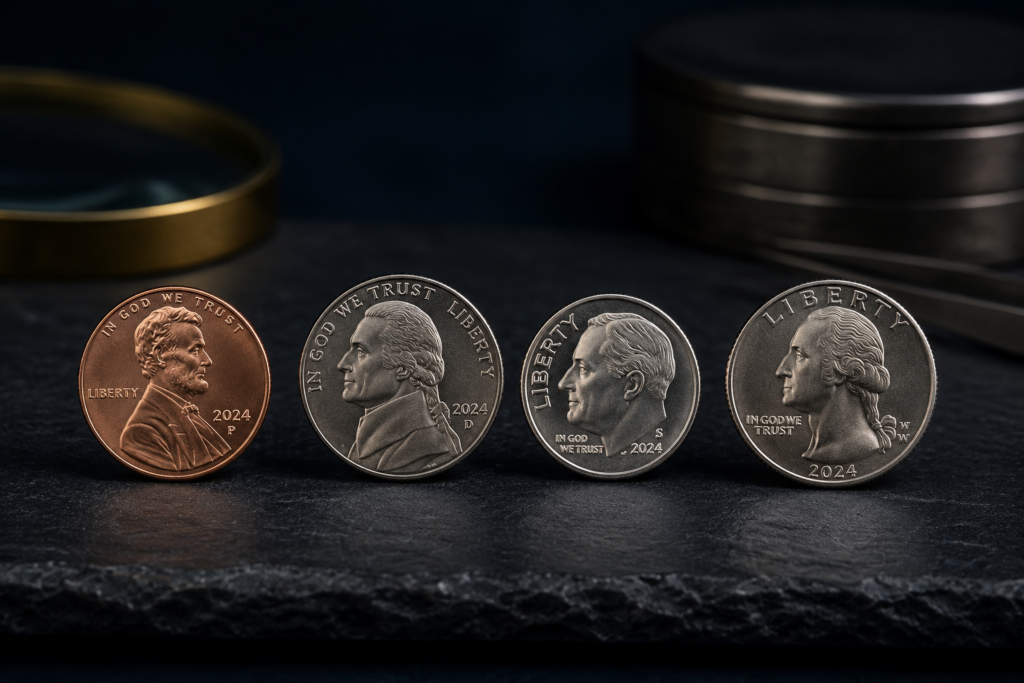
The United States Mint is the federal agency responsible for every coin that passes through American hands. It runs four active production facilities — Philadelphia, Denver, San Francisco, and West Point — plus historic mints at Carson City and New Orleans that closed a century ago. The single letter you see on most U.S. coins tells you which branch struck it. This guide walks through the history, the branches, and the mintmarks.
What is the U.S. Mint?
The U.S. Mint is a bureau of the United States Department of the Treasury responsible for designing, manufacturing, and distributing all circulating U.S. coinage. It also produces commemorative coins and the American Eagle bullion programs (gold, silver, platinum, and palladium). It was established by the Coinage Act of 1792 and is one of the oldest continuously operating federal agencies.
One quick clarification, because the confusion is widespread: the U.S. Mint does not produce paper money. Paper currency is printed by the Bureau of Engraving and Printing, a separate Treasury bureau headquartered in Washington with a second facility in Fort Worth. The Mint makes coins, the BEP makes notes, and Fort Knox stores gold reserves — three different agencies and facilities that get tangled together in casual conversation.
A brief history of the U.S. Mint
Congress passed the Coinage Act of 1792 on April 2, 1792, establishing the U.S. dollar as the basic unit of currency and authorizing a federal mint to produce it. Philadelphia, then the nation’s capital, was chosen as the site. The Philadelphia Mint became the first federal building constructed under the Constitution. It struck the first U.S. coins — the 1792 half disme, a small silver five-cent piece — within months. For the full coinage story this article only touches, see the full history of U.S. coinage.
For the first four decades, Philadelphia was the only U.S. mint. That changed in the 1830s, when gold discoveries in North Carolina and Georgia and a thriving Southern economy made shipping raw bullion to Philadelphia impractical. Congress authorized three branch mints in 1835: Charlotte, North Carolina; Dahlonega, Georgia; and New Orleans, Louisiana. All three opened in 1838. Charlotte and Dahlonega struck only gold; New Orleans struck both silver and gold and operated, with interruptions, until 1909.
The California Gold Rush prompted the San Francisco Mint, which opened in 1854, to convert Western gold into coinage on the spot. The Comstock Lode silver boom prompted Carson City, Nevada, which opened in 1870, to do the same for silver — its CC-mintmarked Morgan dollars are among the most prized coins in American collecting. Denver opened in 1906, converting an existing federal assay office into a full minting facility to handle the metal flowing in from the Rocky Mountain mines.
The Coinage Act of 1873 consolidated Mint operations under a centralized administration in the Treasury Department. The Civil War, FDR’s 1933 gold recall, and the Coinage Act of 1965 (which ended 90% silver coinage) each reshaped what the Mint made and how, but the institutional structure has held since 1873. The Manila Mint, operated under U.S. authority in the Philippines from 1920 to 1941, was the only U.S. mint ever located outside the continental United States.
The newest active facility is West Point, which began life in 1937 as a silver bullion depository. It produced cents alongside Philadelphia during the 1970s and was elevated to full mint status in 1988, when it took over the new American Eagle bullion program.
The four active production facilities
Today the U.S. Mint operates four production facilities. Each has a distinct role, and each puts a different mintmark on the coins it strikes.
Philadelphia (P or no mintmark)
Philadelphia is the headquarters and the largest producer of circulating coinage. It houses the Mint’s engraving department, where the sculptural models for new coin designs originate. Most of the cents, nickels, dimes, and quarters in your pocket were struck here.
Philadelphia coins historically carried no mintmark — the P was added only to the wartime silver nickel from 1942 to 1945, and then to all circulating denominations except the cent starting in 1980. The Lincoln cent has never carried a P mintmark.
Denver (D)
Denver is the second-largest producer of circulating coinage and runs parallel to Philadelphia, striking the same denominations with a D mintmark. It opened in 1906 in the converted Denver Assay Office building. Denver also produces a substantial share of the Mint’s commemorative coin output.
A note for collectors: the D mintmark on coins dated 1838–1861 indicates Dahlonega, Georgia, not Denver — Dahlonega struck only gold and only in that pre-Civil War window.
San Francisco (S)
San Francisco struck circulating coinage continuously from 1854 until the 1970s, when its role shifted almost entirely to collector products. Today the San Francisco Mint produces the annual U.S. proof sets, the silver proof sets, and a handful of commemorative issues.
An S-mintmark Roosevelt dime from a modern year is a proof, not a circulating coin — finding one in change is unusual and worth checking. San Francisco does not currently strike circulating coinage for general release.
West Point (W)
West Point is the Mint’s bullion facility. It strikes the American Gold Eagle, American Silver Eagle, American Platinum Eagle, and American Gold Buffalo — the U.S. government’s gold and silver bullion products. West Point also stores a substantial portion of the U.S. gold bullion reserve (distinct from Fort Knox, which is a separate Army installation in Kentucky).
The W mintmark has appeared on American Eagle proof and burnished issues since the mid-1980s; bullion-strike Silver Eagles and Gold Eagles intended for resale typically carry no mintmark. West Point also strikes some commemorative gold coins and select circulating commemoratives.
Closed historic mints
Four U.S. mints have closed permanently, but their mintmarks still appear on coins found in collections, junk-silver bags, and the occasional bank roll.
- Carson City (CC), 1870–1893. Established to coin silver from the Comstock Lode. Carson City Morgan dollars (1878–1893, with a gap from 1886–1888) are among the most actively traded silver dollars in American numismatics; certain dates command four-figure premiums even in worn condition.
- New Orleans (O), 1838–1861 and 1879–1909. The first New Orleans Mint closed at the start of the Civil War; the second iteration produced widely collected Morgan dollars and a long run of Liberty Seated coinage. The original building still stands and houses a museum.
- Charlotte (C), 1838–1861. A gold-only mint that struck quarter eagles, half eagles, and three-dollar gold pieces from the North Carolina goldfields. The Civil War closed it permanently.
- Dahlonega (D), 1838–1861. Also gold-only, also Civil War casualty. Distinguishable from modern Denver by date — any “D” mintmark on a pre-1861 gold coin is Dahlonega, not Denver.
- Manila (M), 1920–1941. Operated under U.S. authority in the Philippines and struck Philippine coinage in U.S. denominations. The only U.S. mint ever located outside the continental United States; closed by the Japanese occupation in 1942.
U.S. mintmark reference table
Every U.S. mint mark at a glance, active and historic — each letter, the branch it identifies, and what that branch made.
| Mintmark | Branch | Years Active | Coins Produced |
| P | Philadelphia | 1792–present | All circulating denominations; commemoratives. P mintmark used on wartime nickel 1942–45 and on most non-cent denominations from 1980. |
| D | Denver | 1906–present | All circulating denominations; commemoratives. |
| S | San Francisco | 1854–present | Annual proof sets, silver proof sets, limited commemoratives. Circulating coinage in most years 1854–1975. |
| W | West Point | 1988–present (mint status) | American Eagle bullion and proof issues; American Gold Buffalo; select commemoratives. |
| CC | Carson City | 1870–1893 | Silver dollars (Morgan, Trade), smaller silver denominations, gold eagles and double eagles. |
| O | New Orleans | 1838–1861, 1879–1909 | Morgan dollars, Liberty Seated silver, gold eagles and half eagles. |
| C | Charlotte | 1838–1861 | Gold only — quarter eagles, half eagles, three-dollar gold pieces. |
| D (pre-1861) | Dahlonega | 1838–1861 | Gold only — quarter eagles, half eagles, three-dollar gold pieces. Distinct from Denver by date. |
| M | Manila | 1920–1941 | Philippine coinage struck under U.S. authority. |
How to read a mintmark on your coin (and why some don’t have one)
The mintmark on a U.S. coin — also commonly written as “mint mark” — is a single letter or pair of letters that identifies the branch that struck it. Its location on the coin varies by series and by era, and the absence of a mintmark almost always means one specific thing.
Where to look. Before 1965, most silver coinage carried the mintmark on the reverse. Beginning in 1968, after a three-year hiatus (no mintmarks were used on circulating coinage from 1965 through 1967, an anti-hoarding measure during the silver shortage), the mintmark moved to the obverse, near the date. Common series and their mintmark locations:
- Morgan silver dollar (1878–1921): reverse, below the eagle, above the letters “DO” in DOLLAR.
- Peace dollar (1921–1935): reverse, near the eagle’s left wing tip, below ONE.
- Mercury dime (1916–1945): reverse, to the left of the fasces near the base.
- Buffalo nickel (1913–1938): reverse, below FIVE CENTS.
- Walking Liberty half dollar (1916–1947): reverse, lower left below the eagle on most years (obverse below IN GOD WE TRUST on 1916 and early 1917).
- Lincoln cent (1909–present): obverse, below the date.
- Washington quarter (1932–present): reverse below the eagle through 1964; obverse to the right of Washington’s bust from 1968 onward.
Why some coins have no mintmark. Coins struck at the Philadelphia Mint historically did not carry a mintmark — Philadelphia was understood to be the default. The P mintmark was added only to the wartime silver nickel (1942–1945) and then to all circulating denominations except the cent starting in 1980.
The Lincoln cent has never carried a mintmark for Philadelphia. So if you have a 1942 wheat penny, a 1967 dime, a 1978 quarter, or a 1990 cent with no mintmark, it is a Philadelphia coin — not a rare error.
Real Mint errors involve missing dates, off-center strikes, or struck-on-wrong-planchet pieces, none of which look like a coin with a blank space where a mintmark would be.
Proof, business strike, and bullion — what each branch makes today
Three production categories explain why one branch makes the coin in your pocket and another makes the coin in your safe.
Business strike coins are intended for circulation. They’re struck once at high speed on industrial presses, with no special finish. Philadelphia and Denver produce almost all U.S. business-strike coinage today.
Proof coins are struck for collectors. The dies are polished to a mirror finish, the blanks are specially prepared, and each coin is struck two or three times under reduced pressure to bring up sharp design detail. Modern proofs come in the annual U.S. Proof Set and Silver Proof Set, both produced in San Francisco. Proofs trade in PCGS or NGC PR-grade slabs — see the coin grading services comparison for what those grades mean.
Bullion coins are sold for their metal content, with a small premium over spot. The American Silver Eagle, American Gold Eagle, American Gold Buffalo, and American Platinum Eagle are all bullion products of the U.S. Mint, struck at West Point. Most bullion-strike Eagles carry no mintmark; proof and burnished collector versions of the same coins typically carry the W mintmark and are sold separately at higher premiums.
How mintmarks affect a coin’s collectible value
Mint marks matter for value because mintage figures vary by branch. Three principles cover most of it.
First, low-mintage branches command premiums. Carson City produced silver dollars in much smaller quantities than Philadelphia, New Orleans, or San Francisco — the 1879-CC and 1889-CC Morgan dollars are among the most valuable common-design U.S. coins for that reason. See the Morgan silver dollar value guide for the year-and-mintmark detail.
Second, branch rarity is series-specific. For Morgan dollars the Carson City coins are the prize. For Mercury dimes it’s the 1916-D — a Denver issue with a mintage of only 264,000, the key date that anchors the entire series. For Lincoln cents the 1909-S VDB is the famous one. The pattern doesn’t generalize across series; you have to know each series.
Third, modern mintmark variation matters mostly for proof and bullion. A 2024-W burnished American Silver Eagle is a different product (and different price) from a 2024 bullion-strike Silver Eagle with no mintmark. San Francisco silver proof sets, West Point burnished and proof Silver Eagles, and reverse-proof commemoratives are the contemporary collector niches where mintmark trumps date.
Specific values change with the market and with grade. Each coin’s value page in the knowledge center carries current ranges by date and mintmark; this article exists to explain the mintmark — not to price every coin that wears one.
Frequently asked questions
Why doesn’t my coin have a mintmark?
Most U.S. coins struck in Philadelphia before 1980 — and every Lincoln cent ever struck in Philadelphia — carry no mintmark. It’s a Philadelphia coin, not a rare error. The P mintmark was added to the wartime silver nickel from 1942 to 1945 and then to all circulating denominations except the cent starting in 1980.
Where are U.S. coins made today?
Four active facilities: Philadelphia and Denver for circulating coinage, San Francisco for proof coins, and West Point for American Eagle bullion and select commemoratives. The Mint’s headquarters is in Washington, D.C., but no coins are produced there.
Is the U.S. Mint the same as Fort Knox?
No. Fort Knox is the United States Bullion Depository — a separate Army installation in Kentucky that stores gold reserves but does not produce coins. West Point also stores gold bullion as part of the U.S. reserve, distinct from Fort Knox. Coins are made at the four production facilities; gold reserves are held at the depositories.
Does the U.S. Mint print paper money?
No. Paper currency is produced by the Bureau of Engraving and Printing, a different bureau of the Treasury Department. The U.S. Mint produces coins only.
What’s the rarest U.S. mintmark?
The 1870-S Seated Liberty dollar — only nine confirmed examples — is among the rarest U.S. coins of any mintmark. The 1804 Draped Bust silver dollar, though not technically a mintmark rarity, is the most famous. Among regularly issued coins, the 1916-D Mercury dime, the 1909-S VDB Lincoln cent, and the 1879-CC and 1889-CC Morgan dollars are the headline mintmark rarities.
What does the W mintmark mean on a Silver Eagle?
West Point. The W mintmark has appeared on American Silver Eagle proof and burnished collector issues for most of the program’s history. Bullion-strike Silver Eagles intended for resale typically carry no mintmark, even when struck at West Point. The W mintmark also appears on American Gold Eagle proofs, American Platinum Eagles, and American Gold Buffalo issues.
Can you tour the U.S. Mint?
Philadelphia and Denver offer free public tours that walk visitors past the production floor and through the Mint’s history exhibits. San Francisco and West Point do not offer public tours, for security reasons. Reservation requirements and current schedules are posted on usmint.gov.
