
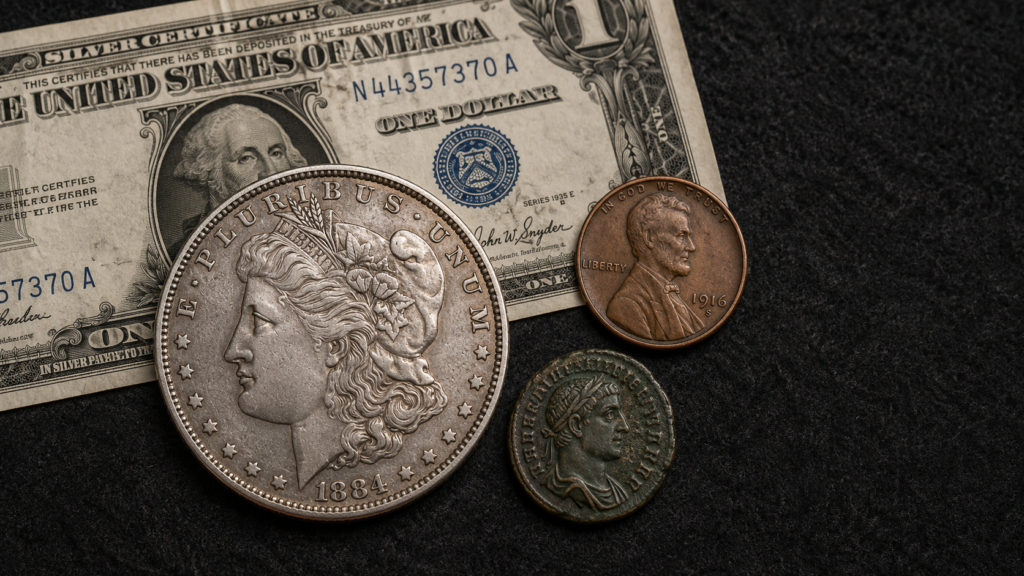
A numismatist is someone who studies and collects coins, paper money, tokens, and related objects. The word comes from the Latin numisma, meaning “coin.” Today it covers everyone from a kid with a Whitman folder to a scholar cataloging ancient Greek tetradrachms. Whether that makes coin collecting a hobby, an investment, or both depends on how you go about it — and this guide walks through the difference.
What is a numismatist?
A numismatist is a person who studies and collects coins, paper currency, tokens, medals, and related objects. The word comes from the Latin numisma (“coin”), itself rooted in the Greek nomisma (“current coin, custom”). The field they study is called numismatics, and the term covers everyone from casual hobbyists to professional curators and dealers.
“Numismatist” doesn’t mean credentialed expert. Anyone who collects coins and learns about them qualifies — the American Numismatic Association uses the word for every one of its tens of thousands of hobbyist members.
Numismatics vs. coin collecting — the terminology, untangled
A handful of words travel together in this space — worth sorting once.
- Numismatist: The person who collects or studies.
- Numismatics: The field of study itself.
- Exonumia: Tokens, medals, casino chips, transit fare tokens. Coin-like objects that aren’t legal-tender coinage.
- Notaphily: The collecting of paper money.
- Scripophily: The collecting of antique stock and bond certificates.
“What do you call a coin collector?” is one of the most-searched related questions. The technically correct answer is “numismatist,” though “coin collector” works fine in everyday conversation. The Coin Glossary defines each of the deeper terms in more depth.
A short history of numismatics
Coin collecting is roughly as old as coins, but the modern field is usually traced to the 14th-century Italian poet Petrarch, who cataloged Roman coins and corresponded with rulers about their portraits. By the 1600s and 1700s, “coin cabinets” had become a fixture of European royal courts and university libraries.
In the United States, two organizations anchor the field. The American Numismatic Society was founded in 1858 as a scholarly research body. The American Numismatic Association followed in 1891 and grew into the country’s largest hobbyist organization, with a chartered congressional mission to advance numismatics.
The Smithsonian’s National Numismatic Collection holds roughly 1.6 million objects — the largest such collection in the U.S. Readers wanting the parallel story of the coins themselves can follow the history of U.S. coinage in our dedicated guide.
What numismatists actually study and collect
Numismatics is much broader than the Whitman folder of pennies most people picture:
- U.S. series collecting. Morgan silver dollars, Peace dollars, Lincoln wheat pennies, Buffalo nickels, Mercury dimes, Walking Liberty half dollars — structured sets you can complete over years.
- World and ancient coins. Roman denarii, Greek tetradrachms, Chinese cash coins, British sovereigns. Common Roman bronzes start under $20.
- Errors and varieties. Doubled dies, off-center strikes, repunched mintmarks. The 1955 doubled-die Lincoln cent still trades into the thousands in higher grades.
- Tokens, medals, and exonumia. Civil War store cards, Hard Times tokens, So-Called Dollars — a parallel hobby with its own catalogs.
- Paper currency. Civil War fractional notes, large-size silver certificates, National Bank Notes, star-replacement notes.
- Methodologies. Many collectors organize by type set (one example of each design) or date set (every year-and-mintmark combination of one series).
Coin collecting as a hobby
At its core, the hobby is about the search and the story. A Morgan dollar isn’t interesting because it’s silver — it’s interesting because Congress passed the Bland-Allison Act of 1878 to placate Western silver miners. Every coin sits inside a piece of history.
The other half is the hunt. Searching bank rolls of cents for wheat pennies, picking through dealer junk boxes for a missing date, watching auctions for an upgrade in grade — “cherry-picking” is the standard term. Coin clubs, regional shows, and the ANA’s annual World’s Fair of Money exist because the social side of the search matters.
The starter kit hasn’t changed in fifty years: a current Red Book (the Guide Book of United States Coins by R.S. Yeoman), a Whitman or Dansco folder to hold a series, a 5x or 10x loupe, and clean cotton or nitrile gloves. ANA membership opens up The Numismatist magazine and the Summer Seminar at Colorado College.
Hobbyists, generally, are not worried about getting their money back. The satisfaction is the return.
Coin collecting as an investment
Treating coins as an investment is a different exercise, and it pays to be candid about the economics.
Numismatic coins carry a substantial premium over their melt value. That premium has to be paid up front and recovered on sale. On common-date material, dealer buy/sell spreads of 20–40% are normal. Spreads tighten on certified key dates, but you rarely escape them entirely. By contrast, an American Silver Eagle sells back to most dealers within a few percent of spot on the day.
Liquidity is the second cost: bullion sells anywhere on short notice, but a certified MS-65 Standing Liberty quarter needs the right buyer — often weeks or months.
Grading is the third: a one-point difference (MS-64 vs. MS-65) can double or halve a price, and grading is a judgment call until the coin sits in a PCGS or NGC slab.
Authentication is the fourth — counterfeits exist for almost every collectible date, and a polished or “improved” coin can lose 50–80% of its catalog value. The Coin Grading Services guide explains why certification matters.
There is real upside in segments of the market — certified key-date 20th-century coins, scarce early American material, and certified pre-1933 gold have shown long-term appreciation across multiple cycles. But the returns came with concentration risk, ten- to twenty-year holds, and the knowledge to buy the right coins at the right prices. Most readers who tell themselves they’re “investing in coins” would have done better in bullion.
The Numismatic vs. Bullion Coins comparison goes deeper on the decision, and the Best Gold Coins to Buy guide is the next step for readers who decide bullion is the better fit.
This is general information, not investment advice — numismatic coins are a specialized market and individual results vary widely.
Hobby vs. investment — the practical differences
How the same activity looks under each frame.
| Dimension | Coin Collecting as a Hobby | Coin Collecting as an Investment |
| Primary goal | Enjoyment, learning, completion of a set. | Capital appreciation or store of value. |
| What you buy | Whatever interests you, often inexpensive raw coins. | Certified key dates, scarce varieties, certified pre-1933 gold. |
| Price you pay | Face value to a modest premium. | Substantial premium over melt; often hundreds to thousands per coin. |
| Grading | Nice to know. | Critical — one grade point can double or halve value. |
| Time horizon | Years to decades; open-ended. | Ten to twenty years or more to absorb spreads. |
| Liquidity at sale | Local dealer, eBay, coin club; modest prices easily moved. | Specialist dealer or auction house; weeks to months. |
| Typical return | Break-even or small loss; the experience is the return. | Underperforms bullion on average, with occasional standouts. |
How to start collecting (without getting fleeced)
If the hobby side appeals, the path in is well-worn:
- Pick a scope. A series (Lincoln wheat pennies, Buffalo nickels), a type set, or a theme. Don’t try to collect everything — the hobby becomes incoherent fast.
- Buy a current-year Red Book before you spend anything else. Learn what each coin is worth at each grade before you walk into a shop.
- Start with raw, common-date coins from a reputable local dealer — ideally an ANA member dealer. Skip mail-order rarities and television auctions until you’ve handled a few hundred coins.
- Once you’re spending more than about $200 on any single coin, buy only PCGS- or NGC-certified examples. The grading fee is small insurance against authentication and grading risk.
- Document everything as you go: date acquired, dealer, price paid, grade, provenance. Inheriting an undocumented collection is a known headache — the inventory step is what saves your heirs.
Frequently asked questions
What’s the difference between a numismatist and a coin collector?
Technically, none. “Numismatist” is the formal term, used widely by both hobbyists and professionals. The American Numismatic Association calls every one of its members a numismatist. “Coin collector” is the plain-English equivalent and works fine in conversation.
Is coin collecting a dying hobby?
No. ANA membership remains in the tens of thousands, major auction houses regularly report record prices on key-date material, and U.S. Mint commemoratives still sell out. The demographics skew older, but the hobby is healthy and the entry cost is low.
Do numismatists make money?
Most don’t, and most aren’t trying to. Full-time dealers and a handful of professional collectors do; the average hobbyist breaks even at best on common-date material. The economics work better on rare, certified, long-held coins.
What’s the most valuable U.S. coin ever sold?
The 1933 Saint-Gaudens double eagle, which sold for $18.9 million at Sotheby’s in 2021. It’s the only example of that date legally permitted in private hands; the rest were ordered melted during FDR’s 1933 gold recall.
Can I be a numismatist without spending much?
Yes. Searching circulated coin rolls from the bank for wheat pennies, war nickels, or pre-1965 silver dimes costs only face value. Many serious collectors started this way.
Are bullion coins like American Silver Eagles considered numismatic?
Generally, not. They’re bullion coins valued mainly by metal content. The exception is low-mintage proof or burnished issues, which trade with a numismatic premium based on mintage and grade rather than silver weight.
This article is for informational and educational purposes only. It is not financial, investment, legal, or tax advice. Consult a qualified professional about your specific situation.
