
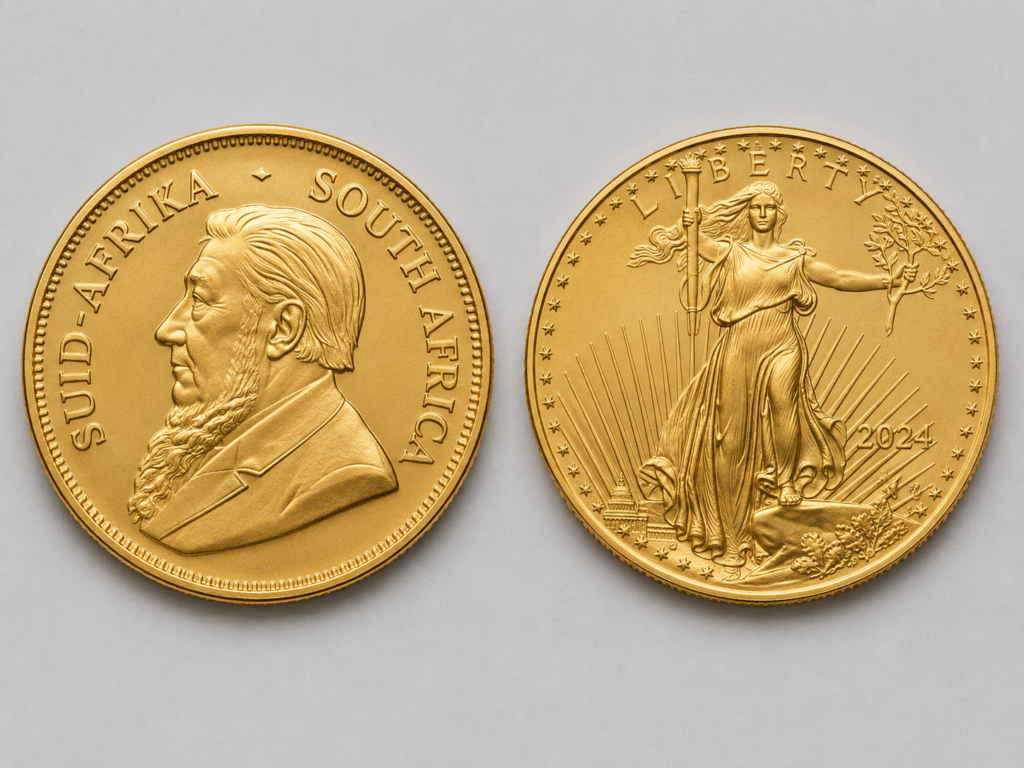
The South African Krugerrand and the American Gold Eagle are the two most globally recognized 1 troy ounce gold bullion coins. Both are 22-karat — .9167 fine. Both contain one troy ounce of pure gold. Both weigh 33.93 grams gross.
They diverge on the dimensions that actually matter to a portfolio decision: IRA eligibility, premium over spot, and resale liquidity in the U.S. market. The Gold Eagle is IRA-eligible by specific IRS exception. The Krugerrand is not. This guide walks each dimension and closes with a clear buying recommendation.
This article is for informational and educational purposes only and does not constitute tax advice. Premium figures and dealer pricing move daily; confirm current pricing with your dealer and IRA eligibility rules with your custodian or tax professional before purchase.
Which gold bullion coin should you buy?
The South African Krugerrand and the American Gold Eagle are both 1 troy ounce gold bullion at .9167 fine. Purity, gold content, and gross weight are identical. The two practical differences are IRA eligibility and the premium over spot.
For an IRA-held position, the American Gold Eagle is the only option. It is named as a specific exception in IRC §408(m)(3); the Krugerrand is not.
For a buyer focused on the lowest premium spend per ounce of physical gold held outside an IRA, the Krugerrand is the default. It is the workhorse low-premium 1 troy ounce gold bullion coin in the global market.
For an investor building a long-term gold position, holding both is reasonable. Gold Eagles for the IRA-eligible sleeve; Krugerrands for taxable bullion exposure at a lower premium.
The South African Krugerrand
The Krugerrand is the official gold bullion coin of South Africa, produced by the South African Mint and Rand Refinery since 1967. It is the original modern gold bullion coin — the first to use the model of a sovereign-issued bullion coin denominated by metal content rather than face value.
Each 1 troy oz Krugerrand contains one troy ounce of pure gold in a .9167 fine alloy of 91.67% gold and 8.33% copper. The copper alloy gives the coin its characteristic reddish-orange hue and adds wear resistance. Gross weight is 33.93 grams; diameter is 32.77 millimeters.
The obverse is Otto Schultz’s portrait of Paul Kruger, founding president of the South African Republic. The reverse is Coert Steynberg’s springbok antelope, the national animal of South Africa. The coin has no face value; it is legal tender in South Africa by weight.
Krugerrand imports into the United States were restricted during the apartheid era and resumed freely after sanctions were lifted. The coin has been widely traded in the U.S. for decades and is sold by every major U.S. dealer without restriction. Premiums over spot have historically run at the low end of the sovereign-bullion range.
The American Gold Eagle
The American Gold Eagle is the official gold bullion coin of the United States, produced by the U.S. Mint since 1986 under the Gold Bullion Coin Act of 1985. Each 1 troy oz Gold Eagle contains one troy ounce of pure gold in a .9167 fine alloy of 91.67% gold, 3% silver, and 5.33% copper.
Gross weight is 33.93 grams; diameter is 32.7 millimeters. The coin carries a nominal $50 face value despite trading at gold-content value in the low five figures. The alloy mix gives the coin a slightly warmer color than pure-gold bullion coins.
The obverse is a modern adaptation of Augustus Saint-Gaudens’ Liberty walking with torch and olive branch — the same figure used on the celebrated 1907 Saint-Gaudens $20 Double Eagle. The reverse has run in two distinct designs: Miley Busiek Frost’s family of eagles in nest (Type 1, 1986 through mid-2021) and Jennie Norris’s profile of a bald eagle (Type 2, mid-2021 to present).
The Gold Eagle is IRA-eligible by specific IRS exception, one of the very few gold coins below .995 fineness that the IRS allows in self-directed precious metals IRAs. Premiums over spot have historically run higher than Krugerrand premiums — driven by U.S. Mint production cost, domestic brand demand, and the IRA-eligibility utility built into the coin.
Side-by-side specifications
The published specifications for both coins, side by side. Gold content, purity, gross weight, edge, and U.S. capital gains treatment all match. IRA eligibility is the headline divergence.
| Specification | South African Krugerrand | American Gold Eagle |
| Issuing mint | South African Mint / Rand Refinery | U.S. Mint |
| First minted | 1967 | 1986 |
| Gold content | 1 troy oz (31.103 g) | 1 troy oz (31.103 g) |
| Purity | .9167 fine (22-karat) | .9167 fine (22-karat) |
| Alloy composition | 91.67% gold, 8.33% copper | 91.67% gold, 3% silver, 5.33% copper |
| Gross weight | 33.93 g | 33.93 g |
| Diameter | 32.77 mm | 32.7 mm |
| Thickness | 2.84 mm | 2.87 mm |
| Edge | Reeded | Reeded |
| Face value | None (legal tender by weight) | $50 USD |
| Obverse design | Paul Kruger portrait (Schultz) | Liberty walking (Saint-Gaudens adaptation) |
| Reverse design | Springbok antelope (Steynberg) | Family of eagles (Type 1) or eagle profile (Type 2) |
| Security features | Reeded edge only | Reeded edge only |
| IRA eligible | No (not named in IRC §408(m)(3)) | Yes (specific IRS exception) |
| Fractional sizes | 1/2, 1/4, 1/10, 1/20, 1/50 oz | 1/2, 1/4, 1/10 oz |
Two observations worth pulling out of the table. Both coins contain the same one troy ounce of pure gold; the .9167 fineness is identical. The 22-karat alloy choice is a durability decision — copper on the Krugerrand, copper-silver on the Gold Eagle — not a gold-content compromise.
The metal content floor under both coins is the same: one troy ounce times the live gold spot price. See our melt value guide for the framework.
IRA eligibility — the biggest practical difference
The American Gold Eagle is eligible for self-directed precious metals IRAs. The Krugerrand is not. The split traces directly to the U.S. tax code.
IRC §408(m)(3) sets the default rule: gold held in an IRA must be at least .995 fine. Both coins are .9167 fine and would normally be excluded. The American Gold Eagle is named as a specific exception in the statute. The Krugerrand is not named, so it falls under the default rule and cannot be held in an IRA.
The practical consequences for portfolio construction:
Building a self-directed precious metals IRA
The American Gold Eagle works. The Krugerrand does not. There is no workaround — you cannot transfer Krugerrands into an existing IRA, and a custodian will reject the deposit.
Holding gold outside an IRA
Both coins work equally. The fineness, the gold content, and the metal content floor are identical. The choice turns on premium and resale, not on eligibility.
Running both an IRA sleeve and a taxable sleeve
A split allocation is reasonable. Gold Eagles inside the IRA; Krugerrands in the taxable sleeve at the lower premium. Tag each holding to its sleeve so the split stays clear at tax time.
Other IRA-eligible 1 troy oz gold bullion coins for context
American Gold Buffalo (.9999), Canadian Gold Maple Leaf (.9999), Austrian Gold Philharmonic (.9999), Australian Gold Kangaroo (.9999), Britannia (.9999 since 2013). The Krugerrand is the most prominent globally recognized gold bullion coin that is not IRA-eligible.
Premium over spot: where the two coins diverge
Both coins trade at a premium above the gold spot price, and the premium gap is the most consequential difference for a buyer sizing a taxable gold position. The Krugerrand carries the lowest premium of any major 1 troy ounce sovereign gold bullion coin.
Three factors drive the Krugerrand’s premium advantage: South African Mint and Rand Refinery production cost at scale, decades of accumulated global supply, and the coin’s status as the workhorse low-premium ounce. The Gold Eagle’s premium reflects U.S. Mint production cost, domestic brand demand, the IRA-eligibility utility, and periodic premium spikes during retail-shortage cycles.
The premium gap is durable. Krugerrand premiums compress further during stable retail-supply periods, and Gold Eagle premiums can widen meaningfully during shortage cycles — the 2020 COVID surge and the 2021 retail run are the recent reference points.
For a buyer building a position over many purchases, the cumulative premium difference is real money. Live premium figures move daily; check current dealer pricing at purchase. See our premium over spot guide for the framework.
Liquidity, resale, and counterfeit detection
Both coins are recognized at every major U.S. and international gold bullion dealer. The Gold Eagle has a marginal liquidity edge in U.S. retail and pawn markets because it is the domestic default.
Krugerrands trade at the same U.S. dealers at comparable liquidity but occasionally at a slightly wider bid-ask spread. Internationally, the ordering reverses — the Krugerrand is the most universally recognized gold bullion coin in the world by total production, and resale at any major non-U.S. dealer is excellent.
Counterfeit detection on either coin relies on the same baseline verification: weight (33.93 grams), diameter (32.77 mm for the Krugerrand and 32.7 mm for the Gold Eagle), thickness, and the ping test that produces a characteristic ring on a struck gold coin. Neither coin carries surface security features on the standard bullion strike.
A scale accurate to 0.01 grams, a caliper, and an electromagnetic conductivity tester eliminate the overwhelming majority of counterfeits. See the guide to selling precious metals for the full resale framework.
Frequently asked questions
Is a Krugerrand IRA eligible?
No, the Krugerrand is not eligible for self-directed precious metals IRAs. IRC §408(m)(3) requires gold held in an IRA to be at least .995 fine, and the Krugerrand is .9167 fine. The American Gold Eagle is named as a specific exception in the statute and qualifies despite the same .9167 fineness; the Krugerrand is not named and falls under the default rule.
What is the difference between a Krugerrand and an American Gold Eagle?
Both coins contain one troy ounce of pure gold at .9167 fine purity and weigh the same 33.93 grams gross. The four practical differences are IRA eligibility (yes for the Gold Eagle, no for the Krugerrand), premium over spot (the Krugerrand runs lower), U.S. resale liquidity (the Gold Eagle has a marginal edge in U.S. retail), and design. The Krugerrand carries Paul Kruger and a springbok; the Gold Eagle carries Liberty walking and either a family of eagles or an eagle profile depending on year.
Which is purer — the Krugerrand or the American Gold Eagle?
Both coins are equally pure at .9167 fine — also expressed as 22-karat. The difference is in the alloy choice: the Krugerrand uses 8.33% copper for durability and a characteristic reddish hue, while the Gold Eagle uses 3% silver and 5.33% copper for a slightly warmer color. Both contain the same one troy ounce of pure gold per coin.
Why does the American Gold Eagle cost more than the Krugerrand?
The Gold Eagle carries a higher premium over spot than the Krugerrand because of four structural factors: higher U.S. Mint production cost per coin, stronger domestic brand demand in the U.S. retail market, the IRA-eligibility utility built into the coin, and periodic premium surges during retail-shortage cycles. South African Mint and Rand Refinery production at scale keeps Krugerrand premiums at the low end of the sovereign-bullion range. Both coins contain the same one troy ounce of pure gold; the price difference is the premium, not the metal.
Is the Krugerrand or the American Gold Eagle a better investment?
Neither coin is categorically a better investment; the choice depends on which dimension matters most to your portfolio. For an IRA-held position, the Gold Eagle is the only option because the Krugerrand fails the IRS fineness rule. For a taxable position focused on the lowest premium spend per ounce of physical gold, the Krugerrand is the default. For a long-term position, holding both is reasonable and spreads sovereign issuer risk across two of the most globally recognized gold bullion coins.
Are Krugerrands worth buying today?
Krugerrands remain one of the best-value 1 troy ounce gold bullion coins for taxable holdings because of the durable low premium and global recognition. The coin trades at the same gold-content value as every other 1 troy ounce sovereign gold bullion coin — the metal-content floor is one troy ounce times the gold spot price — but you pay less premium to acquire each ounce. The IRA-eligibility constraint is the only structural reason to choose the Gold Eagle over the Krugerrand for taxable holdings.
Do Krugerrands and American Gold Eagles hold their value equally?
Both coins track the gold spot price at a one-to-one ratio because each contains one troy ounce of pure gold — the metal-content floor under both coins is identical. The differences in resale value come from the premium, not the gold. Krugerrands command excellent bids globally and the strongest international recognition; Gold Eagles command a stronger premium-side bid in U.S. retail and pawn markets. Across a long holding period, both coins move with gold and both hold their portfolio value as gold bullion.
Track your gold bullion coins in Gold Silver Ledger
A split gold position raises a recordkeeping question that gets harder as the position grows. Which Eagles are inside the IRA sleeve and which Krugerrands are in the taxable sleeve? What did each cost, including the premium paid?
Gold Silver Ledger keeps both coins as standard catalog items. The published gold weight and purity are already populated. You record the year, quantity, and acquisition price; cost basis is locked at purchase.
Current value renders against the live gold spot price continuously. Filters and tags separate IRA-sleeve Eagles from taxable-sleeve Krugerrands, or roll everything into a combined gold bullion coin view.
Analytics surfaces the premium spend per coin. You see what each ounce of physical gold cost above spot — and the cumulative cost of tilting toward Eagles for IRA utility or toward Krugerrands for the lower premium.
This article is for informational and educational purposes only and does not constitute investment, sale, or tax advice. Specifications cited above are pulled from South African Mint, Rand Refinery, and U.S. Mint primary sources at the time of writing; premium and dealer pricing figures move daily. The IRA-eligibility framework summarizes IRC §408(m)(3) and current IRS rules; confirm current eligibility with your IRA custodian and a qualified tax professional before any purchase intended for IRA holdings.
