
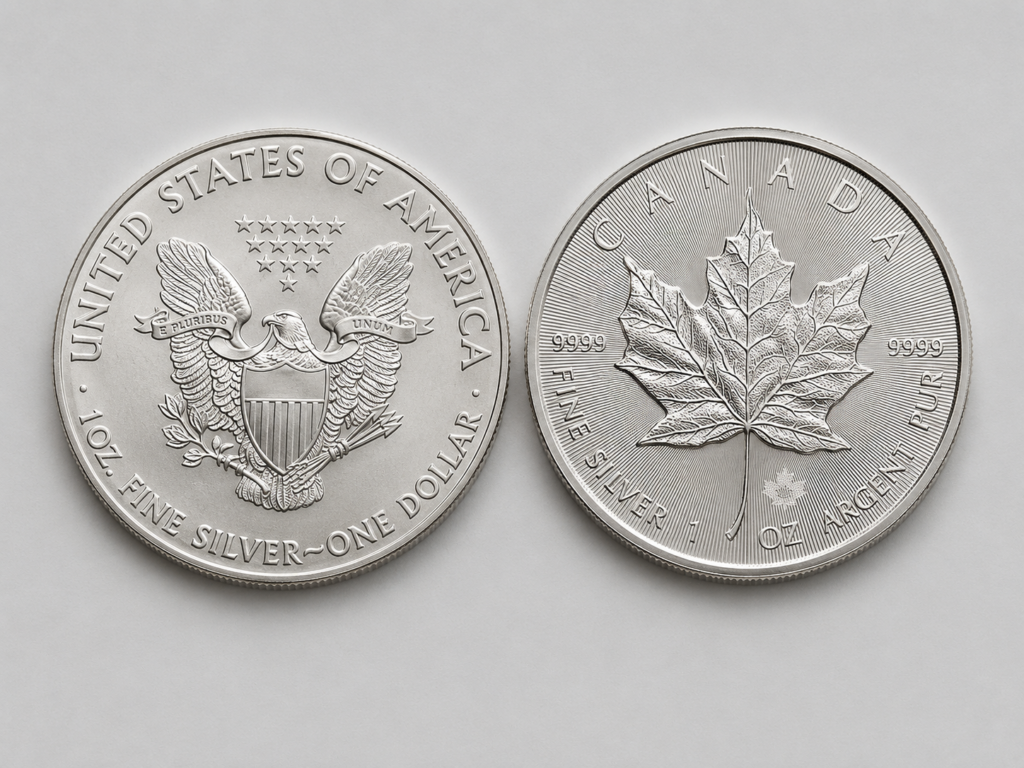
The American Silver Eagle and the Canadian Silver Maple Leaf are the two dominant 1 troy ounce silver bullion coins in the North American market. Both are sovereign-issued, both are guaranteed for weight and purity, both qualify for self-directed precious metals IRAs, and both are recognized at any major bullion dealer.
They differ on five dimensions that matter to a portfolio decision: purity, premium over spot, security features, resale liquidity, and design. Below, we’ll walk through each dimension and close with a clear buying recommendation.
This article is for informational and educational purposes only. Premium figures and dealer pricing move daily; consult current dealer quotes and the live silver spot price at the moment of purchase. Specifications cited here are pulled from U.S. Mint and Royal Canadian Mint primary sources at the time of writing.
Which silver coin should you buy?
The American Silver Eagle and the Canadian Silver Maple Leaf are both 1 troy ounce silver bullion coins backed by their respective sovereign mints. The Eagle is .999 fine silver and typically carries the higher premium over spot. The Maple Leaf is .9999 fine silver and typically carries the lower premium.
For a U.S.-based portfolio investor who values domestic resale liquidity and design recognition, the Silver Eagle is the default choice. For a buyer who values the highest available purity and the lowest premium spend per ounce, the Silver Maple Leaf is the default.
For an investor building a long-term position, holding both is reasonable. The two coins spread sovereign issuer risk and give resale flexibility across multiple market conditions.
The rest of this guide walks through each dimension that drives the choice: purity, premium over spot, security and counterfeit resistance, IRA eligibility and resale, and design.
The American Silver Eagle
The American Silver Eagle is the official silver bullion coin of the United States, produced by the U.S. Mint since 1986 under authorization of the Liberty Coin Act. Each coin contains one troy ounce (31.103 grams) of .999 fine silver, measures 40.6 millimeters in diameter, and carries a $1 face value.
The obverse is Adolph A. Weinman’s Walking Liberty — the same figure used on the Walking Liberty half dollar from 1916 through 1947. The reverse has run in two distinct designs: John Mercanti’s heraldic eagle and shield (Type 1, 1986 through mid-2021), and Emily Damstra’s eagle landing with oak branch (Type 2, mid-2021 to present). Composition, weight, and diameter have not changed across either type.
The Eagle is the highest-volume silver bullion coin in U.S. retail and one of the most heavily traded silver bullion coins worldwide. It qualifies for self-directed precious metals IRAs and is accepted at every major U.S. dealer.
The trade-off is premium. Eagles have historically carried the highest premium over spot of any 1 troy ounce silver bullion coin, driven by U.S. Mint production cost, domestic brand demand, and a series of well-documented premium spikes during retail demand surges. The premium gap to other 1 troy ounce sovereign silver coins has at times exceeded half the spot value of the silver itself.
The Canadian Silver Maple Leaf
The Canadian Silver Maple Leaf is the official silver bullion coin of Canada, produced by the Royal Canadian Mint since 1988. Each coin contains one troy ounce (31.103 grams) of .9999 fine silver — the highest purity available in mass-produced silver bullion. The coin measures 38 millimeters in diameter and carries a $5 Canadian face value.
The obverse carries the effigy of the reigning Canadian monarch — Queen Elizabeth II through 2023 and King Charles III from 2024 onward. The reverse is the iconic Canadian sugar maple leaf, unchanged in its core composition since 1988 and refined in 2014 with radial line security texturing across the entire field.
The Maple Leaf is the second-highest-volume silver bullion coin worldwide and the dominant 1 troy ounce silver bullion coin in the Canadian retail market. It qualifies for self-directed precious metals IRAs and is accepted at every major North American and international bullion dealer.
The Royal Canadian Mint added two notable security features in 2014: the radial line background and a laser-engraved miniature date inside a privy mark on one of the maple leaves. Premiums over spot have historically run meaningfully below Silver Eagle premiums for comparable purchase quantities.
Side-by-side specifications
The published specifications for both coins, side by side. Silver content, IRA eligibility, and U.S. capital gains treatment match. Purity, diameter, edge detail, and security features diverge.
| Specification | American Silver Eagle | Canadian Silver Maple Leaf |
| Issuing mint | U.S. Mint | Royal Canadian Mint |
| First minted | 1986 | 1988 |
| Silver content | 1 troy oz (31.103 g) | 1 troy oz (31.103 g) |
| Purity | .999 fine | .9999 fine |
| Gross weight | 31.103 g | 31.11 g |
| Diameter | 40.6 mm | 38.0 mm |
| Thickness | 2.98 mm | 3.29 mm |
| Edge | Reeded | Reeded with serrations |
| Face value | $1 USD | $5 CAD |
| Obverse design | Walking Liberty (Weinman) | Canadian monarch effigy |
| Reverse design | Heraldic eagle (Type 1) or eagle landing (Type 2) | Sugar maple leaf |
| Security features | Reeded edge only | Radial lines, micro-engraved privy mark, reeded edge |
| IRA eligible | Yes (clears .999 minimum) | Yes (clears .999 minimum) |
| U.S. capital gains treatment | Collectible (28% max long-term rate) | Collectible (28% max long-term rate) |
Two observations worth pulling out of the table. First, both coins contain the same one troy ounce of silver. The .9999 fineness on the Maple Leaf does not mean it holds more silver than the .999 Eagle — it means the Maple Leaf has slightly less alloy.
The metal content of the floor under both coins is the same: one troy ounce times the live silver spot price. See the melt value guide for the framework.
Second, both coins clear the .999 minimum fineness for self-directed precious metals IRAs. Purity is not a tiebreaker on IRA eligibility.
Premium over spot — where the two coins diverge
Both coins trade at a premium above the silver spot price, and the premium gap between Eagles and Maple Leafs is the single most consequential difference for sizing a position. The Silver Eagle’s premium reflects U.S. Mint production cost, domestic dealer markup, and structural demand surges during retail-shortage cycles. The Silver Maple Leaf’s premium reflects Royal Canadian Mint production cost and dealer markup at a generally lower baseline.
Across most market conditions, a single Silver Eagle costs several dollars more than a single Silver Maple Leaf. During shortage cycles — the 2020 COVID surge and the 2021 retail run are the recent reference points — the gap has widened meaningfully. The per-ounce premium gap compounds across a position of any size.
The premium gap is not a permanent verdict for either coin. Eagle premiums compress during stable retail-supply periods, and Maple Leaf premiums can rise modestly if Royal Canadian Mint production tightens. What is durable is the structural ordering: the Eagle has historically carried the higher premium, the Maple Leaf the lower.
For a buyer building a position over many purchases, the cumulative premium difference is real money. Live premium figures move daily; check current dealer pricing at purchase and confirm the premium against the silver spot price for that day.
See the premium over spot guide for the framework.
Security features and counterfeit resistance
Counterfeit silver bullion coins are a real and growing market problem. Chinese-source counterfeits of both the Silver Eagle and the Silver Maple Leaf circulate in raw resale markets, particularly through online auction platforms.
Both mints have responded with security features; the Royal Canadian Mint has gone further on the Maple Leaf. The specific features on each coin:
American Silver Eagle
Reeded edge with consistent reed count. No surface security features on the bullion strike. Authentication relies on weight (31.103 grams), dimensions (40.6 mm diameter, 2.98 mm thickness), and the ping test — a struck silver coin produces a characteristic high-pitched ring distinct from base metal counterfeits.
Canadian Silver Maple Leaf, radial lines
Precise, machine-cut concentric lines that radiate from the center of both faces. Nearly impossible to replicate without Royal Canadian Mint-grade tooling. The radial lines produce a characteristic light pattern when the coin is tilted under a light source — a quick visual authentication step at any dealer counter.
Canadian Silver Maple Leaf, Bullion DNA privy mark
A laser-engraved miniature replica of the coin’s date inside a privy mark on one of the maple leaves on the reverse. Visible only under magnification and verifiable by Royal Canadian Mint-authorized dealers using a specific imaging device that reads the micro-mark against the mint’s database.
Both coins, standard verification
Weight, diameter, and thickness specifications that any caliper, scale accurate to 0.01 grams, and ping-test app can verify in seconds. A buyer who weighs and measures any bullion coin before purchase eliminates the overwhelming majority of counterfeits without specialized equipment.
IRA eligibility, liquidity, and resale
Both the American Silver Eagle and the Canadian Silver Maple Leaf qualify for self-directed precious metals IRAs under IRS rules. The IRS requires silver held in an IRA to be at least .999 fine; the Eagle meets the floor and the Maple Leaf exceeds it.
Both coins are accepted by every major IRA custodian, including Equity Trust, STRATA Trust, Kingdom Trust, Madison Trust, GoldStar Trust, and the long tail of smaller custodians. For an IRA-held position, either coin works without compromise. See the silver IRA guide for the full eligibility framework.
On the resale side, the U.S. market is structurally tilted toward the Silver Eagle. Every U.S. dealer, every pawnshop that accepts bullion, and every coin show floor buys Eagles at standard bid prices. Maple Leafs trade at the same dealers at comparable liquidity, occasionally at a slightly wider bid-ask spread because the Eagle is the domestic default.
In the Canadian market, the ordering reverses — Maple Leafs are the domestic default. Internationally, both coins are universally recognized at major dealers.
The practical takeaway: if you expect to resell into the U.S. retail market, the Eagle has a marginal liquidity edge. In any other resale scenario, the two coins are functionally equivalent.
See the guide to selling precious metals for the full resale framework.
Frequently asked questions
Is the Silver Eagle or Silver Maple Leaf a better investment?
Neither coin is categorically a better investment than the other; the choice depends on which dimension matters most to your portfolio. The Silver Eagle gives you the deepest U.S. resale liquidity and the iconic Walking Liberty design at a higher premium over spot. The Silver Maple Leaf gives you the highest available purity in mass-produced silver bullion and the strongest mainstream anti-counterfeiting features at a lower premium. Both contain the same one troy ounce of silver, both qualify for self-directed precious metals IRAs, and both are recognized at every major dealer.
Which is purer — the American Silver Eagle or the Canadian Silver Maple Leaf?
The Canadian Silver Maple Leaf is more pure, at .9999 fine silver compared to the Silver Eagle’s .999 fine. Both contain the same one troy ounce of silver per coin — the .9999 fineness on the Maple Leaf means slightly less alloy in the gross weight, not slightly more silver. The IRS minimum fineness for silver held in a self-directed IRA is .999, so both coins clear the bar cleanly.
Why does the American Silver Eagle cost more than the Canadian Silver Maple Leaf?
The Silver Eagle carries a higher premium over spot than the Silver Maple Leaf because of three structural factors: higher U.S. Mint production cost per coin, stronger domestic brand demand in the U.S. retail market, and periodic premium surges during retail-shortage cycles. The Royal Canadian Mint produces the Maple Leaf at a lower cost basis and Canadian retail premiums run at a lower baseline. Both coins contain the same one troy ounce of silver; the price difference is the premium, not the metal.
Are Silver Eagles and Silver Maple Leafs IRA eligible?
Yes, both the American Silver Eagle and the Canadian Silver Maple Leaf qualify for self-directed precious metals IRAs under IRS rules requiring silver held in an IRA to be at least .999 fine. The Silver Eagle clears the floor at .999 and the Silver Maple Leaf exceeds it at .9999. Major IRA custodians including Equity Trust, STRATA Trust, Kingdom Trust, Madison Trust, and GoldStar Trust accept both coins for self-directed silver IRA holdings.
Can you tell a fake Silver Eagle or Silver Maple Leaf?
Most counterfeit Silver Eagles and Silver Maple Leafs can be detected with three basic checks: a scale accurate to 0.01 grams to verify the 31.103-gram weight, a caliper to verify diameter (40.6 mm for the Eagle, 38 mm for the Maple Leaf), and the ping test, which produces a characteristic high-pitched ring on a struck silver coin distinct from base metal. The 2014-and-later Maple Leaf adds two further layers: the radial line texturing across both faces and the laser-engraved Bullion DNA privy mark verifiable by Royal Canadian Mint-authorized dealers. Buy from established dealers when possible and verify weight and dimensions on any raw market purchase.
Should I buy Silver Eagles, Silver Maple Leafs, or both?
Holding both is a reasonable allocation for a long-term silver position because the two coins spread sovereign issuer risk and give you resale flexibility across U.S. and international markets. If you have to choose one, the Silver Eagle is the default for U.S.-based portfolios that prioritize domestic resale liquidity and iconic design. The Silver Maple Leaf is the default for purity-first allocations and for buyers focused on lowering the cumulative premium spend across a position built over many purchases.
Do Silver Eagles and Silver Maple Leafs hold their value equally?
Both coins track the silver spot price at a one-to-one ratio because each contains one troy ounce of silver — the metal-content floor under both coins is identical. The differences in resale value come from the premium, not the silver. Eagles command a stronger premium-side bid in U.S. retail and pawn markets; Maple Leafs command a stronger bid in Canadian markets and a comparable bid at international dealers. Across a long holding period, both coins move with silver and both hold their portfolio value as silver bullion.
Track your Silver Eagles and Silver Maple Leafs in Gold Silver Ledger
A mixed silver bullion position raises a simple question: what am I holding, what did I pay for it, and what is it worth right now? A spreadsheet handles the first part badly and the last two worse.
Gold Silver Ledger keeps Eagles and Maple Leafs on the same Holdings view. Each coin is a standard catalog item with the published silver weight and purity already populated. You record the year, quantity, and acquisition price; cost basis is locked at purchase.
Current value renders against the live silver spot price continuously. Filters and tags pull Eagles into their own view, pull Maple Leafs into their own view, or roll both into a combined silver bullion coin view.
Analytics surfaces the premium spend per coin. You can see the actual cost of tilting one direction or the other across a position built over many purchases — the answer to the Eagle-versus-Maple sizing question without adding numbers up by hand.
This article is for informational and educational purposes only and does not constitute investment, sale, or tax advice. Specifications cited above are pulled from U.S. Mint and Royal Canadian Mint primary sources at the time of writing; premium and dealer pricing figures move daily. Confirm current pricing and IRA eligibility with your dealer and your IRA custodian before purchase. Cross-check all specifications against U.S. Mint and Royal Canadian Mint primary sources at the time of reading.
