
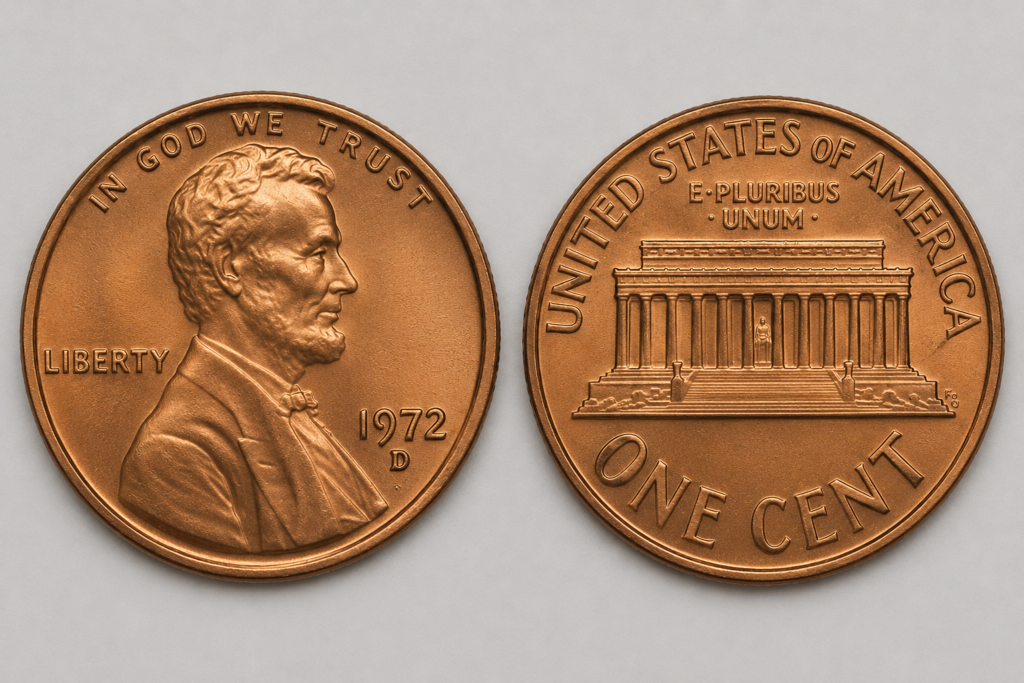
The Lincoln Memorial cent ran for fifty years, from 1959 — the 150th anniversary of Lincoln’s birth — through 2008, when the Bicentennial reverse designs replaced the Memorial. Most Lincoln Memorial pennies are worth face value. Pre-1982 cents are 95% copper and hold a few cents of copper at typical copper levels, though federal regulations prohibit melting them.
The 1969-S Doubled Die Obverse, the 1972 and 1995 Doubled Die Obverses, the 1982 Small Date zinc, and high-grade Mint State examples carry real collector premiums. This guide hands you the year-by-year detail, the doubled-die diagnostics, and the honest answer on the copper question.
What is a Lincoln Memorial penny worth today?
Most Lincoln Memorial pennies — common-date pieces from the heavy production years of the 1960s through the 2000s — are worth face value in circulated grade. Three categories carry a meaningful premium above face. The doubled-die varieties lead the list: the 1969-S Doubled Die Obverse is the holy grail of the series and trades in the low five to mid six figures even in circulated grade; the 1972 DDO, the 1983 Doubled Die Reverse, and the 1995 DDO each trade in the low three to mid four figures at Mint State.
The 1982 Small Date copper-plated zinc, a scarce transition-year variety, carries a modest premium across grades. And high-grade Mint State examples — MS-67 RED and above — carry a premium across most dates because the Memorial cent struck poorly, and full-luster survivors are scarce.
Pre-1982 copper Lincoln cents are a separate question. Each one contains roughly 2.95 grams of copper — about 2.5 to 3 cents of copper at typical copper levels, which is meaningfully above the coin’s face value. Federal regulations prohibit melting them, so the copper content is currently not directly realizable through sale to a refiner.
Hoarding intact copper cents by the bag or pound is legal and is a meaningful slice of the precious-metals-adjacent market. The copper question gets a dedicated section below. The year-by-year chart works through the per-date ranges; the doubled-die section is next.
Reading a Lincoln Memorial penny — date, mintmark, and the reverse design
The obverse shows Abraham Lincoln’s right-facing bust — Victor David Brenner’s original 1909 design, unchanged since — with IN GOD WE TRUST inscribed above, LIBERTY to the left of the bust, the date to the right, and the mintmark just below the date.
No mintmark means Philadelphia. D means Denver. S means San Francisco — proof issues every year, plus a small business-strike production in 1968, 1969, 1970, 1971, and 1974 when Philadelphia and Denver capacity ran short.
A mintmark is the small letter that identifies the mint that struck the coin; a doubled die is a die-production error in which one of the design elements was struck onto the die more than once with slight offset, producing visible doubled lettering or doubled numerals on every coin struck from that die.
The reverse shows Frank Gasparro’s Lincoln Memorial design — the front facade of the Lincoln Memorial in Washington, D.C. — with UNITED STATES OF AMERICA arcing above, E PLURIBUS UNUM inscribed across the top of the Memorial, and ONE CENT below. A satisfying detail visible on high-grade examples: Lincoln himself appears as a tiny seated figure inside the Memorial, between the columns.
The Memorial reverse ran 1959 through 2008, replacing the Wheat reverse used 1909 through 1958. The Wheat penny value guide carries the 1909–1958 series; our 1943 Steel Penny guide carries the wartime composition anomaly inside that period; our Indian Head penny value guide carries the pre-Lincoln cent (1859–1909) for any reader sorting an older pile.
Specifications: diameter 19.05 millimeters. Edge plain. Composition varies by year — the 1982 transition is the dividing line and gets the next section.
1982 — the year copper became zinc
Before 1982, every Lincoln Memorial cent was 95% copper — 5% tin and zinc from 1959 to 1962, and 5% zinc only from 1962 onward. Weight: 3.11 grams. By 1982, rising copper prices had pushed the metal content of a cent above its face value, and the U.S. Mint changed the composition to copper-plated zinc — a 97.5% zinc core with a thin 2.5% copper plating. Weight dropped to 2.5 grams. Diameter stayed at 19.05 millimeters and the design did not change. The transition happened mid-year, which is why 1982 is the only year both compositions exist on circulation strikes.
Seven distinct 1982 varieties were produced: 1982 Large Date copper, 1982 Small Date copper, 1982 Large Date zinc, 1982 Small Date zinc, 1982-D Large Date copper, 1982-D Large Date zinc, and 1982-D Small Date zinc (no 1982-D Small Date copper was struck).
The 1982 Small Date zinc is the scarcest of the seven and the only one with a consistent collector premium across grades. The composition test on any 1982 cent is straightforward: a copper 1982 cent weighs 3.11 grams; a zinc 1982 cent weighs 2.5 grams. A kitchen scale that reads to 0.1 grams resolves the question on any single coin, and a refrigerator magnet will not stick to either composition (both are non-magnetic).
The 1969-S Doubled Die Obverse — the holy grail
The 1969-S Doubled Die Obverse shows strong, clearly visible doubling on LIBERTY, IN GOD WE TRUST, and the date — the kind of bold doubling that is unmistakable even at a glance on a well-preserved coin. The variety was struck at the San Francisco Mint in 1969 and entered circulation in small numbers; PCGS and NGC have certified fewer than 100 examples between them across all grades.
Authenticated examples trade in the low five figures in circulated grade, in the mid five figures at MS-63 RED, and reach the mid to high six figures at MS-65 RED. A single auction record at MS-64 RED sold for over $126,000 in 2008. The CONECA attribution number is FS-101.
The market is dense with counterfeits and altered coins. The 1969-S without doubling — a common business-strike date — is sometimes altered to show added doubling on the obverse, and online listings occasionally tag standard 1969-S cents as DDOs in the hope of catching an inexperienced buyer.
Authentication by PCGS or NGC is non-negotiable on any suspected example, and no premium should be paid on a raw 1969-S DDO claim. Two practical points are worth holding onto: real DDO doubling is bold and visible without a loupe; machine doubling (a common worthless effect that mimics DDO doubling at first glance) appears flat and shelf-like under magnification rather than rounded and clearly offset.
Lincoln Memorial penny value chart by year and mintmark
The chart below covers every Lincoln Memorial cent date from 1959 through 2008 with one row per year showing Philadelphia and Denver MS-65 RED business-strike values and the San Francisco PR-67 DCAM proof value. Variety sub-rows are inserted under the years they apply to. Circulated values across the series are essentially face — the chart focuses on Mint State because that is where the collector premium lives.
Ranges are illustrative and pulled from the PCGS Price Guide and NGC Coin Explorer at the time of writing. “Face” means the coin trades at $0.01 face value at that grade; “—” means the mint did not produce that issue in that year. Re-quote a live source for current pricing before any sale.
Last updated: June 2026. Cross-checked against PCGS Price Guide and NGC Coin Explorer at publication.
| Year / Variety | P MS-65 RED | D MS-65 RED | S PR-67 DCAM (proof) | Notes |
| 1959 | $4 | $4 | $10 | |
| 1960 Large Date | $3 | $3 | $8 | |
| 1960 Small Date | $20 | $3 | $15 | 1960 SD scarcer than LD on P |
| 1960-D Small Date | — | $250 | — | 1960-D SD is a key variety |
| 1961 | $3 | $3 | $8 | |
| 1962 | $3 | $3 | $8 | Tin removed from alloy |
| 1963 | $3 | $3 | $8 | |
| 1964 | $3 | $3 | $8 | |
| 1965 | $5 | — | — | No proofs 1965–1967 (Special Mint Sets only) |
| 1966 | $5 | — | — | |
| 1967 | $5 | — | — | |
| 1968 | $5 | $5 | $8 | S-mint business strikes begin |
| 1968-S business strike | — | — | — | $5 at MS-65 RED |
| 1969 | $5 | $5 | $8 | |
| 1969-S business strike | — | — | — | $5 at MS-65 RED |
| 1969-S DDO | — | — | — | $125,000+ at MS-65 RED — FS-101 |
| 1970 | $4 | $4 | $8 | |
| 1970-S Large Date | — | — | $8 | |
| 1970-S Small Date | — | — | $40 | MS-67 RED reaches $200 |
| 1971 | $4 | $4 | $8 | |
| 1971-S business strike | — | — | $5 | |
| 1972 | $4 | $4 | $8 | |
| 1972 DDO (P) | $500 | — | — | FS-101 — MS-66 RED $1,500 |
| 1973 | $3 | $3 | $8 | |
| 1974 | $3 | $3 | $8 | |
| 1974-S business strike | — | — | $5 | |
| 1975 | $3 | $3 | $10 | |
| 1976 | $3 | $3 | $10 | |
| 1977 | $3 | $3 | $8 | |
| 1978 | $3 | $3 | $8 | |
| 1979 | $3 | $3 | $8 | |
| 1980 | $3 | $3 | $8 | |
| 1981 | $3 | $3 | $8 | |
| 1982 Large Date copper | $5 | $5 | — | 3.11 g — copper composition |
| 1982 Small Date copper | $25 | — | — | 3.11 g — scarcer than Large Date copper |
| 1982 Large Date zinc | $3 | $3 | — | 2.5 g — copper-plated zinc |
| 1982 Small Date zinc | $75 | $25 | — | 2.5 g — scarcest 1982 variety |
| 1982-S proof | — | — | $8 | Proof only — copper composition |
| 1983 | $3 | $3 | $10 | |
| 1983 Doubled Die Reverse | $750 | — | — | FS-801 — MS-66 RED $2,500 |
| 1984 | $3 | $3 | $10 | |
| 1984 Doubled Ear (P) | $400 | — | — | FS-101 — MS-65 RED |
| 1985 | $3 | $3 | $10 | |
| 1986 | $3 | $3 | $10 | |
| 1987 | $3 | $3 | $10 | |
| 1988 | $3 | $3 | $10 | |
| 1989 | $3 | $3 | $10 | |
| 1990 | $3 | $3 | $10 | |
| 1991 | $3 | $3 | $10 | |
| 1992 | $3 | $3 | $10 | |
| 1993 | $3 | $3 | $10 | |
| 1994 | $3 | $3 | $10 | |
| 1995 | $3 | $3 | $10 | |
| 1995 DDO (P) | $80 | — | — | FS-101 — accessible doubled die |
| 1996 | $3 | $3 | $10 | |
| 1997 | $3 | $3 | $10 | |
| 1998 | $3 | $3 | $10 | |
| 1998-S Wide AM | — | — | $40 | Proof-die error on business strike |
| 1999 | $3 | $3 | $10 | |
| 1999-S Wide AM | — | — | $400 | Scarcest Wide AM |
| 2000 | $3 | $3 | $10 | |
| 2000 Wide AM (P) | $30 | — | — | Proof-die error on business strike |
| 2001 | $3 | $3 | $10 | |
| 2002 | $3 | $3 | $10 | |
| 2003 | $3 | $3 | $10 | |
| 2004 | $3 | $3 | $10 | |
| 2005 | $3 | $3 | $10 | |
| 2006 | $3 | $3 | $10 | |
| 2007 | $3 | $3 | $10 | |
| 2008 | $3 | $3 | $10 | Final year of Memorial reverse |
Key varieties and doubled dies above the floor
The Lincoln Memorial cent variety market is dense with counterfeits and altered coins. Added-doubling alterations on standard 1969-S, 1972, and 1995 business strikes are common in raw eBay listings. Any coin you suspect of being a doubled die, the 1982 Small Date zinc, an MS-67 RED high-grade example, or a 1998-S / 1999-S Wide AM error should be professionally authenticated by PCGS or NGC before sale. Raw variety claims routinely sell at half the slabbed price because buyers price in authentication risk.
The list below covers the keys, the doubled dies, the Wide AM proof-die errors, and the high-grade business strikes in the order they matter.
1969-S Doubled Die Obverse (FS-101)
The headline variety of the series. Bold, unmistakable doubling on LIBERTY, IN GOD WE TRUST, and the date. Trades in the low five figures in circulated grade and reaches the mid to high six figures at MS-65 RED. Fewer than 100 PCGS / NGC certified examples across all grades. Authentication is non-negotiable; do not pay premium on raw claims.
1972 Doubled Die Obverse (FS-101)
Strong doubling on LIBERTY, IN GOD WE TRUST, and the date. Less rare than the 1969-S but still scarce — trades in the low three figures circulated and reaches the high three to mid four figures at MS-65 RED. The most-finable of the major doubled-die varieties in roll searches.
1983 Doubled Die Reverse (FS-801)
Visible doubling on ONE CENT and on UNITED STATES OF AMERICA on the reverse. Trades in the mid three figures at MS-63 RED and reaches the high three to low four figures at MS-65 RED. The only major reverse doubled die in the series.
1995 Doubled Die Obverse (FS-101)
Strong doubling on LIBERTY and IN GOD WE TRUST. Trades in the low three figures at MS-63 RED and reaches the high double digits to low three figures at MS-65 RED. The most accessible doubled-die variety for collectors building a variety set; survives in larger numbers than the 1969-S or 1972 DDOs.
1982 Small Date zinc
The scarcest of the seven 1982 transition varieties. Trades at modest premium in circulated grade and reaches the low three figures at MS-67 RED. The composition test (2.5 grams = zinc; 3.11 grams = copper) confirms the planchet on any 1982 cent.
1984 Doubled Ear (FS-101)
Doubling visible on Lincoln’s ear and beard. Trades in the high double digits at MS-63 RED and reaches the low three figures at MS-65 RED. Sometimes attributed as a die abrasion rather than a true doubled die in earlier references; PCGS and NGC both attribute as a doubled die now.
1998-S, 1999-S, and 2000 Wide AM proof-die errors
Business-strike coins struck with proof reverse dies, on which the letters A and M in AMERICA sit farther apart than on the standard business-strike reverse. The 1999 Wide AM is the scarcest and trades in the high three figures at MS-65 RED; the 1998-S and 2000 Wide AM trade in the high double digits to low three figures.
High-grade Mint State copper cents (MS-67 RED and above)
The Memorial cent struck poorly across the series, especially in the 1960s and 1970s. Full-luster MS-67 RED examples are scarce on most dates and reach the low three figures; MS-68 RED examples on any date reach the four-figure range when offered.
Are copper Lincoln cents worth their melt value?
A pre-1982 copper Lincoln Memorial cent contains roughly 2.95 grams of copper — 95% of the 3.11-gram coin — which works out to a metal-content value of roughly 2.5 to 3 cents per coin at typical copper levels. That is meaningfully above the coin’s $0.01 face value, and the math is straightforward. The catch is federal regulation. Under 31 CFR 82.1, in effect since 2006, it is illegal to melt U.S. one-cent or five-cent coins, illegal to export them in volume for melt, and illegal to treat them as bulk metal for sale to refiners.
The U.S. Treasury enforced the regulation specifically to prevent large-scale melting that would have removed copper cents from circulation as the metal-content arbitrage opened up. The melt-value framework that drives silver coin pricing applies to copper cents in principle; the legal context blocks the direct realization.
Bulk copper cent hoarding, by contrast, is legal — owning, trading, and holding intact pre-1982 copper cents is permitted under the same regulation that prohibits melting. Coin shops, online dealers, and metal hoarder marketplaces sell unsearched copper-cent bags by weight at a small premium over face, typically in the 1.5-to-2-times-face range for sorted copper-only bags.
The thesis behind the hoarding is that the federal melt ban may be lifted at some future point, or that copper-content valuation will eventually be priced into intact-coin secondary markets even without melting.
Whether that thesis pencils out is for the holder to decide; the article does not endorse a position. What matters for accurate framing is that pre-1982 copper cents carry a real copper content floor that is currently legally unrealizable through melting, and that bulk hoarding is a meaningful slice of this audience’s behavior.
The 1982 weight test (3.11 g = copper, 2.5 g = zinc) is the diagnostic that separates the metal-content rolls from the face-value rolls in any mixed pile.
Frequently asked questions
How much is a 1968 penny worth?
A common-date 1968 Philadelphia or 1968 Denver Lincoln cent is worth face value in circulated grade and roughly $5 at MS-65 RED. The 1968-S business strike trades at similar levels. The 1968-S proof trades at $8 to $10 at PR-67 DCAM. No major doubled-die variety is associated with the 1968 date; high-grade Mint State examples are the only path to meaningful premium.
How much is a 1969 penny worth?
A common-date 1969 Philadelphia, Denver, or San Francisco business strike Lincoln cent is worth face value in circulated grade and roughly $5 at MS-65 RED. The 1969-S Doubled Die Obverse, the holy grail of the Lincoln Memorial cent series, is a separate story — authenticated examples trade in the low five figures circulated and reach the mid to high six figures at MS-65 RED. The market is dense with counterfeits, so any suspected 1969-S DDO requires PCGS or NGC authentication before any premium is paid.
What years are copper pennies?
Lincoln Memorial cents struck from 1959 through mid-1982 are 95% copper (with 5% tin and zinc from 1959 to 1962, and 5% zinc only from 1962 onward). Cents struck from mid-1982 onward are copper-plated zinc — a 97.5% zinc core with a 2.5% copper plating. The 1982 transition happened mid-year, which is why 1982 is the only year both compositions exist on circulation strikes. A 1982 copper cent weighs 3.11 grams; a 1982 zinc cent weighs 2.5 grams.
Are copper pennies worth more than face value?
A pre-1982 copper Lincoln cent contains roughly 2.95 grams of copper, worth about 2.5 to 3 cents at typical copper levels — meaningfully above the coin’s one-cent face value. Federal regulation 31 CFR 82.1 prohibits melting U.S. cents, so the copper content is not directly realizable through sale to a refiner. Hoarding intact copper cents by the bag or pound is legal, and unsearched copper-cent bags sell at a small premium over face in the secondary market.
What is the 1969-S Doubled Die penny?
The 1969-S Doubled Die Obverse is a die-error variety from the San Francisco Mint showing bold, clearly visible doubling on LIBERTY, IN GOD WE TRUST, and the date on the obverse. Fewer than 100 examples have been authenticated by PCGS and NGC across all grades, making it one of the rarest and most valuable Lincoln cent varieties. Authenticated examples trade from the low five figures in circulated grade into the mid to high six figures at Mint State.
Are 1982 pennies copper or zinc?
Both. 1982 is the only year of the Lincoln Memorial cent series in which both copper and copper-plated zinc compositions were struck. Seven distinct 1982 varieties exist: Large Date copper, Small Date copper, Large Date zinc, Small Date zinc, plus the Denver versions of each. A copper 1982 cent weighs 3.11 grams; a zinc 1982 cent weighs 2.5 grams, so any kitchen scale that reads to 0.1 grams resolves the composition. The 1982 Small Date zinc is the scarcest of the seven and carries a consistent collector premium.
Why are some pennies copper and some zinc?
The U.S. Mint changed the Lincoln cent’s composition in mid-1982 because rising copper prices had pushed the metal content of a cent above its face value. A new composition of copper-plated zinc — 97.5% zinc core with a 2.5% copper plating — cost meaningfully less to produce than the previous 95% copper alloy and brought the cent back below its face-value production cost. The design and diameter did not change; only the weight dropped, from 3.11 grams to 2.5 grams.
This article is for informational and educational purposes only and does not constitute investment, sale, or numismatic advice. Value ranges in the chart are illustrative; cross-check against PCGS Price Guide and NGC Coin Explorer before any sale. Any suspected 1969-S Doubled Die Obverse, 1972 DDO, 1983 DDR, 1995 DDO, 1984 Doubled Ear, 1982 Small Date zinc, or MS-67 RED high-grade example should be professionally authenticated by PCGS or NGC. The federal melt ban on U.S. one-cent and five-cent coins (31 CFR 82.1) is currently in effect; this article does not endorse any position on whether the regulation will be amended.
