
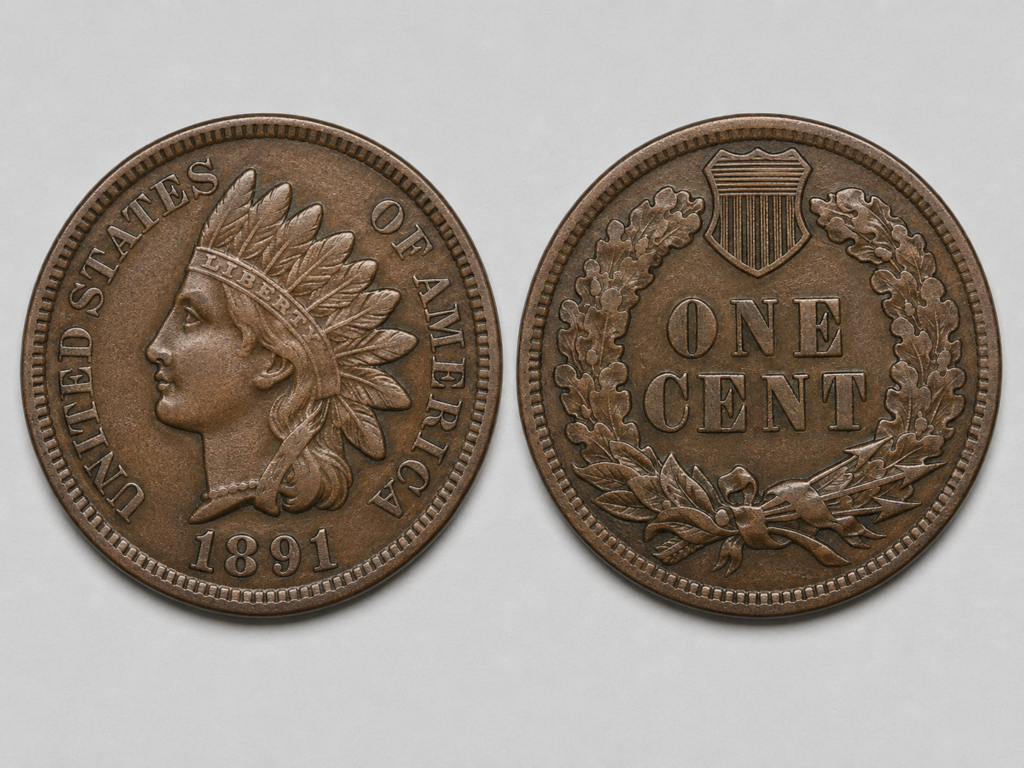
The Indian Head cent ran for fifty-one years, from 1859 to 1909. Most surviving pieces trade today in the $1 to $5 range — collector value, not metal value, because U.S. cents cannot legally be melted. A handful of dates and varieties carry real premiums: the 1877, the 1908-S and 1909-S, the 1864 L, a few overdates, and high-grade Mint State Red examples of any year.
This guide gives you the identification steps, the year-by-year chart, the key-date list, and the condition framing in one place.
The article is for informational and educational purposes only. Value ranges cited here are illustrative and pulled from PCGS Price Guide and NGC Coin Explorer at the time of writing — pricing moves, so re-quote a live source before any sale. Any Indian Head cent suspected of being the 1877, an 1864 L variety, an overdate, a mintmarked S issue, or a top-grade Mint State Red example should be professionally authenticated by PCGS or NGC before sale.
What is an Indian Head penny worth today?
Most circulated Indian Head cents from the common-date years — the 1880s, 1890s, and the early 1900s — trade in the $1 to $5 range in Good through Fine condition. The 1877 sits in the hundreds in Good and climbs into the thousands in Fine and above.
The 1908-S and 1909-S sit in the low to mid hundreds across circulated grades. The 1864 L variety carries a meaningful premium over the 1864 No L from the same year. Mint State Red examples of common dates jump into the low to mid three figures, and the very highest grades reach the four figures.
There is no metal value floor on an Indian Head cent. Melting U.S. cents has been illegal since 31 CFR 82.1 took effect in December 2006, which means an Indian Head cent’s value is collector value from the first dollar to the last. The melt value framework that applies to silver and gold coins does not apply here.
The chart below shows the year-by-year ranges; the identification steps that follow explain what a coin in your hand actually is.
Is it really an Indian Head cent? Identification before valuation
The obverse shows a Liberty bust facing left, wearing a feathered headdress with the word LIBERTY on the headband. Despite the name, the figure is Liberty in a Native American-style headdress — not a portrait of a Native American. The date sits below the bust.
The reverse shows either a laurel wreath (1859 only) or an oak wreath with a shield at the top and a small bundle of arrows at the bottom (1860 through 1909). Diameter is 19 millimeters, the same as the Lincoln cent and the wheat cent that followed.
Weight is 4.67 grams for the 1859 through early-1864 copper-nickel coins, and 3.11 grams for the mid-1864 through 1909 bronze coins. A kitchen scale that reads to 0.1 grams resolves the difference. The most common identification mistake is a heavily worn or corroded Lincoln cent assumed to be older than it is.
If your coin’s reverse shows two wheat ears flanking the words ONE CENT, you are holding a wheat cent (1909 through 1958) — see the wheat penny value guide. If the reverse shows the Lincoln Memorial building, you are holding a 1959-or-later Lincoln cent.
The wreath-and-shield reverse with no wheat ears and no building is the Indian Head cent. Indian Head cents contain no silver — see the silver coin identification reference if that was your starting question.
How to read the date and mintmark
The date is on the obverse below the bust. The mintmark — on the reverse, in the small space below the wreath bow — is either absent (Philadelphia, every year from 1859 through 1909) or S (San Francisco, only 1908 and 1909). No other mint struck Indian Head cents.
Two specific traps are worth heading off. First: the only legitimate mintmarked Indian Head cents are the 1908-S and 1909-S. Any other date with what looks like an S below the wreath is almost always debris, corrosion, or an alteration. There is no 1877-S or 1869-S, despite occasional auction-site optimism.
Second: a worn date is the single most common reason a key-date suspicion turns out wrong. Late nineteenth-century cents in Good or About Good often have a partial date that reads as 1877 but is actually 1879, 1872, or 1878.
A coin you suspect is an 1877 should be confirmed by date diagnostics and the LIBERTY headband detail, then sent to PCGS or NGC for authentication if value is on the line.
The three Indian Head types and what they tell you about the coin
The series ran fifty-one years and changed twice along the way. The reverse design changed after a single year, and the composition changed midway through 1864. Knowing which type your coin is tells you the alloy, the weight, and the rough rarity tier without checking the chart first.
Type 1 (1859 only): Laurel wreath reverse
The 1859 Indian Head cent is a one-year design. The reverse shows a laurel wreath around ONE CENT, without the shield that appears in every later year. Composition is 88 percent copper and 12 percent nickel — the so-called white cent — at 4.67 grams and 19 millimeters. Mintage was just over 36 million. A clean Fine 1859 trades in the low double digits; Mint State examples carry meaningful premiums because the white-cent alloy was hard on dies and well-struck survivors are uncommon.
Type 2 (1860–1864): Copper-nickel oak wreath with shield
From 1860 onward the reverse changes to an oak wreath with three arrows at the base and a shield at the top — the design that runs for the rest of the series. Composition stays at 88/12 copper-nickel through early 1864. Coins from this period read pale yellow-gold rather than copper-red and weigh noticeably more than the bronze cents that followed.
Type 2 dates are common enough that prices stay modest in circulated grades but climb at Mint State, where the white-cent alloy’s strike issues compound.
Type 3 (mid-1864–1909): Bronze oak wreath with shield
Partway through 1864, Congress switched the cent to a bronze composition — 95 percent copper, 5 percent tin and zinc — at 3.11 grams. The design stayed the same. This is the composition you almost certainly have if your coin is dated 1865 through 1909, and it is the composition the wheat cent inherited unchanged in 1909. The 1864 bronze coins introduced designer James B. Longacre’s L initial on the lower ribbon of the headdress late in the year, marking the start of the 1864 L variety.
Weight and color are the fastest way to tell a Type 2 from a Type 3 without specialist tools. A pale yellow coin weighing close to 4.7 grams is copper-nickel; a copper-red or brown coin weighing close to 3.1 grams is bronze.
Indian Head penny value chart by year and mintmark
The chart below covers every year of the series, grouped by composition. Ranges are illustrative retail values at four condition tiers — Good (G-4), Fine (F-12), Extremely Fine Red-Brown (EF-40 RB), and Mint State Red-Brown (MS-63 RB) — pulled from PCGS Price Guide and NGC Coin Explorer at the time of writing.
The S column is folded into the year column for the two dates that exist (1908-S, 1909-S); every other row is Philadelphia. Re-quote a live source for current pricing before any sale.
| Year | G-4 Good | F-12 Fine | EF-40 RB | MS-63 RB |
|---|---|---|---|---|
| Type 1 — Copper-nickel laurel wreath reverse (1859 only) | ||||
| 1859 | $14–20 | $30–45 | $90–140 | $350–500 |
| Type 2 — Copper-nickel oak wreath with shield (1860–1864) | ||||
| 1860 | $9–13 | $18–25 | $50–80 | $180–260 |
| 1861 | $25–35 | $45–65 | $100–150 | $300–450 |
| 1862 | $7–10 | $14–20 | $35–55 | $130–180 |
| 1863 | $7–10 | $14–20 | $35–55 | $130–180 |
| 1864 (CN) | $14–20 | $25–40 | $60–90 | $200–300 |
| Type 3 — Bronze oak wreath with shield (mid-1864 through 1909) | ||||
| 1864 No L | $9–13 | $18–25 | $50–75 | $130–200 |
| 1864 L | $50–75 | $110–150 | $250–350 | $600–900 |
| 1865 | $9–13 | $18–25 | $50–75 | $130–180 |
| 1866 | $50–70 | $90–130 | $200–280 | $400–600 |
| 1867 | $55–75 | $95–135 | $210–290 | $450–650 |
| 1868 | $40–55 | $75–100 | $160–220 | $380–550 |
| 1869 | $80–110 | $230–310 | $475–700 | $1,000–1,500 |
| 1870 | $70–95 | $200–275 | $410–585 | $850–1,200 |
| 1871 | $90–120 | $260–360 | $500–700 | $1,000–1,500 |
| 1872 | $115–155 | $325–435 | $625–825 | $1,300–1,800 |
| 1873 | $25–35 | $50–70 | $130–185 | $325–475 |
| 1874 | $20–28 | $40–55 | $100–140 | $300–425 |
| 1875 | $20–28 | $40–55 | $110–150 | $325–450 |
| 1876 | $30–42 | $70–95 | $175–250 | $450–650 |
| 1877 | $700–950 | $1,500–2,000 | $3,000–4,000 | $7,000–9,500 |
| 1878 | $30–42 | $70–95 | $175–240 | $450–625 |
| 1879 | $9–13 | $25–35 | $60–85 | $180–260 |
| 1880 | $4–6 | $9–13 | $30–45 | $130–185 |
| 1881 | $4–6 | $9–13 | $30–45 | $120–170 |
| 1882 | $4–6 | $9–13 | $30–45 | $120–170 |
| 1883 | $3–5 | $8–12 | $25–40 | $110–160 |
| 1884 | $5–8 | $13–18 | $40–60 | $140–200 |
| 1885 | $9–13 | $25–35 | $75–110 | $200–285 |
| 1886 | $6–9 | $20–30 | $90–130 | $275–385 |
| 1887 | $3–5 | $6–10 | $25–40 | $110–160 |
| 1888 | $3–5 | $7–10 | $25–40 | $115–165 |
| 1889 | $2–4 | $5–8 | $20–30 | $100–140 |
| 1890 | $2–4 | $5–8 | $20–30 | $100–140 |
| 1891 | $2–4 | $5–8 | $20–30 | $100–140 |
| 1892 | $2–4 | $5–8 | $20–30 | $100–140 |
| 1893 | $2–4 | $5–8 | $20–30 | $100–140 |
| 1894 | $9–13 | $20–30 | $60–90 | $180–260 |
| 1895 | $2–4 | $5–8 | $18–28 | $95–135 |
| 1896 | $2–4 | $5–8 | $18–28 | $95–135 |
| 1897 | $2–4 | $5–8 | $18–28 | $95–135 |
| 1898 | $2–4 | $5–8 | $18–28 | $95–135 |
| 1899 | $2–4 | $5–8 | $18–28 | $90–130 |
| 1900 | $2–4 | $4–7 | $15–25 | $80–115 |
| 1901 | $2–4 | $4–7 | $15–25 | $80–115 |
| 1902 | $2–4 | $4–7 | $15–25 | $80–115 |
| 1903 | $2–4 | $4–7 | $15–25 | $80–115 |
| 1904 | $2–4 | $4–7 | $15–25 | $80–115 |
| 1905 | $2–4 | $4–7 | $15–25 | $80–115 |
| 1906 | $2–4 | $4–7 | $15–25 | $80–115 |
| 1907 | $2–4 | $4–7 | $15–25 | $80–115 |
| 1908 (Phila.) | $2–4 | $4–7 | $15–25 | $80–115 |
| 1908-S | $110–160 | $175–250 | $300–425 | $475–650 |
| 1909 (Phila.) | $14–20 | $25–35 | $55–80 | $130–180 |
| 1909-S | $475–650 | $750–1,000 | $1,200–1,600 | $1,800–2,400 |
Last updated: June 2026. Cross-checked against PCGS Price Guide and NGC Coin Explorer at publication.
Philadelphia struck every year of the series, almost all common-date arrivals are Philadelphia (no mintmark), and the famous Indian Head dates are mostly Philadelphia — the 1877 is Philadelphia; the overdates are Philadelphia.
The US Mint at San Francisco struck only the 1908-S and 1909-S, the only two S-mint Indian Head cents in existence, and both are scarce in any grade. The series ended in 1909 when the Lincoln cent replaced it at the centennial of Lincoln’s birth — the first U.S. circulating coin to depict a real person.
Key dates and varieties worth a closer look
A handful of Indian Head dates and varieties drive almost all of the meaningful value in the series. Any coin you suspect of being a key date, an overdate, or a high-grade Mint State Red example belongs in front of a PCGS or NGC grader before sale — altered dates (1879 or 1872 reworked to read 1877), reworked mintmarks, and problem coins are common enough that slabbed pieces routinely sell at two to four times raw prices in this series. The list below is the working set.
1877
The king of the series. Mintage 852,500, the lowest of any regular-issue date. Worth several hundred dollars in Good, into the low thousands in Fine, and into the five figures at Mint State Red. The 1877 is the date every Indian Head set is anchored around; counterfeits and altered dates are routine.
1909-S
The final-year San Francisco issue, mintage 309,000 — lower than the 1877 mintage by a factor of three, but with better survival because collectors of the era saw the end of the series coming and saved examples. Worth several hundred dollars in Good and well into the four figures at Mint State Red. Not to be confused with the 1909-S VDB Lincoln cent, which is a different coin in a different series.
1908-S
The first-year San Francisco issue, mintage 1,115,000. Worth roughly $100 in Good and into the four figures at Mint State Red. The 1908-S and 1909-S are the only two mintmarked Indian Head cents in the series.
1864 L
The variety introduced late in 1864 when designer James B. Longacre’s L initial was added to the lower ribbon of the headdress. Carries a meaningful premium over the 1864 No L from the same year; the call requires a clear look at the ribbon detail and is best confirmed by PCGS or NGC.
1869 and 1869/9
1869 is a semi-key in its own right at a mintage of 6.4 million with low survival; the recut-date variety (formerly cataloged as 1869/8, now understood as 9-over-9) carries an additional premium when authenticated.
1888/7 overdate
An 8 punched over a 7 in the last digit of the 1888. Rare and routinely counterfeited; PCGS or NGC attribution is the standard.
1872
A quiet semi-key — mintage 4.04 million, low survival relative to mintage. Carries a meaningful premium across all circulated grades and is one of the harder common-name dates to find problem-free.
High-grade Mint State Red, any date
Indian Head cents struck poorly throughout the series and full Red survival is uncommon. A common-date piece in MS-65 RD can carry a three-figure premium over its MS-63 RB price; the gap widens fast at MS-66 RD and above.
How color tier and condition drive value
Two condition multipliers move Indian Head cent value most: color tier and the Sheldon grade. Color tier is unique to copper coinage. Red (RD) means full original mint red color, vanishingly rare on Indian Head cents because the bronze composition patinates over time. Red-Brown (RB) means partial red and partial brown patina. Brown (BN) means fully patinated to brown.
Most circulated Indian Head cents arrive Brown; almost no inherited heirloom piece is Red. The color premium widens fast at high grades — at MS-65 a common-date RD Indian Head can be five to ten times the BN price.
Sheldon grade runs from G-4 (Good, full date and rim visible but heavy wear) through AU-58 (about uncirculated, traces of wear on the highest points only) for circulated coins, and from MS-60 through MS-70 for Mint State. Most inherited Indian Head cents cluster in G-4 through F-12 — that is the realistic range and it is the right range to expect.
Mint State Red examples of any pre-1900 date are scarce and reward professional grading by PCGS or NGC. Grade and color can drive 10× to 50× value swings on common dates and 100× swings on key dates; get a coin in front of a grading service before sale on anything that looks Mint State Red or might be a key date.
Track every Indian Head cent in Gold Silver Ledger
An Indian Head accumulation is bimodal. Most pieces are common-date Philadelphia cents worth $1 to $5, and one or two pieces — an 1877, a 1908-S, a 1909-S, an 1864 L, a confirmed overdate, a Mint State Red common-date — can be worth more than the rest of the pile combined. The job of a tracker is to keep that bimodal pile readable so the keys do not get filed away with the filler.
Gold Silver Ledger logs each Indian Head cent as its own line. The purchase date and what you paid come from the transaction you record at buy time, and three label fields on each item are yours to fill in: a year tag, a nickname, and a search-indexed reference tag.
The mintmark, the variety (1864 L, 1888/7, 1869/9 if applicable), the color tier, the Sheldon grade, and the certification number all go in the reference label in whatever shorthand works for you — a typical entry reads something like “1864 L — RB MS-63 — PCGS 12345678,” and search across the Holdings view pulls every 1877 candidate, every L variety, or every Red-tier coin to the front in one query. The portfolio total updates as you add pieces.
The step-by-step guide to inventorying a coin or bullion collection walks through the capture for a multi-date set.
When and how to sell an Indian Head cent
There are four paths and they get used in different combinations depending on the pile.
Sell the common-date bulk to a local coin dealer or by the lot on eBay
Fastest, lowest unit price, typical realization $1 to $3 per common-date piece in Good through Fine. Appropriate for the ninety percent of an estate accumulation that is common-date filler with no key dates or varieties hiding in it.
Sell individual semi-keys
An 1872, an 1864 L, a higher-grade common date — to a dealer at roughly sixty to eighty percent of PCGS Price Guide retail raw, or seventy to ninety percent slabbed. The slabbed gross is meaningfully higher because the authentication transfers buyer risk.
Sell key dates
An 1877, a 1908-S, a 1909-S, a confirmed overdate, anything Mint State Red — on eBay or another auction marketplace after PCGS or NGC slabbing. Gross is higher than dealer raw; fees and authentication friction reduce net, but the math usually still favors the slabbed sale on a key date.
Consign the very best pieces
An 1877 in Mint State, a 1909-S in Mint State Red, top-pop varieties — to Heritage or Stack’s Bowers for maximum price discovery. Slow, but the right call for the headline rarities. The broader sale framework lives in the guide to how to sell gold or silver; the dealer / online marketplace / auction house structure applies to Indian Head cents even though they are not precious metal.
Anything suspected of being a key date, an overdate, or Mint State Red goes to PCGS or NGC before sale — the Indian Head market is dense with counterfeits and altered coins, and slabbed pieces routinely sell at multiples of raw prices.
Frequently asked questions
What is an Indian Head penny worth today?
Most circulated Indian Head cents trade for $1 to $5 in Good through Fine condition; the key dates (1877, 1908-S, 1909-S) and major varieties (1864 L, 1888/7 and 1869/9 overdates) climb into the hundreds in Good and the thousands at Mint State. Color tier and Sheldon grade drive the spread, and Mint State Red examples of any date carry premiums over the same date in Brown.
What is the rarest Indian Head penny?
The 1877 is the rarest Indian Head cent of the regular issues by surviving population, despite the 1909-S having a lower mintage figure — the 1877 was struck without collector saving in mind, and most pieces went into circulation and stayed there. The 1909-S has the second-lowest survival count and trades alongside the 1877 in the key-date tier; the 1864 L, 1872, 1869, and the overdates round out the upper rarities.
How can I tell if my Indian Head penny is a 1908-S or 1909-S?
A 1908-S or 1909-S Indian Head cent shows a small S mintmark on the reverse, in the open space below the wreath bow. The mintmark is small and faint on heavily worn coins; if the area below the wreath is smooth with no letter visible, the coin is a Philadelphia piece (no mintmark). The S only exists on the 1908 and 1909 dates — no other Indian Head year has an S mintmark, so any other suspected S issue is misread or altered.
What is the difference between an 1864 L and an 1864 No L?
The 1864 L has a tiny L initial — for designer James B. Longacre — on the lower ribbon of the headdress; the 1864 No L does not. Both are bronze 1864 cents from the second half of the year (the early-1864 copper-nickel coins are a separate variant); the L variety was added late in 1864 once Longacre’s initial was approved for the die. The L carries a meaningful premium across all grades and is best confirmed by PCGS or NGC because the L is small and frequently obscured by wear.
Is an Indian Head penny made of silver?
No, Indian Head cents are either copper-nickel (1859 through early 1864) or bronze (mid-1864 through 1909), with no silver content at any point in the series. The earlier copper-nickel coins read pale yellow and are sometimes mistaken for a precious metal alloy on first inspection, but the alloy is 88 percent copper and 12 percent nickel.
How much is an 1877 Indian Head penny worth?
An authenticated 1877 Indian Head cent in Good condition trades for several hundred dollars at retail, climbs into the low thousands in Fine, and reaches the high four figures and into the five figures at Mint State Red. The 1877 is the most-counterfeited and most-altered date in the series; coins offered for sale should be slabbed by PCGS or NGC, and an unauthenticated 1877 should be treated as altered until proven otherwise.
Why are some Indian Head pennies yellow and some copper-colored?
Indian Head cents from 1859 through early 1864 were struck in an 88 percent copper, 12 percent nickel alloy that reads pale yellow-gold; from mid-1864 through 1909 they were struck in a 95 percent copper, 5 percent tin and zinc bronze that reads copper-red when new and patinates to brown over time. The composition change happened partway through 1864, so 1864 dates exist in both alloys and are distinguished by weight (4.67 grams copper-nickel, 3.11 grams bronze) and color.
Should I clean an Indian Head penny before selling it?
No, cleaning an Indian Head cent damages the surface and reduces resale value, often substantially, because grading services label cleaned coins with a “details” grade that trades at a steep discount to a problem-free coin in the same wear tier. Brown patina is the normal and expected surface for a hundred-plus-year-old copper coin; a too-bright or unnaturally shiny Indian Head cent is a warning sign, not a feature. Leave the surface alone and let the buyer assess the coin as it is.
This article is for informational and educational purposes only and does not constitute investment, sale, or numismatic advice. Value ranges in the chart are illustrative; cross-check against PCGS Price Guide and NGC Coin Explorer before any sale. Any suspected key date, overdate variety, or top-grade Mint State Red example should be professionally authenticated by PCGS or NGC.
