
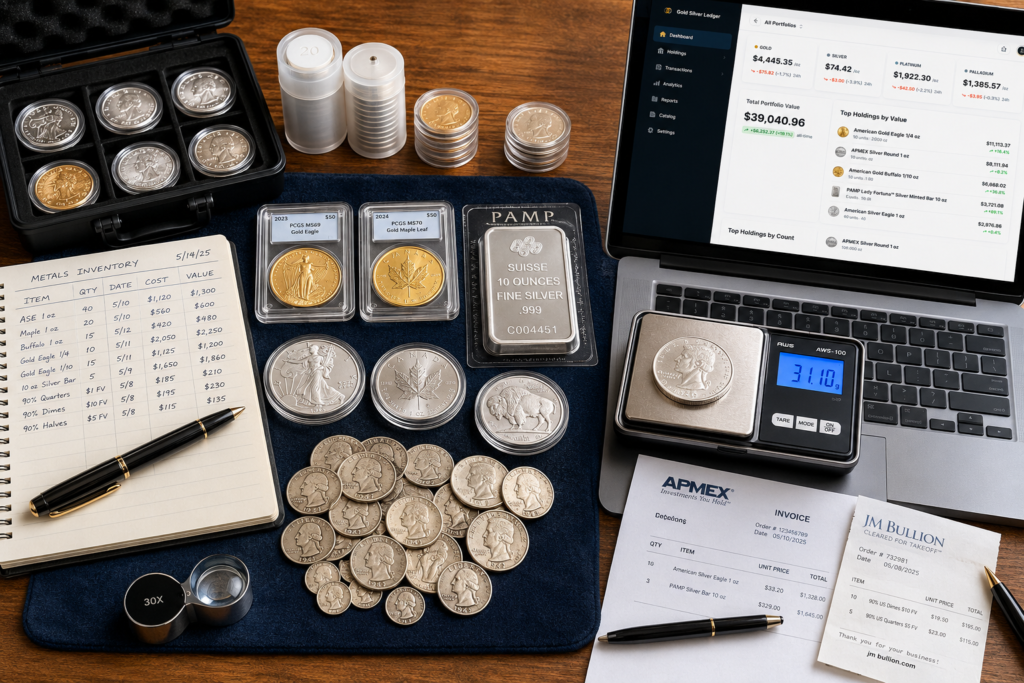
Most investors do not start with an inventory. The holdings live in tubes, capsules, dealer envelopes, and a safe deposit box, and the closest thing to a record is a folder of emailed receipts. Then a sale comes up, or an insurance call, or a question from a spouse, and the absence of a per-piece list becomes the problem.
This guide is a working process for how to inventory a coin collection — an evening or two to sort, identify, weigh, photograph, and record what is on the table, plus a cadence for keeping it current after. For the conceptual case, see the broader portfolio-tracking guide; this article is the hands-on companion.
What “inventorying a collection” actually produces
Inventorying a coin or bullion collection means producing a per-piece record that captures what each item is, what you paid for it, when you bought it, and a way to identify it later, so the collection is traceable for resale, taxes, insurance, and inheritance. The output is a list — one row per physical piece — not a single total.
That distinction matters. A count tells you how many ounces of silver you own; an inventory tells you which exact coins make up that count and what the cost on each one was.
A valuation tells you what your holdings are worth today; an inventory is the record the valuation runs against. Grading is something else again — a separate numismatic activity that this article notes but does not cover. The job here is to build the per-piece list.
What you’ll need before you start
Two short setups: the physical workspace and the reference materials. Neither needs to be elaborate. The point is to have everything in arm’s reach so the actual cataloging is not interrupted by a trip to look up a spec or hunt for a receipt.
Physical workspace
A flat, well-lit surface — kitchen table, dining table, or a desk works. A soft cloth or microfiber towel protects coin surfaces, especially for collectible pieces. A jeweler’s scale with 0.01 g resolution is what you want; a kitchen scale will not resolve the fractions that matter. A phone camera is fine for photos as long as the light is good. Cotton gloves are sensible for numismatic pieces and skippable for generic bullion.
- Soft work surface: A microfiber cloth or a clean towel.
- Jeweler’s scale: 0.01 g resolution.
- Phone or camera: With decent light.
- Magnifier or 10x loupe: For mintmarks and condition checks (optional).
- Cotton gloves: For numismatic pieces (optional).
- Plastic flips or staging trays: For working through one product at a time.
Reference materials
Pull the receipts and the lookup sources you’ll need in one pass so you’re not switching tabs every other coin. Dealer order confirmations and invoices are the cost-basis source for everything you have records on. For backdated entries with missing receipts, a historical spot price reference (Kitco’s historical chart, BullionByPost) lets you reconstruct the spot that applied on the purchase date.
A coin identification reference — the U.S. Mint’s product pages, sovereign mint pages, or a Red Book for collectible coins — answers any “what is this exactly” question.
- Dealer receipts: Invoices and order confirmations.
- Historical spot reference: For any backdated entries.
- Coin identification reference: Mint sites, Red Book, or a numismatic database.
- Weight and ASW tables: For your coins — see the precious metals conversion chart.
Step 1: Sort and stage the physical pile
Before any data entry, sort the metals into lanes. The pile gets converted from “a heap” into “groups you can work through one product at a time,” which is what makes the cataloging fast.
Two passes. First pass: by metal — gold here, silver there, platinum and palladium if you have them, and a separate corner for pieces you are not yet sure about.
Second pass within each metal: by form — coins, rounds, bars, junk silver — and then loosely by product within each form. Junk silver gets its own lane regardless of metal because the entry process for it works differently from the rest.
This step is mostly physical. It does not need notes yet. The goal is to set yourself up so the next several steps run cleanly through one product at a time.
Step 2: Identify each piece
Now name what each item IS. Three identification flavors show up in a typical inventory, and each one is captured slightly differently. The point is a clean answer for every coin and bar in front of you, not a numismatic education.
Bullion coins, bars, and rounds
For standard bullion — American Silver Eagles, Canadian Maples, PAMP Suisse bars, generic 1 oz rounds — identification is mostly product-name pattern matching against the mint or refiner’s catalog page. The product determines weight, fine weight, and purity by spec. You don’t measure or guess these for a known product; you copy them from the published specification.
- Product name: American Gold Eagle 1 oz, PAMP Suisse 10 oz silver bar, generic 1 oz silver round.
- Metal: Gold, silver, platinum, or palladium.
- Form: Coin, bar, or round.
- Weight: In troy ounces, the global precious-metals convention.
- Purity: .9999, .999, .9167, or .90.
Numismatic and semi-numismatic coins
For collectible coins — Morgan dollars, Walking Liberty halves, Buffalo nickels — mint year and mintmark matter alongside the product. Mintmark placement varies by series: Morgan dollars carry it on the reverse below the wreath, Walking Liberty halves on the obverse below the motto for pre-1917 pieces and on the reverse for 1917 onward. Condition is its own field; for inventory purposes, a rough note is enough. A full grade is a separate exercise.
- Series and denomination: Morgan dollar, Walking Liberty half, Buffalo nickel.
- Mint year: The year stamped on the coin.
- Mintmark: P, D, S, CC, O, or none.
- Rough condition: Circulated, AU, or BU — a note, not a graded number.
Junk silver
For pre-1965 U.S. silver coinage — dimes, quarters, halves — the unit of inventory is usually face value rather than the individual coin. Standard ASW multipliers convert face value into silver content: 90% coinage runs at roughly 0.715 troy ounces of silver per dollar of face. The data point you record per junk-silver lot is the face value, the denomination mix inside the lot, and the multiplier — not a per-coin weight. See the junk silver guide for the full breakdown.
- Denomination mix: Dimes, quarters, or halves (or a mix).
- Total face value: e.g., $5.00 in 90% dimes.
- Silver content multiplier: 0.715 troy oz ASW per $1 face for 90% coinage.
Step 3: Weigh and verify
For known bullion, weight is a verification step rather than a data-collection step. Put each piece on the scale and confirm it matches the published spec. A 1 oz American Gold Eagle weighs 33.93 g gross — Eagles are 22 karat, alloyed with copper and silver, so the gross weight is higher than the fine weight even though the coin contains exactly one troy ounce (31.10 g) of pure gold.
A 1 oz Canadian Gold Maple, by contrast, weighs 31.10 g exactly, because Maples are .9999 pure with no alloy.
If the scale and the spec disagree by more than a small margin, that is a flag worth investigating before the entry goes into the inventory. For unknown bars and rounds — generic refiner pieces, older privately-minted rounds — the scale becomes the primary source. Record what the scale says and trust it.
Step 4: Photograph for the record
One photo per piece, or one representative photo per group for fungible bullion. Obverse and reverse for numismatic coins. A single shot is enough for a tube of identical Silver Eagles, since the whole tube is the unit you are documenting.
Keep the setup simple: good light, a neutral background, no flash glare on the coin face. Include a sense of scale on at least one shot per session — a ruler in frame works. The photos serve three purposes: insurance documentation if you ever need to file a claim, sale-listing reference if you ever decide to sell privately, and a visual backup when a serial number is not readable from the inventory list itself. Insurance carriers will ask for them; see the insurance guide for what specifically to provide.
Step 5: Record the per-piece data
Now the data structure. Three subsections — product identity, purchase context and cost components, and personal identifiers. The field names below match exactly what the Gold Silver Ledger purchase form captures, which is one way to know the list is real.
Product identity
Fields that describe what the piece IS — copied straight from Step 2.
- Product name
- Metal: Gold, silver, platinum, or palladium
- Form: Coin, bar, round, or junk.
- Weight in troy ounces.
- Fine weight
- Purity
Purchase context and cost components
Fields from the receipt. The single most common mistake on a hand-built inventory is recording only the total amount paid — “$2,510” — without separating the spot price from the premium. The split matters: spot moves continuously, but the premium you paid is a fixed dollar number on a specific day. For backdated entries, the spot to record is the historical spot on the purchase date, not today’s spot.
- Purchase date.
- Dealer or source.
- Transaction or order reference.
- Spot price at the moment of purchase, in USD per troy ounce.
- Premium-over-spot per unit, in dollars — not a percentage.
- Shipping and handling, allocated to this purchase.
Personal identifiers
The hooks that make a row findable in six months. Three label types: a personal name for the piece, a short identifier or code, and a piece-specific date that is not the purchase date. None of these are required for cost basis, but a few of them turn a wall of rows into something you can navigate.
- Nickname: “Grandma’s Eagle,” “birthday coin.”
- Reference: a serial number, a certification ID, a personal SKU, or a dealer order number.
- Mint year annotation: the year stamped on the coin, because catalog entries are year-agnostic by design.
Step 6: Reconstruct cost basis when receipts are missing
Most people have receipts for some purchases and not others, especially for pieces bought years ago, inherited, or acquired at a coin show in cash. Missing receipts are not a reason to skip the row — the IRS allows reasonable reconstruction based on contemporaneous evidence, and a documented reconstruction is better than a blank cost basis on the day of a sale. See the full cost-basis guide for the deeper treatment.
Three practical fallbacks, in rough order of strength:
- Cross-reference bank or credit card statements against the purchase date to pin down the exact dollar amount paid, then back into spot and premium from the recorded price.
- Look up historical spot for the purchase date and add a reasonable premium estimate for that product and that year, documenting both the source for spot and the basis for the premium estimate.
- For inherited pieces, cost basis steps to the fair market value on the date of death — record FMV and the source you used, not the original purchase price. See the inherited collection guide for the full treatment.
Step 7: Add labels and notes for findability
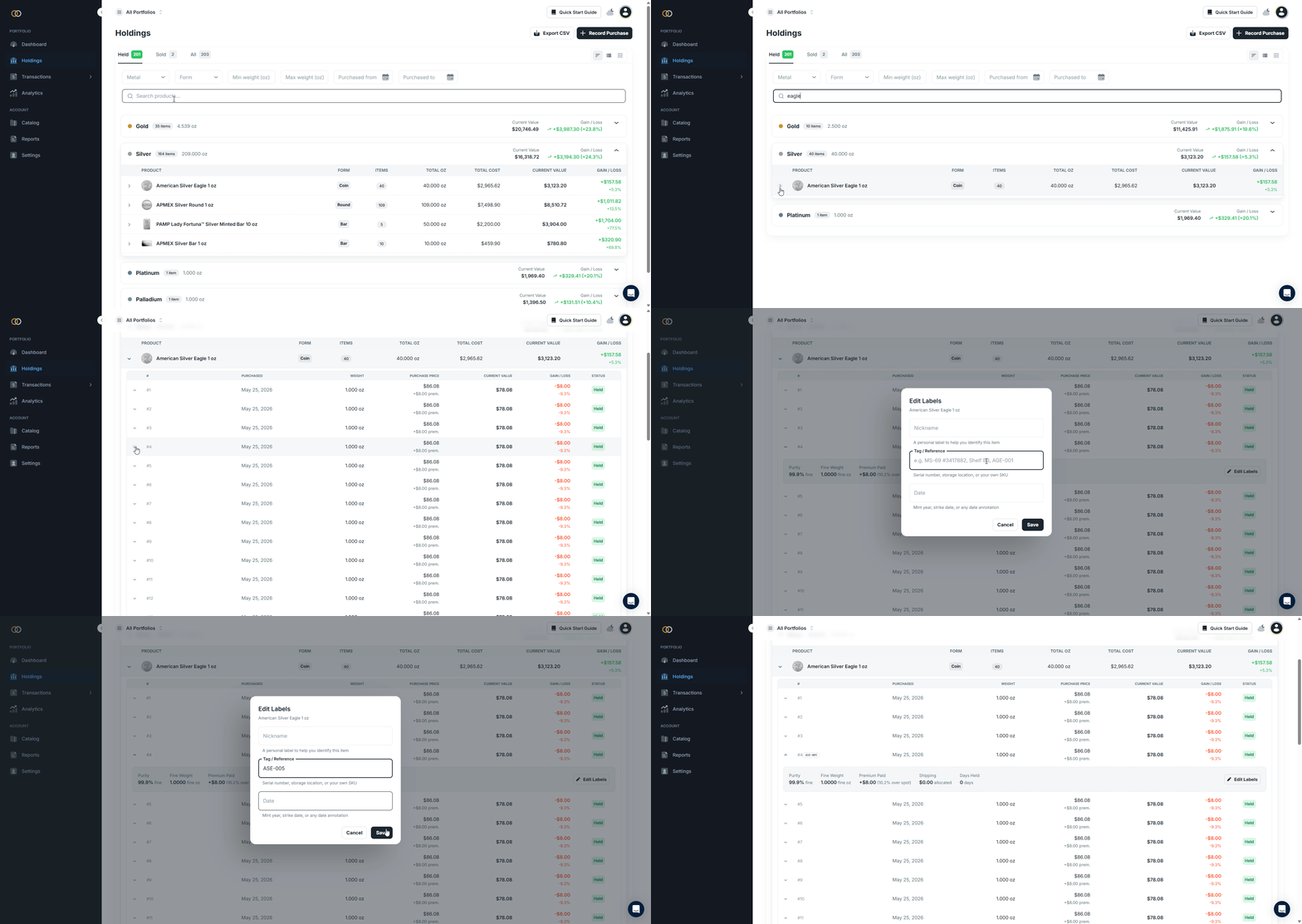
With the data captured, do a quick pass over the labels. Three short label types are worth knowing because they map directly to the three label fields on every item in Gold Silver Ledger and to the equivalent columns in any spreadsheet built to the same pattern.
Nicknames
A nickname is a personal label that travels with one specific piece. Provenance is the most durable pattern — “Grandma’s coin,” “first APMEX order,” “1995 birthday gift.” Physical descriptors work for pieces you might need to pick out of several that look alike: “ding on rim,” “spot on Liberty’s cheek.”
The pattern that does not hold up is generic — “the nice one,” “favorite” — because in six months you will not remember which one was nice. Set nicknames sparingly; the field is most useful when only the pieces that genuinely deserve a name carry one.
References
A reference is a short identifier you can repeat across multiple pieces or that uniquely identifies one. A graded coin’s certification ID, a bar’s LBMA serial number, a personal SKU you’ve set up, or a dealer order number all work. Used consistently, a reference becomes a free-text index: type the code into search and the matching pieces surface in one filter.
Pick one format per category and stick to it — mixing “MS-67” with “Mint State 67” defeats the index because search treats them as two different strings.
Mint year annotation
A free-text date that lives on the item itself — most commonly the mint year for numismatic and semi-numismatic pieces. This field exists separately from the purchase date because a coin has its own date independent of when you got it. A 2019 American Gold Eagle and a 2025 American Gold Eagle share one catalog entry, but the year on your specific coin matters for resale and date-matching to the receipt.
Use a tight, consistent format: “2008,” “1924.” One thing to know if you keep your inventory in Gold Silver Ledger: the Holdings search bar does not index this field. If you want a year to be searchable, put it in the Reference field as well.
Where the inventory lives — spreadsheet vs. purpose-built tracker
The work in Steps 1 through 7 produces a list of rows and fields. That list has to live somewhere. A spreadsheet is the obvious default; a purpose-built tracker handles the parts a spreadsheet struggles with. Below is a practical mapping; for the full structural comparison, see the broader portfolio-tracking guide.
When a spreadsheet is enough
Small inventories — under roughly thirty pieces — all bullion (no numismatic specifics), with no immediate plans to sell or report. A spreadsheet built around the field list from Step 5 is fine for this. A small, disciplined spreadsheet beats no inventory every time.
The structural limits show up later. Spot prices don’t refresh, so the current-value column drifts. Premium splits get buried inside totals once a row has more than a couple of edits. Specific Identification on sales becomes manual matching that gets harder every year. Multi-currency math creeps in if you ever buy in one currency and live in another.
What Gold Silver Ledger adds
Gold Silver Ledger maps directly to the steps above. The portfolio selector and the metal and form filters on the Holdings page cover the sorting from Step 1. The Record Purchase form covers Steps 2 through 5: a product picker for built-in catalog or custom items, a quantity that produces one inventory item per physical piece, a per-unit premium-over-spot field in dollars, a spot-at-purchase field that auto-fills with live spot and is overrideable for backdated entries, a dealer dropdown, and a purchase date.
The three label fields on every item — Nickname, Reference, and a mint-year annotation — cover Step 7 exactly.
The Holdings page renders the finished inventory in three views: a group view organized by metal and product, an item view that is a flat sortable product list, and a card view that lays out one card per physical piece with the product thumbnail.
Search across the page matches product names, nicknames, and references, so a reference scheme built during Step 7 turns into a usable index.
Step 8: Keep the inventory current
A working inventory is one you update as the holdingschanges. Four cadences keep it that way. Record every new purchase the day it arrives, while the receipt is still in hand and the spot price is still close to the buy.
Record every sale by specific identification — pick the exact pieces sold rather than averaging the cost — because both the realized gain and the holding-period treatment depend on which specific coins are left.
Run a short audit once a quarter: open the Holdings page, scan the count against the physical units, and fix anything the eye catches. At year-end, export the full history for tax records and pull the annual report — that is the point at which short-term and long-term sales separate and the capital-gains treatment is calculated.
The difference between an inventory that is done once and an inventory that stays accurate is mostly this last step.
Frequently asked questions
How do I start a coin inventory from scratch?
Start a coin inventory from scratch by sorting the physical pile into lanes by metal and form, then working through one product at a time — identify, weigh, photograph, and record per-piece data including product, purchase date, dealer, spot at purchase, premium paid, and a personal identifier. An evening or two of focused work is usually enough for a collectionof fifty to a hundred pieces.
What should I record for every coin or bar?
Record the product (name, weight, purity, form), the purchase date, the dealer or source, the spot price that applied at the moment of purchase, the premium paid above spot in dollars, any allocated shipping, and a personal identifier — a nickname, a serial number, or the specific mint year on the coin. One row per physical piece is the right resolution; one row per product is too coarse for Specific Identification on a future sale.
Do I need to photograph every bullion coin?
Photographing every bullion coin is not required, but at a minimum, one representative photo per tube or roll of identical pieces is worth taking, and obverse-and-reverse shots are worth taking for each numismatic piece. Photos serve three purposes: insurance documentation, sale-listing reference, and visual identification when a serial number is not readable from the inventory list. Generic bullion benefits less from per-piece photos than collectible coins do.
How do I inventory a collection I inherited?
Inventory an inherited collection by working through the same steps — sort, identify, weigh, photograph, record — but with one cost-basis difference: the basis on inherited pieces steps to the fair market value on the decedent’s date of death, not the original purchase price. Document FMV with a source: a dealer appraisal, a contemporaneous spot reference, or a written valuation. See the inherited collection guide for the full treatment.
How do I handle junk silver in an inventory?
Handle junk silver by recording it at the lot level — total face value, denomination mix, and the standard ASW multiplier (about 0.715 troy ounces of silver per dollar of face for 90% pre-1965 U.S. coinage) — rather than coin-by-coin. The melt-value calculation is face value × multiplier × current spot; the cost basis is what you paid for the lot plus any shipping allocated to it.
What’s the best app to keep a coin inventory?
The best app to keep a coin inventory is one built specifically for physical bullion and collectible coins — with item-level records, premium-over-spot tracked as its own field, locked-in historical spot on every purchase, live current value, and a sales workflow that supports Specific Identification cost basis. Gold Silver Ledger is built around those requirements. A spreadsheet works for a few holdings.
Should I record the condition or grade on bullion coins?
Recording condition is worth a short note on numismatic and semi-numismatic pieces (circulated, AU, BU) and is generally unnecessary on generic bullion. Formal grading is a separate exercise that produces a number — like MS-67 — assigned by a service such as PCGS or NGC. If you have graded coins, record the grade and the certification ID in the inventory; if you do not, a rough condition note on the collectible pieces is enough.
Build your inventory in Gold Silver Ledger
Gold Silver Ledger holds the per-piece list this article just walked through and keeps it working. Every row stays priced against current spot, every entry carries the spot price it was purchased at, and Specific Identification is built into the sales flow — so a future sale references the exact pieces you tagged when you did the inventory, not an average.
Searchable nicknames and references make a Reference column full of certification IDs or dealer order numbers behave like a real index, not a field you have to scroll.
The app is what stops the inventory from going stale the week after the weekend you spent building it.
Start your free trial on the Gold Silver Ledger pricing page.
This article is for informational and educational purposes only. It is not financial, investment, legal, or tax advice. Cost-basis reconstruction guidance for missing receipts is general; consult a qualified tax professional about complex situations, including inherited holdings and partial-lot reconstructions across multiple years.
