
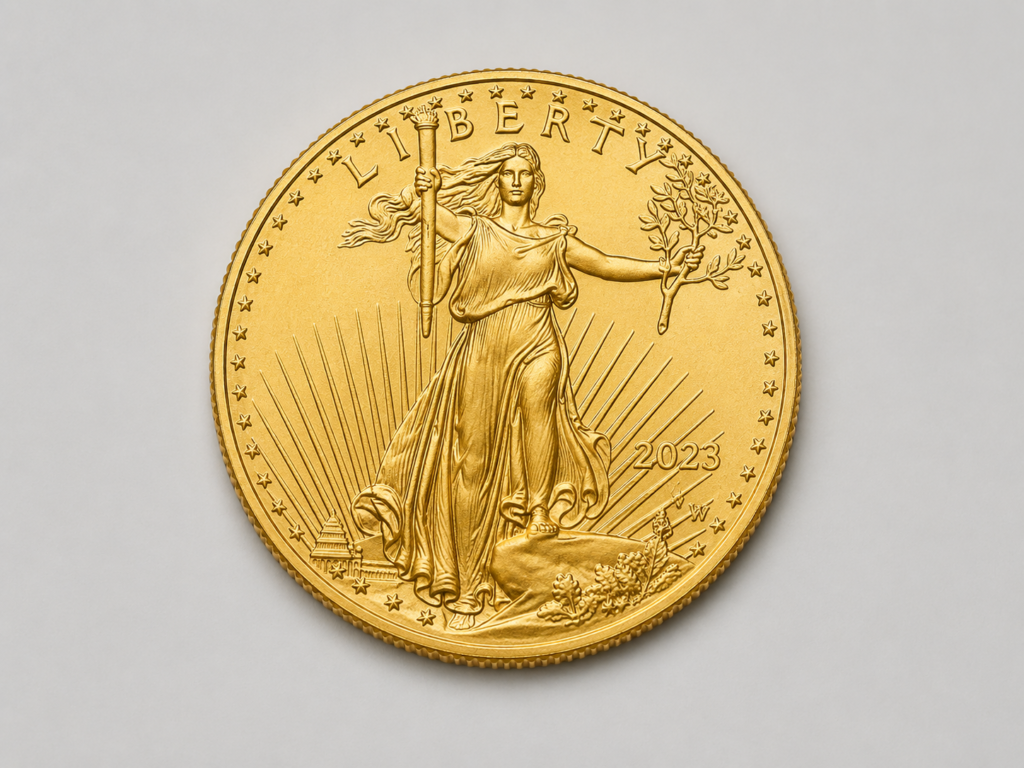
The American Gold Eagle is the official gold bullion coin of the United States. The U.S. Mint has produced it since 1986 under the Gold Bullion Coin Act of 1985. Each coin is .9167 fine (22-karat), comes in four sizes and three product variants, and is IRA-eligible by specific IRS exception.
It is the workhorse U.S. gold bullion coin and one of the most commonly held gold positions in U.S. portfolios. This guide walks every dimension a buyer needs — specifications, designs, variants, premium over spot, IRA eligibility, where to buy, and how to track what you own.
Premium figures and dealer prices move daily; the numbers in this guide are durable framing rather than current quotes. Tax treatment is informational and not professional advice. For the buying side, see how the Gold Eagle compares to the South African Krugerrand.
What is the American Gold Eagle?
The American Gold Eagle is the official gold bullion coin of the United States, produced by the U.S. Mint since 1986. Each 1 troy ounce Gold Eagle contains one troy ounce (31.103 grams) of pure gold in a .9167 fine (22-karat) alloy of 91.67% gold, 3% silver, and 5.33% copper. Gross weight is 33.93 grams, diameter is 32.7 millimeters, and the coin carries a nominal $50 face value despite trading at its gold content.
The Gold Eagle is produced in four sizes — 1 oz, 1/2 oz, 1/4 oz, 1/10 oz — and three product variants: Bullion (the standard bullion strike), Proof (the premium-priced collector strike with mirror-finish fields), and Burnished (a matte-finish limited-mintage variant sometimes labeled Uncirculated). The 1 oz Bullion strike is the workhorse U.S. gold bullion coin. All four sizes of the Bullion variant are IRA-eligible by specific IRS exception under IRC §408(m)(3).
History and the Gold Bullion Coin Act of 1985
Private gold ownership had only been legal in the United States for a decade when Congress passed the Gold Bullion Coin Act of 1985. Executive Order 6102 (1933) effectively criminalized private gold ownership; the Gold Reserve Act of 1934 cemented the prohibition; the ban stood until December 1974, when Public Law 93-373 restored private gold ownership.
The American Gold Eagle program launched in 1986 as the U.S. answer to the South African Krugerrand and the Canadian Gold Maple Leaf, which by then dominated the global gold bullion coin market.
The Gold Bullion Coin Act mandated three things. The gold had to be sourced from newly mined U.S. sources. The obverse had to use a design symbolic of liberty. The coins had to be produced in 1 oz, 1/2 oz, 1/4 oz, and 1/10 oz sizes with face values of $50, $25, $10, and $5. The U.S. Mint launched the Bullion strike in 1986; the Proof strike followed the same year; the Burnished variant launched in 2006 to mark the program’s twentieth anniversary.
The Gold Eagle now sits as the workhorse U.S. gold bullion coin. It is accepted at every major U.S. dealer and most international dealers, it is IRA-eligible by specific IRS exception, and it is one of the most commonly held gold bullion coins in U.S. portfolios. Total program production has run into the tens of millions of ounces across the four sizes and three variants.
Specifications and sizes
The Gold Eagle ships in four sizes. Gold content, purity, and alloy are identical in proportion across all four; only the gross weight, diameter, and thickness scale down. Every Bullion-strike size in the table below is IRA-eligible.
| Specification | 1 oz | 1/2 oz | 1/4 oz | 1/10 oz |
| Gold content | 1 troy oz (31.103 g) | 0.5 troy oz (15.552 g) | 0.25 troy oz (7.776 g) | 0.1 troy oz (3.110 g) |
| Purity | .9167 fine | .9167 fine | .9167 fine | .9167 fine |
| Alloy | 91.67% Au · 3% Ag · 5.33% Cu | same | same | same |
| Gross weight | 33.93 g | 16.97 g | 8.48 g | 3.39 g |
| Diameter | 32.7 mm | 27.0 mm | 22.0 mm | 16.5 mm |
| Thickness | 2.87 mm | 2.24 mm | 1.83 mm | 1.26 mm |
| Edge | Reeded | Reeded | Reeded | Reeded |
| Face value | $50 | $25 | $10 | $5 |
| First minted | 1986 | 1986 | 1986 | 1986 |
| IRA-eligible (Bullion) | Yes | Yes | Yes | Yes |
The 1 oz Gold Eagle is the highest-volume size and carries the lowest premium per gold ounce in the series. Fractional sizes carry progressively higher premiums per ounce as size decreases — U.S. Mint production cost per coin does not scale down linearly with metal content.
Designs — Saint-Gaudens and the Type 1 / Type 2 reverse
The obverse is a modern adaptation of Augustus Saint-Gaudens’ Liberty walking with torch and olive branch — the same figure used on the celebrated 1907 Saint-Gaudens $20 Double Eagle, widely regarded as the most beautiful U.S. coin design ever produced. The adaptation places Liberty striding forward against the Capitol dome, with the U.S. flag in the background and rays of sunlight extending from behind her. The legends LIBERTY and the year of strike appear on the obverse along with a number of stars that varies by year.
The reverse ran in two distinct designs across the program’s life. Type 1, in use from 1986 through mid-2021, used Miley Busiek Frost’s family of eagles in nest — a male eagle flying over a nest with a female eagle and eaglets, symbolizing the American family. Type 2, in use from mid-2021 to present, uses Jennie Norris’s profile of a bald eagle approaching with branches, a redesign commissioned for the program’s thirty-fifth anniversary. Composition, weight, and diameter did not change across the type transition.
Some collectors prefer the Type 1 reverse for its narrative depth and its association with the program’s original decades. Others prefer the cleaner Type 2 profile and the contemporary execution. From a portfolio standpoint, both types carry identical gold content, identical purity, and equivalent dealer recognition. The type designation is a collector preference, not a buying-decision factor for a pure-bullion position.
The three product variants — Bullion, Proof, and Burnished
The American Gold Eagle is produced in three product variants. All three share the same Saint-Gaudens obverse, the same gold content per size, and the same .9167 fineness. From a buying standpoint they are distinct — pricing, finish, packaging, and use case differ.
Bullion
Standard production strike with a brilliant uncirculated finish. Priced at gold spot plus a modest premium. This is the workhorse Gold Eagle — the variant you buy for pure gold exposure, the variant accepted at every major dealer at the tightest spreads, and the variant eligible for self-directed precious metals IRAs. Sold loose or in U.S. Mint tubes.
Proof
Premium collector strike with mirror-finish fields and frosted devices, struck on specially prepared planchets with multiple striking passes. Priced significantly above the Bullion strike. The premium reflects the production process and the collector demand, not gold content. Sold in U.S. Mint presentation cases with certificates of authenticity. NOT eligible for IRAs — the IRA exception applies only to Bullion strikes.
Burnished
Limited-mintage matte-finish variant, sometimes labeled Uncirculated. Priced between the Bullion and Proof strikes. Sold in U.S. Mint packaging. Like Proofs, Burnished strikes are NOT eligible for IRAs.
For a pure gold-allocation position, the Bullion strike is the buying choice — lowest premium, highest liquidity, IRA-eligible. Proof and Burnished strikes are collector products with collector premiums and should be evaluated on those terms.
Premium over spot — what you pay above the gold price
Every Gold Eagle trades at a premium above the gold spot price. The premium covers U.S. Mint production cost, dealer markup, and the brand premium the U.S. Mint commands in the domestic retail market. Premiums vary on four dimensions: size (fractional sizes carry higher premiums per ounce than the 1 oz), variant (Bullion lowest, Burnished higher, Proof highest), purchase quantity (per-coin premium typically compresses on larger orders), and market conditions.
Premiums spike during retail-shortage cycles. The 2020 COVID surge and the 2021 retail run are the recent reference points; Gold Eagle premiums widened meaningfully during both. Live premium figures move daily, so check current dealer pricing at purchase and confirm the premium against the gold spot price for that day. For a position built across many purchases, the cumulative premium spend is real money — a 5% premium versus a 7% premium compounds over a multi-year accumulation.
See our premium over spot guide for the framework and the spot price guide for the live-data layer.
IRA eligibility — the IRC §408(m)(3) exception
The American Gold Eagle is eligible for self-directed precious metals IRAs. The eligibility traces directly to U.S. tax code: IRC §408(m)(3) sets the default rule that gold held in an IRA must be at least .995 fine. The Gold Eagle is .9167 fine and would normally be excluded. The statute names the American Gold Eagle as a specific exception, so the eligibility flows from that explicit statutory language rather than from the metal-content default.
The exception applies to the Bullion strike in all four sizes (1 oz, 1/2 oz, 1/4 oz, 1/10 oz). Proof and Burnished strikes are not covered by the exception and are not eligible for IRAs. A custodian will reject a Proof or Burnished deposit. The IRA-eligibility utility is one of the structural reasons the Bullion Gold Eagle sits in so many U.S. portfolios — it is one of a small number of sub-.995 gold coins that the IRS specifically allows.
Other 1 oz gold bullion coins eligible for self-directed precious metals IRAs include the American Gold Buffalo (.9999 fine), the Canadian Gold Maple Leaf (.9999 fine), the Austrian Gold Philharmonic (.9999 fine), the Australian Gold Kangaroo (.9999 fine), and the British Gold Britannia (.9999 fine since 2013).
The Krugerrand, despite identical .9167 fineness to the Gold Eagle, is not IRA-eligible — it is not named in the statute. See our gold IRA guide for the full framework.
How and where to buy
Bullion Gold Eagles are sold at every major U.S. gold bullion dealer (APMEX, JM Bullion, Money Metals Exchange, SD Bullion, Provident Metals, Hero Bullion), at major coin dealers, and at some local coin shops. The Bullion strike is not sold direct by the U.S. Mint to the public — the Mint distributes Bullion strikes through a network of authorized purchasers who resell to the retail market. Proof and Burnished strikes are sold direct by the U.S. Mint during their release windows and on the secondary market after.
Pricing across major U.S. dealers tends to sit within a few percent of each other on a same-day basis. The premium gap between dealers is usually smaller than the per-coin premium itself, so dealer selection matters less than market timing and order size.
For a first purchase, work with an established dealer that publishes pricing transparently, has a clear shipping and insurance policy, and handles inbound authentication on returns. Place the order during U.S. market hours when the spot price is moving normally; some dealers lock pricing at order placement, others at payment confirmation, so confirm the size, variant, quantity, and all-in price before submitting.
The how to buy gold guide walks the broader buying framework.
Authentication, storage, and resale
Authentication on a Gold Eagle relies on the published specifications. Weigh the coin — 33.93 grams for the 1 oz, scaling down for fractional sizes. Measure the diameter (32.7 mm on the 1 oz) and the thickness (2.87 mm on the 1 oz). Check the reeded edge and the design execution.
The ping test produces a characteristic ring on a struck gold coin that is distinct from base metal. For higher-value purchases, an electromagnetic conductivity tester (Sigma Verifier or equivalent) adds a layer of verification. The U.S. Mint does not embed serial numbers, micro-engraving, or surface security features on the standard Bullion strike; verification is specification-based.
Storage choices include a home safe rated for fire and theft, a bank safe deposit box, a private depository (Brink’s, Loomis, Delaware Depository), or an IRA-custodian-held depository for IRA positions. Each carries tradeoffs. Home storage maximizes access and minimizes ongoing cost but exposes the position to theft and insurance gaps.
Depository storage adds an ongoing storage fee but removes the security burden. IRA-held Gold Eagles must be stored at an approved depository — home storage of IRA gold is not permitted under IRS rules.
Resale at any major U.S. dealer is straightforward. The Gold Eagle is one of the most universally recognized gold bullion coins in the U.S. retail market and trades at tight dealer bid-ask spreads. Document the sale carefully for tax purposes — U.S. capital gains on physical gold are taxed as collectibles, up to 28% on long-term gains rather than the standard 15–20% long-term capital gains rate.
Consult a qualified tax professional before filing. See the guide to selling precious metals for the full resale framework.
Frequently asked questions
What is the American Gold Eagle?
The American Gold Eagle is the official gold bullion coin of the United States, produced by the U.S. Mint since 1986. Each 1 troy ounce coin contains one full ounce of pure gold in a .9167 fine (22-karat) alloy, is produced in four sizes (1 oz, 1/2 oz, 1/4 oz, 1/10 oz) and three variants (Bullion, Proof, Burnished), and is IRA-eligible by specific IRS exception.
How much gold is in an American Gold Eagle?
A 1 troy ounce American Gold Eagle contains exactly one troy ounce (31.103 grams) of pure gold. The coin weighs 33.93 grams gross because it is alloyed at .9167 fine (22-karat) with 3% silver and 5.33% copper for durability; the alloy does not reduce the gold content. Fractional sizes (1/2 oz, 1/4 oz, 1/10 oz) contain proportionally less pure gold and weigh proportionally less gross.
Is the American Gold Eagle IRA-eligible?
Yes, the Bullion strike of the American Gold Eagle is IRA-eligible by specific exception under IRC §408(m)(3), in all four sizes (1 oz, 1/2 oz, 1/4 oz, 1/10 oz). The default IRA rule requires gold to be at least .995 fine; the Gold Eagle is .9167 fine and would normally be excluded, but the statute names it as a specific exception. Proof and Burnished strikes are not covered by the exception and are not eligible.
What is the difference between a Bullion, Proof, and Burnished Gold Eagle?
Bullion is the standard production strike priced just above gold spot — the variant you buy for pure gold exposure, and the only variant eligible for IRAs. Proof is a premium collector strike with mirror-finish fields and frosted devices, priced significantly above Bullion. Burnished is a limited-mintage matte-finish variant priced between the two. All three share the same gold content and the same Saint-Gaudens obverse.
What is the difference between a Type 1 and Type 2 American Gold Eagle?
Type 1 and Type 2 refer to the reverse design. Type 1 (1986 through mid-2021) uses Miley Busiek Frost’s family of eagles in nest. Type 2 (mid-2021 to present) uses Jennie Norris’s profile of a bald eagle approaching with branches. Composition, weight, diameter, IRA eligibility, premium, and resale are identical across the type transition — the choice is a collector preference, not a structural difference.
Why is the American Gold Eagle only .9167 fine?
The .9167 fineness (22-karat) is a durability choice, not a quality compromise. The 8.33% alloy (3% silver, 5.33% copper) hardens the coin so it resists wear better than a .9999 fine coin that handles softly. Every 1 oz Gold Eagle still contains a full troy ounce of pure gold — the alloy is added on top, which is why the coin weighs 33.93 grams gross rather than 31.103 grams.
Where is the best place to buy American Gold Eagles?
Established U.S. bullion dealers (APMEX, JM Bullion, Money Metals Exchange, SD Bullion, Provident Metals, Hero Bullion) are the standard buying venues for the Bullion strike, along with major coin dealers and reputable local coin shops. Same-day pricing across major dealers tends to fall within a few percent, so order size and timing matter more than dealer selection. Proof and Burnished strikes are sold direct by the U.S. Mint during their release windows and on the secondary market after.
How much should you pay over spot for an American Gold Eagle?
Premium varies by size, variant, quantity, and market conditions, so a single durable answer is not possible — check live dealer pricing at purchase. The Bullion strike carries the lowest premium of the three variants; 1 oz coins carry lower premium per ounce than fractional sizes; larger orders typically compress per-coin premium. Premiums widen meaningfully during retail-shortage cycles. The premium over spot guide walks the framework for calibrating expectations against the current market.
Track your American Gold Eagles in Gold Silver Ledger
A Gold Eagle position usually grows in three directions at once. Years accumulate. Sizes diversify — a 1 oz here, a 1/10 oz there. Variants enter the picture if you keep a Proof or a Burnished alongside the Bullion sleeve. After a few purchases, the question of what each coin cost above spot and where it physically lives stops fitting on a single spreadsheet line.
Gold Silver Ledger handles each size and variant as its own catalog item. You record the year, the quantity, the acquisition price, and the storage location at purchase; cost basis is locked at that moment. The Bullion sleeve assigned to your IRA custodian’s depository sits separately from the Bullion sleeve at home or in a private depository.
Current value renders against the live gold spot price continuously. Filters pull the full Gold Eagle position into one view, break it out by size, year, or storage location, or roll Eagles in with Buffaloes and Maples for a combined gold view. The Custody Statement shows holdings organized by location with collapsible per-location cards.
Analytics surfaces the premium spend across the position and the per-coin cost basis versus current value. The Tax Report excludes disposals of IRA-held Eagles from taxable totals automatically — the storage location does the work, no manual flagging.
This guide is for informational purposes and does not constitute financial, investment, or tax advice. Premium figures, spot prices, and dealer quotes move daily; verify current numbers before any purchase or sale. Consult a qualified tax professional before filing on physical-bullion disposals.
