
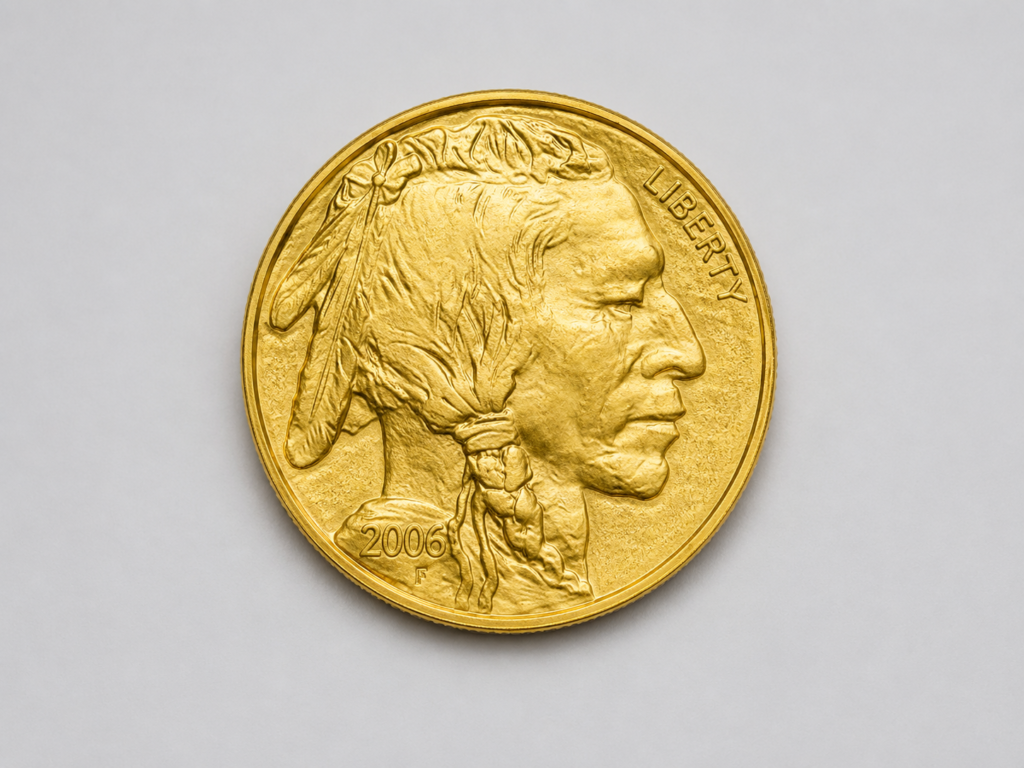
The American Gold Buffalo is the first .9999 fine 24-karat gold bullion coin produced by the United States Mint. Launched in 2006 under the Presidential $1 Coin Act, it contains one troy ounce of pure gold, carries a nominal $50 face value, and is IRA-eligible by default IRS rule — no specific statutory exception is required.
The obverse and reverse are adapted directly from James Earle Fraser’s 1913 Indian Head / Buffalo nickel, one of the most celebrated U.S. coin designs of the twentieth century. This guide walks every dimension a Buffalo buyer needs.
Premium figures and dealer prices move daily; the numbers in this guide are durable framing rather than current quotes. Tax treatment is informational and not professional advice. For the .9167 fine sister coin from the same mint, see the American Gold Eagle complete buyer’s guide.
What is the American Gold Buffalo?
The American Gold Buffalo is the first .9999 fine 24-karat gold bullion coin produced by the U.S. Mint. Each 1 troy ounce coin contains one troy ounce (31.103 grams) of pure gold, weighs 31.108 grams gross (the 0.005 gram difference is the trace alloy required for striking), measures 32.7 millimeters in diameter, and carries a nominal $50 face value despite trading at gold-content value.
The Buffalo is produced as a Bullion strike (the standard production coin) and a Proof strike (the premium collector coin). Fractional sizes (1/2 oz, 1/4 oz, 1/10 oz) shipped only in 2008 and only as collector strikes; the Mint has not produced fractional Buffalos since.
The 1 oz Bullion Buffalo is IRA-eligible under the default IRS rule for gold of .995 fineness or higher — no specific statutory exception is needed, unlike the .9167 fine American Gold Eagle.
History — the 2006 launch and 24-karat U.S. gold
The American Gold Buffalo launched in 2006, twenty years after the American Gold Eagle. Congress authorized the program in the Presidential $1 Coin Act of 2005 (Public Law 109-145) — a multi-purpose statute primarily known for the Presidential dollar coin series, which also directed the Treasury Secretary to produce a 24-karat gold bullion coin.
The Buffalo is the first .9999 fine gold coin ever produced by the U.S. Mint; the Gold Eagle is .9167 fine (22-karat) by statute and cannot be re-struck at higher purity.
The launch was timed against the global shift toward .9999 fine sovereign gold. By 2006, the Canadian Gold Maple Leaf (.9999 since 1982) and the Austrian Gold Philharmonic (.9999 since 1989) had captured most of the demand for 24-karat sovereign gold.
The U.S. Mint introduced the Buffalo to compete in that segment while continuing to produce the Gold Eagle for the 22-karat market. The Buffalo’s 2006 launch was a structural decision, not a redesign of the Eagle.
The 2008 production year is the program’s most distinctive chapter. The U.S. Mint planned a fractional-size collector series for the program’s third year (1/2 oz, 1/4 oz, 1/10 oz, all in Proof and Burnished collector strikes). Production was disrupted by the gold demand surge during the 2008 financial crisis; the Mint suspended sales mid-year, then resumed for the 1 oz Bullion strike only.
Fractional Gold Buffalos exist only from 2008 and trade as numismatic collectibles at significant premiums above their gold content; the 1 oz Bullion has been the only standard production size since.
Specifications and the .9999 fineness
The Buffalo ships in one standard production size — 1 troy ounce. The specifications below describe the Bullion strike, which is the workhorse 24-karat U.S. gold coin.
| Specification | Value |
| Gold content | 1 troy oz (31.103 g) |
| Purity | .9999 fine (24-karat) |
| Alloy | 99.99% gold, trace alloy required for striking |
| Gross weight | 31.108 g |
| Diameter | 32.7 mm |
| Thickness | 2.95 mm |
| Edge | Reeded |
| Face value | $50 USD |
| Issuing mint | U.S. Mint |
| First minted | 2006 (Bullion and Proof) |
| IRA-eligible (Bullion) | Yes — by default .995 rule |
The Buffalo’s gross weight (31.108 g) is almost identical to its pure gold content (31.103 g) because the .9999 alloy is effectively pure — the trace alloy is structural, not material to the coin’s gold content. By contrast, the .9167 fine Gold Eagle weighs 33.93 grams gross to contain the same one troy ounce of pure gold; the extra 2.8 grams is the silver-copper hardening alloy. The pure gold content per coin is identical; the difference is the surrounding alloy.
Design — the 1913 Buffalo nickel revived
The Gold Buffalo’s obverse and reverse are adapted directly from James Earle Fraser’s 1913 Type 1 Indian Head / Buffalo nickel — one of the most celebrated U.S. coin designs of the twentieth century. The obverse shows a profile of a Native American chief.
The U.S. Mint describes the figure as a composite based on Fraser’s work with several sitters; Fraser’s own accounts named different individuals at different times, and the modern attribution carries a degree of historical ambiguity.
The reverse shows an American bison standing on a raised mound — the Type 1 1913 design before the U.S. Mint modified it later in 1913 to a flat ground (Type 2) to improve the durability of the FIVE CENTS denomination. The Gold Buffalo restores the Type 1 raised-mound reverse.
The bison model is traditionally identified as Black Diamond, a resident of the New York Zoological Park (the Bronx Zoo) in the early 1900s; like the obverse, the attribution carries some historical ambiguity that Fraser’s accounts did not fully settle.
The design has not changed since the 2006 launch. The Bullion and Proof strikes share the same Fraser obverse and reverse; the difference is finish and packaging, not design. The Buffalo’s lineage gives it a distinct identity in U.S. numismatic culture — the Gold Eagle revives Saint-Gaudens’ 1907 Liberty, and the Gold Buffalo revives Fraser’s 1913 Indian Head, making the two coins the U.S. Mint’s parallel tributes to the early-twentieth-century U.S. coin design golden age.
Bullion vs. Proof — and the 2008-only fractional anomaly
The Gold Buffalo ships in two product variants on the standard production schedule. A third historical category exists only for collectors.
Bullion
Standard production strike with a brilliant uncirculated finish. Priced at gold spot plus a premium. This is the workhorse Gold Buffalo — the variant you buy for pure gold exposure, the variant accepted at every major dealer at the tightest spreads, and the variant eligible for self-directed precious metals IRAs. Sold loose or in U.S. Mint tubes.
Proof
Premium collector strike with mirror-finish fields and frosted devices, struck on specially prepared planchets. Priced significantly above the Bullion strike. Sold in U.S. Mint presentation cases with certificates of authenticity. NOT eligible for IRAs — the same rule that applies to the Gold Eagle.
2008-only fractional collector strikes: 1/2 oz, 1/4 oz, 1/10 oz Proofs and Burnished. Produced once during the program’s third year and never re-issued. Trade as numismatic collectibles at premiums well above bullion content and are not part of the standard buying decision for a portfolio investor.
For a pure gold-allocation position, the 1 oz Bullion strike is the buying choice — lowest premium, highest liquidity, IRA-eligible. The Proof is a collector product. The 2008 fractionals are dedicated to numismatic territory.
Premium over spot — why the Buffalo costs more than the Gold Eagle
The Gold Buffalo trades at a higher premium over spot than the Gold Eagle. Three structural reasons. First, .9999 fine 1 troy oz coins require more careful production than .9167 fine coins because the softer 24-karat metal handles less well during striking — the U.S. Mint’s per-coin production cost is higher.
Second, the Buffalo is produced in a single standard size; the per-coin fixed cost is not distributed across multiple sizes the way the Gold Eagle program is. Third, the Buffalo competes against other .9999 fine sovereign coins (Maple Leaf, Philharmonic, Britannia, Kangaroo) in the 24-karat segment, where U.S. Mint domestic brand premium applies.
The premium gap is durable. Buffalo premiums sit consistently above Gold Eagle premiums in the U.S. retail market; the gap widens further during retail-shortage cycles. For a portfolio investor sizing a 24-karat position over many purchases, the cumulative premium spend is real money.
Live premium figures move daily, so check current dealer pricing at purchase. See our premium over spot guide for the framework and the spot price guide for the live-data layer.
IRA eligibility — the .9999 default, no exception required
The American Gold Buffalo is eligible for self-directed precious metals IRAs by the default IRS rule. IRC §408(m)(3) sets the rule that gold held in an IRA must be at least .995 fine. The Buffalo is .9999 fine and clears the threshold by 0.49%. No specific statutory exception is required, unlike the .9167 fine Gold Eagle, which sits below the default threshold and qualifies only because the statute names it as an explicit exception.
For the IRA-focused investor weighing the Buffalo against the Eagle, the eligibility path is a structural distinction even though the outcome is the same — both coins are accepted by IRA custodians. The Buffalo’s path is cleaner statutorily; the Eagle’s path is a specific named exception. For the practical buyer, the choice usually comes down to premium (the Eagle is lower) versus purity preference (the Buffalo is 24-karat).
The exception applies to the Bullion strike only. Proof and 2008 fractional collector strikes are NOT eligible for IRAs, and a custodian will reject a Proof or fractional deposit. Other 1 oz gold bullion coins eligible by the .9999 default rule include:
- Canadian Gold Maple Leaf (.9999 since 1982)
- Austrian Gold Philharmonic (.9999 since 1989)
- Australian Gold Kangaroo (.9999)
- British Gold Britannia (.9999 since 2013)
- The Krugerrand (.9167 fine) is the most prominent globally recognized gold bullion coin that is NOT IRA-eligible — it is not named in the statute. See the gold IRA guide for the full framework.
How to buy, and how to handle a 24-karat coin
Bullion Buffalos are sold at every major U.S. gold bullion dealer (APMEX, JM Bullion, Money Metals Exchange, SD Bullion, Provident Metals, Hero Bullion), at major coin dealers, and at some local coin shops. The Bullion strike is not sold direct by the U.S. Mint to the public — the Mint distributes Bullion strikes through a network of authorized purchasers who resell to the retail market.
Proof strikes are sold direct by the U.S. Mint during their release windows and on the secondary market after. Pricing across major U.S. dealers tends to sit within a few percent of each other on a same-day basis.
Handling considerations for a .9999 fine coin matter more than for the .9167 Gold Eagle. The softer 24-karat metal scratches, marks, and fingerprints more easily than the harder 22-karat alloy. Handle by the edges only, keep coins in their original capsules or in inert holders, and avoid setting loose 24-karat coins against each other.
Surface marks on a .9999 fine bullion coin do not affect the gold content but can affect resale value if the coin moves toward the collector market. Our how to buy gold guide walks the broader buying framework.
Authentication, storage, and resale
Authentication relies on the published specifications — weight (31.108 g for the 1 oz), diameter (32.7 mm), thickness (2.95 mm), and the reeded edge. The ping test produces a characteristic ring on a struck gold coin that is distinct from base metal.
The .9999 fine alloy gives the Buffalo a slightly higher conductivity reading on a Sigma Verifier than the .9167 fine Gold Eagle, which is useful for distinguishing the two when a coin is out of capsule. The U.S. Mint does not embed serial numbers or surface security features on the standard Bullion strike; verification is specification-based.
Storage choices include a home safe rated for fire and theft, a bank safe deposit box, a private depository (Brink’s, Loomis, Delaware Depository), or an IRA-custodian-held depository for IRA positions. The soft-coin handling consideration argues mildly in favor of depository storage for higher-value 24-karat positions — depository handling minimizes incidental surface marks during inspection and inventory.
IRA-held Buffalos must be stored at an approved depository; home storage of IRA gold is not permitted under IRS rules.
Resale at any major U.S. dealer is straightforward. The Buffalo is one of the most universally recognized .9999 fine gold bullion coins in the U.S. retail market and trades at tight dealer bid-ask spreads. Resale on Proof Buffalos depends heavily on the condition of the original packaging and certificate; loose Proofs lose much of their numismatic premium and trade closer to Bullion levels.
Document the sale carefully for tax purposes — U.S. capital gains on physical gold are taxed as collectibles, up to 28% on long-term gains rather than the standard 15–20% long-term capital gains rate, so consult a qualified tax professional before filing. See the guide to selling precious metals for the full resale framework.
Frequently asked questions
What is the American Gold Buffalo?
The American Gold Buffalo is the first .9999 fine 24-karat gold bullion coin produced by the United States Mint, launched in 2006 under the Presidential $1 Coin Act. Each 1 troy ounce coin contains one full ounce of pure gold, carries a nominal $50 face value, and is IRA-eligible by default IRS rule. The obverse and reverse are adapted from James Earle Fraser’s 1913 Buffalo nickel.
Is the American Gold Buffalo IRA-eligible?
Yes, the 1 troy ounce Bullion strike of the American Gold Buffalo is IRA-eligible under the default IRS rule for gold of .995 fineness or higher. The Buffalo is .9999 fine and clears the threshold without needing a specific statutory exception. Proof Buffalos and the 2008-only fractional collector strikes are not eligible for IRAs.
What is the difference between an American Gold Buffalo and an American Gold Eagle?
Both are 1 troy ounce gold bullion coins from the U.S. Mint with a $50 face value, but they differ on purity, alloy, IRA-eligibility path, design, and premium. The Buffalo is .9999 fine (24-karat) and IRA-eligible by default rule; the Eagle is .9167 fine (22-karat) and IRA-eligible by specific statutory exception. The Buffalo’s design is Fraser’s 1913 Buffalo nickel; the Eagle’s is Saint-Gaudens’ 1907 Liberty. The Buffalo trades at a higher premium over spot.
Why does the American Gold Buffalo cost more than the American Gold Eagle?
Three structural reasons drive the premium gap. The .9999 fine alloy is softer and requires more careful production, so the U.S. Mint’s per-coin cost is higher. The Buffalo is produced in a single standard size, so the per-coin fixed cost is not distributed across multiple denominations the way the Gold Eagle program is. The Buffalo also competes against other .9999 fine sovereign coins in the 24-karat segment, where the U.S. Mint’s domestic brand premium applies.
Does the American Gold Buffalo come in fractional sizes?
Not on the standard production schedule. The U.S. Mint produces the Gold Buffalo in 1 troy ounce only as a regular issue. Fractional sizes (1/2 oz, 1/4 oz, 1/10 oz) shipped only in 2008, only as Proof and Burnished collector strikes, and have never been re-issued. Those 2008 fractionals exist on the secondary market as numismatic collectibles, not as standard bullion stock.
Are Gold Buffalos a good investment?
The Buffalo’s investment case is the same as any 1 troy ounce sovereign gold bullion coin — it tracks the gold spot price minus the dealer’s bid-ask spread, with a premium paid at purchase that becomes a cost basis recorded against future sale proceeds. Compared to the Gold Eagle, the Buffalo offers higher purity (.9999 versus .9167) at the cost of a higher premium and softer handling. The right answer depends on your purity preference, your IRA situation, and your tolerance for the premium gap. This is not investment advice.
How do you handle and store a .9999 fine gold coin?
Handle a 24-karat coin by the edges only and keep it in its original capsule or an inert holder. The softer .9999 alloy scratches, marks, and fingerprints more easily than the .9167 Gold Eagle, and surface marks can affect resale value if the coin drifts toward the collector market. For storage, a home safe rated for fire and theft, a bank safe deposit box, a private depository, or an IRA-custodian-held depository all work — the depository options reduce the risk of incidental surface marks for higher-value positions.
Track your American Gold Buffalos in Gold Silver Ledger
Most U.S. portfolios that hold Buffalos also hold Gold Eagles, often with one sleeve in the IRA and another in taxable. The premium gap between the two coins — durable, structural, real money over time — only becomes visible when you can see what you paid above spot for each coin and how that compares across years and dealers.
Gold Silver Ledger keeps the 1 oz Bullion Buffalo and the 1 oz Proof as separate catalog items. You record the year, the quantity, the acquisition premium, and the storage location at purchase; cost basis is locked at that moment. The IRA-versus-taxable split is the storage location itself, not a free-text label.
Current value renders against the live gold spot price continuously. Filters break the position out by sleeve, by coin, by year, or roll Buffalos in with Eagles and Maples for a combined gold view. The Custody Statement shows holdings organized by storage location with collapsible per-location cards.
Analytics surfaces the premium spend across the position. The cumulative cost of the Buffalo premium versus the Eagle premium becomes visible per ounce and over time — the structural gap turns from theoretical into measurable. The Tax Report excludes disposals of IRA-held Buffalos from taxable totals automatically; the storage location does the work. Start your trial on the Gold Silver Ledger pricing page.
This guide is for informational purposes and does not constitute financial, investment, or tax advice. Premium figures, spot prices, and dealer quotes move daily; verify current numbers before any purchase or sale. Consult a qualified tax professional before filing on physical-bullion disposals.
