
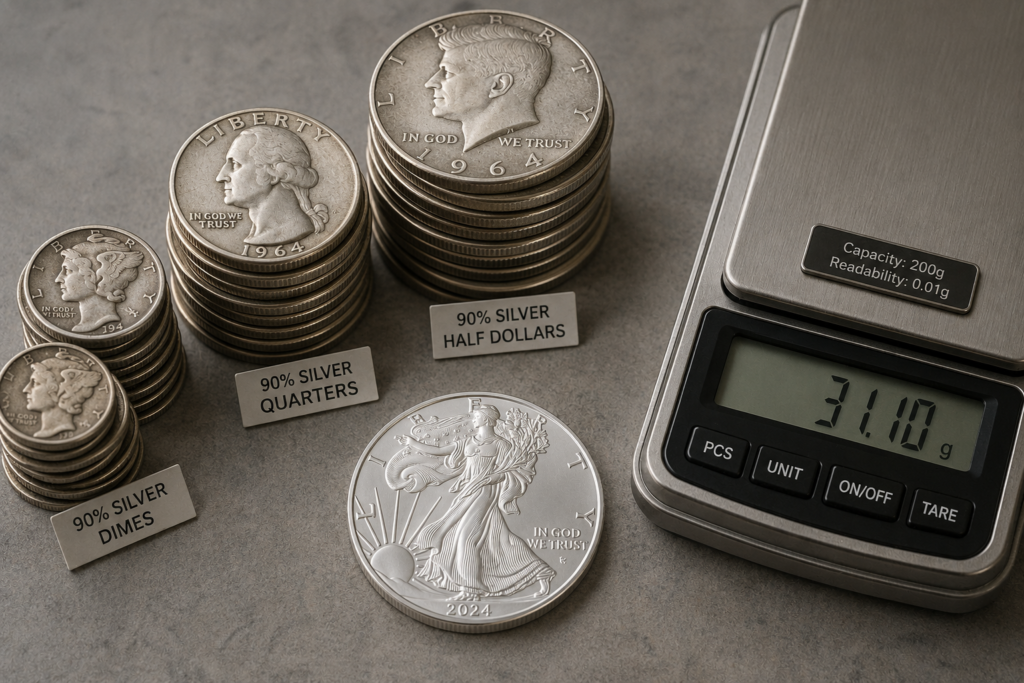
Pick up any silver coin, gold coin, or generic round and the same question applies: what is the metal alone worth? Melt value is the answer. The formula is the same for every coin — the troy ounces of pure metal in it, multiplied by the current spot price for that metal. A 1 oz American Silver Eagle holds 1 troy oz of silver, so its melt value is one ounce of silver at spot.
A 1964 quarter holds 0.1808 troy oz, a $20 Saint-Gaudens holds 0.9675. The number the formula produces is the floor: what a refiner would pay if the coin were melted. Retail price sits above it; collector premium can sit far above it.
This article is for informational and educational purposes only. ASW figures cited here are standard published values; dollar examples use round, hypothetical spot prices. Re-quote live spot before treating any number as current.
What melt value actually means
Melt value is the value of the metal content in a coin, calculated as the metal weight in troy ounces times the current spot price for that metal. For most US and bullion coins, the metal weight is a published constant — actual silver weight (ASW) for silver coins, actual gold weight (AGW) for gold — so the practical formula is ASW × spot or AGW × spot.
The name comes from refining: melt value is approximately what a refiner would pay for the metal if the coin were melted, minus their margin. Synonyms — intrinsic value, metal value, scrap value, bullion value — describe the same number; we use “melt value” because that is what dealer pricing settles on.
Melt value is a floor, not a price. Retail dealers sell above melt — the gap is the premium over spot. Collectors may pay well above melt for rarity, grade, or variety, which is why a worn 1921 Morgan dollar can trade close to melt while a graded example trades many multiples of it. Every other price for a coin is measured against the metal-only floor underneath.
The melt value formula
Two inputs in the practical version: the coin’s metal weight in troy ounces, times the current spot price per troy ounce. For nearly every coin you are likely to hold, the metal weight is a published constant — ASW for silver, AGW for gold — and the math is just that constant times spot.
The longer alternative starts from the coin’s gross weight and applies purity to get back to metal weight; both paths reach the same answer.
Metal weight: the practical number for most coins
Metal weight is the troy ounces of pure silver or gold in the coin, regardless of any alloy. For US and bullion coins it is a published constant: a 1 oz American Silver Eagle holds 1.000 troy oz of silver, a 1964 quarter holds 0.1808 troy oz, a $20 Saint-Gaudens holds 0.9675 troy oz of gold.
The table further down lists the constants you will use most. One troy ounce equals 31.1035 grams, so if a published figure is in grams, divide by 31.1035 to get troy oz. See our troy ounce explainer and the precious metals conversion chart for the deeper unit discussion.
Purity and gross weight: the longer alternative
If you do not have a published ASW or AGW to start from, you can derive it from the coin’s gross weight (the total weight including alloy) and its purity. Purity, also called fineness, is the share of total weight that is the named metal: .999 fine silver is 0.999; 90% pre-1965 US silver is 0.900; a 22-karat American Gold Eagle is 0.9167.
Gross weight × purity gives metal weight, which then multiplies by spot. The shorter ASW or AGW × spot path skips the conversion. Note that bullion is defined by value-from-metal-content rather than a purity threshold, which is why a .9167 Gold Eagle is still bullion despite being 22-karat.
Spot: live wholesale price per troy ounce
Spot price is the live wholesale price for one troy ounce of refined metal, set on the futures markets in New York and London and updated throughout the trading day. It is quoted in US dollars per troy ounce. Spot moves continuously, which means melt value moves continuously too: the melt value on a Silver Eagle today is a different dollar number than tomorrow, even though the coin’s metal weight has not changed.
When you run the formula manually, pull spot from a single live source — a brokerage feed, Kitco, or the LBMA daily fix — and timestamp whatever calculation you save.
Melt value on the coins you actually hold
The inputs change from coin to coin; the formula does not. The table below summarizes published weight, fineness, and ASW for the coin classes most US investors are holding. Each class then gets a worked example using a round hypothetical spot.
| Coin | Total weight | Fineness | ASW (troy oz) |
| Pre-1965 dime (Roosevelt, Mercury, Barber) | 2.50 g | .900 | 0.0723 |
| Pre-1965 quarter (Washington, Standing Liberty, Barber) | 6.25 g | .900 | 0.1808 |
| Pre-1965 half dollar (Walking Liberty, Franklin, 1964 Kennedy) | 12.50 g | .900 | 0.3617 |
| Morgan or Peace silver dollar | 26.73 g | .900 | 0.7734 |
| American Silver Eagle (1 oz) | 31.103 g | .999 | 1.0000 |
| American Gold Eagle (1 oz) | 33.93 g | .9167 | 1.0000 |
| American Gold Buffalo (1 oz) | 31.103 g | .9999 | 1.0000 |
| Pre-1933 $20 Double Eagle | 33.44 g | .900 | 0.9675 |
| Pre-1933 $10 Eagle | 16.72 g | .900 | 0.4838 |
Pre-1965 US 90% silver (junk silver)
US dimes, quarters, half dollars, and silver dollars struck before 1965 contain 90% silver. The standard ASW figures are 0.0723 troy oz per dime, 0.1808 per quarter, 0.3617 per half dollar, and 0.7734 per silver dollar. Run the formula on a Roosevelt dime at a hypothetical $60 per troy ounce silver: 0.0723 × $60 ≈ $4.34 in metal.
For bag math, the industry uses a shortcut — face value × silver multiplier × spot — where the multiplier is 0.715 troy oz of silver per $1 face value of pre-1965 90% coinage. At $60 silver, a $100 face value bag holds 71.5 troy oz of silver, or about $4,290 of metal.
Modern bullion coins (Eagles, Maples, Buffaloes, Krugerrands)
Modern 1 oz sovereign bullion is the simplest case because the ASW or AGW is right in the name. An American Silver Eagle and a Canadian Silver Maple Leaf each contain exactly 1.000 troy oz of pure silver. An American Gold Buffalo contains 1.000 troy oz of pure gold at .9999 fineness.
The American Gold Eagle is the case to remember: the coin weighs 33.93 g because it is 22-karat (.9167 fine) gold alloyed with copper and silver, but it still contains exactly 1.000 troy oz of pure gold. Krugerrands match that pattern. At a hypothetical $4,800 per troy ounce gold, the melt value of a 1 oz Gold Eagle is $4,800. Fractional bullion just scales down.
Pre-1933 US gold coins (Liberty Head, Indian Head, Saint-Gaudens)
Pre-1933 US gold coins confuse readers because their weights are calibrated to face value, not to a round troy ounce, and the fineness is .900. Published AGW figures: 0.9675 troy oz for the $20 Double Eagle, 0.4838 for the $10 Eagle, 0.2419 for the $5 Half Eagle, and 0.1209 for the $2.50 Quarter Eagle. At a hypothetical $4,800 per troy ounce gold, a Saint-Gaudens has a melt value of about $4,644.
The bigger note: pre-1933 gold often carries a substantial numismatic premium above melt — common-date examples in average condition trade well above the floor because of collector demand and survival rates.
Melt value, collector value, and retail price
A coin can carry three different numbers, from lowest to highest. Melt value is the floor — the metal alone. Dealer bid is what a buyer pays you: at melt minus a small margin on bullion-grade material, at melt plus a substantial premium on collector-grade material. Retail price is what you pay a dealer, sitting above bid by the dealer’s margin.
A 1921 Morgan silver dollar at a hypothetical $60 silver has a melt value of about $46; a circulated example might fetch $55 to $75 from a coin shop; a graded MS-65 can retail well above $200.
How Gold Silver Ledger surfaces melt value across your portfolio
Knowing the formula and running it once on a single coin is one task. Running it on every line in your portfolio, every time spot moves, in the currency you actually use — that is a different task. Gold Silver Ledger does the per-line math live so you can see the metal-only floor at portfolio scale.
Current value computed live on every Holdings row
Each line in your Holdings shows a Current Value column computed as the line’s metal weight times live spot. The catalog has the ASW or AGW for roughly 170 standard products built in — Eagles, Maples, PAMP bars, Krugerrands, the rest of the modern lineup — so adding a coin pulls the right metal weight automatically.
Custom items let you enter metal weight directly for anything outside the catalog. Spot pulls from live sources on the app’s standard refresh cadence. The display unit (troy oz, grams, or kilograms) is yours to set.
Junk silver — face value × multiplier × spot
Junk silver is its own line type because you hold face value rather than counted individual coins. Enter the face value in dollars; the ledger applies the standard 0.715 silver multiplier and live silver spot to render live melt value for the bag.
The same math runs whether the bag is mixed or sorted — the 0.715 multiplier is per dollar of face value, not per coin, and that is how the bag market actually prices junk silver.
Forty percent Kennedy halves (1965–1970) and 35% wartime Jefferson nickels (1942–1945) use their own multipliers, applied the same way.
Portfolio-scale view on the Analytics page
Analytics rolls per-line current value up to the metal level: total troy ounces of gold, silver, platinum, and palladium, with current value in your selected currency.
Metal Allocation is the at-a-glance answer to “what is the portfolio worth at today’s spot.” Because the underlying math is melt-value-based on every row, the totals are an honest floor read — they do not inflate to retail. Cost basis sits alongside in the same view.
Analytics runs on Pro and Premium; the Current Value rendering on Holdings is on every plan, Starter included.
Common mistakes calculating melt value
Five recurring errors come up when you run the formula by hand. Each is fixable on the next pass.
- Avoirdupois ounce instead of troy: The troy ounce is about 10% heavier than the kitchen-scale ounce, so substituting one for the other compounds the error across every coin in the calculation.
- Gross weight instead of metal weight: A 1964 quarter weighs 6.25 grams in total but only 5.625 grams of that is silver; starting from gross weight requires applying 0.900 purity to get back to metal weight. Starting from the published ASW (0.1808 troy oz) skips the step.
- Karat read as fineness: A 22-karat gold coin is .9167 fine, not 0.22; mixing the two forms turns the calculation into nonsense.
- Stale spot input: Melt value moves continuously with spot, so the calculation is only useful with a live or clearly timestamped spot price.
- Melt confused with refiner offer: Refiners pay below melt to cover refining cost and margin; most retail sellers should be comparing melt to a dealer bid for the coin itself, not to a refiner offer.
Frequently asked questions
What is the melt value of a coin?
Melt value is the value of the metal content in a coin, calculated as the troy ounces of pure metal in the coin times the current spot price for that metal. For most US and bullion coins the metal weight is a published constant — actual silver weight (ASW) or actual gold weight (AGW) — so the practical formula is ASW × spot or AGW × spot. Melt value is the floor: what a refiner would pay if the coin were melted, minus their margin.
How do I calculate the melt value of any coin?
Multiply the coin’s metal weight in troy ounces by the current spot price per troy ounce. For most US and bullion coins the metal weight is a published constant — actual silver weight (ASW) or actual gold weight (AGW) — so the math is ASW × spot or AGW × spot. If you only have the coin’s gross weight (the total weight including alloy), multiply gross weight × purity to get metal weight first, then times spot.
What is the melt value of a 1964 quarter?
A 1964 Washington quarter contains 0.1808 troy ounces of silver, because it is 90% silver and weighs 6.25 grams. At a hypothetical $60 per troy ounce, the melt value is 0.1808 × $60 ≈ $10.85.
Is melt value the same as scrap value?
Melt value and scrap value usually refer to the same number — the metal-only value calculated as weight × purity × spot. Scrap value is the term refiners and jewelers tend to use; melt value is the term coin dealers and bullion buyers tend to use. Both describe the same floor.
Can I sell coins for their melt value?
You can usually sell bullion-grade coins close to melt value, though most dealers bid slightly under melt on common silver and gold bullion to cover inventory cost. Collector-grade coins generally trade well above melt because of numismatic premium; selling them at melt would leave the premium on the table. Get a dealer bid for the specific coin before deciding.
Does melt value change over time?
Melt value changes continuously because spot price changes continuously — the weight and purity of a coin are fixed, but the dollar value of an ounce moves throughout the trading day. A 1 oz Silver Eagle holds the same one ounce of silver today as a year ago, but its melt value in dollars is a different number because spot has moved.
See your portfolio’s melt value live in Gold Silver Ledger
You know the formula. The question is whether you want to re-run it by hand every time silver or gold moves, on every line, in the currency you actually use. The ledger handles it: the catalog supplies weight and fineness for the standard products, junk silver is priced the way the bag market does it, and Analytics rolls the per-line numbers up to a portfolio metal allocation.
This article is for informational and educational purposes only and does not constitute financial, investment, or purchasing advice. ASW figures cited above are standard published values from US Mint and Royal Canadian Mint specifications and from established coin catalogs. Dollar examples use round, hypothetical spot prices for illustration; pull live spot from a reputable source before treating any dollar figure as current.
