
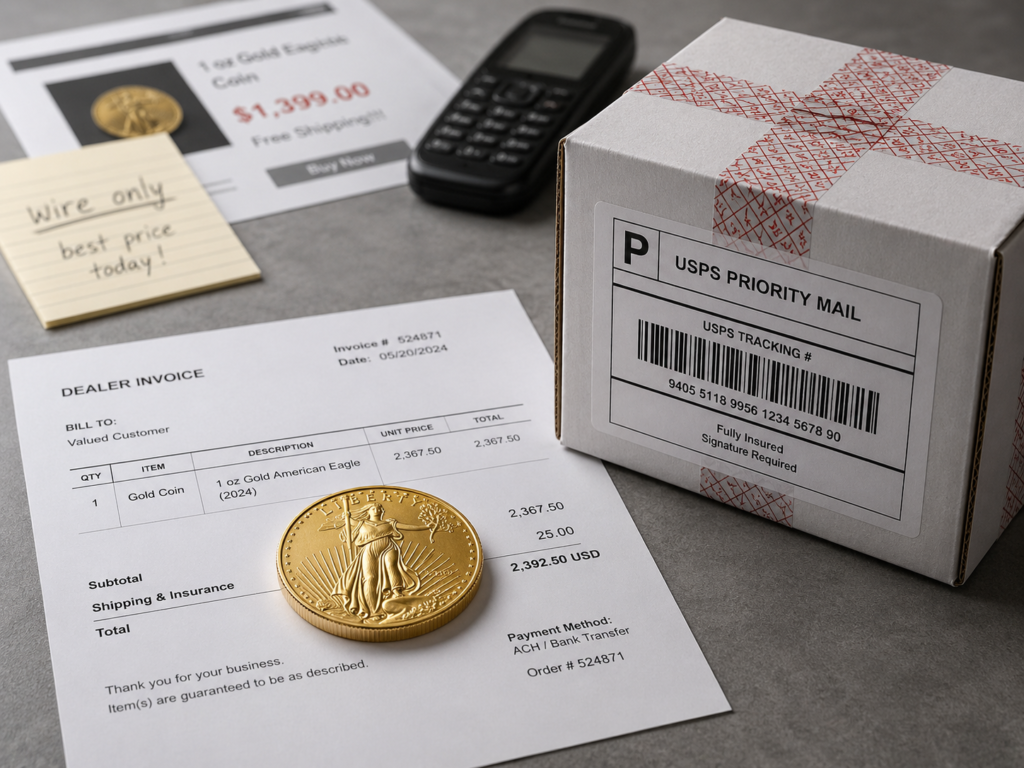
Almost nobody loses money on gold because the metal itself turned out to be a bad idea. They lose it at the edges of the transaction: a cloned dealer site, a wire that shipped nothing, a common coin sold as a rare one, a phone salesperson steering a retirement account into overpriced metal.
The gold is rarely the problem. The deal is. This guide treats buying gold safely as a repeatable process, and walks you through where each common scam tries to slip in and the specific move that shuts it down.
This article is general consumer-safety information, not investment, legal, or tax advice. Dealer reputations, pricing, and fraud tactics change. Verify a seller and current pricing at the time of purchase, and report suspected fraud to the appropriate authority.
The safest way to buy gold is a process, not a product
The safest way to buy gold is to buy widely recognized bullion, like a current government-mint gold coin, from an established and accredited dealer, at a transparent premium over the live spot price, using a traceable payment method with insured, tracked delivery, and to keep a record of what you paid. Safety comes from the process, not from any single coin.
Every worry about buying gold falls into one of two buckets. The first is whether the metal is genuine: the physical question of weight, dimensions, magnetism, and assay, which our guide to spotting fake gold and silver covers in full.
The second, and the one this article is built around, is whether the transaction is genuine: the seller, the price, the payment, and the delivery. You can hold a real one-ounce coin and still have been cheated on the deal.
If you are still deciding what to buy in the first place, start with our complete guide to buying gold for the forms, sizes, and where-to-buy basics. This guide assumes you have roughly settled on recognizable gold bullion and focuses only on doing the transaction safely.
Which gold-buying scams should you guard against?
Fraud in the gold market clusters into a handful of recognizable patterns. You don’t need to memorize every variation. You need to know which step of the purchase each one attacks, because that is where the defense lives.
Counterfeit product passed as genuine
Plated tungsten bars, fake “Liberty” rounds, and copied sovereign coins get sold by someone who knows they are fake. The defense is physical authentication plus buying from a dealer with a real reputation to protect.
Fly-by-night and cloned dealer sites
A slick site with no verifiable history, or a near-perfect copy of a known dealer’s site at a slightly different web address, is built to take one round of payments and vanish. Confirm you are on the real dealer’s domain before you enter anything.
Non-delivery and advance-payment fraud
You pay, tracking never appears, and support goes silent. It is most common when the seller insists on an irreversible payment method that leaves you no way to claw the money back.
Bait-and-switch pricing
A near-spot price is advertised to get you on the phone, then the salesperson pushes you into “exclusive” or “better” coins at a much higher markup once you are talking. The advertised deal is rarely what you end up buying.
Overpriced “rare” or graded-coin upsell
Common bullion gets repackaged as scarce, collectible, or proof and sold at a large numismatic markup you will not recover on resale. This is the engine behind many phone-room and IRA pitches.
High-pressure gold IRA and “home storage IRA” schemes
Unsolicited pitches steer retirement savings into overpriced metal through a self-directed IRA, wrapped in urgency and fear. The account can be legitimate; the markup and the pressure are the problem.
Unsolicited buy-and-sell solicitations
Cold calls, mailers, and door-to-door “we buy and sell gold” offers pressure a fast decision on someone else’s terms. A real purchase never depends on you acting in the next few minutes.
Payment-method traps
A seller who will only accept a bank wire, cryptocurrency, or gift cards is steering you toward methods with no chargeback and effectively no recourse. The payment demand itself is the warning sign.
How do you vet a gold dealer before you buy?
The single highest-leverage safety decision is who you buy from. Get the seller right, and most of the other risks shrink. A legitimate dealer is easy to confirm and has nothing to hide about its history, its pricing, or how it buys back what it sells.
Verifiable history and identity
Look for years in business, a real physical address, a working phone number, and a business name that matches across its site, its reviews, and its payment processor. Gaps here are the first sign of a fly-by-night operation.
Industry standing
Membership in the Professional Numismatists Guild or the American Numismatic Association, and for the largest names, status as a US Mint Authorized Purchaser, are checkable credentials. The US Mint does not sell bullion coins to the public directly; it sells to a small set of authorized purchasers who supply the retail market.
Independent reputation
Read a Better Business Bureau profile and third-party reviews for the pattern of complaints, not just the headline score. Look specifically for delivery and billing disputes, which is where transaction fraud shows up.
Transparent pricing
A legitimate dealer publishes live, spot-linked prices on the site rather than “call for our best price.” Hidden pricing is where bait-and-switch starts.
A published buyback policy
An established dealer makes a two-way market and tells you upfront how it buys back what it sells. Our guide to selling gold covers what a fair buyback looks like.
Traceable payment and no pressure
Real credit-card and bank options, not wire- or crypto-only, are a good sign, and a dealer that refuses reversible payment is telling you something. So is any “act in the next hour” urgency, which legitimate pricing never requires.
Price red flags: below-spot bait and the rare-coin upsell
A price at or below the live spot price is almost always a lure, not a bargain. Dealers acquire metal at spot plus a premium and add their own margin, so a legitimate retail price sits above spot; our premium over spot guide explains why. An advertised sub-spot price is typically bait to capture your call or your payment details, after which the real terms appear.
The second red flag runs the opposite direction: a much higher price dressed up as value. Common bullion gets relabeled as “rare,” “collectible,” “proof,” or “exclusive,” and sold at a numismatic markup far above its metal content. For a buyer whose goal is gold exposure, that markup is money you are unlikely to recover when you sell. This upsell is the engine behind many phone-room and IRA pitches.
The defense is the same in both directions. Compare the asking price to the metal content at live spot, and treat the gap as the premium you are being asked to pay. A normal bullion premium on a widely traded gold coin is modest; a premium several times that size needs a specific, verifiable reason, and “it’s rare” on a common coin is not one. When the story and the price do not match, stop.
Paying and taking delivery safely
Pay with a method that can be reversed. A credit card gives you chargeback rights if the goods never arrive or arrive counterfeit, and that protection is worth more than a small surcharge on a first purchase with an unfamiliar seller. Treat any demand for a bank wire, cryptocurrency, or gift cards as a serious red flag, because those methods are effectively final and are the preferred channel of non-delivery fraud.
For shipped gold, insist on tracked, insured, signature-required delivery, and confirm in writing who bears the loss if a package goes missing in transit. Our guide to insuring gold and silver covers where dealer coverage ends and your own begins. Inspect the shipment against the invoice before you sign off, and open packaging on camera if the order is large.
Buying locally removes shipping risk but adds handling risk. Meet at the dealer’s established storefront or another safe, public location, verify the coin before any cash changes hands, and get a written, itemized receipt. Never carry a large amount of cash to meet an unvetted seller arranged through a marketplace listing.
Are gold IRA companies a scam?
A gold IRA is a legitimate structure; the scam is the high-pressure sale and the excessive markup, not the account type. Retirement savings are the biggest prize in gold fraud, and regulators have said so directly. The CFTC, FINRA, and NASAA have issued a joint warning about operations that push people at or near retirement to move savings into overpriced metal through a self-directed IRA, using fear of markets and urgency as the lever.
Our gold IRA guide covers how the account actually works.
The damage is usually not fake metal; it is real metal at an unreal price. Regulators have documented cases of exorbitant commissions and fees, in one example roughly $150,000 in charges on a $300,000 rollover, often hidden inside “exclusive” or graded coins recommended by salespeople who, unlike a fiduciary adviser, are paid on commission and are not obligated to act in your interest.
The defense is to slow the pitch down. Any legitimate opportunity survives you hanging up, checking the firm, and comparing the coins’ price to their metal content at live spot. Be especially wary of “home storage IRA” claims, which regulators treat as a compliance trap. If a caller manufactures urgency around your retirement account, that urgency is the product.
If a deal goes wrong, keep the paper trail
If you think you have been cheated, act fast and in writing. Dispute the charge with your card issuer, then report the fraud to the FTC at reportfraud.ftc.gov, the FBI’s Internet Crime Complaint Center for online and wire fraud, the CFTC for metals and IRA schemes, and your state attorney general. A Better Business Bureau complaint adds public pressure. Speed matters, because chargeback and reporting windows close.
What makes any of that recourse workable is a record you kept from the start: who you bought from, on what date, what you paid, the premium over spot, and a receipt or order number. That same record protects you long after the purchase. When a buyer or a “we buy gold” offer comes in low later, the only way to know you are being lowballed is to know exactly what you paid and what the metal is worth now.
Gold Silver Ledger is built to hold that record without a spreadsheet. Each holding carries its cost basis locked at purchase, and its current value against live gold spot, and three per-item labels give you a place for the dealer, order number, or lot on every coin. Holdings views let you search and filter what you own, so proving what you paid, or spotting a lowball offer, is a glance rather than an archaeology project.
If you want that paper trail in place from your first coin forward, you can start with the free Starter tier and keep the record where the live values already live.
Start your free trial and set it up before your next purchase.
Frequently asked questions
What is the safest way to buy gold?
The safest way to buy gold is to buy recognizable bullion from an established, accredited dealer at a transparent premium over spot, pay with a reversible method, take insured and tracked delivery, and keep a receipt. Each step closes off one of the common scams, so treat safety as a process rather than a single “safe” coin.
How do I know if a gold dealer is legitimate?
A legitimate gold dealer has a verifiable history, a real address and phone number, transparent spot-linked pricing, a published buyback policy, and industry standing you can check, such as Professional Numismatists Guild membership or US Mint Authorized Purchaser status. Read third-party reviews for the pattern of delivery and billing complaints, not just the overall score.
Is it safe to buy gold online?
Buying gold online is safe when you use an established dealer with verifiable history, transparent pricing, reversible payment options, and insured, tracked shipping. The risk rises sharply with unknown websites, cloned versions of real dealer sites, and sellers who demand wire, crypto, or gift-card payment, so vet the seller before you enter any payment details.
Why would a gold dealer sell gold below the spot price?
A legitimate dealer will not sell gold below spot, because they acquire metal at spot plus a premium and add a margin on top. An advertised below-spot price is almost always bait to capture your call or payment information, after which the real, higher terms appear, so treat any sub-spot offer as a warning sign rather than a deal.
What is the safest way to pay for gold?
The safest way to pay for gold is a reversible method such as a credit card, which gives you chargeback rights if the order never arrives or arrives counterfeit. Bank wires, cryptocurrency, and gift cards are effectively final and offer no recourse, so a seller who accepts only those methods is a red flag.
What should I do if I bought fake or overpriced gold?
If you bought fake or grossly overpriced gold, dispute the charge with your card issuer immediately and report the fraud to the FTC at reportfraud.ftc.gov, the FBI Internet Crime Complaint Center, the CFTC for IRA or metals schemes, and your state attorney general. Act quickly, because chargeback and reporting windows close, and keep every receipt and communication as evidence.
Is it safe to buy gold on eBay or Facebook Marketplace?
Buying gold on eBay or Facebook Marketplace carries the highest counterfeit and non-delivery risk of the common channels, because anyone can list and the verification burden falls entirely on you. It can work once you can authenticate coins yourself and use buyer-protected payment, but for a first purchase, an established bullion dealer is the safer route.
This article is general consumer safety information, not investment, legal, or tax advice. If a gold or retirement account offer is being pitched to you, consider consulting a qualified, fee-based professional before moving any money.
