
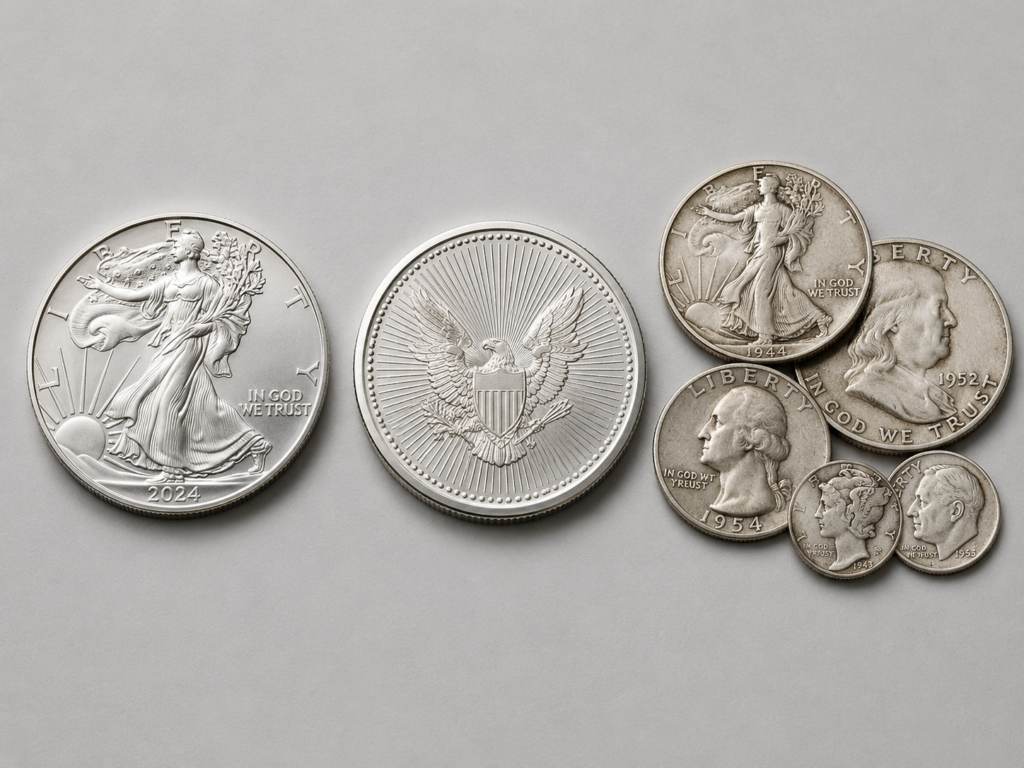
A $5,000 silver position weighs around ten pounds and fills a small shoebox. The same $5,000 in gold fits in your palm. That single fact reorganizes every decision below — what to buy, what to pay above the spot price (silver premium runs 15 to 35 percent on a typical coin, not the 3 to 6 percent a current Gold Eagle carries), how to store it, and how to think about adding to it over time.
This guide walks the silver-buying decision through the three constraints that make silver structurally different: dollar volume per ounce, premium percentage, and the pre-1965 US coinage option that gold does not have.
This article is general information, not investment advice. Spot prices, dealer premiums, sales-tax rules, and IRA fineness standards change. Verify with current dealer sources and a qualified tax professional at the time of purchase.
The three lanes of silver buying
When you buy silver, you are choosing among three distinct lanes, each with a different premium structure, a different secondary-market behavior, and a different role in a portfolio. A first purchase usually picks one lane and stays there for the first several coins; mixing lanes intelligently comes later.
The three lanes share the same metal floor — published silver weight × live spot — but they price the layer above that floor very differently. Our silver bullion guide covers the broader category context.
Sovereign-mint bullion coins
Government-issued silver coins from national mints: American Silver Eagle (US Mint), Canadian Silver Maple Leaf (Royal Canadian Mint), Silver Britannia (Royal Mint, UK), Vienna Philharmonic (Austrian Mint), Mexican Silver Libertad (Casa de Moneda de México), Chinese Silver Panda (People’s Bank of China).
The authority of a national mint pushes premium per ounce to the highest tier in silver — typically 15 to 35 percent over spot — and pushes resale liquidity to the highest tier as well. Default first purchase for most US buyers.
Generic rounds and bars
Private-mint silver in 1 oz, 5 oz, 10 oz, and 100 oz formats from refiners such as Sunshine Mint, Asahi, Republic Metals, SilverTowne, and others. No sovereign-mint authority — pricing reflects metal content plus a smaller fabrication premium, typically 5 to 15 percent over spot on 1 oz rounds and lower on the larger bar sizes.
Pre-1965 junk silver
US dimes, quarters, half dollars, and silver dollars struck at 90% fineness through 1964, plus 1965 to 1970 Kennedy halves at 40%. Priced by face value × multiplier × spot rather than by per-coin retail. Lowest premium per ounce of any silver lane for buyers comfortable with small-denomination silver.
No IRA-eligibility path at any face value — the .999 default rule excludes 90% and 40% coinage outright.
What your dollar actually buys: the silver budget math
Silver is roughly 80 times less expensive per troy ounce than gold. That ratio is the silver-to-gold ratio, and it has historically moved between 50:1 and 100:1 depending on market conditions.
The practical effect: a starter budget that buys a single ounce of gold buys roughly 80 ounces of silver, and a 100-ounce silver position is a workable starter holding while a 100-ounce gold position is a five-figure commitment by weight alone. Live ratios change with the market — check the current silver spot price before sizing a purchase.
A working rule of thumb at recent silver pricing (verify against live spot when purchasing). With $500, you can expect roughly 12 to 16 ounces of sovereign-mint bullion coins, or 16 to 22 ounces of generic rounds, or 18 to 25 ounces of junk silver by metal weight.
With $1,000, those numbers roughly double. With $5,000, the position becomes a meaningful piece count — 130 to 170 ounces of sovereign-mint coins or 200-plus ounces of junk silver — and the volume problem covered later in this guide becomes a real storage consideration.
The dollar math has a portfolio implication that gold buying does not have. A $5,000 silver position is one to two hundred individual coins or pieces depending on the lane and the size mix. Tracking what you paid for each piece versus what the current metal content is worth at live spot is not optional. It is the difference between knowing your position and guessing at it.
Most spreadsheets and dealer apps cannot handle the per-piece accounting at this volume cleanly. The position-level visibility problem starts at the silver scale.
Why silver almost never trades at spot
Silver premium over spot is structurally higher than gold premium over spot. A current-year American Silver Eagle that holds 1 troy ounce of silver routinely retails at 4 to 8 dollars over spot — a premium percentage of 15 to 35 percent when spot is in a typical recent range.
A current-year American Gold Eagle that holds 1 troy ounce of gold retails at 80 to 150 dollars over spot — a premium percentage of 3 to 6 percent. The dollar premium on the silver coin is smaller; the percentage premium is much larger. Both numbers move with the market and require verification at purchase.
Three structural reasons. Per-coin fabrication and distribution costs are roughly fixed regardless of the metal price — striking a 1 oz silver coin costs about the same as striking a 1 oz gold coin, but that fixed cost spread across $60 of silver is a larger percentage than the same cost spread across $4,300 of gold.
Industrial silver demand (electronics, photovoltaics, soldering) creates a separate price pressure that does not affect gold the same way. And retail silver inventory is more constrained relative to demand at the dealer level, with that scarcity getting priced into premium during high-demand months.
The practical rule. When buying silver, you are paying the premium percentage, not the dollar premium. A four-dollar premium on a twenty-six-dollar coin is a 15 percent transaction cost on the metal; a 150-dollar premium on a 2,400-dollar gold coin is a 6 percent transaction cost.
The percentage matters more in silver because it compounds across the larger piece count. Generic rounds reduce the percentage; junk silver reduces it further; sovereign-mint coins pay the percentage for authority. Our premium over spot guide covers the framework in depth.
Junk silver: the category gold does not have
From 1873 through 1964, US dimes, quarters, half dollars, and silver dollars were struck at 90 percent silver and 10 percent copper. The Coinage Act of 1965 removed silver from dimes and quarters and reduced the half dollar to 40 percent silver from 1965 through 1970; from 1971 forward, US circulating coinage carries no silver.
“Junk silver” is the dealer term for this pre-1965 90 percent coinage (and the 1965 to 1970 40 percent Kennedy halves), priced by face value × multiplier × spot rather than as numismatic coins.
The face-value math is mechanical. One dollar of face value in 90 percent silver coinage contains approximately 0.715 troy ounces of pure silver — the exact figure depends on whether the dollar is made up of dimes (2.5 g each), quarters (6.25 g each), half dollars (12.5 g each), or silver dollars (26.73 g each).
The dealer multiplier — typically 18× to 22× face value depending on spot price and dealer markup — combines the face-to-silver conversion and the premium into a single number. A 1,000-dollar face value bag of 90 percent junk silver contains approximately 715 troy ounces of silver.
Junk silver is the lowest-premium lane in silver buying. The appeal to a beginner is the divisibility (a dime is a quarter-ounce silver purchase, not a one-ounce commitment), the historical recognizability (every coin is a US circulating coin from inside living memory), and the cleanness of the math.
The constraint: junk silver is not IRA-eligible at any face value or multiplier — the .999 default fineness rule excludes 90 percent and 40 percent coinage outright, and no statutory exception covers it.
Our junk silver guide covers the full framework, including the common date pickups, sorting, and the multiplier math at different spot levels.
Quick face-value reference:
- $1.00 face value in 90% silver dimes, quarters, or half dollars: approximately 0.715 troy oz of silver.
- $1.00 face value in 1965 to 1970 Kennedy half dollars (40% silver): approximately 0.295 troy oz of silver.
- $1.00 face value in pre-1936 silver dollars (Morgan, Peace): approximately 0.7734 troy oz of silver (one silver dollar equals one dollar face).
- $1,000 face value 90% silver “junk silver bag”: approximately 715 troy oz of silver.
- $500 face value 90% silver “half bag”: approximately 357 troy oz of silver.
The four-question test for your first silver purchase
The first silver purchase has more lanes than the first gold purchase, but the decision narrows quickly once you answer four questions in order. Each question routes you to one of the three lanes from the section above. Our silver coins versus bars comparison goes deeper on the lane-by-lane mechanics.
Do I want to hold this in an IRA?
If yes, go to sovereign-mint bullion coins at .999 fineness or higher, or to .999 generic rounds and bars from IRS-approved refiners. Junk silver and pre-2013 Silver Britannias are out. If no, the IRA constraint disappears and the full lane choice opens up, including junk silver.
Am I optimizing for the lowest premium per ounce?
If yes, junk silver wins on dollar-per-ounce-of-silver, generic rounds come second, and sovereign-mint coins come last. If no — if you want the resale liquidity and the mint authority — sovereign-mint coins justify the higher premium percentage.
How am I going to store this?
If you have limited safe space, a smaller piece count in higher-density bars (10 oz, 100 oz) or 1 oz sovereign-mint coins minimizes the volume. If junk silver bags or stacked 1 oz rounds fit your storage setup, the lower-premium lanes open up. Storage volume is a real silver-specific constraint covered later in this guide.
Am I buying this to hold for the long term or for divisibility in some future scenario?
Long-term hold: bars and 1 oz coins keep the math simple. Divisibility-focused: junk silver dimes and quarters are the only true sub-ounce silver you can buy at metal-content prices.
Where to buy silver, and the sales-tax dimension
For a first purchase, the major online US bullion dealers are the default — APMEX, JM Bullion, Money Metals Exchange, SD Bullion, Provident Metals, Hero Bullion, Gainesville Coins. They publish live premium pricing, ship insured, and accept standard payment methods.
Local coin shops are the close second; in-person inspection plus immediate physical possession plus zero shipping cost can offset a slightly higher premium for a starter purchase.
Banks rarely sell silver in the US, and pawn shops are not the place for a starter silver purchase.
The sales-tax dimension is meaningfully different for silver than for gold. Many US states tax precious-metal purchases below a face-value or dollar-amount threshold or at premium-over-spot percentages above a stated cap; silver hits those thresholds more often than gold because the dollar amount per coin is smaller.
As of recent reference dates, roughly forty US states exempt precious metals from sales tax with varying conditions; the remaining states tax all or most precious-metal purchases. Online dealers collect sales tax based on your shipping address, not on the dealer location. Check your state’s current rule at the dealer cart before checkout.
Online marketplaces (eBay, Etsy, Facebook Marketplace) sit outside the major-dealer category and carry the highest counterfeit risk in silver. The premium is sometimes lower than dealer pricing, but the verification burden falls entirely on you. For a first purchase, the major dealer route is the recommendation.
Once you have a verified reference coin in hand, marketplace purchases become a meaningful supplement for back-year and lower-mintage issues at a closer-to-spot price.
Authentication for silver: what is different from gold
Silver authentication uses two methods gold authentication does not. The magnet slide test takes advantage of silver’s diamagnetic property — a strong neodymium magnet placed on a tilted silver coin slides slowly, retarded by the eddy currents that silver generates as the magnetic field passes. A counterfeit struck in steel or iron snaps to the magnet outright.
A counterfeit struck in lead, brass, or tungsten shows no slide effect either; the magnet drops free. Only genuine silver shows the characteristic slow slide. The ping test works on silver because of the metal’s acoustic signature when struck — a clean high tone that lasts a second or two, distinct from the dull thud of a base-metal counterfeit.
Weight, diameter, and density still apply. An American Silver Eagle weighs 31.103 g (1 troy oz) at 40.6 mm diameter; a Canadian Silver Maple at the same 1 oz size measures 38.0 mm. Silver density is 10.49 g/cm³ — lower than gold (19.3) and higher than lead (11.34).
Plated tungsten cores are impractical in silver because tungsten density (19.3) is so far from silver’s that the weight is wrong; lead-core fakes fail the density check and the magnet slide.
Verification checklist for any silver purchase:
- Weight on a digital jewelry scale: 1 oz silver coins should hit 31.103 g (±0.05 g for circulation wear); junk silver coins should hit their published per-coin weight.
- Diameter with calipers: Published mint specification per coin, typically ±0.1 mm tolerance.
- Magnet slide test: A strong neodymium magnet should slide slowly down a tilted silver coin.
- Ping test: A clean high tone lasting a second or two on a sharp tap.
- Edge inspection: Reeded or smooth edge per the mint spec; no seams or visible plating boundaries.
- Density check: Water displacement should yield 10.49 g/cm³ for pure silver, scaled down by alloy for 90 percent junk silver.
- Sigma Verifier or XRF: Dealer-grade verification, available at most major coin shops.
Storage and the silver volume problem
A 100-ounce silver position weighs roughly 7 pounds and fits in a small tube box. A 500-ounce silver position weighs roughly 35 pounds and starts to dominate a home safe. A 1,000-ounce silver position weighs around 70 pounds and is at the boundary of comfortable home storage for most buyers; beyond that, a bank safe deposit box (with insurance considerations) or a private precious-metals depository (segregated or non-segregated storage, monthly fees) becomes the practical path.
The volume problem is the silver-specific storage constraint. Gold buyers rarely encounter it because $50,000 in gold fits in a small jewelry box.
Storage method routes by position size, by IRA status, and by your personal risk tolerance. Home storage is fine for most starter positions and offers maximum access — a quality home safe with a UL Residential Security Container rating or better, bolted to the floor or wall, handles a low-four-figure position cleanly.
Bank safe deposit boxes are inexpensive (around $30 to $150 per year depending on size) but are not FDIC-insured and not always accessible during emergencies. Private depositories (Brink’s, IDS, Loomis, A-M Global) charge roughly half a percent to one percent per year on stored value, are insured, and handle the volume problem at scale. IRA-held silver must be at an IRS-approved depository, never at home.
IRA placement: the .999 rule and what falls outside
Under IRC §408(m)(3), silver held in an IRA must meet a .999 default fineness standard or qualify under a named statutory exception. The default rule covers most modern silver bullion coins — the Canadian Silver Maple Leaf at .9999, the Silver Britannia post-2013 at .999, the Mexican Silver Libertad at .999, the Vienna Philharmonic at .999, the Chinese Silver Panda at .999 — and 1 oz silver bars and rounds from IRS-approved refiners.
The default rule excludes coins below .999 fineness, including the pre-2013 Silver Britannia (.958) and all pre-1965 US 90 percent junk silver (.900). The American Silver Eagle is the named statutory exception that covers any-fineness American Silver Eagles at every vintage.
The clean rule. Junk silver (90 percent or 40 percent) cannot be placed in an IRA at any face value or dealer multiplier. Pre-2013 Silver Britannias cannot be placed in an IRA. Generic silver rounds and bars need to be .999 and from IRS-approved sources (Asahi, Sunshine Mint, Republic Metals, and similar refiners). American Silver Eagles, regardless of vintage, are eligible.
Other sovereign-mint silver bullion coins at .999 or higher are eligible. This split is cleaner than the gold split, where only the American Gold Eagle holds a named exception, and the Krugerrand fails both the fineness rule and any exception.
For a first silver purchase intended for a taxable account, the IRA constraint disappears and the lane choice opens up to junk silver and to the full premium-versus-authority tradeoff across all three lanes. For an IRA position, sovereign-mint bullion coins at .999 fineness or higher are the default first purchase.
Our silver IRA guide covers the full framework, the eligible coin and bar lists, and the depository requirement in depth.
Building the silver position over time
The most common pattern for building a silver position is a regular cadence — monthly, quarterly, or per-paycheck — into the same lane (or two lanes) until the position reaches a target ounce count. Cost averaging works in silver because the premium percentage varies less than the spot price does month to month. If you buy a fixed dollar amount per cadence, you accumulate more ounces in low-spot months and fewer in high-spot months without thinking about market timing. The premium spend across the position is the lever you actually control.
A silver position grows in piece count faster than a gold position grows in dollar cost. After twenty-four months of regular monthly silver buying, you commonly have 200 to 400 individual silver pieces across two or three lanes — some Eagles, some generic rounds, perhaps a junk silver pickup or two.
Per-piece cost basis varies. Premium spend varies. The position-level picture — total silver weight, total cost basis, current value at live spot, average premium percentage — is the thing that lets you make sensible decisions about adding to the position versus rotating into a different lane or eventually selling part of it.
Gold Silver Ledger is built for that visibility. The silver catalog covers the major sovereign-mint coins, the generic round and bar sizes, and junk silver as face-value items with the multiplier math handled automatically.
Frequently asked questions
How much silver should I buy as a beginner?
A workable starter target for most first-time buyers is 50 to 100 ounces of silver, accumulated over six to twelve months at a steady cadence rather than in one large purchase. That range gives you enough position to make tracking meaningful, enough piece count to learn lane-by-lane differences, and enough dollar exposure to feel like a real allocation without locking up serious capital before you know what works for you.
Should I buy silver coins, rounds, or bars first?
For a first purchase, sovereign-mint bullion coins (American Silver Eagle, Canadian Silver Maple) are the default because they carry the cleanest resale liquidity and the most-recognized authentication signal. Generic rounds and bars are the right second purchase once you have a reference coin in hand and want to drop your premium percentage. Junk silver is the right purchase once you have decided you want sub-ounce divisibility at the lowest premium per ounce in the silver market.
Is junk silver a good way to buy silver?
Junk silver is the lowest-premium lane in silver and is a strong choice if you are buying for taxable accounts, value sub-ounce divisibility, and are comfortable with small-denomination US coinage. The constraint is that junk silver is not IRA-eligible at any face value or multiplier — the .999 default fineness rule excludes 90 percent and 40 percent coinage. For an IRA position, sovereign-mint .999 bullion is the route instead.
Why is silver so much more expensive than the spot price?
Silver premium runs structurally higher than gold premium because the fixed per-coin fabrication and distribution cost is a larger percentage of a smaller-dollar metal. Industrial demand and constrained retail inventory add additional pressure. A typical premium percentage on a 1 oz silver coin runs 15 to 35 percent over spot; the same coin in gold runs 3 to 6 percent. Generic rounds reduce the percentage; junk silver reduces it further.
Are silver purchases reported to the IRS?
Silver purchases are not reported to the IRS by the dealer at any size. Dealer sales over $10,000 paid in cash or cash equivalents are reported on Form 8300, which is a money-laundering reporting requirement rather than a precious-metals rule. Subsequent sales of silver may be reportable on Form 1099-B depending on the quantity and product type — the IRS rules on dealer-side reporting of sales are coin-and-quantity specific and worth verifying at the time of sale.
Do I have to pay sales tax on silver?
Sales tax on silver varies by US state. Roughly forty states exempt precious metals from sales tax with varying conditions; the remaining states tax all or most precious-metal purchases, sometimes only below a face-value threshold or above a premium-percentage cap. Online dealers collect sales tax based on your shipping address, so the dealer cart shows the applicable tax before checkout. Check your state’s current rule before each purchase.
How can I tell if a silver coin is real?
Run the magnet slide test, the ping test, and a weight check on a digital scale. Genuine silver causes a strong neodymium magnet to slide slowly down a tilted coin (the diamagnetic effect); a counterfeit either snaps to the magnet or shows no slide at all. A clean ping tone lasting a second or two confirms silver acoustically. The published weight (31.103 g for a 1 oz bullion coin) and diameter must match the mint specification within tolerance.
Can I store silver at home or do I need a depository?
Home storage works fine for most starter silver positions up to several hundred ounces, provided you use a quality safe (UL Residential Security Container rated or better) bolted to a structural element. Larger positions push you toward bank safe deposit boxes (inexpensive but uninsured) or private precious-metals depositories (insured, monthly fees, segregated or non-segregated options). IRA-held silver must be at an IRS-approved depository — home storage is not permitted for IRA silver.
This article is general information only and is not investment, tax, or legal advice. Spot prices, dealer premiums, sales-tax rules, and IRA fineness standards can change. Verify against primary sources at the time of decision and consult a qualified professional for tax-specific or retirement-account questions.
