
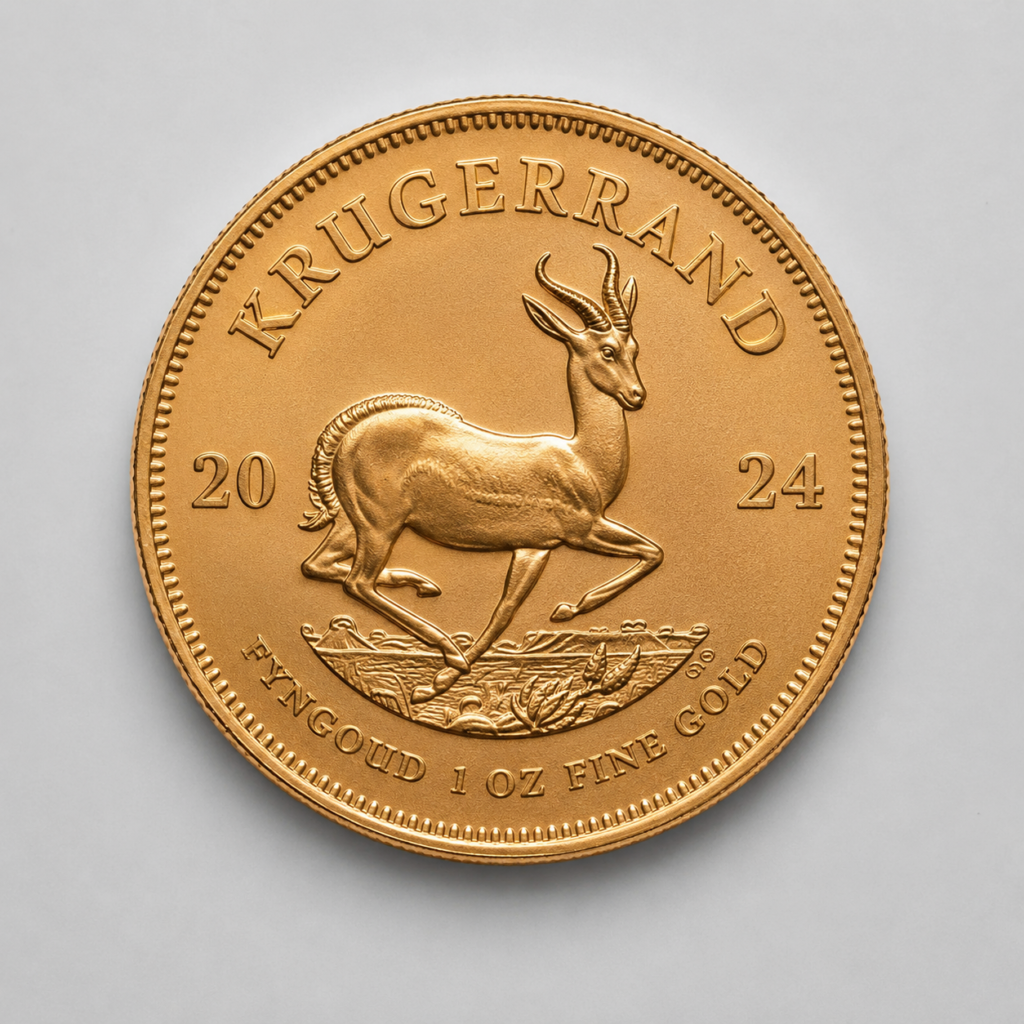
The South African Krugerrand is the original modern gold bullion coin. Produced by the South African Mint and Rand Refinery since 1967, the Krugerrand created the entire sovereign-mint gold-bullion category — every later flagship coin from the Canadian Gold Maple Leaf to the American Gold Eagle exists because the Krugerrand proved the model works.
The 1 troy ounce coin contains one troy ounce of pure gold in a hardened 22-karat copper alloy, trades at the lowest premium over spot of any major 1 oz sovereign gold coin, and is not IRA-eligible. This guide covers every dimension a Krugerrand buyer needs.
Premium figures and dealer prices move daily; the numbers in this guide are durable framing rather than current quotes. Tax treatment is informational and not professional advice. For the U.S. .9167 fine answer that the Krugerrand directly inspired, see the American Gold Eagle complete buyer’s guide; for the U.S. .9999 fine option, see the American Gold Buffalo complete buyer’s guide; for the .9999 fine sovereign benchmark, see the Canadian Gold Maple Leaf complete buyer’s guide.
What is the South African Krugerrand?
The South African Krugerrand is the first modern gold bullion coin, produced by the South African Mint and refined by Rand Refinery since 1967. Each 1 troy ounce Krugerrand contains one troy ounce (31.103 grams) of pure gold in a .9167 fine (22-karat) copper-hardened alloy.
The coin weighs 33.93 grams gross — the extra 2.83 grams is the copper that distinguishes the Krugerrand’s orange-gold color — measures 32.77 millimeters in diameter, and is 2.84 millimeters thick.
The Krugerrand carries no fixed face value but is legal tender in South Africa at its gold content value.
The program ships as a Bullion strike (the standard production coin) and a Proof strike (the premium collector coin) in a full fractional ladder (1 oz, 1/2 oz, 1/4 oz, 1/10 oz, with 1/20 oz and 1/50 oz collector sizes added later).
The Krugerrand is NOT eligible for self-directed precious metals IRAs — it sits below the IRS default .995 fineness rule and is not named as an explicit statutory exception, unlike the .9167 fine American Gold Eagle.
History — the 1967 launch and the original modern bullion coin
The Krugerrand launched on July 3, 1967, produced by the South African Mint and refined by Rand Refinery from South African gold. The launch was a deliberate response to global private-investor demand for an affordable, recognizable, legal-tender vehicle for owning physical gold by the ounce.
The 1 troy oz weight, the 22-karat hardened alloy, the legal-tender status, and the gold-content-priced retail model were all design choices that defined what a modern bullion coin would mean for every later sovereign program.
By the late 1970s, the Krugerrand held an estimated 90% of the global gold-coin market. The follower programs that copied the Krugerrand template arrived through the 1980s: the Canadian Gold Maple Leaf in 1979 (.999 fine, upgraded to .9999 in 1982), the Chinese Gold Panda in 1982, the Australian Gold Nugget (later Kangaroo) in 1986, the American Gold Eagle in 1986, the British Britannia in 1987, and the Austrian Vienna Philharmonic in 1989. The Krugerrand was the model every later program studied.
The Krugerrand was banned from U.S. import from October 1986 to July 1994 under the Comprehensive Anti-Apartheid Act of 1986, which prohibited the importation of South African Krugerrands as part of broader U.S. sanctions on apartheid-era South Africa. The ban was lifted following South Africa’s transition to democratic government in 1994.
Krugerrands imported into the U.S. before October 1986 remained legal to own and trade throughout the ban; the prohibition was on new import. The post-1994 re-opening restored the Krugerrand’s place in the U.S. retail gold-bullion market, where it has traded continuously since.
Specifications and the 22-karat alloy
The Krugerrand ships in a full fractional ladder, but the specifications below describe the 1 oz Bullion strike — the workhorse Krugerrand and the variant most positions are built around.
| Specification | Value |
| Gold content | 1 troy oz (31.103 g) |
| Purity | .9167 fine (22-karat) |
| Alloy | 91.67% gold, 8.33% copper (no silver) |
| Gross weight | 33.93 g |
| Diameter | 32.77 mm |
| Thickness | 2.84 mm |
| Edge | Reeded (220 serrations on the 1 oz) |
| Face value | None fixed — legal tender at gold-content value |
| Issuing authority | South African Mint Company |
| Refiner | Rand Refinery |
| First minted | 1967 |
| Standard sizes | 1 oz, 1/2 oz, 1/4 oz, 1/10 oz (Bullion); 1/20 oz, 1/50 oz collector |
| IRA-eligible (Bullion) | No — below default .995 rule, not named as statutory exception |
The Krugerrand’s gross weight (33.93 g) is meaningfully higher than its pure gold content (31.103 g) because of the 8.33% copper hardening alloy — the same alloy approach the American Gold Eagle later adopted. The 22-karat alloy is harder than .9999 fine gold, which makes the coin more resistant to scratches, surface marks, and edge wear during handling and storage.
The copper also gives the Krugerrand its distinctive warm orange-gold color, visibly different from the cooler yellow of .9999 fine coins like the Maple Leaf and the Buffalo.
Design — Paul Kruger and the Springbok
The obverse carries a profile portrait of Paul Kruger (1825–1904), the fourth president of the South African Republic and the namesake of the coin — Krugerrand combines Kruger with rand, the South African currency. The portrait was adapted by Otto Schultz from an original by Coert Steynberg.
The obverse inscriptions read SUID-AFRIKA / SOUTH AFRICA around the portrait, the dual-language convention of rand-era South African coinage. The portrait has not changed since the 1967 launch.
The reverse shows a springbok antelope (Antidorcas marsupialis), South Africa’s national animal, sculpted by Coert Steynberg. The springbok is shown in mid-stride against a plain field, with the weight and fineness mark (FYNGOUD 1 OZ FINE GOLD on the 1 oz) and the year of mintage.
Like the obverse, the reverse design has not changed since 1967 — the Krugerrand has been visually identical for nearly six decades, a stability no other major sovereign gold bullion program can match.
Bullion vs. Proof — and the 2017 silver and platinum lines
The Krugerrand program has expanded beyond the original gold Bullion strike, though the gold Bullion remains the center of every Krugerrand discussion. For a gold-allocation position, the 1 oz Gold Bullion is the buying choice — lowest premium, highest liquidity, the canonical Krugerrand.
The Gold Proof is collector territory; the Silver and Platinum Krugerrands are separate bullion programs that share the name but trade as their own metals.
Gold Bullion
Standard production strike with a brilliant uncirculated finish, the workhorse Krugerrand. Priced at gold spot plus a premium. Accepted at every major dealer at the tightest spreads in the U.S. retail market.
Gold Proof
Premium collector strike with mirror-finish fields and frosted devices, struck on specially prepared planchets. Priced significantly above the Bullion strike. Sold in South African Mint presentation cases with certificates of authenticity. Trades on the collector market.
Silver Krugerrand (2017 onward)
Launched for the program’s 50th anniversary in 2017 and continued as an annual program. .999 fine silver, 1 troy oz, distinct from the gold program — a separate buying decision and not interchangeable with the gold Krugerrand in pricing or use.
Platinum Krugerrand (2017 onward)
Also launched in 2017 as an annual program. .9995 fine platinum, 1 troy oz, with the same Steynberg springbok reverse. Treated as a platinum bullion holding, not as a gold Krugerrand line extension.
The fractional size ladder
The Krugerrand was the first gold bullion program to offer a fractional ladder alongside the 1 oz coin, and the ladder remains a full set on the standard production schedule. As with every other sovereign program, per-ounce premium rises as the size falls — the 1 oz Bullion is the cost-efficient choice for a gold allocation, and the smaller sizes fit position-sizing flexibility and gifting at higher per-ounce premiums.
1 oz
The workhorse Gold Bullion strike. The center of the program, the tightest dealer premium per ounce, and the most universally recognized 1 oz gold coin in the world by mintage volume. Sold loose or in South African Mint tubes of ten.
1/2 oz
A common fractional choice for mid-sized portfolios. Per-ounce premium sits above the 1 oz by a meaningful gap.
1/4 oz
A common gifting and smaller-position choice.
1/10 oz
The smallest of the standard fractional sizes in the gold Bullion line. Per-ounce premium can run substantially above the 1 oz.
1/20 oz and 1/50 oz
Smaller collector-oriented sizes added later. Per-ounce premium is the highest in the ladder; primarily for gifting, novelty, and ultra-small-position accumulation.
Premium over spot — the cost leader among sovereign 1 oz gold coins
The Krugerrand consistently trades at the lowest premium over spot of the major 1 oz sovereign gold bullion coins in the U.S. retail market. It sits below the Gold Eagle, the Gold Maple Leaf, the Britannia, and the Philharmonic on a typical same-day basis, and well below the Gold Buffalo.
Three structural reasons place the Krugerrand at the cost-leader tier. The South African Mint’s per-coin production cost is supported by the program’s enormous scale — more than 50 million 1 oz Krugerrands have been minted since 1967, an order of magnitude more than any other single 1 oz sovereign gold program.
The 22-karat copper-hardened alloy is cheaper to strike at scale than .9999 fine coins, which require more careful handling on softer planchets. And the Krugerrand carries neither a U.S.-domestic-mint premium nor the collector-base support that lifts U.S. and Canadian programs in the U.S. retail market.
The gap is durable. If you’re sizing a taxable-sleeve gold position at the lowest possible per-coin cost, the Krugerrand is usually the answer. Live premium figures move daily, so check current dealer pricing at purchase.
See our premium over spot guide for the framework and the spot price guide for the live data layer.
Why the Krugerrand is NOT IRA eligible
The South African Krugerrand is NOT eligible for self-directed precious metals IRAs. IRC §408(m)(3) sets the rule that gold held in an IRA must be at least .995 fine. The Krugerrand is .9167 fine — it sits below the threshold by 7.83% and would fail the default rule on its own.
The statute also names a short list of specific exceptions that qualify by name despite sitting below the default rule, and the American Gold Eagle is named in that list, but the Krugerrand is not.
This is the only major sovereign 1 oz gold bullion coin in this position. Every other commonly held foreign sovereign 1 oz gold bullion coin in U.S. portfolios — the Canadian Gold Maple Leaf, the Austrian Gold Philharmonic, the Australian Gold Kangaroo, the British Gold Britannia — clears the default .995 rule because all four are .9999 fine.
The American Gold Eagle is the only .9167 fine coin that qualifies, and only because Congress named it explicitly. The Krugerrand is structurally locked into the taxable sleeve.
For the same .9167 hardened-alloy buying preference with IRA eligibility, the named alternative is the American Gold Eagle. For the lowest-premium gold-content cost-efficiency without the IRA-eligibility constraint, the Krugerrand stays the answer in the taxable sleeve.
Our gold IRA guide covers the full framework, and our Krugerrand vs. American Gold Eagle comparison covers the deeper .9167-vs-.9167 head-to-head. Common 1 oz gold bullion coins that ARE IRA-eligible:
- American Gold Eagle (.9167 fine — named statutory exception)
- American Gold Buffalo (.9999 since 2006 — default rule)
- Canadian Gold Maple Leaf (.9999 since 1982 — default rule)
- Austrian Gold Philharmonic (.9999 since 1989 — default rule)
- Australian Gold Kangaroo (.9999 — default rule)
- British Gold Britannia (.9999 since 2013 — default rule)
How to buy, and how to handle a 22-karat coin
The Krugerrand is sold at every major U.S. gold bullion dealer (APMEX, JM Bullion, Money Metals Exchange, SD Bullion, Provident Metals, Hero Bullion), at major coin dealers, at many local coin shops, and at South African and European dealers internationally. Pricing across major U.S. dealers tends to sit within a few percent of each other on a same-day basis.
The South African Mint Company distributes Bullion strikes through a network of authorized purchasers who resell to the retail market; the mint does not sell Bullion strikes direct to the public. Proof strikes and the Silver and Platinum lines are sold direct by the mint during release windows and on the secondary market after.
Handling a .9167 fine coin is easier than handling a .9999 fine coin. The 22-karat copper-hardened alloy is meaningfully harder than pure or near-pure gold and resists surface marks, fingerprints, and minor edge wear better than coins like the Maple Leaf, Buffalo, Britannia, or Philharmonic.
Handle by the edges only as a habit, but the Krugerrand tolerates ordinary handling well — one of the practical reasons the 22-karat approach has stayed in production for nearly six decades.
Our how to buy gold guide covers the broader buying framework.
Authentication, storage, and resale
Authentication relies on the published specifications — weight (33.93 g for the 1 oz), diameter (32.77 mm), thickness (2.84 mm), and the 220-serration reeded edge on the 1 oz. The ping test produces a characteristic ring on a struck gold coin that is distinct from base metal.
The .9167 fine alloy gives the Krugerrand a slightly different conductivity reading on a Sigma Verifier than .9999 fine coins, which is useful for distinguishing them when out of capsule. The distinctive orange-gold copper-alloy color is itself a useful visual check against base-metal counterfeits, which tend to read as the wrong shade.
Storage choices include a home safe rated for fire and theft, a bank safe deposit box, or a private depository (Brink’s, Loomis, Delaware Depository). Because the Krugerrand is not IRA-eligible, the IRA-custodian depository option is not on the table for Krugerrands — they are taxable-sleeve only by design. The harder 22-karat alloy is more forgiving of incidental handling marks than .9999 coins, which broadens the practical storage options.
Resale at any major U.S. dealer is straightforward. The Krugerrand is the single most universally recognized gold bullion coin in the world by mintage volume and trades at tight dealer bid-ask spreads. Common-date Krugerrands from any year tend to trade at a similar bid because the design has not changed since 1967 and the published specifications are constant.
Document the sale carefully for tax purposes: U.S. capital gains on physical gold are taxed as collectibles, up to 28% on long-term gains rather than the standard 15–20% long-term capital gains rate. Consult a qualified tax professional before filing. See the guide to selling precious metals for the full resale framework.
Frequently asked questions
What is a Krugerrand?
A Krugerrand is the first modern gold bullion coin, produced by the South African Mint and refined by Rand Refinery since 1967. The 1 troy ounce Krugerrand contains one troy ounce of pure gold in a .9167 fine (22-karat) copper-hardened alloy, weighs 33.93 grams gross, and carries no fixed face value but is legal tender in South Africa at its gold-content value. The program also ships in 1/2, 1/4, 1/10, 1/20, and 1/50 oz sizes, with Silver and Platinum Krugerrand lines added in 2017.
Is the Krugerrand IRA-eligible?
No, the Krugerrand is not eligible for self-directed precious metals IRAs under any U.S. framework, because its .9167 fineness sits below the IRS default .995 rule and the statute does not name the Krugerrand as an explicit exception. The .9167 fine American Gold Eagle qualifies only because Congress named it specifically; the Krugerrand was not named and remains structurally locked into the taxable sleeve. For IRA-eligible gold options, look at the Maple Leaf, Buffalo, Philharmonic, Kangaroo, Britannia, or American Gold Eagle.
Why is the Krugerrand cheaper than other 1 oz gold coins?
The Krugerrand consistently carries the lowest premium over spot among major 1 oz sovereign gold coins because of three structural factors. The South African Mint program has been in continuous production since 1967 at enormous scale (more than 50 million 1 oz coins minted to date), which lowers per-coin production cost. The 22-karat copper-hardened alloy is cheaper to strike at scale than .9999 fine coins on softer planchets. And the Krugerrand carries no U.S.-domestic-mint premium and no collector-base support in the U.S. retail market.
What is the difference between a Krugerrand and an American Gold Eagle?
Both are .9167 fine (22-karat) 1 troy ounce gold bullion coins with a copper-hardened alloy approach, but they reach IRA eligibility on different paths and differ on origin, design, face value, and premium. The American Gold Eagle is IRA-eligible because Congress named it in the statute as an explicit exception; the Krugerrand is not eligible because it was not named. The Eagle carries a $50 USD face value, a Saint-Gaudens Liberty obverse, and a U.S.-domestic premium that lifts its retail price above the Krugerrand on a same-day basis.
Why is the Krugerrand a different color than other gold coins?
The Krugerrand’s distinctive warm orange-gold color comes from its 8.33% copper alloy — the only major sovereign gold coin alloyed with pure copper rather than copper-silver blends. The American Gold Eagle uses a copper-silver alloy at the same .9167 fineness, which gives it a slightly cooler yellow tone. The Canadian Gold Maple Leaf and the American Gold Buffalo are .9999 fine with no meaningful alloy content, which gives them the cooler bright yellow of near-pure gold. Color is a useful first-pass visual check against base-metal counterfeits.
Are pre-1986 Krugerrands worth more than later years?
No, common-date Krugerrands from any year typically trade at the same dealer bid because the design has not changed since 1967 and the published specifications are constant. The 1986–1994 U.S. import ban under the Comprehensive Anti-Apartheid Act of 1986 affected new import, not existing holdings, and the post-1994 re-opening normalized U.S. supply. Pre-1986 Krugerrands are still .9167 fine and still trade as bullion. Specific high-mintage years are not numismatically distinguished in the U.S. retail market unless graded and certified.
Does the Krugerrand come in fractional sizes?
Yes, the Krugerrand ships in 1 oz, 1/2 oz, 1/4 oz, and 1/10 oz on the standard production schedule, with 1/20 oz and 1/50 oz collector sizes added later. The Krugerrand was the first gold bullion program to offer a fractional ladder, and every later sovereign program copied the approach. Per-ounce premium rises as the size falls, so the 1 oz remains the cost-efficient choice for a gold-allocation position; the fractionals fit position-sizing flexibility and gifting.
Track your Krugerrands in Gold Silver Ledger
Most U.S. portfolios that hold Krugerrands also hold IRA-eligible gold (Eagles, Buffalos, Maples), and the Krugerrand sleeve sits cleanly in the taxable side because the IRA ineligibility is structural, not optional. The lowest-premium-in-class positioning is why the Krugerrand earns that spot, and tracking the per-coin premium spend against the higher IRA-side premiums is the natural portfolio question.
Gold Silver Ledger keeps a separate catalog item for the 1 oz Bullion Krugerrand and for each fractional size (1/2, 1/4, 1/10 oz), with the smaller collector sizes and the Silver and Platinum Krugerrands as separate items where you hold them. You record the year, quantity, acquisition premium, and storage location at purchase; cost basis is locked at that moment. Storage is set to a taxable-type location, and an IRA-typed location would never hold a Krugerrand by design.
Current value renders against the live gold spot price continuously. Filters let you view Krugerrands by size, by year, or roll them in with Eagles, Buffalos, and Maples for a combined gold view. The Custody Statement organizes holdings by location with collapsible per-location cards.
Analytics surfaces premium spend across the position, so the cumulative cost of the Krugerrand premium reads side by side with the higher Eagle, Buffalo, and Maple premiums per ounce and over time. The cost-leader positioning that drove the Krugerrand purchase decision becomes measurable across the whole gold allocation, not just a per-coin number at purchase.
This guide is for informational purposes and does not constitute financial, investment, or tax advice. Premium figures, spot prices, and dealer quotes move daily; verify current numbers before any purchase or sale. Consult a qualified tax professional before filing on physical-bullion disposals.
