
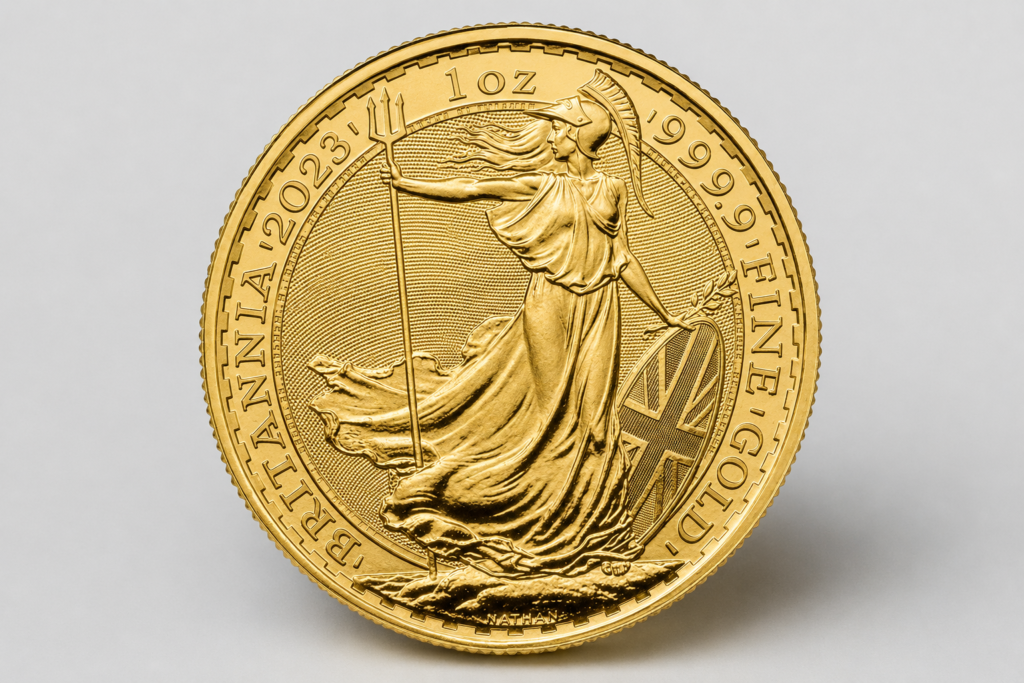
The Gold Britannia is the Royal Mint’s flagship gold bullion coin, in production since 1987. The program was transformed in 2013 when the Royal Mint upgraded the gold from .917 fine (22-karat) to .9999 fine (24-karat) and introduced the most extensive anti-counterfeit feature set of any sovereign gold bullion coin in production at the time.
Post-2013 Gold Britannias are IRA-eligible by default IRS rule, carry a 100-pound face value, and share their standing Britannia design heritage with British coinage going back to the seventeenth century. This guide covers every dimension a Gold Britannia buyer needs.
Premium figures and dealer prices move daily; the numbers in this guide are durable framing rather than current quotes. Tax treatment is informational and not professional advice. The UK Capital Gains Tax exemption frequently cited in Britannia marketing applies to UK-resident holders only and has no effect on a U.S. tax return.
What is the Gold Britannia?
The Gold Britannia is the UK Royal Mint’s flagship gold bullion coin, struck at the Llantrisant facility in Wales. Current production coins are .9999 fine (24-karat) — the fineness standard adopted in the 2013 program upgrade. Earlier issues from 1987 through 2012 were .917 fine (22-karat) with a copper-zinc hardening alloy in the original Eagle-equivalent format.
The 1 troy ounce Gold Britannia contains one troy ounce (31.103 grams) of pure gold, weighs 31.21 grams gross post-2013, measures 32.69 millimeters in diameter, and carries a 100 pound face value as legal tender in the UK. The post-2013 issues are IRA-eligible under the default IRS rule for gold of .995 fineness or higher; pre-2013 .917 fine issues sit below the default threshold and are not IRA-eligible at any custodian.
The 1987 launch and the 2013 fineness upgrade
The Gold Britannia launched in 1987 with the .917 fine alloy approach the American Gold Eagle had introduced a year earlier. Both coins used a hardened 22-karat copper alloy for durability, and both targeted the global investor demand for sovereign-mint gold bullion that the Krugerrand had pioneered in 1967. The Britannia’s 1987 launch placed it as the UK Royal Mint’s answer to the Eagle, the Maple Leaf, and the Krugerrand in the rapidly expanding bullion-coin market of the late 1980s.
The 2013 redesign rebuilt the program. The Royal Mint upgraded the gold from .917 fine to .9999 fine, matching the 24-karat standard the Canadian Gold Maple Leaf had set in 1982 and the American Gold Buffalo had matched in 2006. The fineness upgrade also flipped the program’s IRA-eligibility status — pre-2013 .917 Britannias sit below the .995 IRS default rule and were never eligible, while post-2013 .9999 Britannias clear the default rule cleanly and qualify for any self-directed precious metals IRA.
The same 2013 redesign added the security-feature suite that distinguishes modern Britannias from every prior vintage and from most peer sovereigns: a radial-line surface texture, micro-text inscriptions, and a latent image feature. From 2014 onward, the Royal Mint began rotating the Bullion strike’s reverse design annually alongside Philip Nathan’s classic standing-Britannia motif. From 2023, the obverse switched to Martin Jennings’s King Charles III portrait, replacing the Jody Clark Queen Elizabeth II portrait that ran from 2015 through 2022.
Specifications of the 1 oz Gold Britannia
The specifications below describe the 1 oz Bullion strike, the workhorse Gold Britannia and the variant most positions are built around. Fractional sizes share the same alloy, design, and fineness — only the dimensions, weight, and face value scale down.
| Specification | Value |
| Gold content | 1 troy oz (31.103 g) |
| Purity (current) | .9999 fine (24-karat) – post-2013 |
| Purity (1987-2012) | .917 fine (22-karat) with copper-zinc alloy |
| Gross weight (post-2013) | 31.21 g |
| Diameter | 32.69 mm |
| Thickness | ~2.8 mm |
| Edge | Reeded |
| Face value | 100 GBP |
| Issuing mint | The Royal Mint, Llantrisant, Wales |
| First minted | 1987 (.917); .9999 since 2013 |
| Standard sizes | 1 oz, 1/2 oz, 1/4 oz, 1/10 oz, 1/20 oz, 1/40 oz |
| IRA-eligible (post-2013) | Yes – by default .995 rule |
| U.S. capital gains treatment | Collectible (28% max long-term rate) |
The 1 oz Gold Britannia contains exactly the same one troy ounce of pure gold as the 1 oz Gold Eagle, the 1 oz Gold Buffalo, the 1 oz Krugerrand, and every other 1 oz sovereign gold bullion coin. The differences across these coins are surrounding alloy, mint origin, design, and IRA-eligibility path — not pure gold content. The gold-content floor every 1 oz Gold Britannia sits on is 1 troy oz times the live gold spot price.
Design: the standing Britannia and the rotating reverses
Philip Nathan’s 1987 reverse — Britannia in profile holding a trident in her right hand and a shield emblazoned with the Union Flag in her left, with an olive branch and the inscription BRITANNIA — remains the program’s defining motif. The figure is the classical personification of the British Isles, first appearing on Roman-era coinage under Hadrian and Antoninus Pius in the second century CE, revived on Charles II’s halfpenny in 1672, and present on UK coinage in various forms continuously since.
From 2014 onward, the Royal Mint began issuing the Gold Bullion strike with an annual rotating reverse design alongside Nathan’s classic motif. Each year’s rotating reverse carries a different artist’s interpretation of the Britannia figure, sometimes paired with allegorical accompaniments — a lion, a wave motif, a wind-blown flag. The annual reverses add collector interest to the Bullion line without displacing the standard Nathan reverse that continues in parallel.
The obverse carries the reigning UK monarch’s portrait. Ian Rank-Broadley’s QEII portrait appeared on early Gold Britannias; Jody Clark’s QEII portrait ran from 2015 through 2022; Martin Jennings’s King Charles III portrait has appeared from 2023 onward. The monarch portrait is a real tracking dimension on long-running Gold Britannia positions because the same coin can carry several portraits depending on the year of mintage.
The 2013 security-feature suite
The 2013 Royal Mint redesign added the most extensive anti-counterfeit feature set of any sovereign gold bullion coin in production at the time. Each feature targets a different counterfeit attack vector, and all four sit on top of the standard specifications you can verify yourself.
Radial-line surface texture
A precision-machined radial-line pattern is micro-engraved across the reverse field on every post-2013 Gold Britannia, similar in concept to the Royal Canadian Mint’s 2013 Maple Leaf redesign added in the same year. The pattern reflects light distinctively and is extremely difficult to replicate on counterfeit dies.
Micro-text inscription
Microscopic text reading DECUS ET TUTAMEN, meaning an ornament and a safeguard and historically associated with British coinage edges since the seventeenth century, runs around the design. Visible only under magnification.
Latent image
An angle-dependent latent image is incorporated into the design and is viewable as it shifts under tilting light. Most prominent on certain annual rotating reverse designs.
Standard specification verification
Beneath the proprietary security layer, every post-2013 Gold Britannia matches its published gross weight, diameter, thickness, and reeded-edge profile. A handheld Sigma Verifier reads the .9999 gold conductivity signature in a way that cleanly distinguishes the post-2013 Gold Britannia from pre-2013 .917 issues, from base-metal counterfeits, and from other sovereign coins of different fineness.
The Gold Britannia fractional ladder
The Gold Britannia ships in one of the most complete fractional ladders of any major sovereign gold program — six sizes on the standard production schedule. As with every other sovereign program, per-ounce premium rises as the size falls; the 1 oz Bullion is the cost-efficient choice for a gold-allocation position, and the smaller sizes fit position-sizing flexibility and gifting at higher per-ounce premiums.
1 oz (100-pound face value)
The workhorse Bullion strike and the center of the program. The tightest dealer premium per ounce in the Gold Britannia line and the variant accepted by every IRA custodian for post-2013 issues. Sold loose or in Royal Mint tubes.
1/2 oz (50-pound face value)
A common fractional choice for mid-sized portfolios. Per-ounce premium sits above the 1 oz by a meaningful gap.
1/4 oz (25-pound face value)
A common gifting size and smaller-position choice.
1/10 oz (10-pound face value)
A small fractional size; per-ounce premium runs notably above the 1 oz.
1/20 oz (5-pound face value)
Smaller fraction with a high per-ounce premium.
1/40 oz (0.50 pound face value)
The smallest of the standard gold fractionals; primarily gifting and entry-level. Per-ounce premium is the highest in the ladder.
Premium over spot: where the Gold Britannia sits among .9999 sovereigns
The post-2013 Gold Britannia trades at a premium over spot in line with the other .9999 fine sovereigns — the Canadian Gold Maple Leaf, the Austrian Gold Philharmonic, the Australian Gold Kangaroo. The American Gold Buffalo sits above the Britannia at the highest tier among .9999 coins because of its U.S.-domestic-mint premium. The Krugerrand and the American Gold Eagle, both .9167 fine, sit at the cost-leader tier below the Britannia.
Three structural factors place the Gold Britannia where it does in the premium hierarchy. The Royal Mint’s per-coin production cost on the .9999 alloy is real but supported by the program’s scale across the full fractional ladder. The Britannia carries a Royal Mint brand premium that is modest in the U.S. retail market, lower than the U.S. domestic premium that lifts the Eagle and the Buffalo. The 2013 security-feature investment adds a small structural cost reflected in the premium.
Pre-2013 .917 Gold Britannias trade at a modest discount to current production because they lack the security features, are not IRA-eligible, and because the buyer pool shrinks accordingly. Live premium figures move daily, so check current dealer pricing at purchase.
Our premium over spot guide covers the framework and our gold spot price guide covers the live-data layer.
IRA eligibility by vintage
Post-2013 .9999 fine Gold Britannias are eligible for self-directed precious metals IRAs by the default IRS rule. IRC section 408(m)(3) sets the rule that gold held in an IRA must be at least .995 fine; post-2013 Gold Britannias clear the threshold by 0.49% and need no specific statutory exception.
Pre-2013 .917 fine Gold Britannias are not IRA-eligible. They sit below the .995 default rule and are not named in the statute as an explicit exception, unlike the .9167 fine American Gold Eagle that qualifies only because Congress named it specifically. The split is by vintage, not by coin name — if you are building an IRA position in Gold Britannias, you must specify post-2013 issues, and a custodian will reject a pre-2013 deposit. This is the Gold Britannia-specific edge case the buyer needs to understand before placing an IRA-bound order.
Our gold IRA guide covers the full framework. Comparable 1 oz sovereign gold options eligible for the IRA:
- American Gold Buffalo (.9999 since 2006 — default rule)
- Canadian Gold Maple Leaf (.9999 since 1982 — default rule)
- Austrian Gold Philharmonic (.9999 since 1989 — default rule)
- Australian Gold Kangaroo (.9999 — default rule)
- American Gold Eagle (.9167 fine — named statutory exception)
How to buy, and how to handle a .9999 gold coin
The Gold Britannia is sold at every major U.S. gold bullion dealer (APMEX, JM Bullion, Money Metals Exchange, SD Bullion, Provident Metals, Hero Bullion), at major UK and European dealers, at major coin dealers across both markets, and at many local coin shops. The Royal Mint distributes Bullion strikes through a network of authorized purchasers who resell to the retail market and also sells some Bullion product direct via royalmint.com. Proof strikes and the annual rotating reverses are sold direct by the Royal Mint during release windows and on the secondary market after.
Post-2013 .9999 fine Gold Britannias are meaningfully softer than the pre-2013 .917 issues and softer than the .9167 fine Gold Eagle and Krugerrand. Handle by the edges, keep coins in Royal Mint capsules or inert holders, and avoid setting loose 24-karat coins against each other. Surface marks on a .9999 coin do not change the gold content but can affect resale value if the coin moves toward the collector market.
The UK Capital Gains Tax exemption frequently cited in Britannia marketing applies only to UK-resident holders. For U.S. holders, Gold Britannia disposals are taxed as collectibles up to 28% on long-term gains, the same federal treatment as every other physical gold coin held in the U.S. Treat the CGT-exempt framing as a UK-side talking point that does not affect your U.S. position.
Our how to buy gold guide covers the broader buying framework.
Authentication, storage, and resale
Authentication on a post-2013 Gold Britannia is unusually well-supported because of the layered security features. The published specifications (31.21 g gross for the 1 oz, 32.69 mm diameter, ~2.8 mm thickness, reeded edge) are the buyer-side check. The radial-line micro-engraving on the post-2013 reverse field is visible under proper lighting; the micro-text and latent image are visible under magnification and angle-shift, respectively.
A handheld Sigma Verifier reads the .9999 gold conductivity signature cleanly, and the ping test confirms a struck gold coin profile against base metal. Pre-2013 Gold Britannias rely on the standard specifications check alone with no proprietary security layer.
Storage options include a home safe rated for fire and theft, a bank safe deposit box, a private depository (Brink’s, Loomis, Delaware Depository), or an IRA-custodian-held depository for post-2013 IRA positions. IRA-held Gold Britannias must be stored at an approved depository; home storage of IRA gold is not permitted under IRS rules. Pre-2013 Gold Britannias have no IRA path and live in the taxable sleeve only.
Resale at any major U.S. or UK dealer is straightforward. The Gold Britannia is one of the most universally recognized .9999 fine gold bullion coins in the world, and post-2013 issues trade at tight dealer bid-ask spreads in line with other .9999 sovereigns. Pre-2013 .917 Gold Britannias trade at a modest discount.
Document the sale carefully for tax purposes: U.S. capital gains on physical gold are taxed as collectibles, up to 28% on long-term gains rather than the standard 15-20% long-term capital gains rate. Consult a qualified tax professional before filing. Our guide to selling precious metals covers the full resale framework.
Frequently asked questions
What is the Gold Britannia?
The Gold Britannia is the UK Royal Mint’s flagship gold bullion coin, produced at the Royal Mint in Llantrisant since 1987. Current production coins are .9999 fine (24-karat) and IRA-eligible by default IRS rule; pre-2013 issues were .917 fine (22-karat) and are not IRA-eligible. The 1 troy ounce Gold Britannia carries a 100 pound face value and ships in a full fractional ladder from 1 oz down to 1/40 oz.
Are Gold Britannias IRA-eligible?
Post-2013 .9999 fine Gold Britannias are IRA-eligible by the default IRS rule that requires .995 fineness or higher; pre-2013 .917 issues are not eligible because they sit below the default threshold and Congress did not name them as a statutory exception. The split is by vintage, not by coin name, so a custodian will accept a 2014 Gold Britannia and reject a 2010 Gold Britannia even though both read as Gold Britannia on the label. If you’re building an IRA position, specify post-2013 issues.
What changed with the Gold Britannia in 2013?
The 2013 redesign upgraded the gold from .917 fine (22-karat) to .9999 fine (24-karat) and added a four-feature security suite — radial-line surface texture, DECUS ET TUTAMEN micro-text, a latent image, and the standard specifications verification layer. The fineness upgrade also flipped the program’s IRA-eligibility, moving post-2013 issues into default-rule eligibility while pre-2013 issues remain excluded. The 2013 transition is the defining structural fact about the Gold Britannia program for any U.S. portfolio investor.
What is the difference between a Gold Britannia and a Canadian Gold Maple Leaf?
Both are .9999 fine 1 troy ounce sovereign gold bullion coins and both clear the .995 IRA default rule for post-2013 Gold Britannia issues — the practical differences are mint origin, design, fractional ladder, and the vintage consideration. The Gold Britannia comes from the UK Royal Mint with the standing-Britannia reverse and annual rotating designs since 2014; the Gold Maple Leaf comes from the Royal Canadian Mint with the single-maple-leaf reverse. The Maple Leaf has been .9999 fine since 1982, so vintage doesn’t affect Maple Leaf IRA eligibility; vintage matters significantly for the Britannia because of the 2013 cutoff.
Are Gold Britannias exempt from Capital Gains Tax?
Gold Britannias are exempt from UK Capital Gains Tax because they are British legal currency at face value, but the exemption applies only to UK-resident holders and has no effect on a U.S. tax return. For U.S. holders, Gold Britannia disposals are taxed as collectibles up to 28% on long-term gains, the same federal treatment as every other physical gold coin held in the U.S. The CGT exemption is a real benefit for UK residents and dominates UK-targeted Britannia marketing, but it does not transfer to U.S. tax treatment.
Do pre-2013 Gold Britannias sell at a discount?
Pre-2013 .917 Gold Britannias generally trade at a modest discount to current production because they lack the post-2013 security features and because they are not IRA-eligible — both factors shrink the buyer pool. The discount is real but not large at most major dealers, and pre-2013 issues remain perfectly legitimate bullion at their full gold-content floor of 1 troy oz times the live gold spot price. They simply trade as taxable-sleeve-only stock at slightly tighter dealer margins.
What sizes does the Gold Britannia come in?
The Gold Britannia ships in 1 oz, 1/2 oz, 1/4 oz, 1/10 oz, 1/20 oz, and 1/40 oz on the standard production schedule — one of the most complete fractional ladders of any major sovereign gold program. Per-ounce premium rises as the size falls, so the 1 oz remains the cost-efficient choice for a gold-allocation position; the smaller sizes fit position-sizing flexibility and gifting. Each fractional size carries a scaled face value (50, 25, 10, 5, 0.50 pounds, respectively).
Track your Gold Britannias in Gold Silver Ledger
The 2013 fineness pivot is the defining structural fact about a Gold Britannia holding, and most positions that span pre- and post-2013 issues have an implicit IRA-eligibility split running through them. Pre-2013 .917 issues live in the taxable sleeve by IRS rule; post-2013 .9999 issues can live in either sleeve. Tracking that vintage-driven split by hand is harder than it sounds because the coin reads as Gold Britannia on the label regardless of fineness.
Gold Silver Ledger keeps separate catalog items for the pre-2013 .917 Gold Britannia and the post-2013 .9999 Gold Britannia, plus each fractional size as its own catalog item. The vintage and fineness are baked into the catalog row, so the IRA eligibility reads correctly off the item itself. Cost basis is locked at purchase per item.
Current value renders against the live gold spot price continuously. Filters let you view Gold Britannias by vintage, by size, or roll the position in with Eagles, Buffalos, Maples, and other sovereigns for a combined gold view. The Custody Statement organizes holdings by storage location with collapsible per-location cards.
Analytics surfaces premium spend across the Gold Britannia ladder, across vintages, across sizes. The Tax Report excludes disposals of IRA-held post-2013 Britannias from taxable totals automatically; the storage location does the work. Pre-2013 Britannia disposals flow through the taxable totals as expected. Start your trial on the Gold Silver Ledger pricing page.
This guide is for informational purposes and does not constitute financial, investment, or tax advice. Premium figures, spot prices, and dealer quotes move daily; verify current numbers before any purchase or sale. The UK Capital Gains Tax exemption referenced applies to UK-resident holders only and does not transfer to U.S. holders. Consult a qualified tax professional before filing on physical-bullion disposals.
