
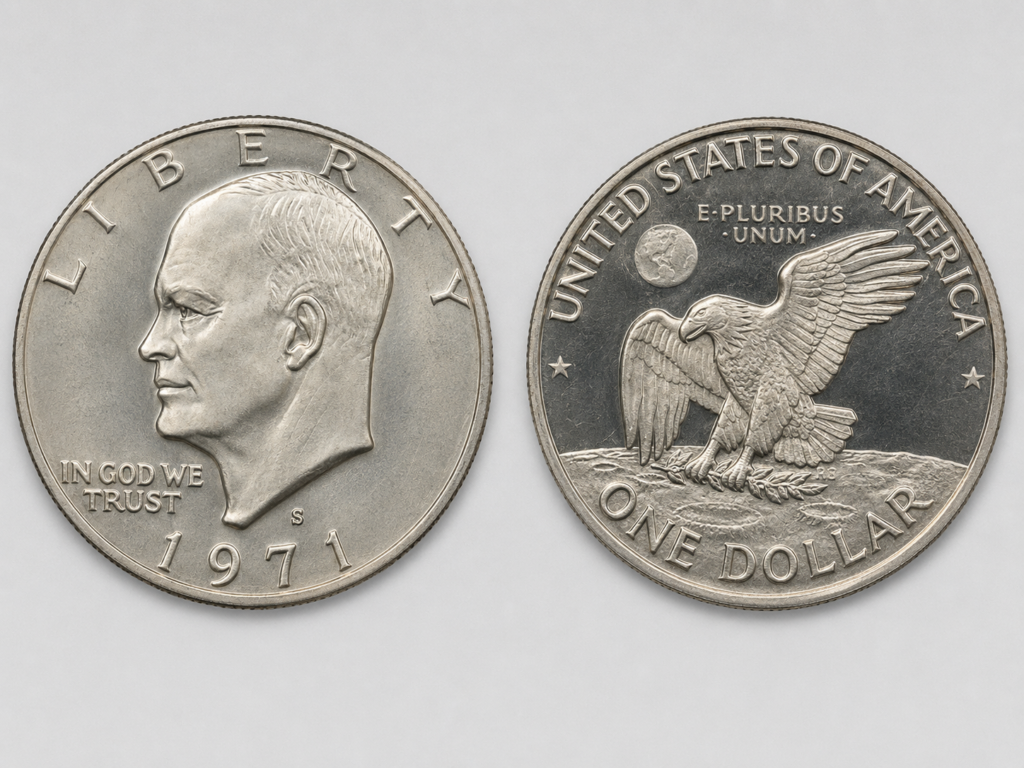
The phrase “1971 silver dollar” is a useful starting point but a misleading endpoint. Most 1971 Eisenhower dollars are copper-nickel clad coins with no silver content, worth one dollar at face value. The US Mint did strike a 40% silver version of the 1971 Ike, but only at San Francisco and only for collector sale: the “Brown Ike” proof and the “Blue Ike” uncirculated. Each holds 0.3161 troy oz of silver.
This guide handles the 1971-specific silver-vs-clad question; the broader silver dollar guide covers the rest of the lineage. Here, the identification check, the value chart, and the Brown Ike vs Blue Ike distinction — in that order.
What is a 1971 Eisenhower dollar worth today?
Most 1971 Eisenhower dollars are clad and worth one dollar at face. The silver floor only applies to the 1971-S Brown Ike (proof) and 1971-S Blue Ike (uncirculated), which each contain 0.3161 troy oz of silver. At typical silver levels, the metal content alone in a Brown Ike or Blue Ike runs roughly $9–$13 per coin.
Circulated clad 1971 (no mintmark) and 1971-D Ikes trade at face. Clad business strikes in MS-66 carry low-three-figure collector premiums, and MS-67 reaches the low-four figures because the Ike struck poorly in 1971 and high-grade survivors are scarce.
The mintmark is the first thing to check. No mintmark means Philadelphia clad; D means Denver clad; S means San Francisco, which can be a clad proof, a 40% silver proof, or a 40% silver uncirculated. Weight and edge confirm which of the three an S-mint coin is.
Is your 1971 Eisenhower dollar actually silver? Quick identification
Three checks confirm a silver Ike in order: mintmark, weight, edge. The mintmark sits on the obverse, on the truncation of Eisenhower’s neck just above the date — not on the reverse, where readers from the Washington and Roosevelt era look out of habit. No mintmark, and D are always clad.
An S mintmark is the only path to silver, but it alone does not confirm it: the 1971-S exists in three forms, two silver and one clad. (“Clad” means a sandwich of nickel-colored outer layers bonded to a copper-colored inner core, which is why a clad coin shows a brown stripe on the edge.)
Weight is the cleanest second check. A 40% silver Ike weighs 24.59 grams; a clad Ike weighs 22.68 grams. A kitchen scale that reads to 0.1 grams resolves the difference. Edge confirms it visually: a clad Ike shows a brown copper stripe sandwiched between two nickel-colored layers on the reeded edge, while a 40% silver Ike shows a uniform silver-colored band with no copper layer.
Original packaging — the brown plastic display box for a Brown Ike, the blue Mylar envelope for a Blue Ike — confirms a silver version when present and unbroken. For the dollar-coin-specific question, the reference on which dollar coins are silver covers every US dollar series from the Morgan through the Sacagawea.
Brown Ike vs Blue Ike: the two 40% silver versions
The 40% silver 1971 Ike was sold by the US Mint in two formats, distinguished by finish and packaging. Both were collector products — neither was struck for circulation.
Brown Ike (1971-S 40% silver proof)
A Brown Ike is a 1971-S 40% silver proof — mirror-finish fields, frosted devices — struck at San Francisco and sold in a brown plastic display box for $10 at issue. Mintage was roughly 4.27 million. Coins removed from the original holder are still authentic but lose original-issue premium. Cameo and Deep Cameo proofs trade meaningfully above standard proof tiers.
Blue Ike (1971-S 40% silver uncirculated)
A Blue Ike is a 1971-S 40% silver business-strike-style uncirculated coin — satin finish, not proof — sold in a blue Mylar envelope for $3 at issue. Mintage was roughly 6.87 million. The “blue” name refers to the envelope, not the coin. Blue Ikes anchor at the silver floor with a modest collector premium when the original envelope is intact.
Both share the same composition: outer layers of 80% silver and 20% copper bonded to a core of approximately 21% silver and 79% copper, yielding a net 40% silver content of 0.3161 troy oz at 24.59 grams. Both were authorized under the legislation that created the Eisenhower dollar series, and both were sold exclusively to collectors who ordered direct from the US Mint.
1971 Eisenhower dollar value chart by variant and grade
The chart below covers all five 1971 Ike variants — two clad business strikes, one clad proof, and the two 40% silver versions — across representative grade tiers. Business strikes show MS tiers; proofs show PR tiers; a dash means the column does not apply.
Ranges are illustrative and reflect PCGS Price Guide and NGC Coin Explorer figures at the time of writing — re-quote a live source before any sale.
| Variant | MS-63 | MS-65 | MS-66 | MS-67 | PR-65 | PR-67 DCAM | PR-69 DCAM |
| 1971 (Philadelphia, clad) | $3–5 | $15–25 | $60–100 | $1,500–3,000+ | — | — | — |
| 1971-D (Denver, clad) | $2–4 | $8–15 | $25–50 | $200–400 | — | — | — |
| 1971-S clad proof | — | — | — | — | $3–5 | $5–10 | $15–25 |
| 1971-S 40% silver proof (Brown Ike) | — | — | — | — | $10–15 | $15–25 | $30–50 |
| 1971-S 40% silver uncirculated (Blue Ike) | $10–15 | $12–18 | $20–35 | $75–150 | — | — | — |
Last updated: June 2026. Cross-checked against PCGS Price Guide and NGC Coin Explorer at publish.
What makes a 1971 Eisenhower dollar worth more than face?
Five paths take a 1971 Ike above the one-dollar face floor. Any coin you suspect falls into one of them belongs in front of a PCGS or NGC grader before sale — counterfeits and mis-attributed varieties are present at the variety end of this market.
40% silver content (Brown Ike, Blue Ike)
The 1971-S 40% silver versions hold 0.3161 troy oz of silver each. At typical silver levels the metal content alone runs in the high single digits to low double digits per coin — well above the one-dollar face value — before any collector premium.
High Mint State clad grades (MS-66 and above)
The Eisenhower dollar struck poorly at Philadelphia and Denver in 1971; fully struck, fully lustrous survivors are scarce. MS-66 examples trade in the low three figures and MS-67 examples reach the low four figures or above when offered.
Cameo and Deep Cameo proofs
1971-S proofs — both clad and 40% silver — carry stronger premiums when the contrast between mirror fields and frosted devices is full-strike Cameo or Deep Cameo. PR-69 DCAM Brown Ikes trade meaningfully above the silver floor.
1971-S Type 2 reverse variety
A small number of 1971-S coins were struck with a sharper, higher-relief reverse hub — the Type 2 — distinguished by more defined earth relief than the standard Type 1. Authenticated examples carry modest premiums; PCGS or NGC attribution is the standard.
Errors and major doubled-die varieties
Off-center strikes, broadstrikes, and FS-401 doubled-die obverses carry premiums driven by the specific error or variety, not by composition. Any suspected error coin should be authenticated before sale.
Frequently asked questions
How can I tell if my 1971 silver dollar is actually silver?
A 1971 Eisenhower dollar is silver only if it has an S mintmark above the date, weighs 24.59 grams, and shows a uniform silver-color edge with no copper stripe. The S mintmark alone is not enough — a 1971-S can also be a clad proof — so weight and edge are the confirming checks. Philadelphia (no mintmark) and Denver (D) 1971 Ikes are always clad.
Are all 1971 Eisenhower dollars silver?
No — only the 1971-S Brown Ike (40% silver proof) and 1971-S Blue Ike (40% silver uncirculated) are silver, and the US Mint sold both to collectors rather than releasing them into circulation. Every 1971 with no mintmark (Philadelphia) and every 1971-D (Denver) is copper-nickel clad with zero silver content.
What is the difference between a Brown Ike and a Blue Ike?
A Brown Ike is a 1971-S 40% silver proof with mirror fields and frosted devices, sold in a brown plastic display box for $10 at issue; a Blue Ike is a 1971-S 40% silver uncirculated coin with a satin finish, sold in a blue Mylar envelope for $3 at issue. Both share the same composition and the same 0.3161 troy oz of silver — the differences are the finish and the packaging.
How much silver is in a 1971-S Eisenhower dollar?
A 1971-S 40% silver Eisenhower dollar — Brown Ike or Blue Ike — contains 0.3161 troy oz of pure silver in a coin weighing 24.59 grams total. The composition is outer layers of 80% silver and 20% copper bonded to a core of approximately 21% silver and 79% copper, for a net 40% silver content. Diameter is 38.1 mm; edge is reeded.
What is a 1971 Eisenhower dollar with no mintmark worth?
A 1971 Eisenhower dollar with no mintmark is a Philadelphia clad business strike, worth one dollar at face in average circulated condition. Mint State examples climb sharply — MS-65 in the $15–$25 range, MS-66 around $60–$100, and MS-67 well into the four figures, because the Ike struck poorly in 1971 and high-grade survivors are scarce.
Should I remove a Brown Ike or Blue Ike from its original packaging?
No, leave a Brown Ike or Blue Ike in its original US Mint packaging if collector value matters. Removed coins are still authentic silver and still trade at the silver floor, but the original-issue premium is real, and PCGS or NGC will note “original government packaging” on the grading service holder when the coin is submitted in it.
See your 1971 silver Ikes’ melt value live in Gold Silver Ledger
A Brown Ike or Blue Ike is a bullion coin first and a collector item second — the 0.3161 troy oz of silver inside is the floor under the price, and that floor moves whenever the silver market does. Gold Silver Ledger tracks each silver Ike as its own line: catalog entry or custom item, weight, and fineness recorded, live silver spot priced against the ASW.
This article is for informational and educational purposes only and does not constitute investment, sale, or numismatic advice. Value ranges above are illustrative; cross-check against PCGS Price Guide and NGC Coin Explorer before any sale. Any suspected Type 2 reverse variety, doubled die, or top-grade Mint State example should be professionally authenticated by PCGS or NGC.
