
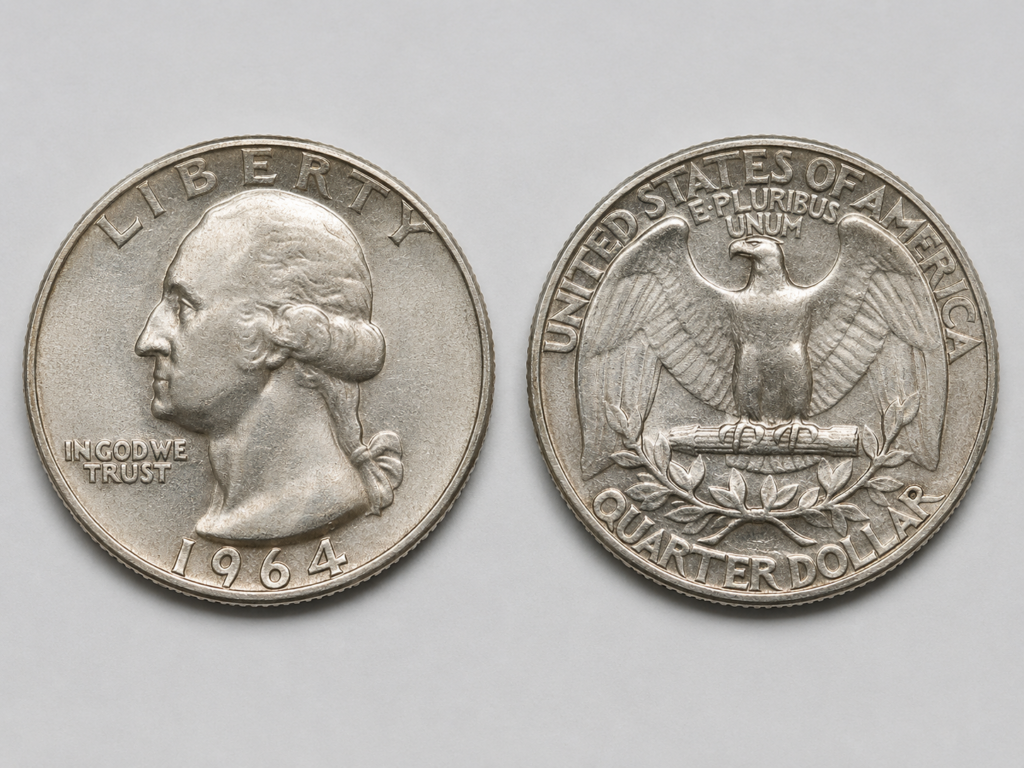
A 1964 Washington quarter is the last year of the 90% silver quarter — every 1965 and later quarter is copper-nickel clad with no silver in it. Each 1964 piece holds 0.1808 troy oz of silver, so its melt-value floor moves continuously with the silver spot price.
Most 1964 quarters are common-date circulated pieces worth a small premium over that silver content. A handful of varieties and high-grade examples trade higher. This guide gives the chart, names the exceptions, and shows where the silver floor stops.
What is a 1964 quarter worth today?
A 1964 Washington quarter contains 0.1808 troy oz of silver and is worth at minimum its silver melt value, which moves with the silver spot price. At a hypothetical $60 silver, the metal content alone runs about $10.85 per coin.
Common circulated 1964 quarters — both 1964 (no mintmark, Philadelphia) and 1964-D (Denver) — trade at melt plus a small dealer premium. In bag math, dealers price them at the standard junk silver multiplier on $1 of face value: $1 face = 0.715 troy oz of silver, times spot.
Mint State examples carry a collector premium that opens up sharply at MS-65 and accelerates above. The 1964 SMS, the Type B and Type C reverse varieties, and cameo proofs from the 1964 proof sets command serious premiums that the rest of this guide breaks down.
Is your 1964 quarter actually silver? Quick identification
Every 1964 Washington quarter is 90% silver — there is no clad version of the 1964 quarter. If the date reads 1964, the coin is silver. Three quick visual checks confirm it: the date is 1964 (1965 and later quarters look almost identical at a glance but are clad and contain zero silver); the edge shows a uniform silver-color band with no copper stripe (a clad quarter shows a brown copper layer sandwiched between two nickel-colored layers on the edge); the weight is 6.25 grams on a kitchen scale (a clad quarter weighs 5.67 grams).
For the broader question of which US coins contain silver, the cross-denomination silver coin identification reference covers every denomination by year.
Reading the date and mintmark on a 1964 quarter
The date sits on the obverse, to the right of George Washington’s portrait. The mintmark — the small letter indicating which US Mint facility produced the coin — sits on the REVERSE, to the right of the wreath at the base of the eagle and below the words QUARTER DOLLAR. That is not the same location as on later Washington quarters, where the mintmark moved to the obverse beginning in 1968.
Two mintmarks appear on 1964 quarters: no mintmark (Philadelphia struck about 564 million) and D (Denver struck about 704 million). Denver out-produced Philadelphia for 1964 — an unusual case in the Washington series — which is why both mints remain easy to find in pre-1965 sorting today.
1964 quarter value chart by mintmark and grade
Both mints sit at the same junk-silver-plus-small-premium pricing through AU-50, and the spread opens in Mint State as condition rarity kicks in.
The ranges below are illustrative and reflect PCGS Price Guide and NGC Coin Explorer figures at the time of writing — pricing moves, so use the live PCGS or NGC entries to confirm before any sale.
| Mintmark | G-4 | VF-20 | AU-50 | MS-63 | MS-65 | MS-67 |
| 1964 (no mintmark) | Melt + $1 | Melt + $1 | Melt + $2 | $8–$12 | $18–$28 | $120–$200 |
| 1964-D | Melt + $1 | Melt + $1 | Melt + $2 | $8–$14 | $18–$30 | $140–$240 |
Last updated: June 2026. Cross-checked against PCGS Price Guide and NGC Coin Explorer at publish.
What makes a 1964 quarter worth more than melt?
Four paths take a 1964 quarter above the junk silver floor. Any coin you suspect falls into one of them belongs in front of a PCGS or NGC grader before sale — counterfeits, altered coins, and mis-attributed varieties are common at this end of the market.
Mint State grade (MS-65 and above)
A 1964 quarter that survived six decades without entering circulation is scarce; the premium rises sharply at MS-65 and accelerates at MS-67. Most high-grade survivors come from original Mint Sets and proof sets rather than from change.
1964 SMS (Special Mint Set)
A small number of 1964-dated quarters were struck with a distinctive satin finish, different from regular business strikes and from proofs. Authenticated 1964 SMS quarters are scarce and trade in the low five figures when offered. Professional authentication by PCGS or NGC is required.
Type B and Type C reverse varieties
A small share of 1964 quarters were struck using leftover proof-style reverse hubs — Type B on Philadelphia coins, Type C on Denver coins. The varieties carry modest premiums in Mint State and need specialist attribution to be priced confidently.
1964 proof issues, especially cameo
Philadelphia struck about 3.95 million proof Washington quarters in 1964, identifiable by mirror-polished fields and frosted devices. Cameo and Deep Cameo proofs trade at multiples of regular proofs at the same grade.
Frequently asked questions
How much is a 1964 quarter worth today?
A 1964 Washington quarter is worth at minimum its silver melt value, calculated as 0.1808 troy oz times the live silver spot price; at a hypothetical $60 silver that floor sits around $10.85 per coin. Common circulated examples trade at melt plus a small premium; Mint State 65 and above, SMS, reverse varieties, and cameo proofs trade higher.
Is a 1964 D quarter rare?
A 1964-D quarter is not rare in circulated condition — Denver struck about 704 million, more than Philadelphia did that year. The 1964-D becomes scarce in MS-65 and above because few were saved without bag marks, and Type C reverse examples carry a modest variety premium when properly attributed.
What is a 1964 quarter made of?
A 1964 Washington quarter is 90% silver and 10% copper, weighs 6.25 grams total, and contains 0.1808 troy oz of pure silver. The diameter is 24.3 mm and the edge is reeded. The composition is identical to every Washington quarter struck from 1932 through 1964.
Why are 1964 quarters the last silver quarters?
The Coinage Act of 1965 ended silver in circulating US quarters, replacing the 90% silver composition with copper-nickel clad after rising silver prices made the silver-content coins worth more as metal than as currency. Quarters dated 1965 and later contain no silver; the 1964 quarter is the cutoff.
How can I tell if my 1964 quarter is a Special Mint Set (SMS)?
A 1964 SMS quarter has a distinctive satin-like surface that differs from both the brilliant luster of a regular business strike and the mirror-polished fields of a proof. Authentication is the only reliable confirmation — populations in PCGS and NGC holders are small, and a real example is worth a low five-figure number, so a suspect coin is well worth a grader’s fee.
Should I spend or save my 1964 quarters?
Save them — every 1964 quarter is worth substantially more as silver content than its 25-cent face value, even in the worst circulated condition. At a hypothetical $60 silver, the metal alone runs about $10.85 per coin; spending one as a quarter throws away over 97% of its value.
See your 1964 silver quarters’ melt value live in Gold Silver Ledger
Junk silver is simple math per coin and tedious math per bag — face value, multiplier, live spot, repeated across however many dollars of face you hold.
Gold Silver Ledger runs that math on every line continuously, so a $50 face bag of 1964s shows its current silver-content value the moment you open the app. A graded Mint State or SMS single goes in as its own catalog entry, and the per-piece premium you paid above the silver floor is locked on the row.
Start a free trial today.
This article is for informational and educational purposes only and does not constitute investment, sale, or numismatic advice. Value ranges above are illustrative; cross-check against PCGS Price Guide and NGC Coin Explorer before any sale. Any suspected SMS, reverse variety, or top-grade Mint State example should be professionally authenticated by PCGS or NGC.
