
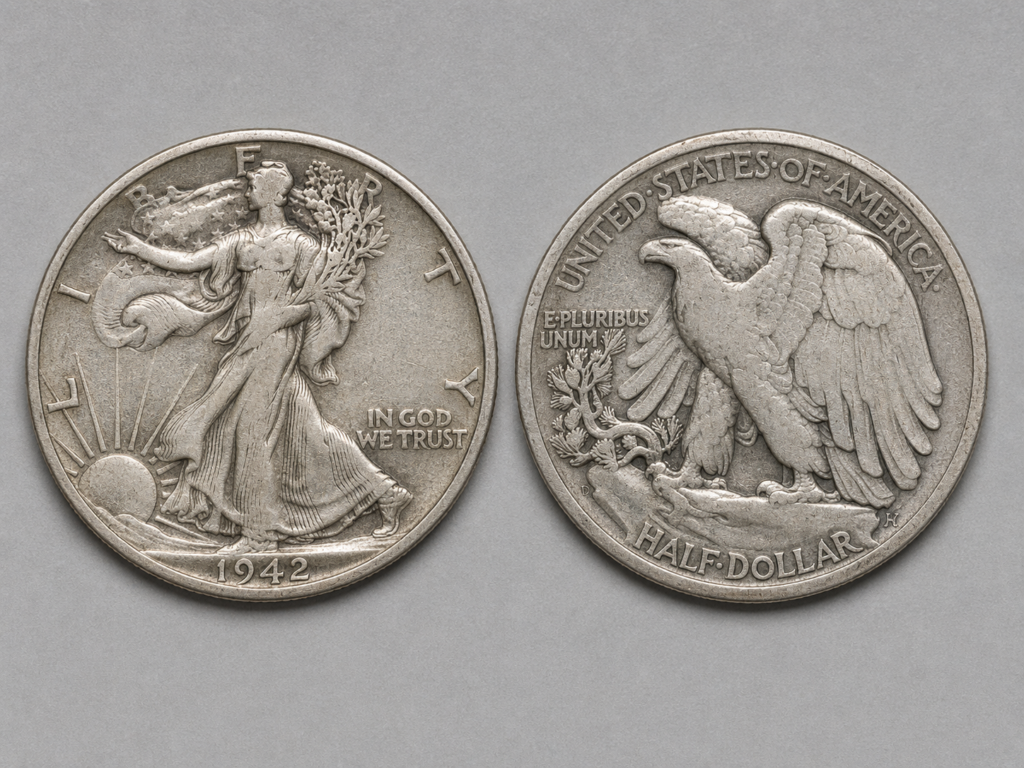
The Walking Liberty half dollar ran from 1916 to 1947 — every coin 90% silver, every coin 12.50 grams, every coin holding 0.36169 troy ounces of silver. Most worn Walkers are worth their silver melt-equivalent. Key dates — the 1921 trio, the 1916 first-year coins, the 1938-D, and the 1917 obverse mintmark varieties — carry premiums above melt. The series had production gaps in 1922, 1924–1926, and 1930–1932.
Quick Answer: What Is a Walking Liberty Half Dollar Worth?
Most worn Walking Liberty half dollars trade at roughly eight to ten times face value at melt-equivalent — they are 90% silver, and the silver content carries the floor on any common date. Above melt, a short list of dates moves on rarity: the 1921 trio (1921-P, 1921-D, 1921-S), the 1916 first-year coins, the 1938-D, and the 1917 obverse mintmark varieties. The 1921-D is the lowest-mintage Walker in the series at 208,000 pieces.
The chart below covers every year and every mint. The key-dates section names the coins that carry numismatic value, the strike-quality section explains why the same date in the same grade can carry different prices, and the selling section routes the rest.
Is It a Walking Liberty? Identification Before Valuation
Before the chart, confirm what you have. The Walking Liberty half dollar entered circulation in 1916, designed by Adolph A. Weinman. The obverse shows Liberty striding toward the sunrise, draped in an American flag, with a branch of laurel and oak in her left hand and her right hand outstretched. The reverse shows a bald eagle perched on a mountain crag, wings raised. Specifications: 30.6 mm diameter, 12.50 grams, 90% silver, reeded edge.
The most common identification error is confusing a Walker with an American Silver Eagle bullion coin. Both share the Walking Liberty obverse — the U.S. Mint recycled Weinman’s design onto the Silver Eagle when the bullion program launched in 1986, and it’s still in use today. Diameter is the decisive check.
The Walker is 30.6 mm and weighs 12.50 grams; the Silver Eagle is 40.6 mm and weighs 31.10 grams. If the coin is roughly half-dollar-sized, it’s a Walker. If it’s noticeably larger than a quarter and feels heavy in the hand, it’s a Silver Eagle.
A second routing question: are Walking Liberty half dollars silver? Yes — every Walker minted from 1916 to 1947 is 90% silver. There is no composition variance across the series, including the war-era 1942–1945 issues. For the full composition story across all U.S. half dollar designs — Walking Liberty, Franklin, and Kennedy — see our guide to which half dollars are silver. For the Kennedy-era valuation, see our Kennedy half dollar value guide.
The Walking Liberty Half Dollar at a Glance
Adolph A. Weinman, a German-born American sculptor, designed both the Walking Liberty half dollar and the Mercury dime in 1916 — two of the most admired American coin designs of the 20th century. The Walker’s obverse shows Liberty mid-stride, the sun rising behind her, the flag flowing across her shoulders. The reverse shows the perched eagle on a mountain crag, wings raised as if about to take flight, a sapling of mountain pine emerging from the rock at the eagle’s feet.
Specifications stay constant across the entire series: 90% silver, 10% copper. Gross weight 12.50 grams. Silver content 0.36169 troy ounces. Diameter 30.6 millimeters. Reeded edge. The design returned in 1986 on the American Silver Eagle bullion coin, where Weinman’s striding Liberty appears on the obverse to this day. For broader U.S. coin design history, see our overview of the history of U.S. coinage.
Production Years and the 1917 Mintmark Transition
The Walker series has two structural quirks that confuse readers more than anything else in the chart: the mintmark moved partway through 1917, and seven years of the run produced no Walkers at all.
The 1917 Mintmark Transition
1916 Walkers carry the mintmark on the obverse, below IN GOD WE TRUST on the lower-left field. The 1917 run started the same way, but the U.S. Mint moved the mintmark to the reverse partway through the year — below the eagle’s perch.
This created four distinct 1917 mintmark varieties: 1917-D Obverse (mintage 765,400), 1917-S Obverse (mintage 952,000), 1917-D Reverse (mintage 1,940,000), and 1917-S Reverse (mintage 5,554,000). The obverse-mintmark coins are scarcer and carry premiums; the reverse-mintmark coins are the common 1917 variant. From 1918 onward, mintmarks stayed on the reverse for the rest of the series.
The Production Gap Years
No Walking Liberty half dollars were struck in 1922, 1924, 1925, 1926, 1930, 1931, or 1932 — seven years across two distinct gaps. The first gap (1922 and 1924–1926) followed a collapse in half-dollar demand after the 1921 production run filled commercial needs. The second gap (1930–1932) followed the demand collapse of the Great Depression. The series resumed in 1933 and ran continuously through 1947.
If you searched “1925 Walking Liberty value” and landed here, the honest answer is that there is no 1925 Walker to find. The Mint struck none. Any coin presented as a 1925 Walker is either an alteration of a different date or a fabrication. The same applies to the other six gap years.
The Walking Liberty Half Dollar Value Chart by Year and Mintmark
The chart is the centerpiece of this article. Rows are years from 1916 through 1947, with separate rows for the four 1917 mintmark varieties and grayed-out rows for the seven production gap years.
Columns are mintmarks (P for Philadelphia, D for Denver, S for San Francisco) plus illustrative value ranges at five grade tiers — G-4, VF-20, MS-63, MS-65, and MS-65 Full Detail.
| Year / Variety | Composition | Worn (G-4 → VF-20) | MS-65 | High-Grade Premium |
| 1916 (P) — first year, obverse MM | 90% silver | $40 – $120 | $400 – $700 | MS-67 $1,500 – $2,500 |
| 1916-D — obverse MM | 90% silver | $40 – $150 | $700 – $1,200 | MS-67 $2,500 – $4,000 |
| 1916-S — obverse MM | 90% silver | $90 – $400 | $2,000 – $3,500 | MS-67 $7,500 – $12,000 |
| 1917 (P) — common | 90% silver | $7 – $30 | $200 – $400 | MS-67 $1,200 – $2,000 |
| 1917-D Obverse MM — variety | 90% silver | $40 – $250 | $4,000 – $6,000 | MS-67 $15,000 – $25,000 |
| 1917-D Reverse MM | 90% silver | $10 – $100 | $1,200 – $2,000 | MS-67 $5,000 – $8,000 |
| 1917-S Obverse MM — variety | 90% silver | $30 – $400 | $5,000 – $9,000 | MS-67 $25,000+ |
| 1917-S Reverse MM | 90% silver | $7 – $40 | $700 – $1,200 | MS-67 $4,000 – $7,000 |
| 1918 – 1920 (P, D, S) — common | 90% silver | Silver melt – $30 | $100 – $300 | MS-67 $500 – $1,500 |
| 1919-D — strike rarity | 90% silver | $20 – $180 | $7,000 – $12,000 | MS-65 Full Detail $25,000+ |
| 1921 (P) — key | 90% silver | $200 – $900 | $9,000 – $15,000 | MS-67 $35,000+ |
| 1921-D — series king (208K mintage) | 90% silver | $350 – $2,500 | $15,000 – $25,000 | MS-67 $50,000+ |
| 1921-S — key | 90% silver | $50 – $700 | $30,000 – $50,000+ | MS-67 $100,000+ |
| 1922, 1924 – 1926, 1930 – 1932 | — | No coins struck | — | — |
| 1923-S, 1927-S, 1928-S, 1929-D/S — semi-keys | 90% silver | $10 – $80 | $400 – $1,500 | MS-67 $2,000 – $8,000 |
| 1933-S, 1934 – 1937 (P, D, S) — common | 90% silver | Silver melt – $30 | $50 – $200 | MS-67 $200 – $1,000 |
| 1938-D — late-series key (491K mintage) | 90% silver | $80 – $200 | $800 – $1,200 | MS-67 $1,800 – $3,000 |
| 1938-P, 1939 – 1947 (P, D, S) — late common | 90% silver | Silver melt – $20 | $30 – $150 | MS-67 $100 – $500 |
Value ranges in the chart are illustrative and reflect the PCGS and NGC price guides at the time of writing. Mintage numbers don’t change; price-guide numbers do. For live retail values, check PCGS CoinFacts or NGC Coin Explorer.
How the Mintmarks Read
Philadelphia struck Walkers every production year of the series with no mintmark. Denver struck Walkers in 1916, 1917, 1918, 1919, 1920, 1921, 1929, 1934, 1935, 1936, 1937, 1938, 1939, 1942, 1943, 1944, 1945, 1946, and 1947 — note the conspicuous Denver absence between 1938 and 1942, making the 1938-D the only Denver Walker between 1933 and 1946 and one of the series’ best-known late-run keys. San Francisco struck Walkers more consistently than Denver across the late series.
From 1916 to mid-1917 the mintmarks sit on the obverse, below IN GOD WE TRUST; from mid-1917 onward they sit on the reverse, below the eagle’s perch.
Key Dates and Varieties: The Walkers Worth a Closer Look
A short list. Most Walkers are common in any grade and trade at their silver melt-equivalent. The dates below are the exceptions — coins where mintage, mintmark position, or strike quality moves value materially above the silver baseline.
1921-D
Mintage 208,000 — the lowest in the entire Walking Liberty series and the series king. The 1921-D commands a premium in every grade from Good through Mint State, with high-grade examples reaching five and six figures at major auction.
The 1921 trio is also the most-counterfeited Walker family; the price gap between certified and raw makes counterfeiting profitable enough to be routine. Any 1921-D suspect belongs at PCGS or NGC for professional attribution before sale or major purchase.
1921-P and 1921-S
Mintage 246,000 (Philadelphia) and 548,000 (San Francisco). The 1921-P is the lowest-mintage Philadelphia Walker; the 1921-S is genuinely scarce in any grade and exceptionally rare in Mint State. The same counterfeit caution applies to both — and to any 1921 Walker. Professional grading is the answer.
1916, 1916-D, and 1916-S
First-year Walkers, all with the obverse mintmark. The 1916 Philadelphia carries a mintage of 608,000, the 1916-S 508,000, and the 1916-D 1,014,400. Together they represent the smallest first-year half dollar production run of the 20th century.
The 1916-S is the second-scarcest of the trio and trades at a premium close to the 1916-P’s; the 1916-D, despite the highest mintage of the three, is still scarce by series standards because most first-year coins entered circulation and wore quickly.
1917 Obverse Mintmark Varieties
The 1917-D Obverse (mintage 765,400) and the 1917-S Obverse (mintage 952,000) are scarcer than their reverse-mintmark counterparts and carry meaningful premiums across all grades. Both are transitional varieties — when the Mint moved the mintmark to the reverse mid-year, the obverse strike runs ended. Identifying which 1917-D or 1917-S you hold requires checking both the obverse (lower-left, below IN GOD WE TRUST) and the reverse (below the eagle’s perch).
The presence of a mintmark on the obverse is the variety; coins with the mintmark only on the reverse are the common type.
1938-D
Mintage 491,600. The 1938-D is the sole Denver Walker between 1933 and 1946 and the late-series key date. Of the “genuinely scarce” Walkers, the 1938-D is the most accessible — both in availability and in price — which makes it the variety an estate-cleanout reader is most likely to actually have, outside the 1921 trio. Premium across all grades from Good through Mint State.
1919-D and the Strike Rarities
The 1919-D (mintage 1,165,000) is a semi-key — its mintage is higher than the 1921 trio’s but the coin is notoriously weakly struck, and high-grade Full Detail examples are exceptionally rare. The 1919-D is the classic Walker strike rarity. The 1919-P and 1919-S also struck weakly. For these coins, grade and strike designation matter more than mintage.
A note on authentication: the 1921 trio is the most-counterfeited Walker family. Most fakes are altered dates on common Walkers from the 1920s — a 1923-S or 1928-S with the second digit reworked into a 1, for instance. For any 1921-trio suspect or any Walker with a claimed Full Detail strike, professional grading through PCGS or NGC is the answer before sale or major purchase.
How Condition and Strike Drive Value
Weinman’s high-relief design caused chronic strike weakness throughout the 32-year run. The high points on the strike — Liberty’s head and her left hand (the hand holding the branch of laurel and oak) — are the diagnostic locations for strike quality. A Walker can grade Mint State 65 by surface and luster but show weak strike on Liberty’s head and hand details, and that designation moves price.
PCGS and NGC apply Full Detail or Full Strike designations to Mint State Walkers with fully struck head and hand definition. The premium is meaningful, particularly on Denver issues from the late 1910s and 1920s — the 1919-D is the classic strike rarity. Assistant Mint engraver George T. Morgan reworked the dies between 1918 and 1936 to improve strikes; the changes helped but never fully solved the problem.
The Sheldon scale runs from Poor-1 to MS-70. For Walkers, the meaningful tiers in this article are circulated (G-4 to AU-58), Mint State (MS-60 to MS-64), Gem (MS-65 to MS-66), Premium (MS-67 and up), and the Full Detail / Full Strike overlay that applies at MS-63 and higher. Strike and grade can drive three- to ten-times value swings on common dates and twenty-times-or-more swings on key dates.
Track Every Walking Liberty by Date, Mint, and Variety
A Walker collection often spans three inventory categories. The first is the common-date 90% silver tier — late-series coins from 1933 onward where the value is largely silver melt-equivalent. The second is the key-date and 1917-obverse-mintmark tier — coins that carry premiums above melt regardless of grade. The third is the high-grade-with-strike-quality tier — common dates that hit MS-65 Full Detail or higher and earn premiums from the combination of grade and strike designation.
Five practical steps:
- Sort by era. 1916–1917 (first-year and transitional, premium tier). 1918–1921 (early production, includes the 1921 keys). 1933–1938 (post-gap resume, includes the 1938-D). 1939–1947 (late series, common-date tier).
- For each coin, record year, mintmark, and — for any 1917 coin — whether the mintmark sits on the obverse or the reverse.
- Flag suspected key dates and any 1921-trio coin for separate handling. Counterfeit risk is highest there; consider professional grading through PCGS or NGC before sale.
- For common-date Walkers, the value question is largely junk-silver math — the silver content per coin times spot, with numismatic premium added only on key dates and high grades. For key dates and high-grade Full Detail coins, the value is the price-guide range, not melt.
- Cross-reference value ranges against PCGS or NGC, log each coin worth tracking, and refresh values when spot moves meaningfully — or once a quarter, whichever comes first.
The three-tier inventory question is one we built Gold Silver Ledger to handle. A common-date 1942-P logs as a junk silver entry at the 90% multiplier; a 1921-D logs as a key date with the variety flagged in the per-item label; a 1942-P graded MS-65 Full Detail logs with the strike designation in the same label field.
Portfolio value rolls up automatically from the per-coin records, and a quick filter surfaces every key-date or full-strike coin.
When and How to Sell a Walking Liberty Half Dollar
Four paths, depending on what you have.
Common-Date Worn Walkers as Junk Silver
For 1933-onward common dates in worn grades, the right path is junk silver — sold by weight at a percentage of spot, the same as pre-1965 quarters and dimes. Local coin dealers and junk silver buyers handle this routinely. For the broader framework, see our guide to junk silver.
Key Dates and High-Grade Coins to a Coin Dealer
For the 1921 trio, the 1916 first-year coins, the 1917 obverse mintmark varieties, the 1938-D, and any common-date Walker certified MS-65 Full Detail or higher, the realistic sale path is a coin dealer (typically 60–80% of price-guide retail for raw, 70–90% for certified) or an auction marketplace like eBay (higher gross but with fees and authentication friction). Certification through PCGS or NGC before sale is worth the cost on these coins.
Auction Marketplace for the Middle Tier
Mid-grade key dates — a VF or XF 1916-D, a Mint State 1938-D, a 1917 obverse mintmark variety in collectible grade — often net more on eBay than at a local dealer, particularly when the coin is certified. The trade-off is fees, time, and the authentication-confidence gap that hits raw 1921-trio sales hardest.
Major Auction House for the Headline Pieces
For a top-population 1921-D, a high-grade 1916-S, a 1919-D in Mint State with a Full Detail designation, or any Walker at the extreme top of the population census, consignment to Heritage Auctions, Stack’s Bowers, or GreatCollections produces the strongest realizations.
For the broader sale framework covering both bullion and numismatic paths, see how to sell gold.
FAQs
Are Walking Liberty half dollars silver?
Yes, every Walking Liberty half dollar minted from 1916 to 1947 is 90% silver, weighs 12.50 grams, and contains 0.36169 troy ounces of silver per coin. There is no composition variance across the series, including the war-era 1942–1945 issues. The wartime composition change applied to nickels only.
How much is a 1942 Walking Liberty half dollar worth?
A 1942 Walking Liberty half dollar in circulated condition trades at roughly its silver melt-equivalent — eight to ten times face value depending on the silver spot price at the moment of sale. The 1942 is among the highest-mintage common dates in the series (more than 47 million across Philadelphia, Denver, and San Francisco combined).
Premiums above melt apply only to high-grade Mint State examples, particularly any 1942 certified MS-65 Full Detail or higher.
What is the rarest Walking Liberty half dollar?
The 1921-D is the rarest Walking Liberty by mintage, with only 208,000 pieces struck — the lowest in the entire series. The 1921 trio (1921-P at 246,000 and 1921-S at 548,000) round out the key-date core. The 1916-D, 1916-S, 1916-P, and 1938-D are the other genuinely scarce dates, and the 1917 obverse mintmark varieties carry premiums above their reverse-mintmark counterparts.
Why was there no Walking Liberty half dollar minted in 1925?
Demand for half dollars collapsed in the early 1920s, leaving the U.S. Mint with adequate supply from prior production runs. The Mint struck no Walkers in 1922 or in 1924–1926. A second gap followed during the Great Depression — no Walkers were struck in 1930, 1931, or 1932 either.
The series resumed in 1933 and ran continuously through 1947. Any coin presented as a 1925 Walker is either an altered date or a fabrication.
What is the difference between a 1917 obverse and reverse mintmark Walking Liberty?
In 1917, the U.S. Mint moved the Walking Liberty mintmark from the obverse to the reverse partway through the year. The 1917-D and 1917-S were each struck in both positions, creating four distinct 1917 mintmark varieties — 1917-D Obverse, 1917-S Obverse, 1917-D Reverse, and 1917-S Reverse.
The obverse-mintmark coins have the D or S below IN GOD WE TRUST on the obverse lower-left; the reverse-mintmark coins have the mintmark below the eagle’s perch. The obverse varieties are scarcer and carry premiums.
Is an American Silver Eagle the same coin as a Walking Liberty half dollar?
No — they share the obverse design but are different coins. The American Silver Eagle is a $1 face value bullion coin first issued in 1986 that contains 1 troy ounce of .999 fine silver, measures 40.6 mm in diameter, and weighs 31.10 grams. The Walking Liberty half dollar is a 50-cent face value circulating coin produced from 1916 to 1947, contains 0.36169 troy ounces of silver in a 90% silver composition, measures 30.6 mm in diameter, and weighs 12.50 grams.
The U.S. Mint recycled Adolph Weinman’s Walking Liberty obverse design onto the Silver Eagle when the bullion program launched.
Are war-era (1942–1945) Walking Liberty halves made of special silver?
No — wartime-dated Walkers are 90% silver, the same composition as every other coin in the series. There is no wartime composition variant for half dollars. The wartime composition change applied to nickels only (the 1942–1945 Jefferson “war nickels” used 35% silver). Wartime Walkers do carry mintmark and grade premiums on certain dates, but those are valuation questions tied to mintage and strike, not composition.
Should I clean a Walking Liberty half dollar before selling it?
Don’t clean it. Cleaning a coin — even gently with a cloth, soap, or any abrasive — leaves microscopic scratches that PCGS and NGC will catch and tag as “Cleaned” on the holder. A cleaned Walker sells for a fraction of an uncleaned equivalent. The buyer wants original surfaces and natural tone; the brown patina on an old silver coin is part of what gives it value.
Track Your Walking Liberty Half Dollar Value the Honest Way
Cataloging Walking Liberty half dollar value across three inventory tiers — common-date silver, key dates, and high-grade strike-premium coins — is the inventory question most spreadsheets get wrong.
Gold Silver Ledger handles it cleanly: a 1942-P logs as a junk silver entry at the 90% silver multiplier, the 1921-D and 1938-D log as key dates with the variety flagged in the per-item Reference field, and a Full Detail strike designation rides on the same label so premium pieces surface at a glance in the holdings view.
