
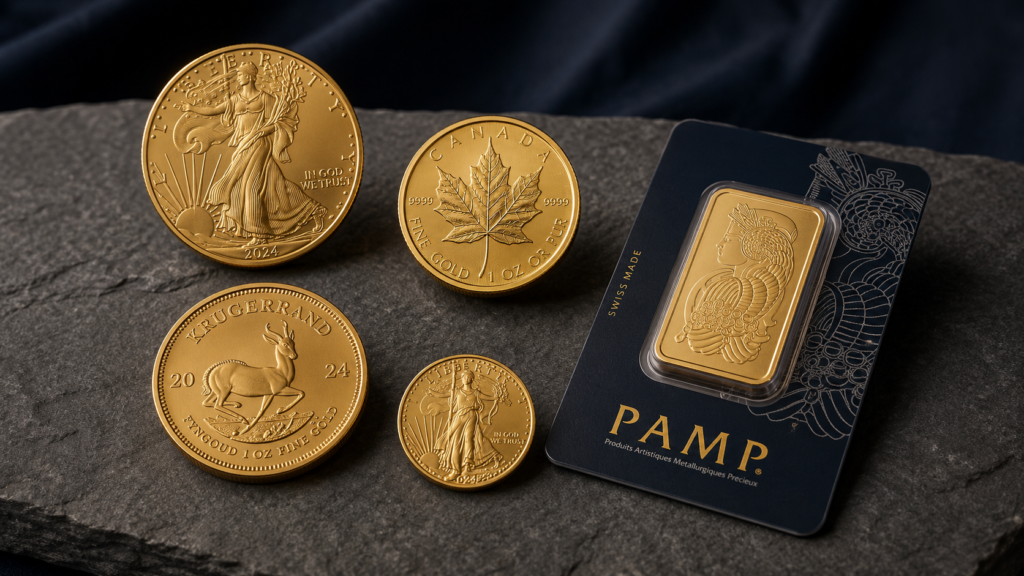
Buying gold sounds like a wealthy person’s hobby — until you actually look at the price of a 1-gram bar and realize a first piece costs less than a phone. The hard part isn’t the money. It’s deciding what to buy, where to buy it without overpaying, and how to keep records so the eventual sale isn’t a tax-time treasure hunt. Here’s the entire path, from “I’m thinking about it” to “I own gold.”
This article is for informational and educational purposes only. It is not financial, investment, or tax advice. Talk to a fee-only fiduciary advisor or a CPA before any purchase of consequence.
What “Buying Gold” Actually Means — The Five Forms
Buying gold means choosing one of five formats: bullion coins (government-minted, priced near the spot price of gold), bullion bars (the lowest premium per ounce), numismatic coins (priced on collector demand, not weight), gold ETFs (paper claims on stored gold), and gold mining stocks (equity exposure, not metal). Most beginners start with bullion coins.
Bullion is gold valued for its metal content — the weight and purity, not a story about rarity. Numismatic coins are priced on collector demand: year, mintage, condition (the grade), and rarity drive value more than weight. ETFs and mining stocks are paper exposure that requires a brokerage account; they behave very differently from owning the metal.
This guide focuses on physical bullion — coins and bars — because that’s where almost every first-time buyer starts.
How Much Gold Should You Buy as a Beginner?
A starter investment doesn’t have to be expensive. A 1-gram gold bar is real gold and costs less than a phone. The decision isn’t whether you can afford gold; it’s where on the budget ladder you start.
Common entry points by budget, using a $2,400/oz spot reference:
- Under $200: 1-gram gold bar (~$100), or a same-day alternative: a 1 oz American Silver Eagle (~$35) covers many beginners until the budget grows.
- $200–$500: A 1/10 oz fractional American Gold Eagle (~$280), or two-to-three 1-gram bars.
- $500–$1,500: A 1/4 oz fractional Eagle (~$650), or a 1/2 oz Maple Leaf (~$1,300).
- $1,500 and up: A full 1 oz bullion coin (American Gold Eagle, Canadian Maple Leaf, American Gold Buffalo, or Krugerrand) at roughly spot plus a 3–5% premium, or a 1 oz bullion bar at slightly less premium.
Many investors use a 5–10% portfolio allocation to precious metals as a rough heuristic. It’s a guideline, not a rule — talk to a financial advisor before applying any allocation to your own situation.
A few things not to do. Don’t borrow to buy gold. Don’t buy at the edge of your budget — gold doesn’t expire, and the price will be there next month. Don’t buy on a single-day spike because a headline made it feel urgent. Gold’s value comes from showing up over years, not from a perfectly-timed first purchase.
What’s the Best Gold Coin to Buy First?
Most beginners start with one of four 1 oz government-minted bullion coins. Each is widely recognized, easy to resell at any major dealer, and minted by a sovereign mint with decades of secondary-market depth.
American Gold Eagle. U.S. Mint, since 1986. 22-karat (about 91.67% pure, alloyed with copper and silver for durability), and the most liquid gold bullion coin in U.S. markets. Available in 1 oz, 1/2 oz, 1/4 oz, and 1/10 oz sizes — the fractional sizes match smaller budgets but carry higher per-ounce premiums.
American Gold Buffalo. Also U.S. Mint (introduced 2006). 24-karat .9999 pure gold for buyers who want a pure coin rather than an alloyed one. Slightly higher premium than the Eagle, and the soft surface scuffs more easily because pure gold is malleable.
Canadian Gold Maple Leaf. Royal Canadian Mint, .9999 pure, with anti-counterfeit features including a micro-engraved laser image and a radial-line background that makes well-made fakes visually obvious under angled light. Often available in the U.S. at a slightly lower premium than the Eagle.
South African Krugerrand. The original modern bullion coin (1967), 22-karat like the Eagle, and the deepest secondary market of any gold bullion coin worldwide. One quirk to note now: at eventual sale, a 25 oz aggregate sale of Krugerrands triggers a 1099-B dealer reporting requirement.
Bars from recognized refiners — PAMP Suisse, Valcambi, Perth Mint, the Royal Canadian Mint — are the lower-premium alternative. 1 oz bars typically run 1–3% over spot, meaningfully below coin premiums. The trade-off: bars are slightly less liquid in private secondary markets, and less giftable.
Most investors eventually mix coins and bars. For year-by-year and mint-by-mint comparison, see our best gold coins to buy guide.
Where Can You Buy Gold Safely?
Four channels handle most first-time gold purchases. Each is best for a specific situation. The table summarizes the trade-offs; the paragraphs below explain each in turn.
Where to buy gold — channel comparison at a glance.
| Channel | Typical premium | Best for | Watch out for |
| Online dealer | 3–6% over spot | Most first-time and ongoing buyers | Shipping/insurance, dealer reputation |
| Local coin shop | 3–8% over spot, variable | Cash purchases, hands-on inspection, building a relationship | Premium varies widely; limited inventory |
| Bank / Costco | 1–3% (Costco bars) | Low-premium 1 oz bars when in stock; brand familiarity | Limited availability; weekly purchase caps; U.S. banks generally do not sell gold |
| Pawn shop | Often 5–15% over spot | Last resort only | Inflated prices on bullion; primarily a selling channel |
Online dealer
APMEX, JM Bullion, Money Metals Exchange, SD Bullion, and Kitco run the largest U.S. buy-side businesses. Pricing is transparent — each product carries a live bid/ask quote — inventory is broad, and an insured shipping kit handles delivery. Verification signals worth checking on a first purchase: years in business, BBB rating, and membership in ICTA (the Industry Council for Tangible Assets) or PNG (the Professional Numismatists Guild). Reputable dealers identify their affiliation in the site footer.
Local coin shop
The right channel when the purchase is small, the buyer wants to hold the coin before paying, or cash is the preferred payment method. The trade-off is variable premium — the same 1 oz Gold Eagle that costs $2,490 at an online dealer might cost $2,520 at one local shop and $2,580 at another. Get two local quotes before buying, and favor shops that publish their daily buy/sell prices.
Banks and Costco
“Buy gold bars from bank” has a specific U.S. answer: most retail banks don’t sell gold to the public. The closest big-box analogue is Costco’s bullion program, which began selling 1 oz PAMP Suisse bars in 2023 and added 1 oz American Gold Eagles in 2024. Premiums run 1–3% — among the lowest available — but inventory is limited, sales are capped per member per week, and listings often sell out within minutes. Outside the U.S., several European banks (notably in Germany and Switzerland) do sell bullion directly.
Pawn shop
Almost always, the worst price for buying gold is from pawn shops are a selling channel, not a buying channel. Skip them for any first purchase.
General marketplaces (eBay, Facebook Marketplace, Craigslist) aren’t safe channels for a first gold purchase: counterfeit exposure is high and dealer recourse doesn’t exist. Stick to verified dealer channels until authentication and pricing feel automatic.
Understanding Spot Price, Premium, and What You Actually Pay
The spot price is the live wholesale price of one troy ounce of gold — the number that scrolls across financial dashboards. It’s set on the futures market and benchmarked by the LBMA reference price twice daily in London. As of May 2026, gold trades near $2,400/oz; the price the day you buy will be different, and any dealer’s pricing tracks spot in near real-time.
The premium over spot is the dealer’s markup. It covers minting, distribution, dealer margin, and product-specific scarcity. As a rule of thumb, the bigger the coin or bar, the lower the premium per ounce.
Worked example — two ways to buy one troy ounce of gold at a $2,400/oz spot reference.
| Item | Spot | Premium | Total paid | Premium % |
| 1 oz American Gold Eagle | $2,400 | $90 | $2,490 | 3.75% |
| 1 oz PAMP Suisse bar | $2,400 | $30 | $2,430 | 1.25% |
The Eagle costs $60 more for the same ounce of gold content. That premium is the price of liquidity — most buyers will accept a Gold Eagle at a glance, while a PAMP bar in original assay packaging needs that packaging to maximize resale value. Both are reasonable choices; first-time buyers usually lean toward the Eagle for the easier mental model. The full mechanics of why premiums vary across products are in our premium over spot guide.
Sales tax depends on where you live. Most U.S. states exempt investment-grade bullion (typically defined as coins or bars above 99.5% purity); about 10 states still apply sales tax. Check the state-by-state rules before a large purchase.
One uncomfortable truth: even on bullion bought at a fair premium, every gold position starts roughly 2–5% below break-even on day one. That’s the buy/sell spread — the gap between the dealer’s ask (what you pay) and bid (what they’d pay to buy it back). It’s structural, not a dealer trick. Build the expectation in from the first purchase; the math of the eventual sale is in our how to sell gold guide.
How Do You Avoid Getting Scammed When Buying Gold?
First-time buyers face three real risks, in roughly this order of likelihood.
Predatory “rare coin” sales
The biggest trap. Low-mintage proof coins, graded slabs, and “limited edition” coins sold by phone or late-night-TV advertising at 50–100% over actual melt value, pitched as investments. The pattern: high-pressure phone follow-up after an initial small purchase, claims that a specific coin is rare or scarce, and a price you can’t calculate from weight and spot.
Rule of thumb: if a salesperson is pushing a specific coin hard and you can’t multiply (weight × purity × spot) and land within 5–10% of the asking price, walk away. The deeper guide on dealer verification is in our safest ways to buy gold article.
Counterfeits on general marketplaces
Fake Gold Eagles and Maple Leafs exist — tungsten-cored, gold-plated, weight-matched — and they show up on eBay, Facebook Marketplace, and at flea markets. Buy from established dealers. For private purchases of any size, a Sigma Verifier or a specific-gravity test pays for itself on the first transaction.
Free silver with purchase promotions
The markup is the giveaway. The “free” item is priced into the gold’s premium — a “free 10 oz silver bar” with a $2,500 gold purchase usually means the gold premium has been quietly inflated by $150–$300 to cover the bar. If the math works the same without the giveaway, it’s a legitimate promo; if the deal disappears without it, it wasn’t a deal.
Taking Delivery and Storing Your Gold
Three storage paths handle most retail bullion holdings. Each has trade-offs worth weighing before the first coin arrives.
Home storage
A fire-rated safe, anchored to the floor or a wall, in a location not obvious to visitors or service workers. Costs run $200–$800 for a basic gun-style fire safe; more for a true UL-rated burglary safe.
The trade-off is insurance: most standard homeowner’s policies cap precious metals coverage at $250–$2,500, well below 10 oz of holdings. A scheduled rider can extend coverage, typically at 1–2% of insured value per year. Read the policy language before storing significant value at home.
Allocated vault storage
Major online dealers offer allocated storage in third-party depositories — your specific items, segregated, insured, available for redelivery or sale on request. Fees run roughly 0.5–1.5% of value per year. The key word is allocated: your specific coins or bars, not a pool claim. Unallocated storage means the depository owes you a quantity of gold but not specific items — a weaker legal position, usually inappropriate for retail holdings.
Bank safe deposit box
Cheap ($30–$200 per year), secure, off-site. Two limitations: the box isn’t FDIC-insured (FDIC covers deposits, not box contents), and some banks now have explicit policies against storing precious metals — confirm before signing.
One note on IRAs. Gold held inside a Gold IRA must be stored in an IRS-approved depository, not at home. The IRS has been clear that “home storage” Gold IRAs marketed by some firms are not legally compliant — see our Gold IRA guide for the full rules.
What Records to Keep from Day One
Record-keeping matters most at purchase because that’s the only time the information is easy to capture. A year later — let alone a decade — receipts get filed in the wrong folder, dealers go out of business, and the email confirmation vanishes into a defunct inbox.
For every gold purchase, capture:
- Date and time of purchase.
- Dealer name and order or invoice number.
- Item description: mint, year, weight, purity, packaging condition.
- Spot price at the time of purchase.
- Premium paid — both the dollar amount and the percentage over spot.
- Total price, including shipping, insurance, and any sales tax.
- Payment method.
- A dated photo of the item as received.
Keep both a digital copy and a physical copy. Paper survives hard-drive failures; digital files survive flood and fire.
These records become your cost basis at sale time. Sell a 1 oz Gold Eagle at $2,500 after paying $2,490, and the taxable gain is $10 — not $2,500. Without records, the IRS default is zero basis, meaning capital gains tax owed on the full sale price rather than the actual $10 gain.
The full mechanics are in our cost basis for precious metals article; the 28% collectibles rate that applies to long-term gains is covered in our capital gains tax on gold article.
Gold Silver Ledger captures purchase price, premium, dealer, date, and a photo at the moment of purchase, and tracks running cost basis and current melt value across every coin and bar you own.
Whichever approach you choose, start it before the first coin arrives — the receipt you can’t find is the one you most need.
When You’re Ready to Buy More
The second gold purchase is easier than the first. The question shifts from “should I buy?” to “what do I buy next?”
Dollar-cost averaging vs. lump sum. Buying gold on a regular schedule — monthly or quarterly — is the approach most active investors use, precisely because it removes the timing question. The trade-offs are in our when to buy gold guide.
Mixing products. As holdings grows, mixing coin and bar sizes adds flexibility: coins (especially Eagles and Maples) for liquidity and easy partial sales, bars for lower premium on larger ounces, fractional coins for budget-matching on regular small purchases. Many people end up with 60–80% coins and 20–40% bars by ounce count.
Three common expansions from a starter investment: adding silver (see how to buy silver), opening a Gold IRA for tax-advantaged exposure, and moving toward allocated storage when home storage starts to feel oversized.
This article is for informational and educational purposes only. It is not financial, investment, or tax advice. Talk to a fee-only fiduciary advisor or a CPA about your specific situation before any large purchase or allocation change.
Frequently Asked Questions
Can I buy gold from a bank?
In the U.S., retail banks generally do not sell gold to the public. The closest big-box analogue is Costco’s bullion program — 1 oz bars and 1 oz American Gold Eagles, sold to members at 1–3% premiums. Outside the U.S., several European banks (notably in Germany and Switzerland) do sell bullion directly.
Is it better to buy gold coins or gold bars?
Coins are more liquid and easier to resell in small lots; bars carry a lower premium per ounce. Most beginners start with coins and add bars as their holdings grow. Most experienced investors end up holding both — it’s a flexibility-vs-price trade-off, not a right-or-wrong choice.
How much is one ounce of gold?
The spot price changes throughout each trading day. As of May 2026, gold trades near $4,500/oz; check our spot price article for current quotes. Bullion coins typically add 3–5% over spot in premium; bullion bars add 1–3%.
Do I need to report a gold purchase to the IRS?
No. There’s no IRS reporting on the buyer’s side for retail gold purchases. (The dealer files Form 8300 when receiving more than $10,000 in cash in a single transaction — that’s the dealer’s obligation, not the buyer’s.) Reporting on the sale side exists for specific product/quantity combinations; see our 1099-B reporting guide.
Can I lose money buying gold?
Yes. Gold is not a guaranteed return; the spot price can drop. The buy/sell spread also means every position starts roughly 2–5% below break-even on day one. Treat any gold purchase as a long-horizon decision.
How do I know if a coin is real?
Buy from established dealers. For private purchases, verify weight and dimensions against the published specs (33.93 g and 32.7 mm for a 1 oz Gold Eagle, 31.10 g and 30.0 mm for a 1 oz Maple Leaf), and use a Sigma Verifier or specific-gravity test for anything over a few hundred dollars. The deeper guide on authentication is in our safest ways to buy gold article.
Start Your Portfolio with Records That Survive It
The receipt from your first gold coin is the most important document you’ll ever have for that coin — and it’s also the one most likely to disappear into a junk drawer. Gold Silver Ledger captures the purchase price, premium, dealer, date, and a photo the moment you buy, and tracks every coin and bar in your portfolio alongside the live spot price. Start your ledger for free before your first purchase arrives.
