
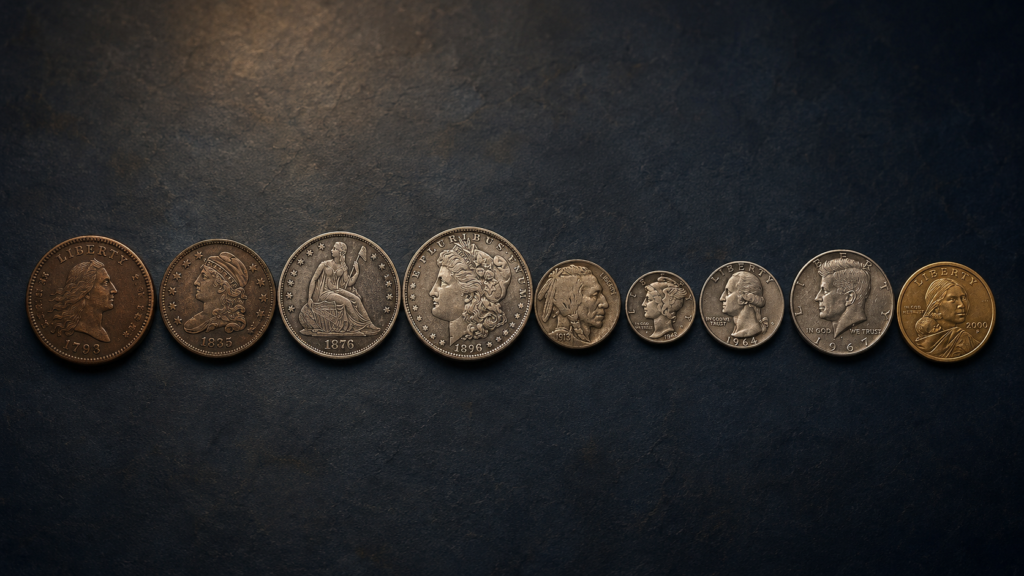
The United States didn’t have a national currency until 1792. Before that, colonists and early Americans made do with Spanish milled dollars, British coin, and paper money that Continental soldiers joked was worthless. The Coinage Act of 1792 changed that: it established the dollar, set silver and gold as the legal standard, and opened the Philadelphia Mint.
More than 230 years of legislation, war, and economic upheaval have shaped every coin that’s ever passed through your hands — and every coin in your collection.
Before the Mint: Colonial Coinage and the Continental Currency
Colonial America ran on improvised money. There was no single currency. Spanish milled dollars — the eight-real coin, colloquially called “pieces of eight” — were the most trusted medium of exchange in the colonies, more common in daily trade than any British coin. Barter, tobacco credits, and commodity notes filled in the gaps between them.
The Continental Congress tried to fix this during the Revolutionary War by issuing paper Continental Currency — bills backed by the promise of future tax revenue. Most citizens didn’t believe that promise would materialize. The currency inflated rapidly and catastrophically; by the war’s end, the phrase “not worth a Continental” had entered the language as shorthand for worthlessness.
The Articles of Confederation, ratified in 1781, gave Congress the power to set coin standards but not to enforce them or fund a mint. States minted their own coins. Private mints operated with minimal oversight. The monetary chaos of the 1780s made clear that the new nation needed a central coinage authority — and the Constitution, adopted in 1787, gave Congress exactly that, alongside the authority to regulate commerce and borrow money on the credit of the United States.
The Coinage Act of 1792: Founding the Dollar
On April 2, 1792, Congress passed the Coinage Act of 1792, formally establishing the U.S. monetary system. The act created the dollar as the basic unit of currency, set a bimetallic standard — meaning both silver and gold would serve as monetary metals at fixed weights — and established the full denomination ladder from the mill up through the gold eagle ($10). It also authorized the construction of the first federal building erected under the new Constitution: the Philadelphia Mint, opened later that same year.
One design question occupied Congress before any of that: whose face should go on the coins? Washington himself objected to placing a living leader’s portrait on currency — he thought it smacked of monarchy. The consensus shifted to an allegorical figure of Liberty, a choice that would persist through the early twentieth century.
The first coins struck at the Philadelphia Mint were the 1792 half disme — small silver five-cent pieces, several hundred of them, produced before the facility officially opened for full operations. Tradition holds that they were minted using silver donated by Washington himself, possibly from Martha Washington’s silverware. Whether completely accurate or polished into legend over time, the story captures the symbolic weight the founders placed on the new coinage: this was a nation declaring, in metal, that it could govern itself.
Early American Coinage (1792–1860): Bimetallism and the “Missing” Coins
For the first few decades of the republic, you could legally spend a U.S. dollar — but finding one in daily circulation was surprisingly difficult. Gresham’s Law — the principle that “bad money drives out good” — applied almost immediately: coins with high intrinsic metal value were hoarded, melted, or exported rather than spent. Foreign coins remained legally accepted in the United States until 1857.
The bimetallic ratio created persistent problems. When Congress fixed the silver-to-gold ratio at 15:1 in 1792, gold was slightly undervalued relative to the open market. Gold coins disappeared into private hoards. The Gold Coinage Act of 1834 adjusted the ratio to 16:1 to bring gold coins back into daily use — but that shift made silver the undervalued metal, so silver coins began disappearing instead.
The California Gold Rush of 1848 amplified the problem. A sudden flood of new gold supply crashed the metal’s relative price, making silver comparatively more valuable. Silver coins were melted in large quantities. In daily commerce, fractional coins became so scarce that businesses used postage stamps as change. Privately issued tokens circulated in their place.
This era also produced some of the most formally elegant American coin designs: the Draped Bust series (1796–1807), the Capped Bust series (1807–1839), and the long-running Seated Liberty series (1836–1891), which placed an allegorical seated figure on dimes, quarters, half dollars, and dollars. These are the coins that furnished the trade of antebellum America — when you could actually find them.
The Civil War and the Greenback Era (1861–1878)
The Civil War broke the fragile coinage system within months of its start. In December 1861, banks suspended specie payment — the redemption of paper notes for gold or silver coin — as wartime demand for hard currency drained reserves. Federal coinage effectively vanished from everyday life.
What replaced it was paper. The Legal Tender Act of 1862 authorized the Treasury to issue paper notes that could not be redeemed for metal but were declared legal tender for most obligations. Soldiers and civilians alike called them greenbacks for their distinctive green ink.
The Coinage Act of 1864 added “In God We Trust” to coins — the motto first appeared on the two-cent piece, reflecting religious sentiment deepened by the war years. The same period produced stopgap denominations designed to serve a public starved for change: the two-cent piece, the nickel three-cent piece, and fractional paper currency in denominations as small as three cents.
After the war, the question of whether to return to hard money — and when — became one of the central political conflicts of the era. The creditor class wanted deflation and stability; debtors and frontier farmers wanted more money in circulation. The Specie Payment Resumption Act of 1875 committed the government to restoring gold-backed payments by January 1, 1879 — a promise it kept, though not without years of wrenching deflation in the economy.
The Resumption Act and its political stakes are covered in the companion article on the Specie Payment Resumption Act.
The “Crime of ’73” and the Silver Debate (1873–1900)
Few pieces of monetary legislation have attracted a nickname as stark as the “Crime of ’73.” The Coinage Act of 1873 reorganized the U.S. monetary system and, in the process, dropped the standard silver dollar from the list of authorized coins — a quiet line item in a long technical document that most legislators and the public didn’t notice until several years later, when it began to bite.
By the late 1870s, Western silver mines were producing enormous quantities of the metal, and the price was falling. If the silver dollar had remained a recognized coin, miners could have brought silver to the Mint for coinage at the old fixed price. Without that right — because the 1873 act had removed it — the market price was all they had. Western farmers faced similar pressure: cheaper silver historically meant more dollars in circulation, which made debts easier to repay in real terms. Eastern creditors preferred gold: stable, deflationary, favorable to those owed fixed sums.
The political battle that followed was one of the defining economic fights of the Gilded Age. The Bland-Allison Act of 1878 restored limited silver coinage — the Morgan Dollar begins here — but didn’t satisfy silver advocates. The Sherman Silver Purchase Act of 1890 expanded government silver buying further before the financial panic of 1893 forced its repeal. William Jennings Bryan’s “Cross of Gold” speech at the 1896 Democratic convention — in which he argued that crucifying mankind on a “cross of gold” would destroy the farm economy — is still considered one of the most electrifying speeches in American political history.
Bryan lost the 1896 election. The Gold Standard Act of 1900 officially ended bimetallism and placed the United States on a monometallic gold standard. The full history of the gold standard, and why it eventually ended, is covered in the companion article on gold standard history.
The Golden Age of U.S. Coinage (1878–1933)
The half-century between the Morgan Dollar’s introduction and FDR’s gold recall produced what many numismatists — coin collectors and historians, in plain terms — consider the finest American coinage in the nation’s history, in terms of design quality, variety, and lasting cultural significance.
The Morgan Dollar, minted from 1878 to 1904 and again in 1921, was designed by George T. Morgan, an English engraver who trained under one of the Royal Mint’s finest medalists before coming to Philadelphia. The obverse portrait of Liberty was modeled on a Philadelphia schoolteacher named Anna Willess Williams, though this wasn’t publicly known during her lifetime. Today, the Morgan Dollar is the most widely collected and traded U.S. silver coin, with hundreds of date-and-mintmark combinations ranging from extremely common to genuinely scarce.
Theodore Roosevelt thought American coinage was embarrassingly plain compared to European work. In 1905, he commissioned the sculptor Augustus Saint-Gaudens to redesign the gold coins. The result — the Saint-Gaudens Double Eagle ($20 gold piece), first issued in 1907 — is considered by many to be the most beautiful coin the United States has ever produced. The high-relief design shows Liberty striding forward with a torch and olive branch, the Capitol dome visible in the background, modeled consciously on ancient Greek coinage.
The Peace Dollar, introduced in 1921 to commemorate the armistice ending World War I, was the last regular-issue 90% silver dollar in American history, struck through 1935. Other standout designs of this era include the Lincoln cent (1909, still running today), the Buffalo Nickel (1913–1938), the Mercury Dime (1916–1945), and the Walking Liberty Half Dollar (1916–1947) — the design revived for the American Silver Eagle in 1986.
For guidance on collecting and buying pre-1933 gold coins from this era, see the companion article on the best gold coins.
FDR’s Gold Recall and the End of Gold Coinage (1933–1934)
On April 5, 1933, President Franklin D. Roosevelt signed Executive Order 6102, requiring U.S. citizens to exchange their gold coins, gold bullion, and gold certificates for Federal Reserve Notes at a rate of $20.67 per troy ounce. The order had limited exceptions: jewelry, dental gold, numismatic coins of “recognized special value to collectors,” and small amounts for industrial use. The deadline was May 1, 1933.
Most Americans complied. The government collected an enormous quantity of gold, much of which was melted and stored at Fort Knox, constructed in 1936 partly for that purpose. The Gold Reserve Act of 1934 then repriced gold at $35 per troy ounce — an effective devaluation of the dollar by roughly 69% overnight. The rationale was to combat deflation and stimulate the Depression-era economy; the method was one of the most sweeping acts of monetary intervention in American history.
The most famous artifact of this episode is the 1933 Saint-Gaudens Double Eagle. The U.S. Mint had produced roughly 445,500 of them before the recall order was issued, but officially, none were released for circulation — they were ordered melted.
A handful survived through irregular means. One specimen was legally validated for private sale in 2002 and sold at Sotheby’s for $7.59 million. A second was certified in 2021 and sold at Sotheby’s for $18.9 million — at the time the highest auction price ever paid for a coin.
After 1933, no gold coins circulated in the United States. Federal Reserve Notes replaced gold certificates. The gold standard survived in a modified form — the dollar remained pegged to gold for international transactions at $35 per ounce — until 1971.
The Coinage Act of 1965 — Silver Leaves Circulation
By the early 1960s, the price of silver on global markets had climbed steadily toward the face value of the coins it was minted into. When a coin’s metal content approaches its denomination, the economically rational move is to pull it from circulation. People did exactly that — first in small numbers, then by the bucket. By 1964, silver coins were vanishing from cash registers faster than the Mint could produce them.
President Lyndon B. Johnson signed the Coinage Act of 1965 on July 23, 1965. The act removed silver entirely from dimes and quarters, replacing them with clad construction — a copper core bonded to outer layers of copper-nickel, giving the modern dime and quarter their silvery appearance without the silver content. The Kennedy Half Dollar, introduced in 1964 following President Kennedy’s assassination, dropped from 90% to 40% silver under the 1965 act, then went fully clad in 1971.
The coins that were 90% silver before the act’s effective date — dimes, quarters, and half dollars dated 1964 and earlier — quietly exited everyday commerce over the following years, as sharp-eyed individuals and collectors pulled them for their metal content. These coins trade today as junk silver — a term of affection rather than derision — valued almost entirely by their silver weight rather than numismatic premium.
For more on buying and valuing junk silver, see the junk silver guide.
Modern U.S. Coinage: Clad, Commemoratives & Bullion Programs (1965–Present)
The dollar’s last formal tie to precious metals ended in August 1971. President Nixon closed the “gold window” — the international mechanism by which foreign central banks could redeem U.S. dollars for gold — ending the Bretton Woods system that had governed international finance since 1944.
The dollar became fully fiat: no metal backing at any exchange rate. That episode, and what it means for the long-run relationship between monetary policy and precious metals, is covered in the companion article on the gold standard.
The decades that followed brought design innovation in the absence of precious metals. The bicentennial quarter, half dollar, and Eisenhower dollar (1975–1976) featured dual dating and reverse designs marking 200 years of independence.
The Susan B. Anthony dollar (1979–1981, 1999) attempted a smaller, more practical dollar coin; the public largely rejected it due to its similarity in size to a quarter. The Sacagawea dollar (2000–present) and Presidential dollar series (2007–2016) extended the experiment.
The most significant modern development for precious metals investors was the launch of the American Gold Eagle and American Silver Eagle bullion programs in 1986 — the U.S. Mint’s formal re-entry into the investment bullion market for the first time since FDR’s recall.
The Silver Eagle’s reverse carries the Walking Liberty design from the 1916–1947 half dollar; the Gold Eagle’s obverse borrows from the Saint-Gaudens $20 gold piece. Both have become among the most recognized bullion coins in the world.
The American Platinum Eagle followed in 1997. The American Gold Buffalo — the first .9999 fine (four-nines fine) gold coin struck by the U.S. Mint, modeled on the 1913 Buffalo Nickel — launched in 2006. The American Silver Eagle series is currently the world’s best-selling silver bullion coin by annual mintage.
The State Quarters program (1999–2008) put five new designs into general circulation every year for a decade, generating the largest mass-participation collecting event in American history. The America the Beautiful quarters (2010–2021) and American Women quarters (2022–2025) continued the tradition of rotating reverses. The modern U.S. Mint operates four production facilities — Philadelphia, Denver, San Francisco, and West Point — each with its own mintmark and specialty.
The mints, their marks, and what they produce are covered in our U.S. Mint article.
Key U.S. Coinage Milestones: Quick-Reference Timeline
Major events in U.S. coinage history, from the founding era to the modern bullion programs.
| Year | Event |
|---|---|
| 1775 | Continental Currency issued by the Second Continental Congress; collapses within years. |
| 1785 | Continental Congress adopts the dollar as the unit of U.S. currency. |
| 1787 | U.S. Constitution grants Congress authority to coin money and regulate its value. |
| 1792 | Coinage Act of 1792 establishes the dollar, bimetallic standard, and the Philadelphia Mint. First coins struck: the 1792 half disme. |
| 1834 | Gold Coinage Act adjusts the silver-to-gold ratio from 15:1 to 16:1 to bring gold coins back into circulation. |
| 1857 | Foreign coins demonetized; the U.S. dollar becomes the sole legal tender in everyday commerce. |
| 1861–1865 | Specie payment suspended. Legal Tender Act authorizes greenback paper money. “In God We Trust” first appears on the 1864 two-cent piece. |
| 1873 | Coinage Act of 1873 removes the standard silver dollar — later called the “Crime of ’73.” |
| 1875 | Specie Payment Resumption Act commits the government to restoring gold-backed payments by 1879. |
| 1878 | Bland-Allison Act restores limited silver coinage. Morgan Dollar introduced. |
| 1900 | Gold Standard Act formally places the U.S. on a monometallic gold standard. |
| 1907 | Saint-Gaudens Double Eagle redesign commissioned by Theodore Roosevelt; widely considered the finest U.S. coin design. |
| 1921 | Peace Dollar introduced to mark the armistice ending World War I. |
| 1933 | Executive Order 6102 requires citizens to surrender gold coins and bullion. Gold Reserve Act reprices gold at $35/oz. |
| 1935 | Last Peace Dollar struck. |
| 1964 | Last 90% silver dimes, quarters, and half dollars struck (dated 1964; production continues into 1966). |
| 1965 | Coinage Act of 1965 introduces clad coinage for dimes and quarters. Half dollars drop to 40% silver. |
| 1971 | Nixon closes the gold window; dollar-gold convertibility ends worldwide. |
| 1986 | American Gold Eagle and American Silver Eagle bullion programs launched by the U.S. Mint. |
| 2006 | American Gold Buffalo introduced — first .9999 fine gold coin struck by the U.S. Mint. |
Frequently Asked Questions
What was the first coin ever minted by the United States?
The 1792 half disme — a small silver five-cent piece — is generally recognized as the first coin struck by the U.S. Mint, produced before the facility officially opened for full operations. A small number were made, possibly using silver provided by George Washington. Surviving examples are extraordinarily rare and bring high prices at auction.
When did U.S. coins stop being made of silver?
Dimes and quarters lost their silver content in 1965 under the Coinage Act of 1965. Half dollars dropped from 90% silver to 40% silver in 1965, then went fully clad in 1971. The practical rule for collectors: any dime, quarter, or half dollar dated 1964 or earlier is 90% silver.
Are any U.S. coins still made of silver today?
Circulating coins contain no silver. The U.S. Mint produces silver collector editions: proof American Silver Eagles, numismatic commemoratives, and enhanced-finish bullion coins. These are sold directly by the Mint at premiums above metal value and are not released into general circulation.
Why is the 1933 Double Eagle so famous?
The 1933 Saint-Gaudens Double Eagle was struck but never legally released for circulation — FDR’s gold recall order intervened. A small number survived. For decades the government treated any privately held example as federal property. One specimen was legally validated for private sale in 2002 and fetched $7.59 million; a second sold in 2021 for $18.9 million, at the time the highest auction price ever paid for a coin.
What is a clad coin?
A clad coin has a copper core bonded to outer layers of a different metal. U.S. dimes and quarters use copper-nickel outer layers, which give them a silvery appearance without the silver content. The process is a metalworking technique — bonding dissimilar metals under pressure — not to be confused with plating, which is a thinner surface coating.
What is the history of U.S. coins in brief?
U.S. coinage began with the Coinage Act of 1792, which established the dollar and the Philadelphia Mint. For most of the nineteenth century, the country operated on a bimetallic standard, with silver and gold coins both legal tender. Gold left circulation in 1933 after FDR’s executive order; silver left in 1965 after the Coinage Act that year. Since 1971, U.S. coinage has been entirely fiat — copper, nickel, and zinc — with the exception of collector and bullion coins produced by the Mint for the investment and numismatic market.
