
You saw silver quoted online, did the mental math on your box of coins and flatware, and then a buyer offered a fraction of it. Some of that gap is normal, and some of it means you’re standing at the wrong counter.
This guide shows how to value what you actually have, where to sell each kind of silver, and why shipping can quietly eat your profit.
This article is for informational and educational purposes only. It isn’t financial, investment, or tax advice. Talk to a CPA or a fee-only fiduciary advisor before any sale of consequence.
What Is Your Silver Actually Worth?
What you’ll get for silver is the spot price minus the buyer’s spread. Recognized bullion coins like the American Silver Eagle sell for roughly 90–100% of spot, and generic rounds and bars trade a few percent under. Junk (90%) silver sells on its silver content, sterling on its .925 content minus a refining margin, and collectible coins on demand rather than weight.
No buyer pays you spot, and that isn’t a trick. Spot is a wholesale reference for large 1,000-ounce Good Delivery bars traded between institutions, and everything smaller carries a spread that covers handling, verification, storage, and margin.
On silver, that spread is a wider percentage than on gold, because the fixed cost of handling a coin is about the same whether the coin holds a little metal or a lot.
Melt value is the place to start: the metal weight times the spot price. Our melt value guide covers the math for any item, and our premium over spot guide explains why a coin costs more than spot when you buy and brings less when you sell.
Collectible coins are the exception to the weight rule; a common circulated Morgan trades near its silver value, while a scarce date can bring several times melt, as our Morgan dollar value guide shows. Your first job is deciding which category each item is in, because every later decision follows from that.
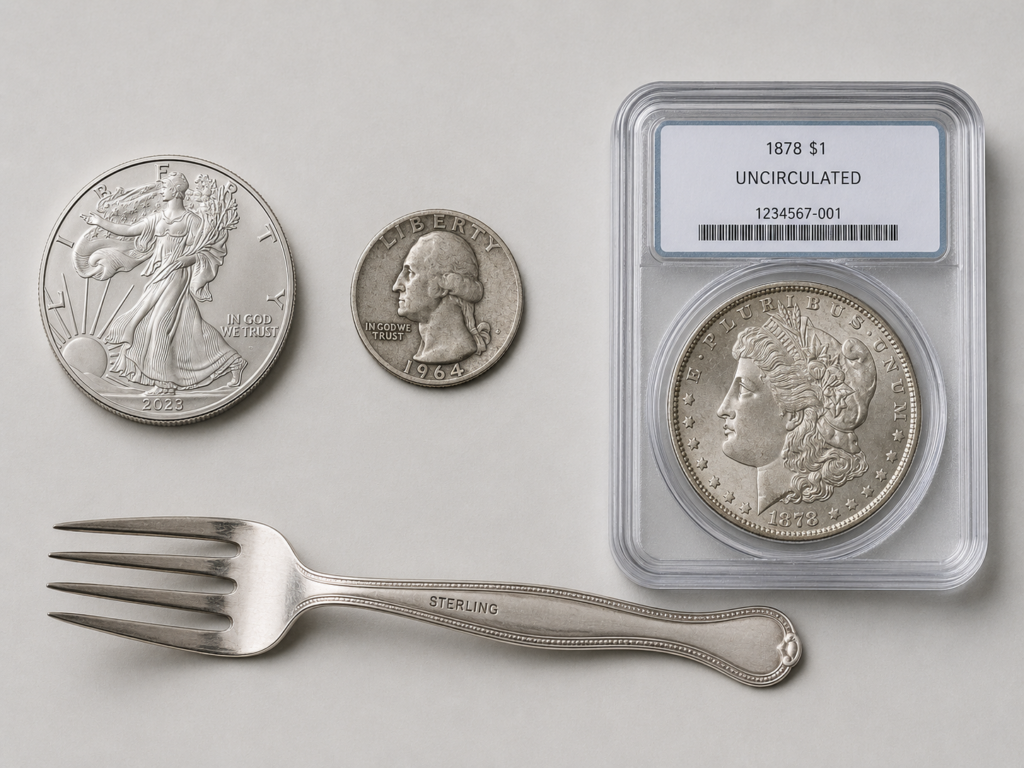
Sort First: Bullion, Numismatic, Junk Silver, Sterling, or Plate
Sorting decides which buyer pays the most, and silver has more categories to sort into than gold. Send Morgan dollars to a scrap buyer and you lose the collector premium; bring sterling to a coin-only shop and you get waved off; treat plate as sterling and you’ll be disappointed at the counter.
Before you contact anyone, write down each item’s stamp, its weight (a gram scale for sterling and jewelry, a troy-ounce count for coins and bars), and the total face value for any junk silver. Coins are counted in troy ounces while sterling is weighed in grams, so convert before you compare to a quote.
Bullion
Government-mint coins (American Silver Eagle, Canadian Silver Maple Leaf, Austrian Philharmonic, Britannia, Libertad) and recognized-refiner rounds and bars carry a known .999 purity, trade near spot, and are accepted by every bullion dealer. Bullion earns its value from metal content rather than from clearing a purity threshold, which our silver bullion guide explains in full.
Numismatic coins
Morgan and Peace dollars, pre-1965 key dates, slabbed or high-grade coins, and proof issues are priced on grade, date, and demand, not weight. A common Morgan trades near melt, while a key date or a top grade can bring multiples, so anything that might be collectible is worth checking before you sell it as metal. Our silver dollar guide helps you tell them apart.
Junk (90%) silver
Dimes, quarters, and half dollars dated 1964 and earlier are 90% silver, and their value comes from silver content figured off face value: $1 in face amount of circulated 90% coin holds about 0.715 troy ounces of silver. The 40% silver Kennedy halves from 1965 to 1970 and the wartime nickels from 1942 to 1945 use smaller multipliers. Our junk silver guide breaks down each denomination.
Sterling silver
Flatware, holloware, and jewelry stamped STERLING or .925 are 92.5% silver, and buyers pay on that content minus a refining margin. Watch for weighted pieces: many candlesticks and some knife handles are reinforced with plaster, cement, or a steel rod, so the gross weight badly overstates the silver. Only the sterling shell counts.
Silver plate
Items marked EPNS, silverplate, A1, or triple or quadruple plate are a microns-thin silver layer over base metal, and most unmarked flatware is the same. This is the silver-side equivalent of gold-filled jewelry: worth almost nothing as metal, wanted by no refiner. Confirm a STERLING or .925 stamp before you expect any payout.
Where to Sell Silver: Five Buyer Channels
Five channels handle most silver sales. Each one fits a certain kind of silver and pays differently, and the table below sums up the trade-offs.
| Channel | Best for | Typical payout | Speed | Privacy |
| Local coin dealer | Bullion coins, junk silver, common numismatic, and small lots of any kind | 90–98% of spot for recognized bullion; junk quoted as a multiple of face | Same day, cash or check | Anonymous below the $10,000 cash and ICTA reporting thresholds |
| National online dealer | Larger positions: 100 oz bars, monster boxes, multi-hundred-ounce lots | 90–99% of spot for liquid coins; a bit less on generic bars | 1–2 weeks to payment | Federal rules apply; dealer keeps shipping records |
| Pawn shop / cash-for-silver | Sterling and scrap jewelry when speed beats maximum payout | 50–75% of melt; worse for unidentified bullion | Same day, cash | Federal rules; many keep state logs |
| Auction house / specialist | Genuine numismatic: key dates, high grades, rare proofs | Hammer price minus a 10–20% seller’s commission | 1–3 months | Not anonymous; identity recorded |
| Refiner (direct) | Volume sterling and scrap that clears the minimum lot | 85–95% of .925 content value | 1–4 weeks, after assay | Federal rules; full ID required |
Silver changes the math that works for gold. Because it’s heavy and cheap per ounce, insured shipping is a real share of a sale, and mailing a small lot to an online dealer can cost more than the spread you’d save locally. The most liquid coins, covered in our comparison of the most liquid silver bullion coins, resell closest to spot in either channel. The channels mirror the gold side, as our gold-selling guide lays out, though silver’s reporting thresholds and shipping costs differ. Match the item and the quantity to the channel:
- Recognized bullion in volume: An online dealer once shipping pencils out, or a local shop.
- Bullion in small amounts: A local shop, to skip the shipping cost entirely.
- Junk (90%) silver: A local coin dealer, or one that posts a junk-silver buy price.
- Genuine numismatic coins: An auction house or a numismatic specialist.
- Sterling and scrap in volume: A refiner, which pays more than a pawn shop because refining is in-house.
- Sterling or scrap in small amounts: A local coin shop or a jeweler who buys.
How Buyers Price Silver: Why the Spread Runs Wider
The bid/ask spread is the gap between what a dealer charges to sell you a coin (the ask) and what they’ll pay to buy the same coin back (the bid). That gap is the dealer’s gross margin, and our bid/ask spread guide treats it in depth.
On silver, the percentage runs wider than on gold for a plain reason: a silver coin holds a small dollar amount of metal, so the fixed cost of handling, verifying, and storing it is a bigger slice of its value.
Pricing a junk silver bag
A $100 face bag of circulated 90% silver holds about 71.5 troy ounces (100 × 0.715). At a spot price of S per ounce, its melt value is 71.5 × S. A dealer quoting “20 times face” is offering $2,000 on that bag, so compare that number against 71.5 × the current spot to see whether you’re above or below melt.
Pricing a sterling set
A flatware set with 40 troy ounces of actual sterling, after you set aside the weighted knife handles, holds 40 × 0.925 = 37 troy ounces of pure silver. At spot S, that content is worth 37 × S. A refiner paying 88% of content pays 0.88 × 37 × S, while a pawn shop pays far less for the same set.
Pricing a bullion coin
One American Silver Eagle at spot S draws about spot to a little over from an online dealer, a few percent under from a local shop, and near scrap from a pawn shop. Then subtract insured shipping if you’re mailing a small lot, which can erase the online edge on anything under a few hundred ounces.
Typical bid-side ranges as a share of spot
When an offer sits inside the typical range for that channel and item, it’s fair. You don’t need to negotiate a fair offer; you need to recognize a bad one and get another quote.
Our premium over spot guide shows the same spread in reverse when you buy. The ranges below are the bid-side norms to check any offer against.
- American Silver Eagle: About spot, a bit over in strong demand or under in soft markets.
- Canadian Silver Maple Leaf: Roughly spot minus 0–5%.
- Generic 1 oz rounds and bars: Spot minus 3–8%.
- 10 oz and 100 oz bars: Spot minus 1–4%, the best per-ounce pricing.
- Junk (90%) silver: A multiple of face, from just under melt to a small premium.
- Sterling scrap: The .925 content minus a 10–20% refining margin.
Step-by-Step: How to Sell Silver for the Best Price
Here are eight steps from “I have silver to sell” to a documented, completed sale.
Step 1: Sort and identify everything
Separate bullion coins, numismatic coins, junk (90%) silver, sterling, and plate. Check each stamp, weigh sterling and jewelry on a gram scale, count troy ounces for coins and bars, total the face value of your junk silver, and set aside anything marked EPNS or silverplate as near-worthless.
Step 2: Look up the current silver spot price and note your quote time
Use a public reference such as Kitco, a dealer price feed, or our pricing page when it’s live. Silver moves through the trading day, and buyers update their bids in near real time, so lock the price at the moment you get a quote.
Step 3: Compute your floor value by category
Bullion: troy ounces × .999 × spot. Junk silver: face value × 0.715 × spot for 90% circulated coin, with separate multipliers for 40% halves and war nickels. Sterling: actual sterling grams × 0.925 ÷ 31.1035 × spot. Numismatic: the floor is melt, the ceiling is the collector market.
Step 4: Weigh shipping against a local sale
This step is specific to silver. Price an insured shipment to an online dealer against a same-day local sale, because heavy, low-value metal is expensive to ship, and on a small or mid-size lot the shipping can cost more than the spread you’d save.
Step 5: Get two or three written quotes from the right buyer types
Quote one online dealer and one local shop for bullion, two local coin dealers for junk silver, a local shop and a refiner for sterling in volume, and a specialist plus an auction house for numismatic pieces. Written quotes keep buyers honest.
Step 6: Compare each quote against your floor
Bullion below about 88–90% of spot for liquid coins is weak, junk silver below melt after a small handling margin is weak, and sterling below about 80% of its .925 content is weak for a refiner-volume lot. Anything in the weak range gets a polite decline and another quote.
Step 7: Confirm payment, timing, and reporting before you agree
Settle whether it’s cash, check, or wire, whether it’s same-day or ship-and-wait, and whether the dealer will issue a Form 1099-B at this quantity and product type. Get the answers in writing before the sale, not after. Don’t let an in-person buyer carry your silver out of sight to “test” it.
Step 8: Complete the sale and save every record
Keep the itemized receipt with the date, the buyer’s name and address, the price and weight per item, and any 1099-B copy, then match it against your purchase records. Missing purchase records default your cost basis to zero, which means tax on the full sale price. Our inventory guide and cost-basis records make this step painless.
Reporting and Taxes: 1099-B Thresholds and the Cash Rule
A disclaimer before the details: none of this is tax advice, and the summary below covers federal treatment only. Talk to a CPA before a sale of any size.
When you sell physical silver for more than you paid, the difference is a capital gain. The IRS treats physical precious metals as collectibles under Internal Revenue Code §408(m), so long-term gains on metal held more than a year face a maximum federal rate of 28%, not the 0/15/20% rates that apply to stocks, and short-term gains are taxed at ordinary income rates.
The 28% figure is a maximum, not a flat rate, and lower brackets pay their ordinary rate up to that cap, as our capital gains tax guide explains. State tax may apply too.
Cost basis is what you originally paid, including the premium over spot. If you can’t document it, the IRS assumes zero and you owe tax on the entire sale price.
Silver’s basis problem is sharper than gold’s because holdings tend to build up from many small purchases over years, and almost nobody keeps a receipt for a single coin. Our cost basis guide shows how to reconstruct or track it.
What dealers must report
Selling certain products at or above the quantities published by the Industry Council for Tangible Assets (ICTA) requires the dealer to file a Form 1099-B. On the silver side, only two items are on that list.
| Product | Reportable quantity | Form |
| Silver bars and rounds | 1,000 troy oz or more (aggregate) | 1099-B |
| 90% silver U.S. coins | $1,000 face value or more (a full bag) | 1099-B |
| American Silver Eagles | NOT REPORTABLE, in any quantity | — |
| Any cash payment to a dealer | More than $10,000 | Form 8300 |
American Silver Eagles are not 1099-B reportable in any quantity, and that’s a structural advantage of U.S. Mint silver bullion worth keeping in mind when you plan a sale. Generic rounds under 1,000 ounces and ordinary numismatic coins generally aren’t on the list either. Our 1099-B reporting guide covers the full ICTA list and its edge cases.
Cash payments, losses, and inherited silver
Form 8300 is separate from the 1099-B. When a dealer takes more than $10,000 in cash or cash equivalents from a customer in one transaction, or in related transactions within a 24-hour window, they must file it. It’s a cash-handling rule that applies when you buy and when you sell, and wires, business checks, and electronic transfers don’t count as cash, as our IRS reporting guide details.
If you sell at a loss, still report the sale. A capital loss on physical silver can offset other capital gains on your return, so a holder who’s underwater after years shouldn’t skip filing. Inherited silver is treated differently again: it receives a stepped-up basis equal to its fair market value on the previous owner’s date of death, while gifted silver generally carries over the giver’s original basis.
Again: the reporting and tax details turn on specifics this guide can’t cover, so talk to a CPA about your situation before you sell.
Red Flags and Common Silver-Selling Mistakes
A few patterns cost silver sellers more than any others.
Mistaking plate for sterling
A heavy tray or flatware set marked EPNS or silverplate is worth almost nothing as metal. Run the stamp check at home so the letdown doesn’t happen at the counter.
Weighing weighted sterling gross
Candlesticks and some knife handles are filled with plaster or cement, and a buyer pays only on the sterling shell. Expecting payment on gross weight makes an honest offer feel like a lowball.
Shipping small silver lots without doing the math
The gold-seller reflex to mail it to an online dealer can lose money on silver, where insured shipping eats the spread. On small and mid-size lots, a local sale often nets more.
Selling numismatic coins to a scrap or junk buyer
A key-date Morgan or a high-grade slabbed coin sold at melt throws away the collector premium. Get anything that might be collectible evaluated first.
Letting a pawn shop price bullion as scrap, or a clock run your decision
A Silver Eagle or a junk-silver bag is a wholesale product to a coin dealer and scrap to a pawnbroker. Silver doesn’t expire, so “this price is only good today” is a reason to slow down, not speed up.
Splitting a sale to dodge reporting
Breaking one sale into pieces to stay under the $1,000-face, 1,000-ounce, or $10,000 cash thresholds is structuring, a federal crime under 31 U.S.C. §5324, even when the sale and the taxes are fully legal. Our anonymity and reporting guide covers what does and doesn’t get reported.
When (or Whether) to Sell Silver
“Is it a good time to sell silver?” is the wrong question for an individual, because it treats a personal decision as a market call. The better questions are yours to answer: Do you need the cash? Are you rebalancing a position that’s grown heavy in metal? Are you clearing an estate or downsizing? Is a particular coin worth more as a collectible than as melt, so that selling it as bullion would destroy value?
Timing does matter in one factual way. A sale on December 31 lands in the current tax year and a sale on January 1 lands in the next, so a seller near year-end with large gains may benefit from waiting, while one with offsetting losses may benefit from selling sooner. That’s a conversation for your CPA, not a rule of thumb.
If you’re selling a large position, consider selling in tranches across a few days or buyers to smooth out silver’s day-to-day swings. That’s a price-risk decision, not a reporting dodge. The right time to sell is when selling solves a problem you actually have, at a price that’s fair for the channel and the item; this guide won’t tell you to sell or to hold.
Sell Well Now, Track Smarter Next Time
The hardest part of selling silver usually isn’t finding a buyer. It’s reconstructing what you paid across years of small, scattered purchases, once the receipts are gone and the inherited pieces never came with any. When your basis is undocumented, the tax lands on the full sale price instead of the actual gain, and that’s the most expensive gap on this whole page.
Gold Silver Ledger keeps your holdings in one place, with live cost basis set against current value, so you can search, filter, and tag what you own instead of digging through a spreadsheet and a shoebox.
You log a purchase as you make it and record the disposition when you sell, so at tax time your gain or loss is the difference between two numbers you already have.
Start your trial on our pricing page and keep a running record, so the next silver sale is arithmetic instead of a receipt hunt. If you’re redeploying the proceeds, our guide to how to buy silver closes the loop.
This guide is educational and isn’t financial or tax advice; consult a CPA about your specific situation before selling.
Frequently Asked Questions
How much can I get for my silver?
Recognized bullion coins like Silver Eagles typically bring 90–100% of the spot price, with generic rounds and bars a few percent lower. Junk (90%) silver is paid on its silver content as a multiple of face value, sterling on its .925 content minus a refining margin, and numismatic coins anywhere from melt up to several times melt for scarce dates and grades.
Where is the best place to sell silver?
There isn’t a single best place, because the right channel depends on what you have and how much of it. Recognized bullion in volume favors an online dealer once shipping pencils out, small lots and junk silver favor a local coin shop, sterling in volume favors a refiner, and genuine numismatic coins favor a specialist or auction house.
Is it better to sell silver locally or online?
For silver, local sales often net more on small and mid-size lots, because insuring and shipping heavy, low-value metal can cost more than the price advantage an online dealer offers. Online dealers tend to win on large positions, where the per-ounce value comfortably carries the shipping cost, so run both numbers before you decide.
How do I know if my silverware is real silver or plated?
Check the stamp: pieces marked STERLING or .925 are solid silver with real melt value, while pieces marked EPNS, silverplate, A1, or triple or quadruple plate are a thin coating over base metal and are worth almost nothing as metal. Unmarked flatware is usually plated, and weighted pieces are sterling only in the shell.
Will the dealer report my silver sale to the IRS?
Only two silver products trigger a 1099-B: silver bars or rounds totaling 1,000 troy ounces or more, and 90% silver U.S. coins totaling $1,000 face value or more. American Silver Eagles aren’t reportable in any quantity, though any cash payment over $10,000 triggers a separate Form 8300.
Can I sell silver without paying taxes?
If you sell at a profit, capital gains tax applies, because there’s no special exemption for physical metal, and long-term gains face a maximum federal collectibles rate of 28%. If you sell at a loss, no tax is owed and the loss may offset other capital gains, and sellers in lower brackets pay their ordinary rate up to the 28% cap.
How is junk silver priced when I sell it?
Junk (90%) silver is priced on silver content rather than per coin: $1 in face value holds about 0.715 troy ounces of silver, so a $100 face bag holds roughly 71.5 troy ounces. Buyers usually quote it as a multiple of face value, which you can check against current spot, and our guide to 90% silver quarters and dimes breaks the denominations down.
What if I inherited the silver and have no records?
Inherited silver receives a stepped-up cost basis equal to its fair market value on the previous owner’s date of death, so you’ll need that date and a fair-market estimate rather than the original purchase price. Reconstruct that value from the spot price on that date for bullion and junk silver, or from a qualified appraisal for numismatic pieces.
